
Newsletter - December 2025
2025 DECEMBER 31
In this month’s issue:
MPC Wrapped
NASA Infrared Telescope Facility Strategic Planning – Seeking Community Input
1. MPC Wrapped
Our year in review.
Observations
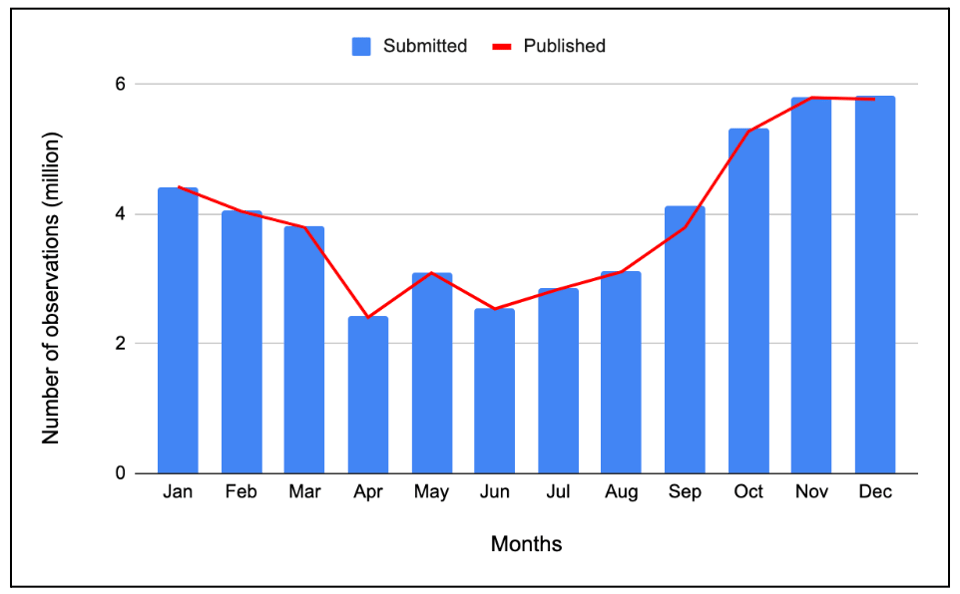
As of December 29, 2025, the MPC received a total of 47.4 million observations in 2025 (Fig. 1). Of these, 46.9 million were published or sent to the Isolated Tracklet File (ITF); the remainder were deleted due to issues such as poor quality or submission errors. This brings the total number of published observations available in the MPC database to an impressive 521.5 million, including 9.5 million observations in the ITF. The milestone of 500 million observations was reached between September 8 and September 9, 2025.
To learn more about how the MPC processes and publishes observations, please refer to our newsletters from March 2023, May 2023, September 2023, April 2024, January 2025, February 2025, and November 2025.
Observations submitted in ADES format
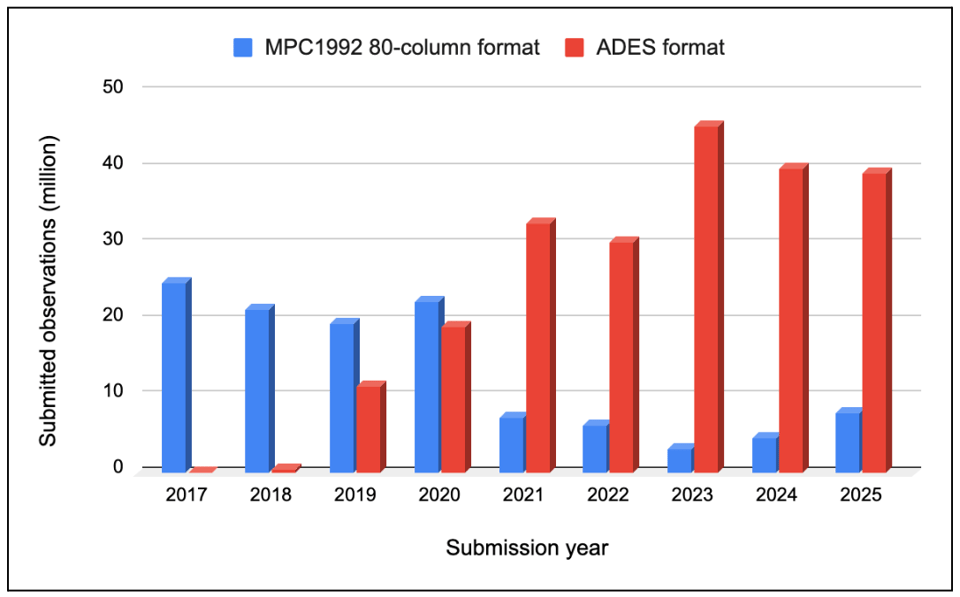
The histogram in Fig. 2 shows the comparison between the number of observations submitted to the MPC in ADES format (red bar) and the ones still submitted in the legacy MPC1992 80-column format (blue bar). We would like to thank the observers for their efforts in adopting the ADES format. We firmly believe that its broader adoption will bring significant benefits to both observers and orbit-computation centers.
Last year, while preparing the December 2024 Newsletter, we noted a slight increase in the number of observations submitted in the MPC 1992 80-column format. In our January 2025 Newsletter we emphasized that while this format remains accepted, we strongly encourage users to submit observations in the ADES format for improved accuracy and efficiency.
This year, we have observed an even larger increase in the number of observations submitted in the legacy format, which is a cause for concern. The MPC does not plan to maintain support for the MPC 1992 80-column format indefinitely, and ADES was approved more than ten years ago. We therefore strongly encourage observers to learn how to submit observations in the ADES format sooner rather than later.
Information about the ADES format can be found in our past Newsletters (August 2023, November 2023, February 2024, April 2024, November 2025) as well as on our documentation page. For any questions about the format or its usage, please contact the MPC via the Jira Helpdesk. If you have suggestions for improvements to the ADES format, we encourage you to open a GitHub issue on the ADES repository.
NEO Confirmation Page
The Near-Earth Object Confirmation Page (NEOCP) provides access to ephemerides for newly discovered fast-moving or otherwise unusual objects that require confirmation. These objects have not yet received official provisional designations from the Minor Planet Center and are referenced using temporary designations.
As of December 29, 2025, a total of 6,331 objects have appeared on the NEOCP, corresponding to an average of 528 objects per month, with occasional peaks exceeding 650 objects in a single month. Of these, 5,013 were designated as new objects, averaging 418 designations per month (Fig. 3).
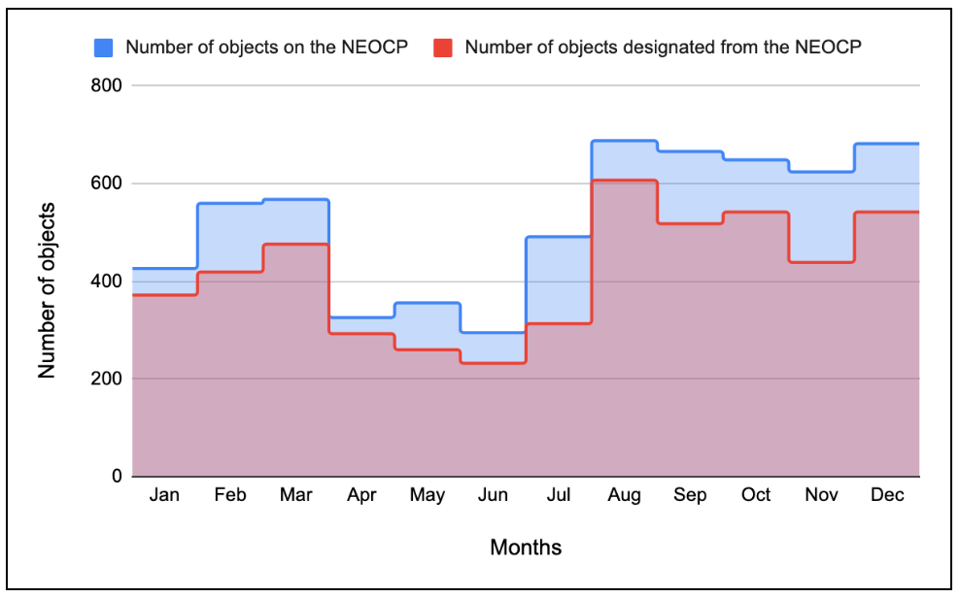
Designations can be assigned either manually by MPC staff or automatically via the NEOCP Automatic Processing (NAP) system. The criteria for removing objects from the NEOCP are detailed on the NEOCP Notes webpage. Before an object is automatically designated, it undergoes a verification process that includes a large number of checks.
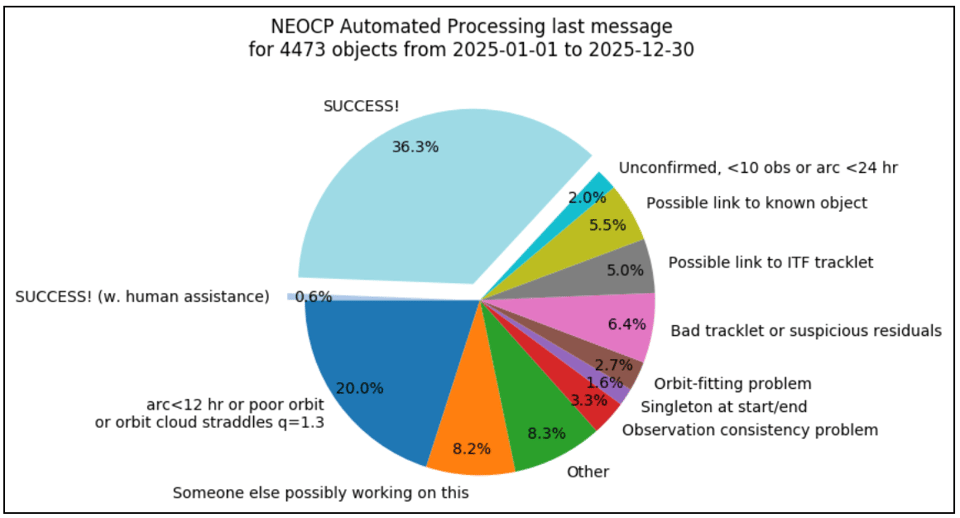
The pie chart in Figure 4 shows the percentage of objects successfully designated by the NEOCP automated system over the past year, along with the other outcomes and the reasons why the code stopped before assigning a designation (with some similar reasons grouped together). Thanks to recent improvements made to the NAP code, we believe that most of the objects in the "Other" and "Possible link to known object" cases will be automatically handled, so we expect the success rate to be higher next year.
For more details on NAP, please refer to our April 2023 and January 2024 newsletters.
Over the coming year, the MPC will focus on:
Developing a new version of the Near-Earth Object Confirmation Page;
Improving our automated procedures for designating objects on the NEOCP (e.g. automatically designate objects with arcs shorter than 24 hours, when possible);
Developing and improving automated processing for the designation of trans-Neptunian objects (TNOs; already developed, with further improvements planned) and comets (currently in progress).
Numbering
One of the MPC’s responsibilities is to assign numbers to minor planets once their orbits have been determined with sufficient accuracy to allow their positions to be reliably predicted far into the future. Numbering is also a necessary prerequisite for naming.
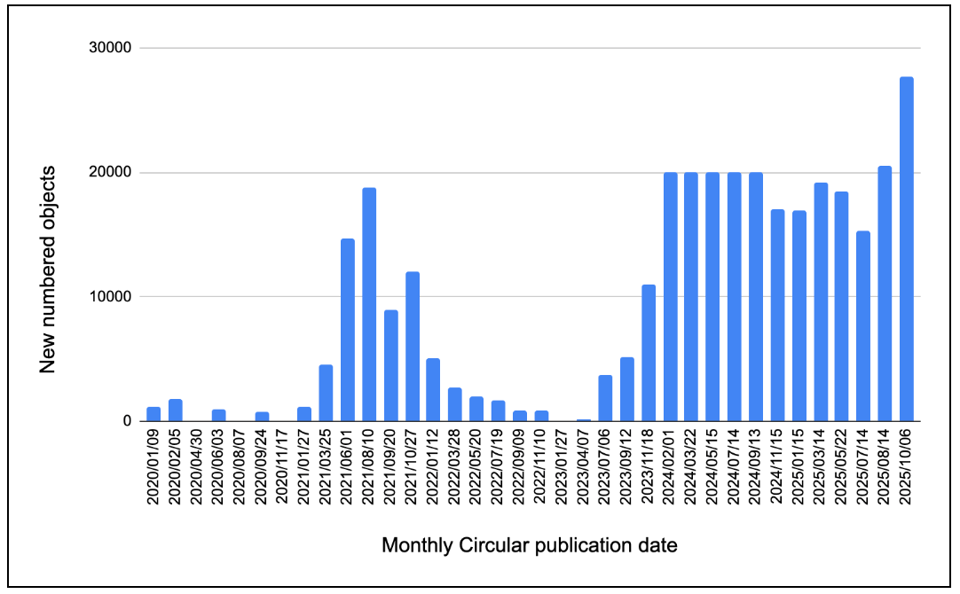
The asteroid numbering process is carried out during the preparation of the monthly publications. The MPC has been working towards reducing the backlog of objects awaiting numbering. Currently, we assign numbers to approximately 20,000 objects in each monthly circular (Fig. 5).
For more details about the numbering process, please refer to our January and May 2024 Newsletters.
Our next goal is to improve our algorithms and documentation for numbering new objects, and to make PostgreSQL tables and APIs available for retrieving discovery information for all objects.
MPC Publications
In May 2025 we asked for feedback from our users to better understand which MPC products are most valuable to the community and to ensure that key information is accessible through our replicated MPC database tables or related APIs on the MPC website. We’d like to thank again all of our contributors who took the time to fill out the questionnaire and to leave a comment for us. The totality of comments and feedback have been very positive, encouraging and extremely helpful to understand what products are the most used. Sometimes it is good to see that the work we are doing is appreciated by our community.
The results of the survey can be found in our August 2025 Newsletter. In particular, the MPC is working toward generating all of its products directly from PostgreSQL database tables. This transition will ensure fully consistent datasets, improved data control, and more flexible ways for us to deliver data to users in a variety of formats that we hope will better support your scientific work.
If you are currently using our replicated tables, we’d like to remind you that we have two useful pages:
The MPC database schema page containing the schema for every single table;
An introductory page containing an introduction to our PostgreSQL replicated tables, but also some examples on how to use our tables and what type of queries are possible. We are also working on updating the examples on the page!
Daily Orbit Update
Over the past few months, we have devoted significant effort to improving the runtime of the Daily Orbit Update Minor Planet Electronic Circulars (DOU MPECs), which are issued daily and contain new identifications and orbit determinations obtained over the preceding 24 hours.
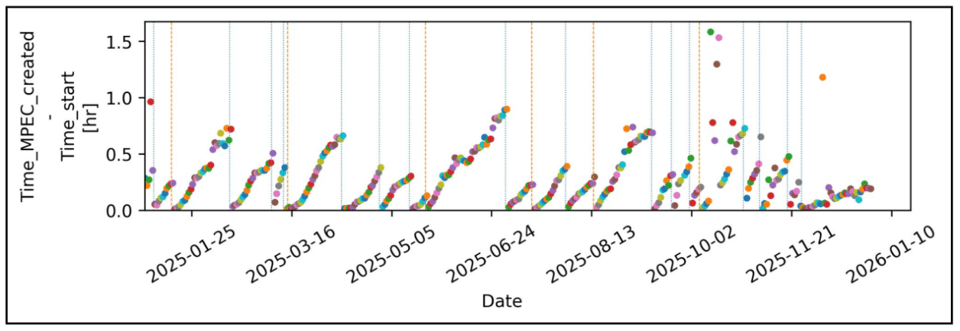
We identified a major source of runtime variability: the code was sequentially scanning a file containing all “awaiting publication” observations and checking, line by line, whether each entry should be included in the DOU (i.e., whether it belonged to a near-Earth asteroid). This approach was slow and inefficient.
We have now implemented an improved solution that retrieves the list of DOU-relevant observations directly from the database using a simple query. This change results in a substantial performance gain (a factor of 10 or more, see Fig. 6). As a consequence, the time required to generate the DOU has become much more consistent. Some additional factors still affect the exact time at which the DOU is distributed by email, and these will be addressed in the coming months.
Identifications
We would like to thank all identification-pipeline submitters who provided attributions and linked ITF tracklets leading to newly discovered objects, particularly NEOs, as well as extensions and attributions of NEOCP objects.
We would like to remind submitters that the pipeline can currently process approximately 500–1,000 submissions per day. If you have a large batch of submissions, please split it into smaller batches. The live processing status is displayed on this website. If you notice that the number of pending submissions does not decrease for an extended period (hours or days), this may indicate that the pipeline is stalled or not functioning properly; please notify us using Jira.
A small fraction of submissions are not processed automatically because they either fail the orbit fitting or contain tracklets that are considered to be of poor quality. These cases are reviewed manually once per week. If you believe your submissions were correct but were not processed, you may submit a support ticket.
For this year, the total number of distinct submissions that we received is 120,962. Among those, we accepted:
58,116 ITF-to-ITF linkages: different tracklets in the ITF were linked together to form a new object. The five major (non-MPC) contributors are listed in the table below:
Name | Number of linkages |
|---|---|
A. Doppler | 31,708 |
P. VanWylen | 6,997 |
B. Engebreth | 2,955 |
R. Weryk | 2,932 |
H. A. Guler | 1,116 |
49,986 ITF-to-DES linkages: tracklets from ITF are added to a known designation. The five major (non-MPC) contributors are listed in the table below:
Name | Number of linkages |
|---|---|
A. Doppler | 35,157 |
P. VanWylen | 7,860 |
A. Lowe | 2,908 |
R. Weryk | 1,341 |
A. Doppler, P. VanWylen | 1,010 |
4,746 DES-to-DES linkages: two designations are linked together. The five (not MPC) major contributors are listed in the table below:
Name | Number of linkages |
|---|---|
A. Doppler | 2,795 |
P. VanWylen | 1,200 |
B. Engebreth | 370 |
A. Lowe | 100 |
F. Manca | 98 |
There were 1,310 extensions or attributions of NEOCP objects through the identifications pipeline.
More statistics that also include NEOCP linkages are available on our website: 2025 - 2024 - 2023 - 2022 - 2021
Vera C. Rubin Observatory
The Vera Rubin Observatory (Rubin) released its first images and data on June 23, 2025 during a global event. With its 8.4-meter telescope and 3,200-megapixel camera, the primary goal of Rubin is to conduct a 10-year study called the Legacy Survey of Space and Time to capture the changes that will take place each clear night across the sky. Rubin will deliver an unprecedented volume of high-quality observations; in particular it will dramatically increase the discovery rate of asteroids, comets and other moving objects.
On Monday, June 23, 2025, while the entire astronomical community, and beyond, was focused on the release of the first images from the Vera C. Rubin Observatory, the MPC team was busy behind the scenes ingesting the first Solar System data products from Rubin. This milestone marks the culmination of years of intense preparation, including the development of new algorithms and the overhaul of our internal infrastructure to handle the unprecedented volume of data Rubin will deliver in the coming months and years.
Detailed information on Rubin’s First Look from the MPC perspective can be found in our June 2025 Newsletter. For an overview of how the MPC prepared for this major milestone, and how the work continued in the following months, please refer to our February 2025 and November 2025 Newsletters.
3I/ATLAS, 2024 YR4, and the fragmentation of the comet C/2025 K1 (ATLAS)
On July 1, 2025, the NASA-funded ATLAS (Asteroid Terrestrial-impact Last Alert System) survey telescope in Rio Hurtado, Chile, first reported observations of a comet originating from interstellar space. Rapid follow-up and precovery observations by Q.-Z. Ye (I41) and S. Deen (W68, M22), including data obtained in June, revealed a highly eccentric, hyperbolic orbit (e ≈ 6).
Tentative reports of cometary activity were subsequently provided by X09 (S. Deen), G37 (Q.-Z. Ye), and T14 (R. Weryk), who noted a marginal coma and a short 3″ tail at a position angle of 280°. Arriving from the direction of the constellation Sagittarius, the comet was officially designated 3I/ATLAS, as announced in MPEC 2025-N12.
Since July 1, 2025, 3I/ATLAS has received more than 5,000 follow-up observations from facilities worldwide, including space-based observatories such as JWST, HST, and ExoMars TGO. The opportunity to closely observe the third known interstellar object over an extended period is particularly exciting, as it allows us to address fundamental questions, including:
What materials and chemical compounds exist around other stars?
How does planet formation proceed in other stellar systems?
How common, and how diverse, are planetesimals across the Galaxy?
How does interstellar space alter the physical properties of small bodies?
In response to the recent surge of false, sensationalist, and alarmist claims circulating on social media regarding the passage of comet 3I/ATLAS through the Solar System, the MPC has collaborated with the IAU Office for Astronomy Outreach (OAO) to develop a series of outreach activities. These materials will serve both as official IAU information and as tools for education and public engagement.
The same Chilean ATLAS station at Río Hurtado discovered 2024 YR4 at the end of last year, specifically on December 27, 2024. 2024 YR4 is an Apollo-type near-Earth asteroid with an estimated diameter of 53–67 m. Between January 27 and February 20, 2025, it reached a Torino Scale rating of 3, reflecting its size and an estimated impact probability exceeding 1% for a potential Earth impact on December 22, 2032. The impact probability peaked at 3.1% on 18 February 2025.
By February 23, 2025, additional observations ruled out an Earth impact in 2032, lowering the Torino Scale rating to 0. Based on all available data, including observations from the James Webb Space Telescope obtained on May 11, 2025, there remains an estimated ~4% probability of an impact with the Moon on December 22, 2032 at approximately 15:19 UTC. The nominal lunar flyby distance is currently estimated at 9,000 ± 74,000 km from the lunar surface.
2024 YR4 made a close approach to Earth on December 25, 2024, two days prior to its discovery, passing at a distance of 828,800 km (2.16 lunar distances). Spectral and photometric analyses indicate that 2024 YR4 is most likely a stony S-type asteroid, with possible L- or K-type classifications, and has a rapid rotation period of approximately 19.5 minutes.
C/2025 K1 (ATLAS) is a non-period comet discovered by the same Asteroid Terrestrial-impact Last Alert System (ATLAS) on May 24, 2025. With a perihelion distance of only 0.33 AU (49 million km), the comet was not expected to survive perihelion passage; however, it did and was successfully recovered on 18 October 2025. In early November 2025, the comet experienced two apparent outbursts, the largest occurring on November 4, during which the brightness increased by approximately 0.9 magnitudes. On the same date, images obtained by the Zwicky Transient Facility (ZTF) revealed a parabolic-shaped feature of material extending up to ~10 arcseconds from the nucleus. By the following day, this feature was no longer visible, while the comet’s tail had noticeably brightened, consistent with the material being transported tailward by solar radiation pressure. This activity was subsequently followed by a fragmentation event, with two distinct components becoming observable.
As of today, at least three fragments have been identified, and the MPC is actively working to consolidate the fragment observations in order to produce a consistent and reliable dataset.
New Program Code policy
As explained in our Program Codes page, the Minor Planet Center (MPC) has historically used program codes to identify different observers observing from the same telescope. The MPC continuously monitors the astrometric quality of all submitted observations. In particular, we perform a careful verification of the astrometry provided by users requesting a new observatory code before assigning it. Program-code assignments, on the other hand, have not been subject to the same scrutiny, until a few months ago, when the MPC, in collaboration with the Singletons and Archival Committees, has identified several archives that are already public or will soon be made publicly available (see SARC webpage). Starting with the submission of archival data, everyone who wishes to submit observations from public archives will need to go through a verification process. The purpose of this change in policy is to try to ensure consistently high standards of astrometric and photometric measurements.
All the information about the SARC Committee and the new program codes policy can be found on our website (program codes policy page, SARC webpage), as well as on multiple newsletters: June 2024, July 2025, and October 2025.
We are grateful to the SARC committee and to our Users for the continued support and collaboration on this matter.
What else?
We updated several existing tools, such as WAMO, following user feedback (January 2025 Newsletter);
We also continued to improve and expand the MPC Explorer by adding new features. Among the most recent updates:
Comet orbits for numbered comets are now available in the MPC Explorer. This feature is part of a broader effort initiated last year to develop and enhance tools for handling comet orbits and observational updates (see the April 2025 Newsletter for details on comet processing)
We added several new lists and plots, including a list of all available observatory codes, a list of dual-status designation objects, and comprehensive lists of asteroid, comet, natural satellite, and interstellar object names.
Further details on recent MPC Explorer updates can be found in our March 2025, April 2025, May 2025, August 2025, September 2025, and November 2025 Newsletters.
We continue developing new APIs, such as the Observatory Code API or the Action Codes API. A full list is available on our website;
We have implemented the new extended packed provisional designation scheme (see our July 2025 Newsletter)
We continue to work closely with our users to improve existing systems and to develop new ones. In this context, we would like to emphasize that the MPC will not deprecate any established key services without providing appropriate advance notice. When new services are released, our goal is to give the community sufficient time to become familiar with them before any legacy systems are phased out.
The MPC remains committed to the continuous improvement of its current services and to the development of new capabilities by leveraging the latest available technologies. In parallel, we keep working on improving our system for Vera Rubin Observatory and NEO Surveyor, which will demand a transformation of how we manage, process, and work with astronomical data.
2. NASA Infrared Telescope Facility Strategic Planning – Seeking Community Input
The NASA Infrared Telescope Facility (IRTF) 10-year strategic plan is being developed. The plan will cover an important period for observatories on Maunakea. It will ensure that IRTF continues to be a leading facility for researchers in planetary science and astrophysics as JWST makes more ground breaking discoveries and Rubin, Roman, NEO Surveyor and other facilities, both ground and space based, begin producing vast amounts of data.
IRTF is a facility open to anyone, regardless of affiliation. We are seeking broad community input on the evolution of the scientific landscape, science priorities and cases, the roadmap for new capabilities and ideas for new instrumentation, enhancements to operations and training, and improvements to the archive, to chart the course for IRTF for the next decade.
A survey has been developed to gather inputs from across the planetary science and astrophysics research communities. We encourage everyone with an interest in IRTF to provide their input.
Everyone that completes the survey can participate in a prize draw for an observing session with IRTF that includes full support and training for planning, conducting and reducing the observations.
Wishing you all a wonderful new year from the MPC!
Add a comment: