
Newsletter - January 2025
2025 JANUARY 31
In this month’s issue:
ADES Submissions
WAMO Tool Updates
Website performance issues
Scheduled migration of the astrometry processing system database to virtual machines
2024 YR4
New MPC Technical Lead
1. ADES Submissions
While preparing our December 2024 Newsletter, we noticed a slight increase in the number of observations submitted in the MPC 1992 80-column format. While this format remains accepted, we strongly encourage users to submit observations in the ADES format for improved accuracy and efficiency.
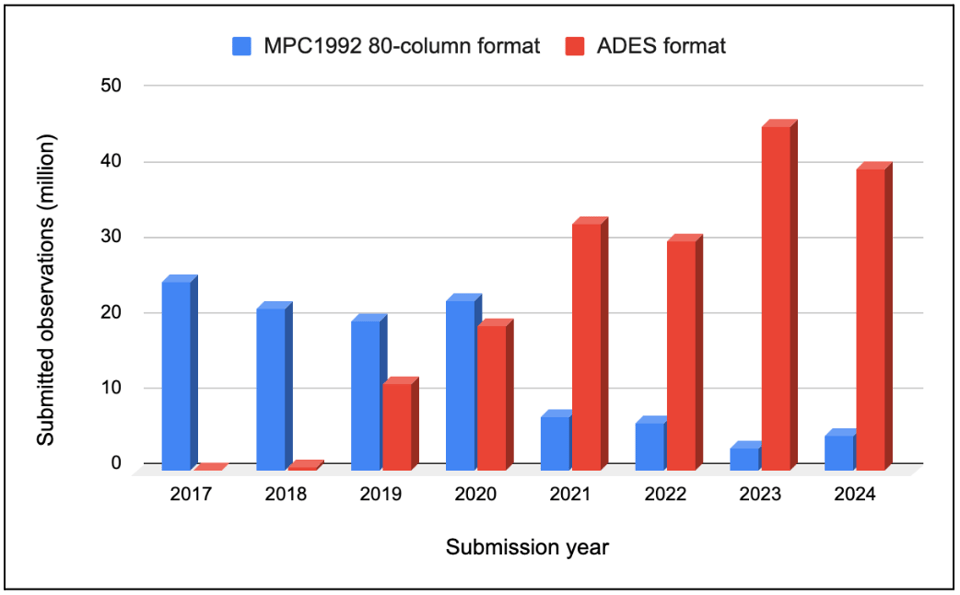
Information about the ADES format can be found in our past Newsletters (August 2023, November 2023, February 2024, April 2024) as well as on our documentation page. For any questions about the format or its usage, please contact us via the Jira Helpdesk. If you have suggestions for improvements to the ADES format, we encourage you to open a GitHub issue on the ADES repository.
2. WAMO Tool Updates
New format
The WAMO API has been updated to use a new format. While requests in the old format (e.g. {"return_type": "string", "obs": ['Lm9FfWAI0000GY2D0100001lI', 'Lm9FfWAI0000GY2D0100001lJ']}) are still accepted, they will be deprecated on March 1, 2025. A deprecation notice is now appended to API responses.
Updating your requests
Python example:
import requests

url = "https://data.minorplanetcenter.net/api/wamo"
obs_list = ['Lm9FfWAI0000GY2D0100001lI', 'Lm9FfWAI0000GY2D0100001lJ']

# For obtaining results in machine-readable format (JSON), please use:
result_json = requests.get(url, json=obs_list)
observations_json = result_json.json()

# For results returned as string (same as before), please use:
result_str = requests.get(url, json=['string'] + obs_list)
observations_str = result_str.text
Curl Example:
# For results in JSON format, please use:
curl https://data.minorplanetcenter.net/api/wamo -H "Content-Type:application/json" \
  --request GET --data '["5T0D452 703"]'
# For results in string format, please use:
curl https://data.minorplanetcenter.net/api/wamo -H "Content-Type:application/json" \
  --request GET --data '["5T0D452 703", "string"]'
The WAMO webpage at https://minorplanetcenter.net/wamo/ remains functional with minor updates to indicate malformed or unrecognized inputs.
New feature: Submission block ID requests
You can now use your submission_block_id codes (e.g., 2024-05-02T21:03:35.001_0000FzZw_01) to request information on your observations batch. We are also working on adding support for submission IDs in future updates.
Documentation
The updated WAMO API documentation is available on our Documentation page.
If you have any questions, feature requests, or encounter issues, please let us know.
3. Website performance issues
Over the past month, we experienced a surge in MPChecker requests from thousands of IP addresses that were not associated with real human users. This caused website performance issues.
To mitigate the impact, we had to temporarily take MPChecker offline at times. We have since implemented a solution to block these spam requests without affecting website performance, and operations have now returned to normal.
However, while addressing the issue, some legitimate IP addresses may have been inadvertently blocked. If you are unable to access our website, please open a Jira ticket to let us know.
We will continue to monitor the situation and will notify users of any further issues. If you encounter any difficulties accessing the site, please reach out.
4. Scheduled migration of the astrometry processing system database to virtual machines
Over the past year, the Minor Planet Center (MPC) has been working on virtualizing its systems in preparation for the significant data influx expected from Vera C. Rubin Observatory (VRO/LSST) and NEO Surveyor.
Virtualization allows multiple virtual machines to run on a single physical server, creating a more flexible, scalable, and reliable computing environment. This improves data processing, system performance, and maintenance efficiency, while reducing downtime.
Upcoming Database Migration & Scheduled Maintenance
As part of this effort, the astrometry processing system database will be migrated to a virtual machine.
The maintenance, originally planned for Monday, January 13, 2025, has been rescheduled to Wednesday, February 12, 2025, at 14:00 UTC (09:00 EST), aligning with the February full moon.
During this 3-hour maintenance window (until 17:00 UTC):
Astrometry submissions will remain open, but data will not be processed until the system is back online.
The MPC website will not be affected.
Given the importance of this transition, we have conducted multiple test runs to ensure a smooth process. However, if we determine that further preparation is needed, we will postpone the migration and notify the community accordingly.
5. 2024 YR4
2024 YR4 is a Near-Earth Asteroid first reported on December 27th, 2024 by the Asteroid Terrestrial Last Alert System (ATLAS) station of the University of Hawai’i in Chile during its usual operations. The asteroid recently got some public attention because of its 1.3% probability of impacting the Earth in December 2032. The impact probability was calculated by the NASA JPL Center for Near-Earth Object Studies (CNEOS) and ESA Near-Earth Objects Coordination Centre (NEOCC) with the NEO Dynamic Site (NEODyS). The International Asteroid Warning Network (IAWN) issued a Potential Asteroid Impact Notification.
As always, the Minor Planet Center (MPC) is focused on ensuring a seamless flow of observational data between astronomers and orbit computation centers to facilitate timely updates to the asteroid’s trajectory. All observations are continuously updated and publicly available via the MPC Explorer. For specific requests about 2024 YR4, please contact us via the Jira Helpdesk.
MPC is currently in preparation mode, meaning that we are working on the Minor Planet Circular and that we can accept remeasurements for 2024 YR4, but we cannot delete old observations at this time. We will clean the dataset once we are out of preparation mode.
If you need to submit any remeasurements, please notify us beforehand.
For archival observations, if you are not part of the original team, please coordinate with them before submitting any data to the MPC.
6. Peter K. G. Williams, the new MPC Technical Lead
The MPC is pleased to welcome Peter K. G. Williams as our new Technical Lead.

Peter completed his undergraduate work at Harvard and earned his PhD at the UC Berkeley Department of Astronomy, where he conducted some of the first scientific studies using the Allen Telescope Array.
In 2012, he joined the Center for Astrophysics as a postdoctoral researcher in the group of Prof. Edo Berger, mainly doing multiwavelength time-domain studies of ultracool dwarfs, gravitational-wave event counterparts, and other variable phenomena.
From 2018 to 2022 Peter held a joint appointment as the Innovation Scientist of the CfA and the American Astronomy Society (AAS), and as Director of the WorldWide Telescope project. More recently, in 2023–2024 he led the DASCH project, overseeing DASCH Data Release 7. Peter started his new role at MPC on December 30th. For more information about Peter, please visit his website.
Add a comment: