
Newsletter - December 2024
2024 DECEMBER 31
1. MPC Wrapped
Our year in review.
2. Observations
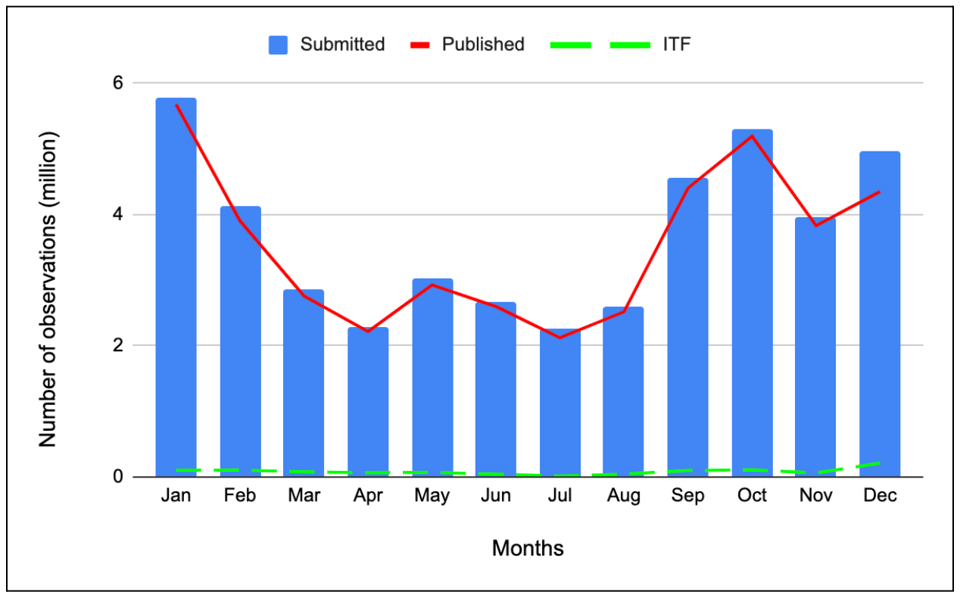
As of December 30, 2024 the MPC received a total of 44.4 million observations in 2024. Among those, 42.5 million observations were published and 1 million observations were moved to the ITF; the others were deleted due to issues such as poor quality or submission errors. This brings the total number of observations available in the MPC database to an impressive 472 million.
To learn more about how the MPC processes and publishes observations, please refer to our Newsletters from March 2023, May 2023, September 2023, and April 2024.
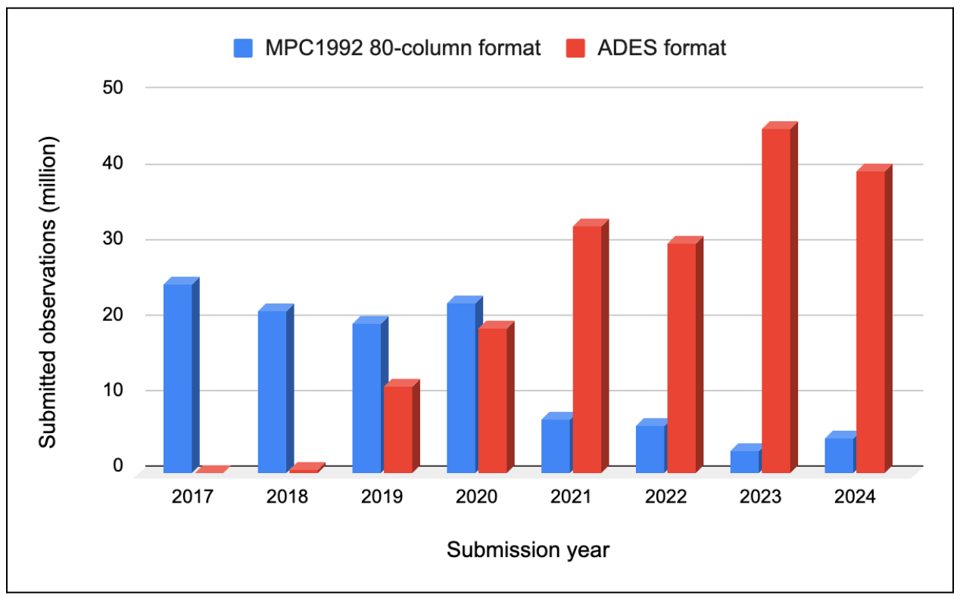
The histogram in Figure 2 highlights that the majority of observations are now submitted to the MPC in the ADES format (both versions 2022 and 2017 are considered in the plot). We’d like to thank the observers for their efforts in adopting the ADES format. We firmly believe that its broader adoption will lead to significant benefits for both observers and orbit computation centers.
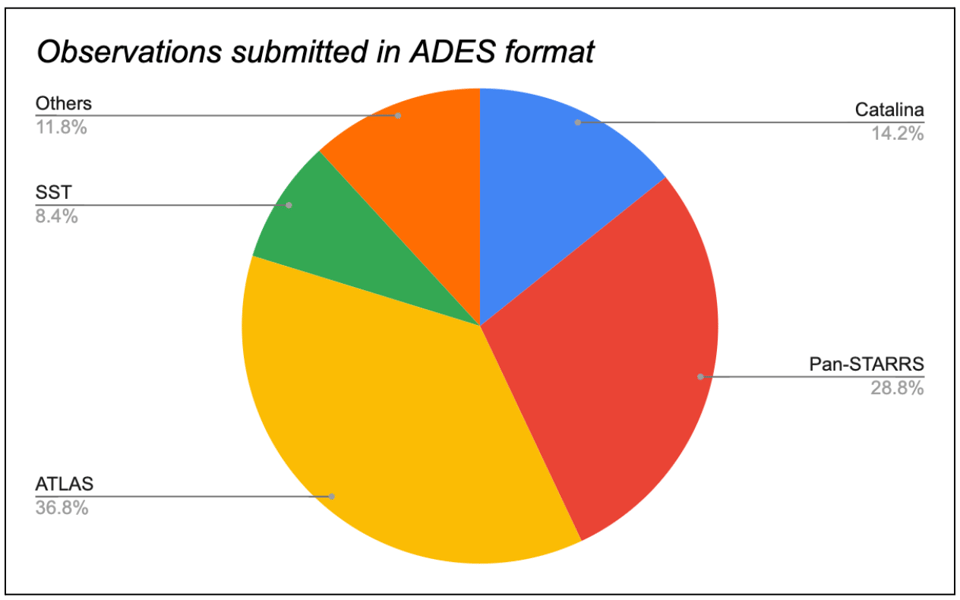
The Pie Chart in Figure 3 shows the percentage of the observations submitted in ADES format (versions 2022 and 2017) by some of the largest NASA funded NEO surveys.
3. NEO Confirmation Page
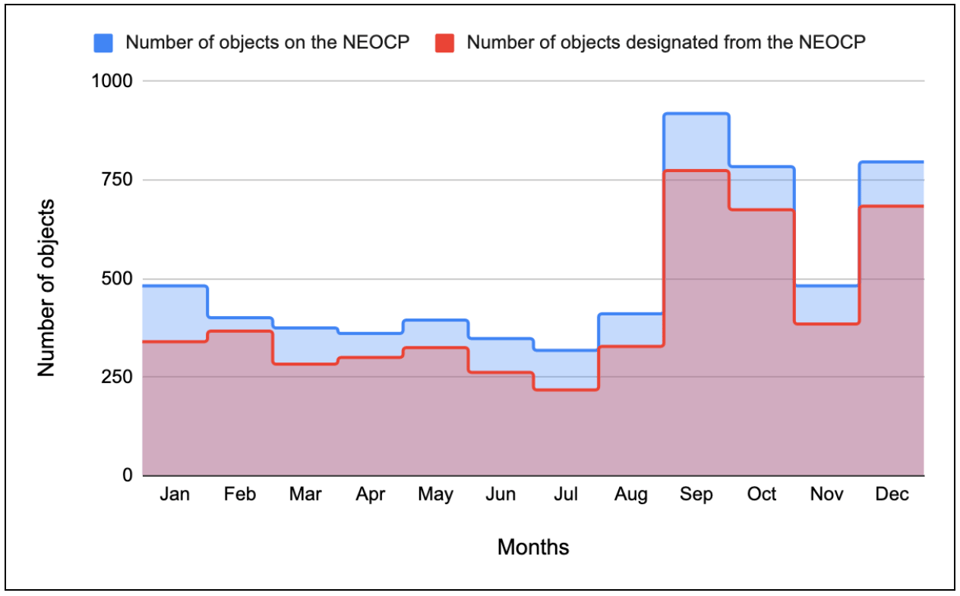
The NEO Confirmation Page (NEOCP) provides access to ephemerides for newly discovered fast-moving or otherwise unusual objects requiring confirmation. These objects have not yet received official provisional designations from the Minor Planet Center and are referenced by temporary designations.
As of December 30, 2024, a total of 6,071 objects have appeared on the NEOCP, averaging 506 objects per month, with occasional peaks exceeding 700 objects in a single month. Of these, 4,941 have been designated as new objects or linked to previously known objects, averaging 412 designations per month.
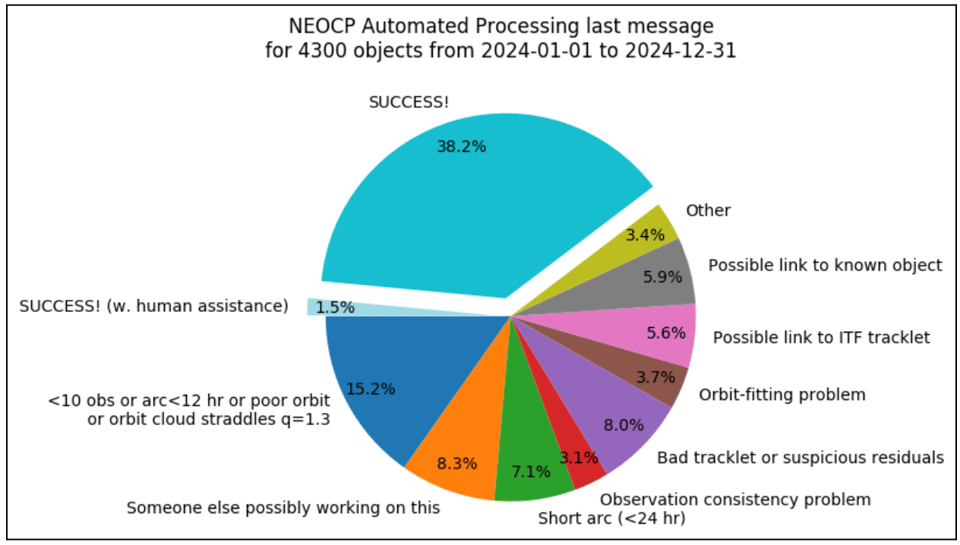
Designations can be assigned either manually by MPC staff or automatically using our new NEOCP Automatic Processing (NAP) system. The criteria for removing objects from the NEOCP are detailed on the NEOCP Notes webpage. Before being automatically designated, the object goes through a verification process that includes a large number of different checks. The pie chart in Figure 5 shows the percentage of objects successfully designated by the NEOCP automated code in the last year, plus all the other cases and reasons why the code stopped before designating the object (some similar reasons have been lumped together). For more details on NAP, please refer to our April 2023 and January 2024 Newsletters.
4. Past impactors
In the last year, four new meter-size objects were discovered a few hours before their impact with the Earth: 2024 BX1, 2024 RW1, 2024 UQ and 2024 XA1. The stories of the four objects are very similar, with slightly different timelines. Additional information is available in the February, September and October 2024 Newsletters.
- 2024 BX1, 2024 RW1 and 2024 XA1 were discovered a few hours before their impact and immediately reported to the MPC and posted on the NEOCP. 2024 UQ was discovered before the impact, but by the time it was reported to the MPC, it had already impacted;
- All the warning systems, such as the MPC internal system, JPL Scout, ESA Meerkat and others flagged all the objects as meter-size potential new impactors and solicited follow-up observations from the community;
- Thanks to the follow-up observations from amateur and professional astronomers, the warning systems narrowed down the impact time and site were predicted with the uncertainties of a few seconds and a few hundreds of meters, respectively.
- When possible, thanks to the accurate predictions, numerous meteorite fragments have been recovered from the ground, opening new exciting possibilities in the study of asteroid composition.
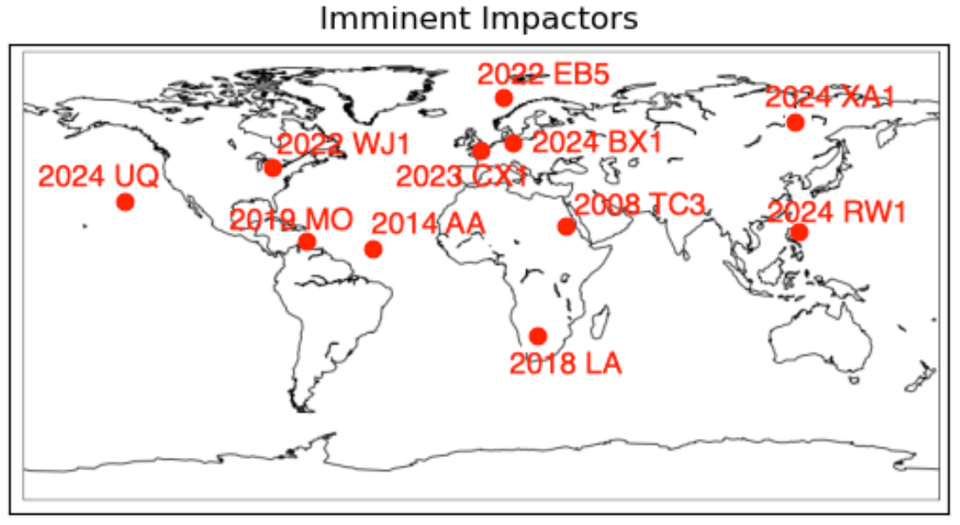
The case of 2024 RW1 differed slightly from previous ones. This object was discovered well before impact, prompting the MPC to take a new approach by designating the object prior to the impact (in contrast to previous imminent impactors, where designation typically occurred post-impact). Upon receiving a designation, the object was removed from the NEOCP.
Although observations remained continuously updated and publicly accessible via the replicated tables and MPC Explorer, user feedback indicated that this approach was not optimal for a case like this.
The MPC is committed to improving our system to strike the best balance between designating objects and keeping them on the NEOCP to facilitate the fastest possible follow-up responses. We are working on different options at the moment, but we’d like to emphasize that these successful stories are good examples of how international collaborations lead to amazing results.
The system has now proved itself to be a well-oiled machine. While these impactors were small and posed no threats, these cases underscore the vital importance of coordinated global efforts in discovering and tracking potentially hazardous asteroids.
5. Numbering
One of the MPC tasks is to assign numbers to minor planets, once their orbits have been determined with sufficient accuracy to predict their positions reliably far into the future. Numbering is also a necessary prerequisite for naming.
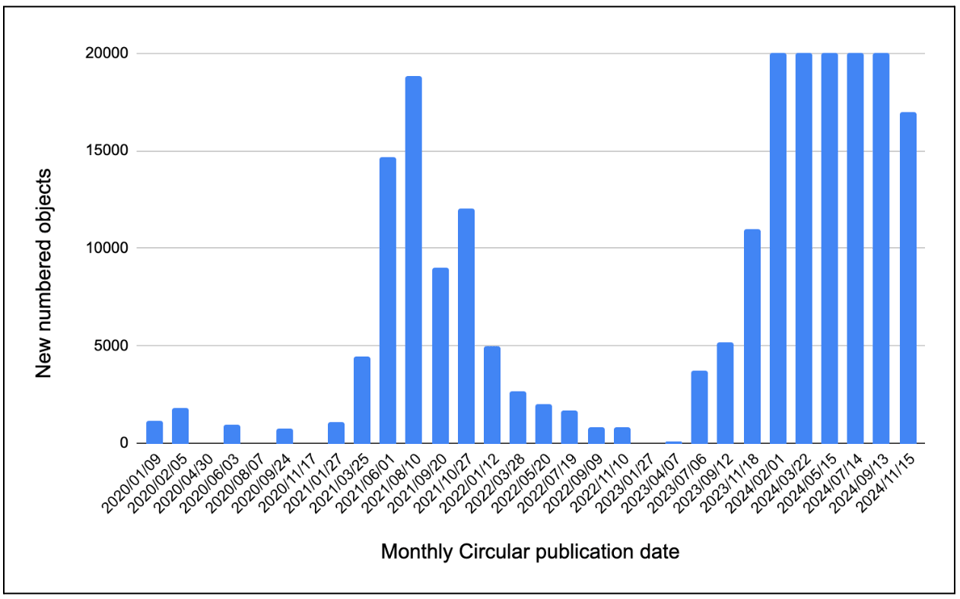
The asteroid numbering process is carried out during the preparation of the monthly publications. In recent months, the MPC has made significant progress in reducing the backlog of objects awaiting numbering. Currently, we number approximately 20,000 objects in each monthly circular.
Our goal has been to clear the backlog and achieve a steady state by the end of 2024, as illustrated in Figure 6.
For more details about the numbering process, please refer to our January and May 2024 Newsletters.
6. Identifications
We’d like to thank all the identifications pipeline submitters who have submitted attributions and linked ITF tracklets leading to newly discovered objects, particularly NEOs, as well as extension and attributions of NEOCP objects. This year we added a few new features to the pipeline: REPLY_EMAIL keyword that sends back a message that the submission fails, partial support for the TNO processing, and we also altered the criteria slightly. Future improvements include full support for the TNOs and parallel processing, making the pipeline faster.
We would like to remind the submitter that currently the pipeline can process up to 500 - 1000 submissions per day, therefore, if you have a large batch, please split it into smaller submissions. The live processing status is displayed on this website. If you see that the number of submissions does not decrease for a long time (hours or days), it means the pipeline does not work or it is stalled, please let us know about it here.
A small fraction of the submissions are not processed automatically because they either fail the orbit fitting or there are tracklets considered to be of poor quality. We reviewed the failures once per week manually. If you believe your submissions were correct and were not processed, you can create a support ticket.
For this year, the total number of distinct submissions that we received is 138,138. Among those, we accepted:
-
79,251 ITF-to-ITF linkages: different tracklets in the ITF were linked together to form a new object. The five major (not MPC) contributors are listed in the table below:
Name
Number of linkages
A. Doppler
44,442
P. VanWylen
7,773
O. Rodrigues
3,844
R. Weryk
3,047
D. Rankin, D. Bamberger, B. Gray
2,526
-
45,781 ITF-to-DES linkages: tracklets from ITF are added to a known designation. The five (not MPC) major contributors are listed in the table below:
Name
Number of linkages
A. Doppler
25,774
P. VanWylen
13,911
R. Weryk
2,626
A. Lowe
661
P. Thomas
610
-
6,408 DES-to-DES linkages: two designations are linked together. The five (not MPC) major contributors are listed in the table below:
Name
Number of linkages
A. Doppler
3,735
P. VanWylen
1,357
R. Weryk
251
F. Manca
136
S. Deen
53
There were 975 extensions or attributions of NEOCP objects through the identifications pipeline.
More statistics that also include NEOCP linkages are available on our website: 2024 - 2023 - 2022 - 2021.
7. What else?
-
We have developed a new tool that is going to replace the current db_search functionality. The tool is called MPC Explorer, and for all the details please refer to our February, March, July, October and November 2024 Newsletters. MPC Explorer fully relies on the PostgreSQL tables, for the observations, orbits and identifications. The data fetching is performed by some new APIs that are also publicly available:
- Designation identifier API
- Observations API
- Orbits API
- NEOCP observations API
- We are working on improving our extant documentation and on creating new ones for every new service we release. Everything is accessible from a centralized Documentation page.
- We keep working with our users to improve our current systems or to create new ones. In this respect, please note that we are not going to deprecate any known MPC key services before giving the right warning. When we release something new, it is always because we want to give the community the time to familiarize themselves with the new service before deprecating any old one.
The MPC is committed to continuously improving our current services and developing new ones by leveraging the latest available technologies. We are also preparing for upcoming surveys that are going to revolutionize how we manage and work with data.
Wishing you all a wonderful new year!
Add a comment: