
Newsletter - September 2024
2024 SEPTEMBER 30
In this month’s issue:
The Edgar Wilson Award
Documentation updates
2024 RW1
1. The Edgar Wilson Award
General Information
The Edgar Wilson Award is conferred annually to amateur astronomers who have discovered one or more comets.
Under the Will of Edgar Wilson of Lexington, Kentucky, a Trust was established from which a fraction of the annual proceeds would be provided to the Smithsonian Astrophysical Observatory (SAO) to administer a perpetual program in support of amateur astronomy.
The terms of the bequest from 1996 - 2020 instructed that the funds be used to identify and honor amateur astronomers who discovered comets during the preceding year.
In October of 2020, the terms of the bequest were changed such that SAO should use the funds to:
Organize programs for amateur astronomers, where the programs shall consist of presentations and training sessions from leading astronomers in the field of comets and asteroids.
Honor amateur astronomers who discovered comets during the preceding year with a commemorative plaque.
Recipients
The recipients of the Edgar Wilson Awards for the annual periods from 11 June 2018 through 11 June 2024 have been posted to the MPC website. The recipients are as follows:
2019 Award Winners
(for the period 2018 June 11 - 2019 June 11)
Award Winners | Comet designation |
|---|---|
Donald Machholz | C/2018 V1 (Machholz-Fujikawa-Iwamoto) |
Masayuki Iwamoto | C/2018 Y1 (Iwamoto) |
**2020 Award Winners** (for the period 2019 June 11 - 2020 June 11)
Award Winners | Comet designation |
|---|---|
Gennady Borisov | 2I = C/2019 Q4 (Borisov) |
Gennady Borisov | C/2019 V1 (Borisov) |
Masayuki Iwamoto | C/2020 A2 (Iwamoto) |
Eduardo Pimentel | P/2020 G1 (Pimentel) |
Cristovao Jacques | C/2020 J1 (SONEAR) |
**2021 Award Winners** (for the period 2020 June 11 - 2021 June 11)
Award Winners | Comet designation |
|---|---|
Leonardo Scanferla Amaral | C/2020 O2 (Amaral) |
Gennady Borisov | C/2020 Q1 (Borisov) |
Georges Attard Alain Maury | C/2021 J1 (Maury-Attard) |
Gennady Borisov | C/2021 L3 (Borisov) |
**2022 Award Winners** (for the period 2021 June 11 - 2022 June 11)
Award Winners | Comet designation |
|---|---|
Hideo Nishimura | C/2021 O1 (Nishimura) |
Alain Maury Georges Attard | P/2021 U3 (Attard-Maury) |
Georges Attard Alain Maury | C/2021 X1 (Maury-Attard) |
Georges Attard Alain Maury | C/2022 J1 (Maury-Attard) |
**2023 Award Winners** (for the period 2022 June 11 - 2023 June 11)
Award Winners | Comet designation |
|---|---|
Georges Attard Alain Maury | C/2022 N1 (Attard-Maury) |
Jost Jahn | P/2023 C1 (Jahn) |
**2024 Award Winners** (for the period 2023 June 11 - 2024 June 11)
Award Winners | Comet designation |
|---|---|
Hideo Nishimura | C/2023 P1 (Nishimura) |
Gennady Borisov | P/2023 T2 (Borisov) |
Jordi Camarasa Grzegorz Duszanowicz | C/2023 V4 (Camarasa-Duszanowicz) |
Robson Henrique dos Santos Hahn | P/2024 FG9 (Nanshan-Hahn) |
2. Documentation updates
The Ele220 format
The MPC ele220 format is an old 220-character string that was created for internal use at the MPC with the goal of storing the information necessary for the orbit computation and propagation of minor planets.
Preliminary orbit information for objects on the NEO Confirmation Page are disseminated in the ele220 format via some of the replicated PostgreSQL tables. While the NEOCP table format won’t change, the MPC is planning to deprecate the ele220 format for everything else, in favor of a new orbit format that we will publish in the next months. For sake of clarity, we have added a new documentation page to describe the ele220 format and its fields.
3. 2024 RW1: A NEW IMPACTOR
In the very early hours of September 4, 2024, Jacqueline Fazekas, a researcher at the Catalina Sky Survey, reported the discovery of a fast moving object detected by Mt. Lemmon Survey (observatory code G96). Shortly after the object was posted on the NEO Confirmation Page, all the monitoring scripts, including the ones from MPC, JPL (Scout) and ESA (Meerkat), noticed that the object had a non-zero impact probability to collide with the Earth. Rapid follow-up from several stations confirmed the impact around 16:40 UTC near the island of Luzon (Philippines).
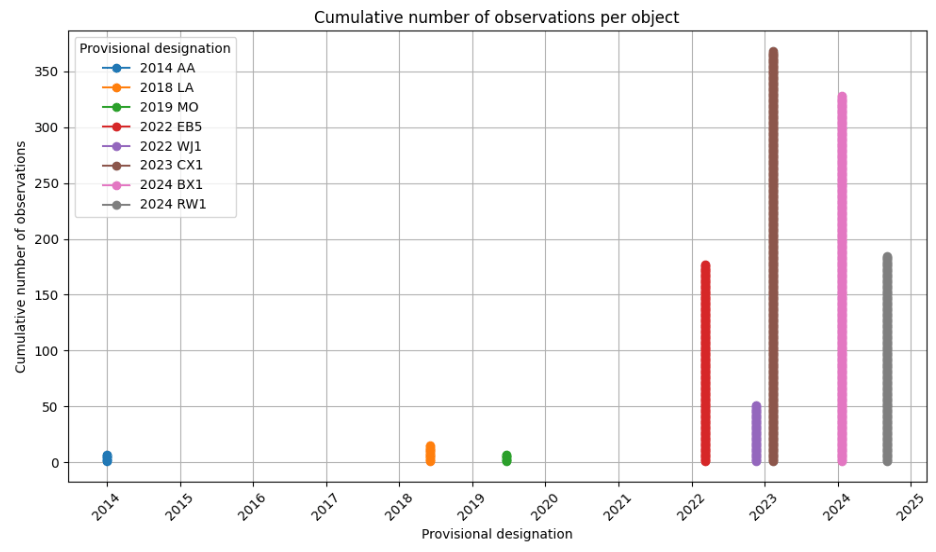
As for the previous confirmed cases, 2024 RW1 was never a concern, but it showed, once again, how the system is well-oiled and the importance of coordinated international efforts to discover and track potential hazardous asteroids (see Figure 1).
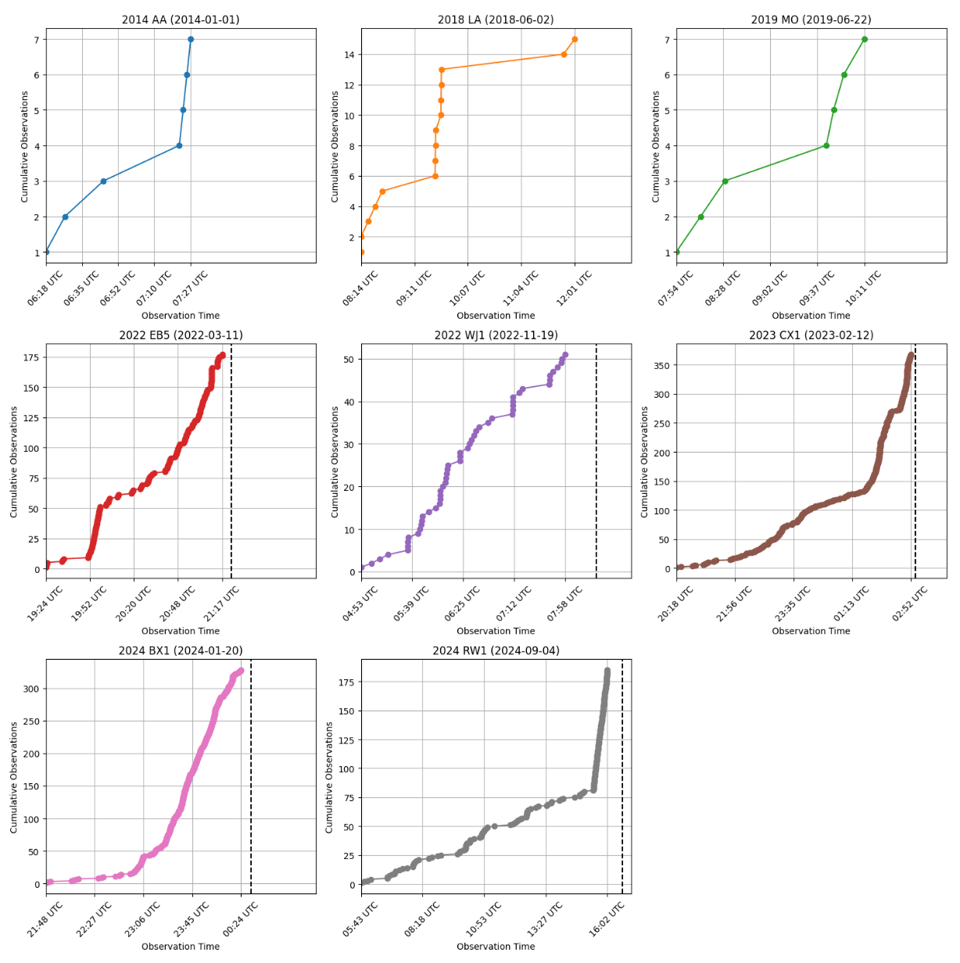
Given the fact that 2024 RW1 was discovered well before the impact, the MPC has decided to try a slightly different approach and to designate the object before the impact (for all the previous imminent impactors, the designation usually happened after the impact). The object was removed from the NEOCP as soon as it received a designation and even though the observations were continuously updated and publicly available via the replicated tables and the MPC Explorer, some feedback from our users have shown that this was not the optimal solution for a case like this one.
We will keep working on tuning our system to find the best compromise between designating the object while keeping it on the NEOCP, to ensure the most rapid follow-up response. It is good to have such test cases!
Add a comment: