Newsletter - October 2024
2024 OCTOBER 31
In this month’s issue:
MPC Explorer
Documentation updates
New month - new impactor
New flag for NEOCP objects
Meetings & Outreach
1. MPC Explorer
We have recently been working on adding some missing features to our MPC Explorer.
Interstellar objects
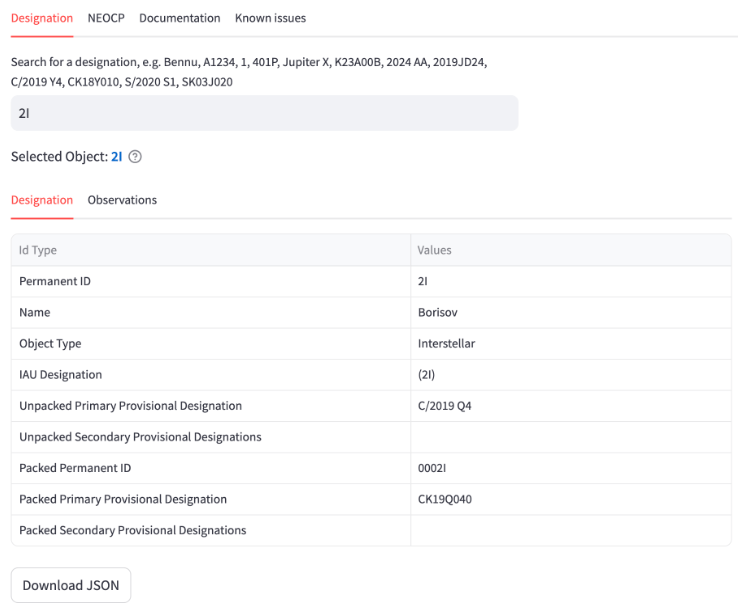
Interstellar objects are now handled correctly by the MPC Explorer, so it is possible to query for 1I ‘Omuamua or for 2I Borisov (Fig. 1). The data available through the MPC Explorer are also available via the MPC APIs.
Different objects with the same name
The MPC Explorer is now able to disambiguate cases in which different objects (e.g. a minor planet and a natural satellite) have the same name. For example, Io is the name of asteroid (85) Io and it is also the name of the first moon of Jupiter.
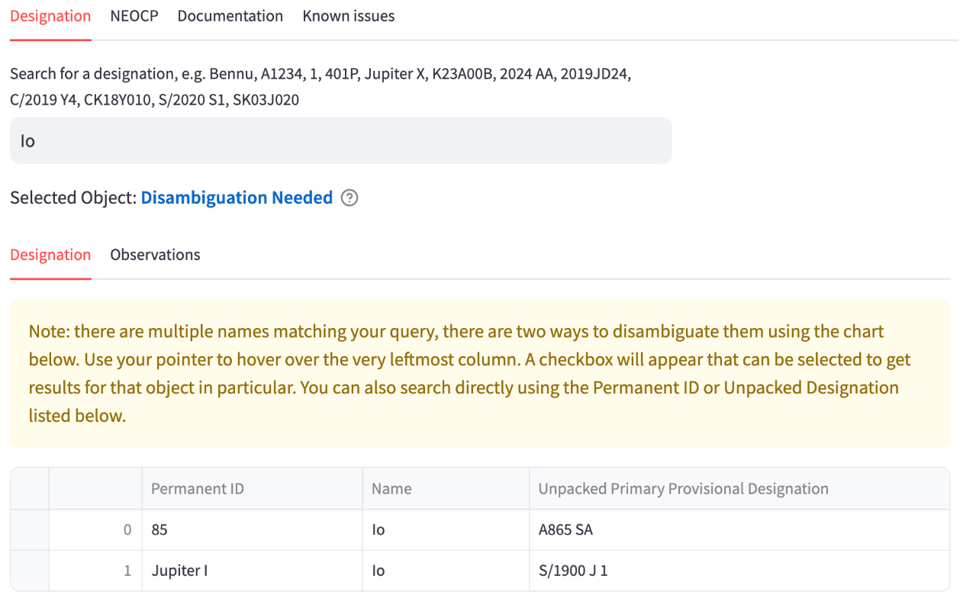
Figure 2 demonstrates how a query for Io now displays a Disambiguation Needed label. When multiple names match the query, users can simply hover over the leftmost column of the table to reveal a checkbox, allowing them to select the desired object. This selection automatically directs them to the relevant page.
Dual status objects
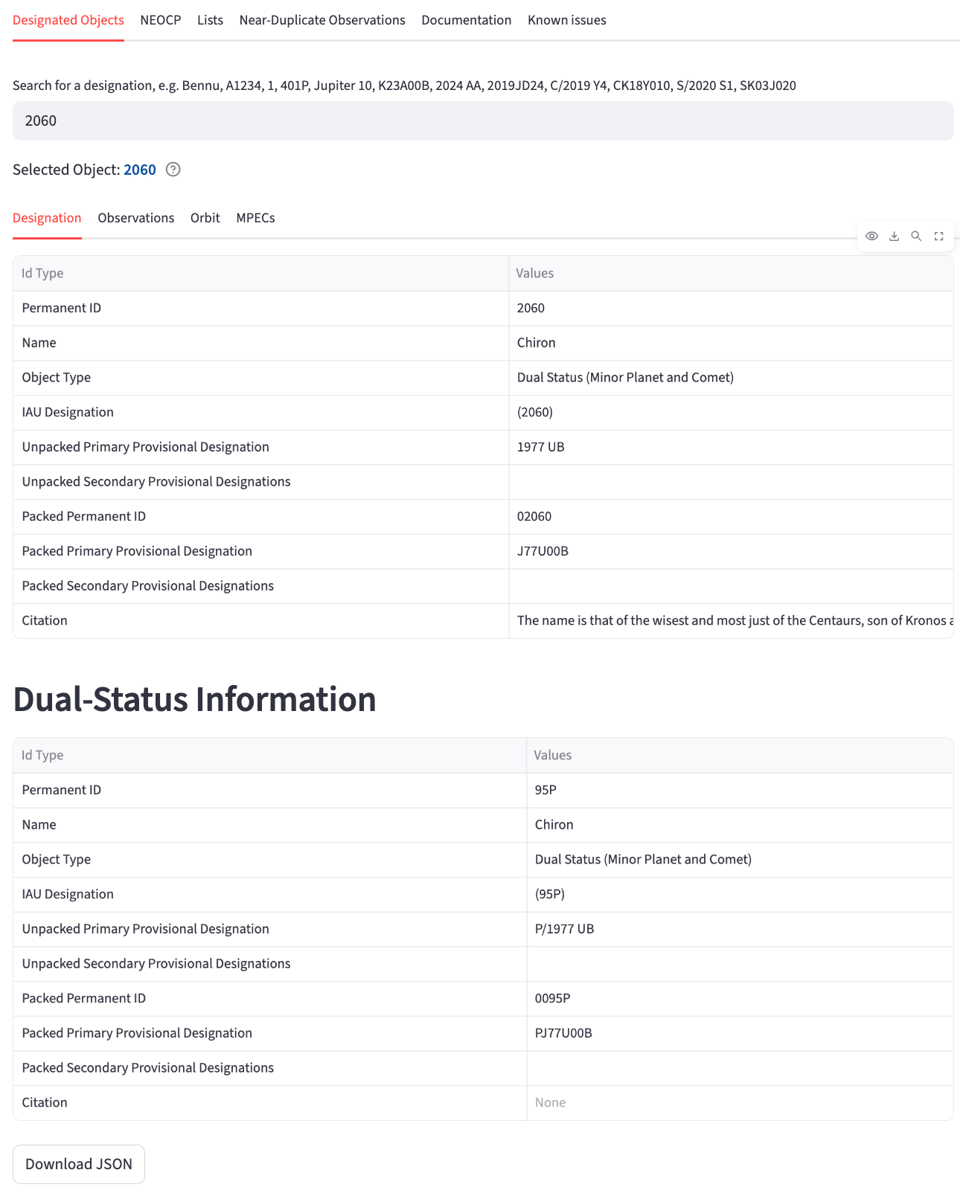
Some objects have dual status, that is they have both minor planet and comet designations. In these cases, the astrometry should be reported under the minor planet designation, but the MPC Explorer now shows information for both designations (Fig. 3). The same applies to the designation identifier API.
2. Documentation updates
We've restructured the Introduction and Examples page for the replicated PostgreSQL tables. This updated page is still accessible from the main Documentation under the Replicated Tables section. It now includes guidance on adding indexes to user-replicated versions of our tables and provides examples of sanity checks users can run. New sample queries have been added to the page as well. We plan to add additional sample queries to the documentation as new tables, such as the orbit tables, are finalized. To check the current status for all the replicated tables, we have added a new column to the table in the schema page. The column indicates the table’s current status:
“Ready” means the table is fully populated and serves as the MPC's main data source.
“Partially populated” indicates that while data is being added, further work or consistency checks are needed before it can be fully utilized.
“Empty” signifies that the table is inactive and not yet suitable as a primary data source.
If you have any questions or comments, please contact us.
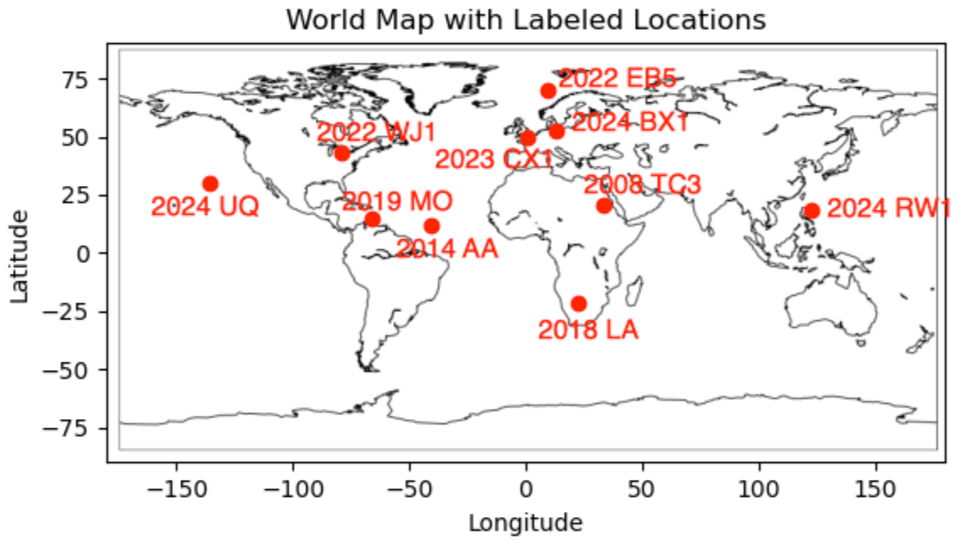
3. New month - new impactor
On the night of October 22nd, H. Weiland reported the detection of a fast-moving object by the ATLAS-HKO, MPC observatory code T05. Shortly after its posting on NEOCP, automated monitoring systems, such as JPL Scout and ESA Meerkat, identified a high probability of impact with Earth. The predicted impact time was several hours before the object was submitted to MPC. Marco Micheli (ESA/NEOCC) later identified a potential flash in the GOES (GLM) satellite imagery, corresponding to the approximate time and location of the expected impact. Micheli subsequently found precovery detections in the Catalina Sky Survey (703) images, validated by the Catalina team as well. USG reported the event to the JPL's Fireball database, confirming the atmospheric entry at 10:54:48 UTC on Oct. 22 UT, at coordinates N30.0, W136.0 and an altitude of 38.2 km. The object has been designated as 2024 UQ in MPEC 2024-U49.
4. New flag for NEOCP objects
Beginning Monday, November 4th, the MPC will introduce a new 'B' flag in the NEOCP Note column. Previously, this column was used to flag potential artificial objects, and the flag 'S' was used. The new 'B' flag will indicate a nominal orbit with a high RMS fit (RMS > 2"), signaling the presence of a possible bad tracklet or an unsuccessful orbit fit that could impact the predicted ephemeris and may require manual review. Moreover, if an object has a 'B' flag, the MPC nominal solution may not be fully reliable.
Please let us know if this change will have a huge impact on your code and you need more time to work on it.
5. Meetings & Outreach
MPC staff members have been very busy in the past months with meetings and outreach events. The MPC Director, Matthew Payne, has given an in person talk during the past DPS in Boise (ID) and a virtual talk during the IAWN meeting.
On October 24th, 2024, the Center for Astrophysics hosted a Comet-Themed Public Observatory Night. The evening began with two talks by Michael Rudenko and Mike Alexandersen, titled "Comets, Kings, and Curious Things" and "Planetary Defense: How Ready Are We for a Potential Impact?" respectively. The idea for the theme came from Rudenko, as Comet C/2023 A3 (Tsuchinshan-ATLAS), with its 80,000-year-long orbit, graced our skies at night. Rudenko also created a scaled model of the Solar System in the auditorium, using rope, batteries, and LEDs to represent planetary distances—with the comet scaled into this immersive display. Michael Rudenko and Mike Alexandersen have also been featured in the weekly CfA newsletter.
On Saturday September 28th, 2024 the Center for Astrophysics hosted Cambridge Explores the Universe, as part of the yearly Cambridge Science Festival. The festival is open to the public and visitors can enjoy exploration stations that include hands-on activities, telescope tours, solar observing, and much more. For the second consecutive year, the MPC took part in the Cambridge Science Festival, with its own booth. The Festival has been a success for both the visitors and the MPC staff.
Add a comment: