
Newsletter - November 2024
2024 NOVEMBER 27
In this month’s issue:
- MPC Explorer: orbits!
- Orbits API
- MPC User Group Meeting
- B flag for NEOCP objects
- Jira Helpdesk statistics
1. MPC Explorer: orbits!
We are incredibly proud and excited to announce that minor planet orbits are now available from the MPC Explorer.
Important Notes:
- The orbits are not yet available for comets or natural satellites. This is a work in progress.
- A comprehensive comparison between the flat files and the orbit table is still in progress. As a result, some inconsistencies may be present.
Now the good news!
When querying for a designated object, the MPC Explorer now shows the new Orbit Tab. The Orbit tab displays the orbit and related statistics of the resolved object. Users can download the orbit data in the mpc_orb JSON format by clicking the Download mpc_orb JSON file button at the bottom of the page.
The orbit data is sourced from the MPC's PostgreSQL internal database, in particular from the mpc_orbits table, which differs from the MySQL/MariaDB database used by the db_search functionality.
All orbits are computed using the OrbFit code.
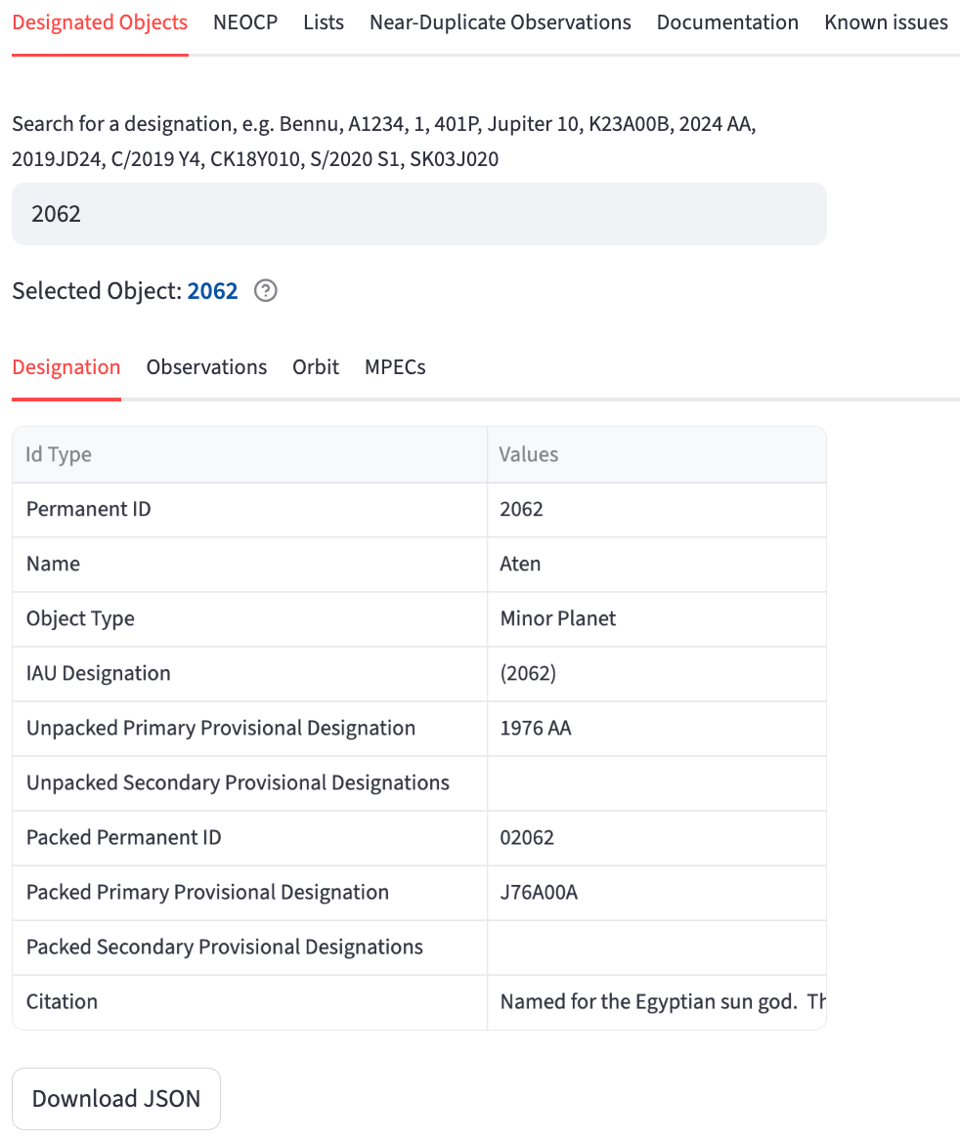
To enhance clarity, the orbit information is divided into the following sections:
- Orbital elements
- Summary Statistics
- Photometric data
-
All
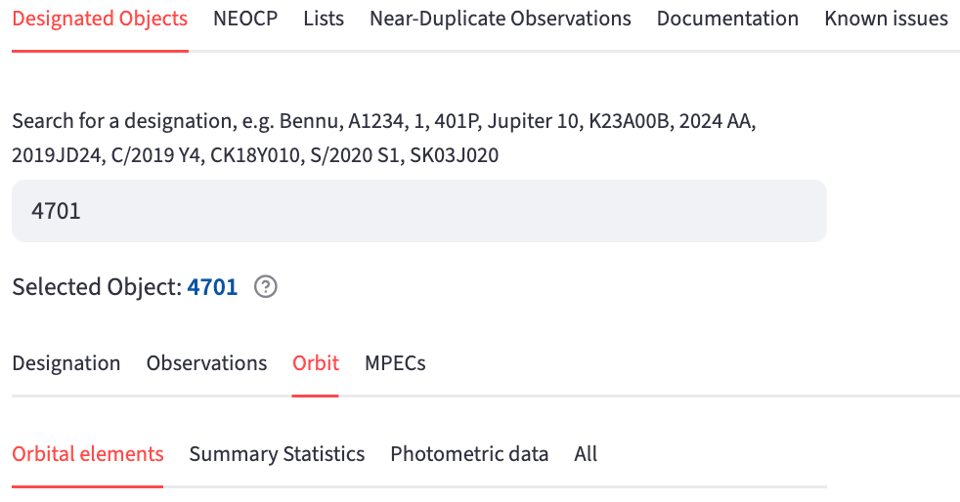
Orbital elements
We provide a combination of heliocentric Cometary elements and Keplerian elements (e.g. perihelion distance q in au, semi-major axis a in au, eccentricity e, etc), and Cartesian elements (e.g positions and velocities) at the current standard epoch.
We also report the uncertainties for all the elements, and for the first time full covariance matrices are also available for the Cometary and Cartesian elements.
In addition to the orbital elements, we provide a set of parameters that describe the dynamical model used in the fit, the ephemerides, the orbit type of the object, etc.
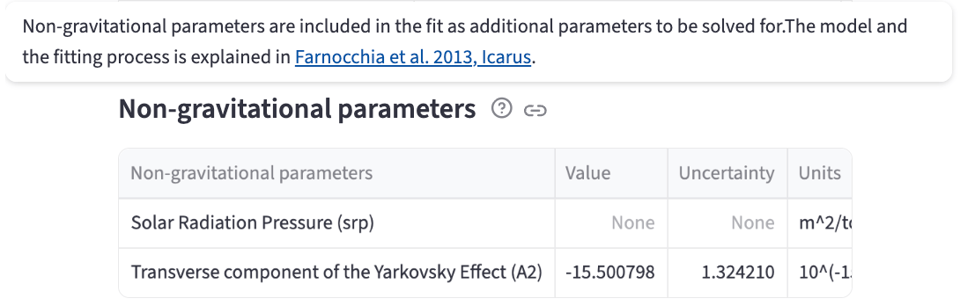
If an orbit has been computed including non-gravitational perturbations, we are now able to show them to our users in the Non-gravitational parameters Section.
Summary statistics
The summary statistics section contains a comprehensive set of summary statistics related to an orbit fit, divided into different categories: observations, selected observations, orbit quality, and orbit computer information. Among the statistics we include radar observations; this is because to utilize all available information, radar observations are currently retrieved using JPL's API. MPC and JPL are collaborating to enable direct submission of radar observations to the MPC in the future.
Photometric data
We provide basic photometric data for the resolved designation. The absolute magnitude (H) is calculated by fitting a linear model to observational data of apparent magnitudes, assuming heliocentric distances of 1 au. The slope parameter (G) is the slope of the linear model and it is set to 0.15 for asteroids.
The estimated diameter (D) is computed from the absolute magnitude (H) using the formula: D = 1329 * 10^(-H/5) * sqrt(1/albedo), where the visual geometric albedo is assumed to be 0.25.
Uncertainties will be added in the future.
All
The all section contains a combined view of all information related to the object's orbit in a single tab.
Documentation and Known Issues
We improved the documentation and we updated it to also include orbit related information.
The known issues are also up-to-date with the state of the art of the mpc_orbits table.
2. Orbits API
The MPC Explorer is entirely API driven, and we have been steadily working to make these APIs publicly accessible.
In February 2024, we introduced our designation-identifier API.
In March 2024, we launched our observations API.
In July 2024, we presented our NEOCP observations API.
Now we are thrilled to introduce our latest addition: the Orbits API.
The API currently supports searches for any single permanent or provisional (primary or secondary) designation, whether in packed or unpacked formats (primary or secondary). In the future, we may expand this capability to allow users to query limited lists of designations.
Output format is mpc_orb JSON format.
For more details, including usage examples, please visit the API documentation.
Please, query responsibly! We also encourage you to please let us know if you encounter any issues.
3. MPC User Group Meeting
The MPC Users' Group is composed of representatives from the major NASA-funded NEO surveys, the NEO follow-up community, the dynamics community, and the simulations community. The goal of the MUG is to provide feedback to the MPC about its current status and future developments. The MUG members and the MPC staff usually meet twice a year. The next meeting will take place on December 17-18 at the University of Maryland, in College Park (MD). The MPC welcomes any feedback from the community (including positive ones!) and we encourage users to share their thoughts before December 16th with the MUG representative Rob Weryk ([email protected]).
For those of you who are not familiar with the MUG or would like more information, please check the MPC User Group Page maintained by SBN.
4. B flag for NEOCP objects
In the October 2024 Newsletter, we introduced a new 'B' flag in the NEOCP Note column. Since we’ve received several inquiries about its purpose, we’d like to clarify its usage.
The 'B' flag is designed to help users make informed decisions about follow-up observations. It indicates the presence of bad tracklets, i.e. user-submitted data that poorly aligns with existing observations. The presence of bad tracklets may result in a less reliable MPC nominal solution on the NEOCP.
When the 'B' flag appears, we do not recommend users perform orbit fits. Instead, the flag serves as a signal to consider alternative follow-up strategies, such as:
- Verifying the data using additional tools like JPL Scout.
- Attempting follow-up observations over a larger area of the sky to account for greater-than-expected uncertainty.
- Opting to delay follow-up until the bad tracklet is removed and the orbits are recomputed.
Bad tracklets on the NEOCP are typically removed promptly. Once removed, if valid tracklets remain, the 'B' flag will disappear from the Note column.
Importantly, the 'B' flag does not override the 'S' flag.
5. Jira Helpdesk statistics
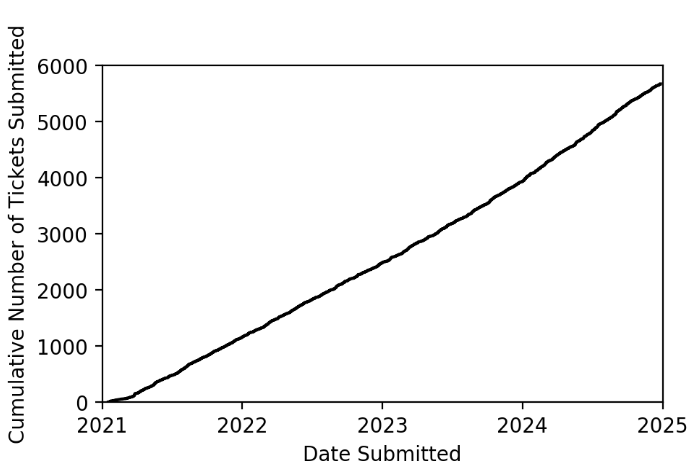
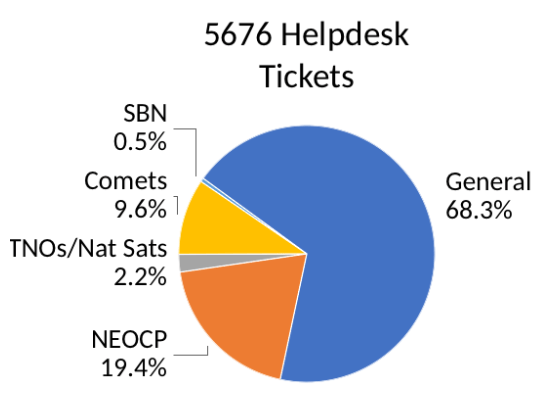
Since adopting the Jira Helpdesk in early 2021, the MPC has received 5,676 tickets from our Users (Fig. 1). While the community needed some time to adapt to the new tool, the Helpdesk has now become the primary channel for user support, with a steady rate of submissions since 2022. Jira enables efficient issue tracking, staff assignment, and prevention of duplicate efforts. It also ensures that users’ concerns are addressed even if some staff members are unavailable.
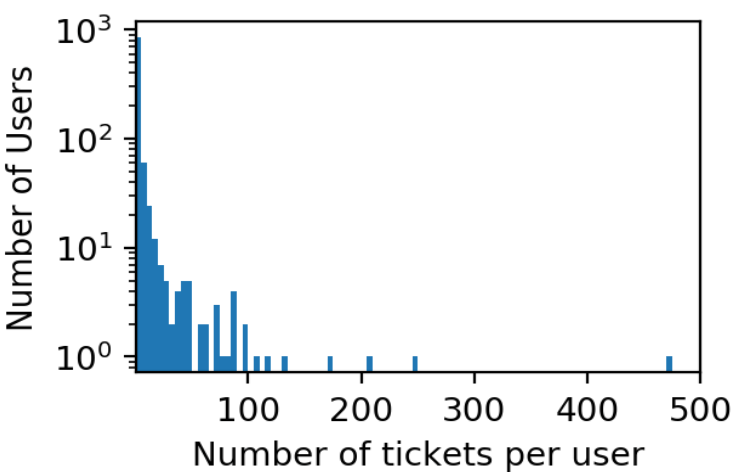
To date, we have received tickets from 988 unique users, with submission patterns varying widely (Fig. 2).
A unique user is defined by a distinct email address, so tickets submitted under different addresses are counted separately.
While 588 users (60% of the total) have submitted only one ticket, a small number of users generate the majority of the activity, including one individual who has submitted 473 tickets. Users with five or more submissions account for 78% of all tickets.
Many users who submit large numbers of tickets are part of the MPC Users group, which allows members to share tickets with others in the group. If you want to know more about the MPC Users group, please check our Contact page. If you want to join the group, please submit a ticket under the General Support portal. To date, 369 tickets have been shared within this group, covering a wide range of inquiries and error reports.
Users can submit tickets to a variety of queues. Please select the most relevant queue to ensure the ticket is directed to the appropriate staff member. If a ticket is misassigned, we reassign it promptly. Figure 3 shows that most tickets are submitted under the "General" queue, which handles a broad range of topics, including publication issues, broken services, observatory code inquiries, discovery credit questions, Jira usage issues, and general questions. Significant numbers of tickets are also received under the NEOCP and Comets queues, while TNOs and Natural Satellites receive fewer inquiries. Additionally, the "Database Replication" queue, associated with SBN tickets, is used to track and resolve database replication issues.
Not all tickets can be resolved immediately, often due to the complexity of the requested changes. When resolving these issues requires a significant investment of time and resources, or when the requests are already part of some internal projects, tickets are labeled Moved to Development, and linked to tickets in our internal development system.
Please check our FAQs for more details on Moved to Development tickets.
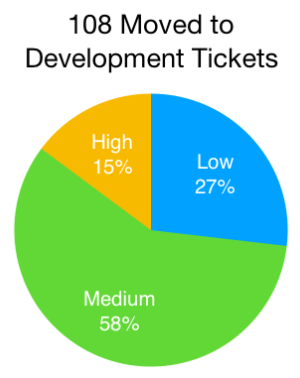
Given the high volume of tickets we receive, each is assigned a priority of Low, Medium, or High. High-priority tickets are actively being addressed or scheduled to be addressed within three months. Medium-priority tickets may be worked within that same time frame, while Low-priority issues typically await an upgrade in priority before significant progress is made. Most Moved to development tickets are classified as Medium priority.
Currently, 108 of our 5,676 tickets are labeled Moved to Development. Many of these tickets are often linked to the same development projects.
Thanks everyone for using the Helpdesk!
Add a comment: