
Newsletter - February 2024
2024 FEBRUARY 02
In this month’s issue:
New year, new impactor
MPC’s new services and APIs
MPC’s updated services
General updates
1. New year, new impactor
The case of 2024 BX1
On the night of January 20, 2024, at 22:48 (CET) the Hungarian astronomer Krisztián Sárneczky, while observing at the Piszkéstető Mountain Station with a 60-cm Schmidt telescope, detected a meter-size asteroid that was on its way to collide with the Earth. The process that led to the prediction of the impact worked flawlessly, as in the case of last year's impactor, 2023 CX. This is a brief summary of the main events that happened after the discovery of 2024 BX1:
Sárneczky reported the first set of three observations to the Minor Planet Center; the observations ended up on the NEO Confirmation Page (NEOCP), as is normal for the discovery of potential NEOs.
Sárneczky continued to track the object and reported immediately a second set of four observations bringing the total number of observations to seven.
The MPC internal warning system, other imminent impactor systems (e.g. JPL’s Scout, ESA’s Meerkat Asteroid Guards, NEOScan, etc.), and astronomers that are continuously monitoring the NEOCP, all flagged the object as a meter-size potential new impactor and solicited follow-up observations from the community.
The object was visible from Europe and initial predictions were already showing that the object was supposed to fly over Germany. After 70 minutes from the discovery, thanks to the follow-up observations from amateur and professional astronomers, JPL’s Scout narrowed down the fall location to 60 kilometers (37 miles) west of Berlin, estimating an impact time of 0:33 UT on January 21, 2024. The impact time and site were predicted within 1 second and 100 meters.
The fireball was visible from as far as Slovakia, with multiple cameras able to record the impact from different locations. Many videos can be easily found online and on social media.
The MPC assigned the 2024 BX1 designation to the object including 188 observations in the Minor Planet Circular MPEC 2024-B76.
Thanks to the accurate predictions, numerous meteorite fragments have been recovered from the ground, opening new exciting possibilities in the study of asteroid composition.
This successful story is just an example of how international collaborations lead to amazing results.
The system has now proved itself to be well-oiled. While this impactor was small and could not create any harm, this case demonstrates the importance of coordinated international efforts to discover and track potential hazardous asteroids.
MPC’s new services and APIs
The case of the impactor proved once again (if needed) that the role of the MPC is crucial in maintaining a clean and complete catalog of orbits and observations. As part of this effort, we are working towards making our data more easily accessible.
MPC Explorer
As part of updating our existing services, we are in the process of working on a replacement of the db_search functionality. The db_search service allows the users to query for a given designation and to retrieve information about the observations and the orbit of the requested object. There are a few issues associated to the use of this functionality:
(a) The data returned by db_search are fetched from our Maria database (MariaDB). As we have already explained in our September 2023 Newsletter, the MariaDB is not always synchronized with the data in our internal postgres database.
(b) The API associated with the db_search, called search_db is returning the data using MariaDB in a non-standard JSON format.
(c) Identifications are not well handled in MariaDB at the moment.
We have thus created a new service called MPC Explorer, a user-friendly application that allows you to search for an object, resolve its identity, and retrieve the observations (for now). Future development will include information on the orbits as well.
MPC Explorer relies on MPC’s APIs that have been recently developed. The goal is to make those APIs accessible to the public as well. We began with the Designation Identifier API.
Search can be done using different types of designations, including the name, the number or the provisional designation of the objects (both packed and unpacked, with or without space). Examples are shown in the Documentation tab. The Designation tab returns all the different versions of the requested designation, plus additional information about identifications (e.g. whether you ask for a primary or secondary, the code will automatically return the primary as well as a list of all the secondary designations associated with it). For an example, see Fig. 1.
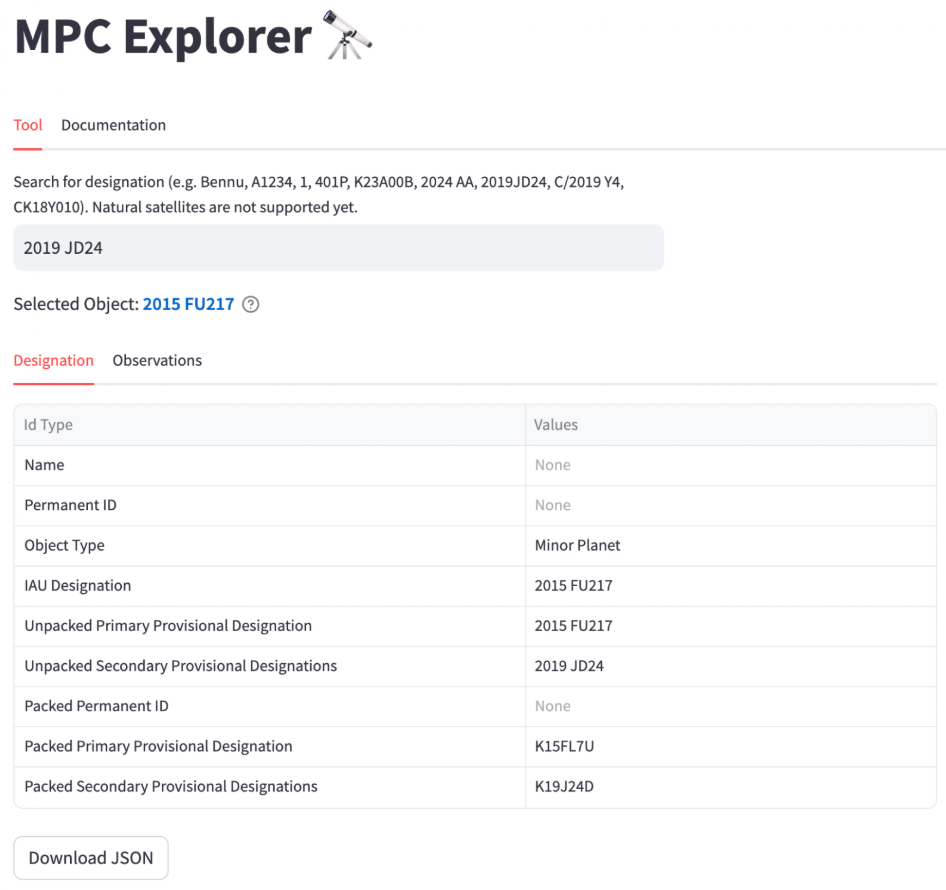
For this release, MPC Explorer works for minor planets and comets, but it does not work when searching for natural satellites. We are planning to add them soon. A JSON format containing all the different designations can be also downloaded from the MPC Explorer.
Along with the designations, the MPC Explorer also returns all the observations associated with the object, see Fig. 2.
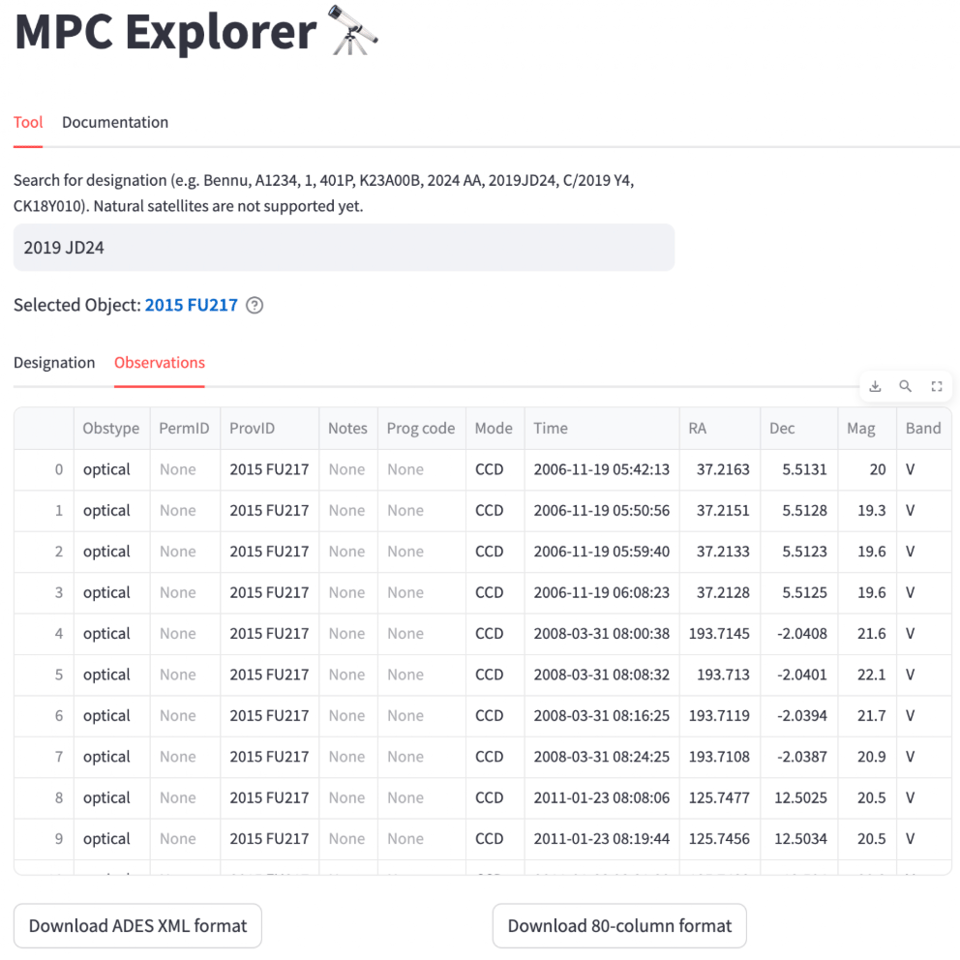
The observations are the results of a query on our internal postgres database. They can be downloaded in both ADES XML format (version 2022) and MPC-1992 80-column format. Users may find differences between the observations returned by the MPC Explorer and the ones returned by the db_search. We are confident that our internal postgres database is more accurate than MariaDB and we encourage the users to start using the observations downloaded from the MPC Explorer. As a reminder, the MPC postgres database is the one that gets replicated to SBN, as explained in our September 2023 Newsletter.
We also encourage users to report any problems to the MPC using our Jira Helpdesk.
In the coming months we plan to add orbits to the MPC Explorer.
Designation Identifier API
The Designation Identifier API is a REST endpoint. You can use your language of choice to send GET requests to the following URL:
https://data.minorplanetcenter.net/api/query-identifierYou can search for an individual ID, or a list (in JSON format) of up to 100. The response for a list will be a dictionary of responses, using the input ids as keys.
Field description and python examples are available within the API documentation. We encourage users to take full advantage of this new API and to report any issues or suggestions via Jira.
MPC’s updated services
We have been working on updating some of our services.
Orbit comparison tool
In the May 2023 Newsletter we introduced our new orbit comparison tool. The tool has been designed with the goal of comparing orbits among the largest orbit computing centers. We started with a comparison between MPC’s orbits from MPCORB.DAT and JPL’s orbits. The July and October 2023 Newsletters show additional features that we have added to the tool in the last months following users’ requests.
During the development of the MPC Explorer, we have concluded that Streamlit was the right tool to use. Streamlit is an open-source Python library that makes it possible to create and share beautiful, custom web apps. It is often used to build and deploy powerful data apps. After moving to the use of Streamlit for the MPC Explorer, to maintain internal coherence among the new tools, we have started the process of migrating them to Streamlit. The first example is thus given by the orbit comparison tool.
The new version is now available online. We find it extremely clean and nice and we hope you will enjoy it as well. We are also in the process of adding orbits from NEOFixer to the tool.
Digest2 update
MPC updated its versions of the digest2 code on Feb 1, 2024, at 0:00 UTC. Please download and test the latest version of the code from https://bitbucket.org/mpcdev/digest2/ and also the updated population model (d2model) and configuration file from https://bitbucket.org/mpcdev/digest2/downloads/.
There were only minor changes: we have fixed a bug in digest2.c (as suggested by John Fairlamb), we have added uncertainties for three new observatory codes and we have updated the population model to reflect the MPCORB catalog from Jan 22, 2024 (1.34 million orbits).
Please report any issues using Jira.
General updates
Updates on ADES
We have recently updated the ADES repository with a couple of new features. The following changes only apply to ADES version 2022 (and not to ADES version 2017):
● ADES 2022 now allows submissions that don’t contain the observers field. This was already allowed for submissions in the MPC1992 80-column format and it turns out to be useful when you are not able to retrieve any information about the observers or the PI of the program who took the observations.
● We have added a limit on the allowed magnitude values. The allowed magnitude values now go from -5 mag to +35 mag. This wide range should not create any problems. Everything is documented in the ADES master file available from the ADES GitHub repository. Please note that as a consequence, if you submit observations with the wrong magnitude value, your batch will be rejected.
● We have expanded the allowed character set for the field obsSubID: submitters are able to choose the form of the string they use for their obsIDs.
The MPC has already implemented and tested the new changes in the submission pipeline. Also, you can always validate your submissions before sending them to us using the following links:
● https://minorplanetcenter.net/submit_psv_test for PSV submissions
● https://minorplanetcenter.net/submit_XML_test for XML submissions.
Finally, if you want more information about the 'new' ADES version, you can read about it in our November 2023 Newsletter.
Updates on the occultation observations
In our August 2023 Newsletter we mentioned that the MPC was working towards the ingestion and publication of a batch of re-measured occultation observations. It took us a few months longer than previewed, but more than 8,000 occultations have been submitted and processed and the orbits of the associated ~2,000 objects have been updated. We also started the preparation of the monthly circulars that will include this new batch. MPC Explorer is already returning the occultation observations when available and the ADES format is thus available for download.
Add a comment: