
Newsletter - November 2023
2023 NOVEMBER 01
In this month’s issue:
Newly MPC hired
ADES format version 2022
High precision astrometry
TESS observations
Meetings
1. Radiy Matveev: MPC newly hired software engineer
 | Your title here The MPC is delighted to introduce our new addition to the group. |
Radiy is a software development enthusiast who enjoys all things related to IT. He is interested in developing scalable applications with emerging technologies and translating business requirements into software solutions. He is curious about the how’s and the why's of any products, either software or hardware. The drive for solving problems with refactoring solutions every day is what he enjoys the most about software development in general.
He holds a Master’s in Computer Science from Pace University, Seidenberg School of Computer Science and Information Systems and graduated in December 2021. He joined the MPC team in October 2023.
If you want to know more about the MPC’s staff, please visit our website.
2. ADES format version 2022
As explained in our August 2023 Newsletter, the Astrometry Data Exchange Standard (ADES) is a format adopted by the IAU in August 2015 with the goal of standardizing the exchange and storage of astrometric data (observations and uncertainties) and their associated data descriptions between observers and orbit computing centers. The format has improved with time, mostly to meet users' requests and needs. The most recent version is 2022, which is backward compatible with version 2017: only a few additional fields have been added, such as the possibility for the observers to submit their own observation identifier.
The MPC is now able to accept submissions in the new 2022 ADES format.
We keep encouraging all the users to submit observations in ADES and also from now to use the new version. We also encourage the users to follow the XML standards and include in your observation file a line containing the XML version and the encoding used (see How to submit observations using ADES v2022).
We also remind you that an ADES repository with the necessary documentation and code is available and public on GitHub.
What does it change for you?
In general, the answer is “very little”.
In practice, we suggest you to pay attention to the following points:
How do I submit observations using ADES v2022?
To submit observations in ADES v2022, you could simply change the header in the following way:
If you are using the XML format, this is how your header should look:
<?xml version="1.0" encoding="UTF-8" standalone="yes"?>
<ades version="2022">
If you are using the PSV format, this is how your header should look:
# version=2022
The same applies to the observations published by the MPC. Starting from January 2024, the MPC will disseminate observations in ADES v2022.Are there any new fields that I should add to my submissions?
If you create your own unique observation identifier as part of your internal processes, you can now optionally submit it in the ADES format. The MPC will store this in its database, and this should allow you to easily create a 1-to-1 correspondence between the MPC’s assigned observation identifier and your initial value. The field name is <obsSubID>.
Is something changing in the MPC obs_sbn replicated table?
The MPC maintains an internal postgres database that contains, among other things, tables of observations and orbits. Our internal postgres database is replicated to the Small Bodies Node (for a more extensive description of the MPC data sources, please refer to our September 2023 newsletter).
The observation table already contains the new fields, so nothing is changing. If you want to know what observations have been submitted in ADES v2022, you can look at the <subFmt> field: it will contain the value M92 for the long-standing 80-column format, A17 for ADES v2017 and A22 for ADES v2022.
Can I validate my observations before submitting them?
You can validate your observations using either the ADES GitHub repository or the MPC website. This is valid for all the ADES versions.
These are the MPC webpages you can use:Validate your XML file: https://minorplanetcenter.net/submit_xml_test
Validate your PSV file: https://minorplanetcenter.net/submit_psv_test
3. High precision astrometry
As explained in the August 2023 newsletter, in recent years the precision in the measurements of asteroid positions has increased, mostly thanks to the ESA Gaia mission. In particular, the technique of stellar occultations has been greatly enhanced by the publication of the Gaia data releases and measurements of asteroid occultations can now reach milliarcsecond accuracies.
Occultations
The main changes between ADES v2017 and ADES v2022 is due to the format required by the occultations. In summary, occultations can now be submitted using two different formats:
The usual format consists of the position of the star and the offset between the star and the asteroid. The observatory code associated with these submissions must be 244.
The position of the star and the position of the observer as if they were a space-based observatory, but located within the Earth. The observatory code associated with these submissions must be 275.
For more information on the occultation format, we refer to the August 2023 newsletter. Starting November 2023, the MPC will replace all the occultation observations in our current database with new measurements sent by Dave Herald (Murrumbateman, NSW Australia).
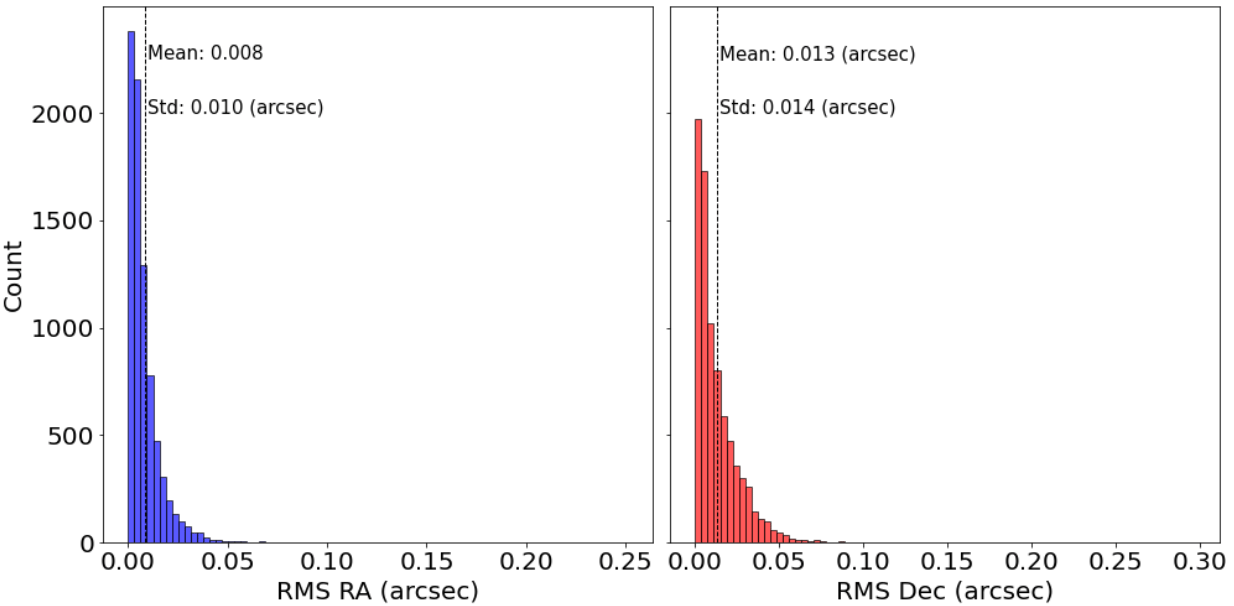
The occultation observations will be submitted with their own uncertainties, including correlations. If you are already using observations in ADES format to fit your orbits, then you should be able to include their uncertainties in your fit. If you are still using the MPC1992 format, you can use fixed weights. To get a better idea, Fig. 1 shows the uncertainties in right ascension and Declination, as computed by Dave Herald. The mean and standard deviation values of both sets are also displayed in the plot.
4. TESS observations
In our March 2023 newsletter we have announced that the MPC had begun to publish minor planet observations taken by the TESS spacecraft. The data includes more than 30 million observations for 65,000 objects (a small fraction of which are NEOs), and spans from 2018 - 2023. We have published more than 20 million observations and we are working to publish the remainder.
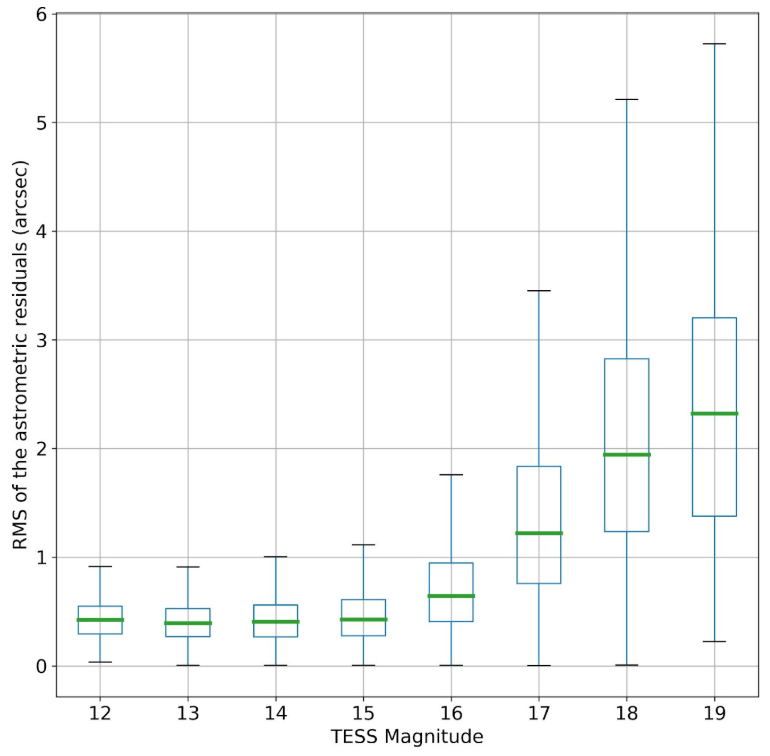
TESS observations are very valuable for photometric studies. We’d like to emphasize again that it is not the MPC's place to discard large numbers of observations when they get sent to us. The MPC already de-weights these measurements for the purpose of orbit fitting, and we leave it up to the end users to decide how they want to handle these observations. To help you with the correct choice of weights for the orbit fitting, we have prepared a box-and-whiskers plot showing the RMS of the post-fit residuals for a sample of the 30 million observations (see Fig. 2).
5. Meetings
The MPC User Group (MUG) meeting
The MPC Users' Group is composed of representatives from the major NASA-funded NEO surveys, the NEO follow-up community, the dynamics community, and the simulations community. The goal of the MUG is to provide feedback to the MPC about its current status and future developments. The MUG members and the MPC staff usually meet twice a year. The next meeting will take place on December 7-8 at the University of Maryland, in College Park (MD). The MPC welcomes any feedback from the community (including positive ones!) and we encourage users to share their thoughts before November 30th with the MUG representative Rob Weryk ([email protected]).
Meeting with representatives from the NEO Surveyor Team
In preparation for the new surveys (e.g. Vera Rubin LSST and NEO Surveyor), the MPC is developing new tools that need to be tested. As part of this work, the MPC has had the pleasure of hosting two representatives from the NEO Surveyor team, Joe Masiero and Dar Dahlen, during the week of October 23rd 2023. The visit has been successful and several tests and progress have been made. We hope to continue having periodic meetings to improve our functionalities and be ready for what’s coming.
Add a comment: