
Newsletter - August 2023
2023 AUGUST 01
In this month’s issue:
ADES format
High-precision astrometry
What’s New
1. ADES format
Astrometric observations are primarily disseminated via two different formats:
the longstanding 80-character MPC1992 format (also informally called obs80)
the more recent IAU Astrometry Data Exchange Standard (ADES)
The MPC1992 standard uses plain text files in a fixed 80-column format to communicate the core pieces of information regarding astrometric observations.
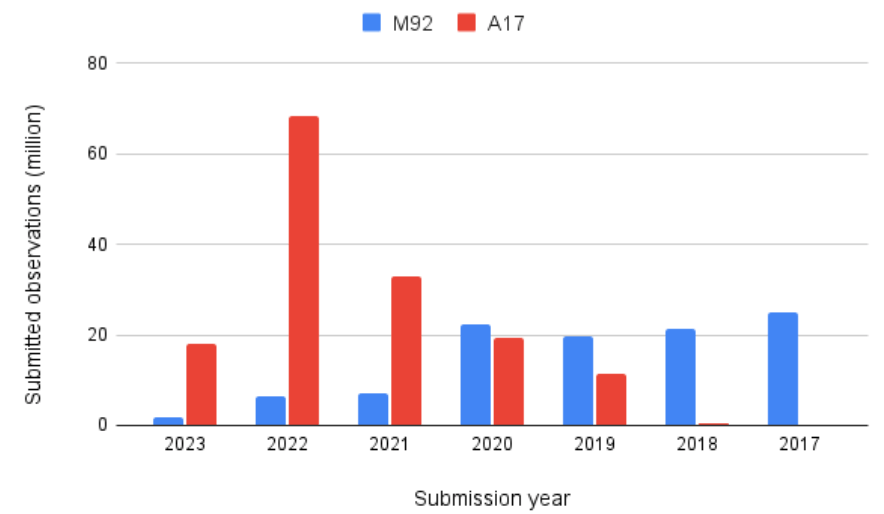
The more recent ADES format was adopted by the IAU in August 2015. It was introduced with the goal of standardizing the exchange and storage of astrometric data (observations and uncertainties) and their associated data descriptions between observers and orbit computing centers. Since its stable (2017) version was released, ADES has become the format most commonly used for submissions (see Fig. 1).
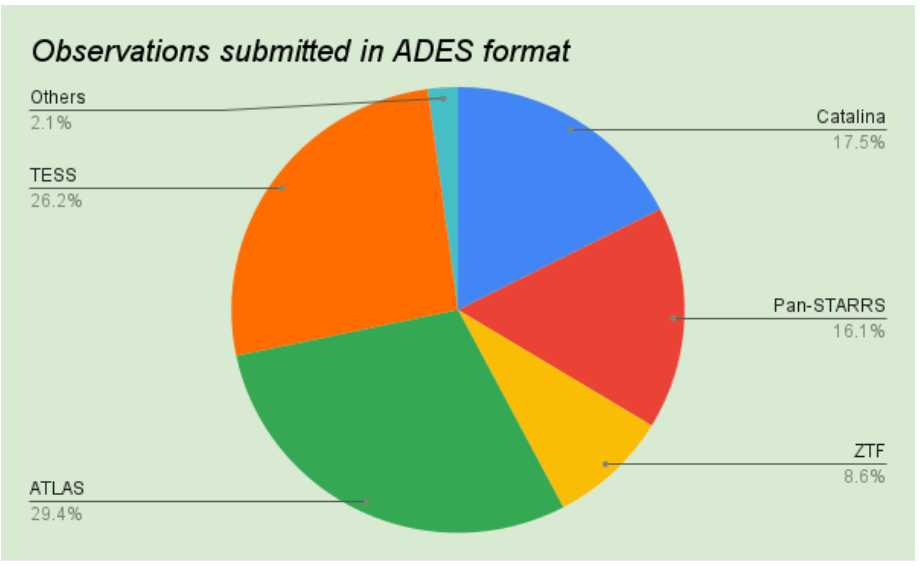
Some of the largest NEO surveys currently use the ADES format when exchanging data (see Fig. 2). The MPC also uses the ADES format internally for orbit-fitting. ADES is available in XML and PSV (Pipe Separated Values) formats.
We remind users that the data submitted to the MPC, including all of the information submitted via ADES, are freely and publicly available via a postgres database table that can be accessed via NASA's Small Bodies Node (SBN). The observations submitted in ADES format can be identified thanks to the subFmt field available in the obs_sbn table. If the observations have been submitted in ADES format, then the field will contain the value A17, otherwise the value that identifies the MPC1992 format is M92. As of today, more than 150 million observations have been submitted to the MPC in ADES format.
Additional information on the ADES format can be found on the MPC website. The page also contains the links to the ADES GitHub repository and examples of submissions in XML and PSV format.
The GitHub repository
All information about the ADES format, including the code to create and validate the format, and related documentation, are publicly available through the ADES GitHub repository. The repository is maintained by a group of people including MPC and CNEOS staff. The MPC is also in the process of updating the documentation on the website, but in the meantime for requests about the ADES format, how to submit observations in ADES or how to use the repository, please contact us via Jira or open an issue in the ADES GitHub repository.
ADES versions
At present, there are two different versions of the ADES format. The first version was published in 2017, and the second one was released in 2022. Hereinafter we will refer to the versions as ADES 2017 and ADES 2022, respectively. Both versions are available on the repository, but the current default version is ADES 2022. The code and documentation related to the 2017 version are available in a folder called past_versions.
Version 2022 should be backward compatible with version 2017. Only a few additional fields have been added to improve both submission and dissemination of the data. One of the main reasons for switching to the new version is that this will allow the MPC to receive and publish occultation observations in a new format (see the High-precision astrometry section).
Important note: at present the MPC only accepts submissions in ADES 2017. Similarly, all the ADES files produced by the MPC are created following the ADES 2017 version. The MPC is in the process of switching from ADES 2017 to ADES 2022. To ensure the backward compatibility of ADES 2022, the MPC is validating all the observations against ADES 2022. Once the validation is complete, the MPC will take the necessary steps to switch to the new version. We estimate that the overall process may take up to a couple of months, which means that we hope to be ready to ingest and disseminate observations in ADES 2022 in the fall. The MPC will send out an Editorial when the system is ready, but we encourage the community to familiarize themselves with the new version.
Useful tips
The ADES GitHub repository contains a folder called Python/ades. Users who are not very familiar with the ADES format may find this folder very useful. It contains scripts to: (a) convert the MPC1992 (obs80) format to ADES XML format; (b) convert ADES XML format to PSV format (more human readable); (c) validate a given ADES file. In addition, the MPC website has two different tools accessible from the website that can be used to validate the XML or PSV format before the submission.
2. High-precision astrometry
In recent years, thanks to the release of new stellar catalogs by the Gaia mission from the European Space Agency (see the Gaia archive for the most recent available data), the precision in the measurements of asteroid positions has increased. In particular, the technique of stellar occultations has been greatly enhanced by the publication of the Gaia data releases and measurements of asteroid occultations can now reach milliarcsecond accuracies.
As part of this improvement, the technique to measure the position of the stellar occultations has also changed and the ADES version 2022 reflects this transition. There are now two different ways of submitting occultation observations. We would like to remind the users that it is not the goal of this newsletter to give details of why and when one choice would be preferable to another or to explain the physics behind the different measurements. We just want the users to familiarize themselves with the different formats.
The first format, already available in ADES 2017 consists in giving the position of the star and the offset between the asteroid position and the star. The associated observatory code is 244, which is the one that was already in use for stellar occultations.
The second format, only available in ADES 2022 consists in giving the position of the star and the position of the observer as if they were a space-based observatory, but located within the Earth. This is because what is measured now are the geocentric coordinates of the point on the fundamental plane corresponding to the axis of the occultation shadow on that plane. From that location and the corresponding time, the asteroid and star are aligned, and the measurement represents an observable condition. A new observatory code has been assigned by the MPC: 275. In this way it will be easier to distinguish standard occultation submissions from this new format.
All the occultations that are now available in MPC1992 format have been remeasured by a team lead by David Herald. They will be submitted to the MPC in the new format, including their uncertainties, as soon as the MPC will be able to handle ADES 2022 (expected in fall 2023). We will publish all the occultations in both the MPC1992 format and ADES 2022 format. For a full exploitation of the data, we recommend users be ready to use the ADES 2022 format.
3. What's New?
The standard epoch has changed
The MPC has switched to a new standard epoch: 60200 MJD, corresponding to the Calendar Date 2023/09/13.
New digest2 population model and configuration file
The MPC uses the digest2 code to rank NEO candidates for follow-up observation. Tracklets with digest2 scores larger than 65 are posted to the NEO Confirmation Page. The digest2 code and its auxiliary files can be downloaded from the Bitbucket repository.
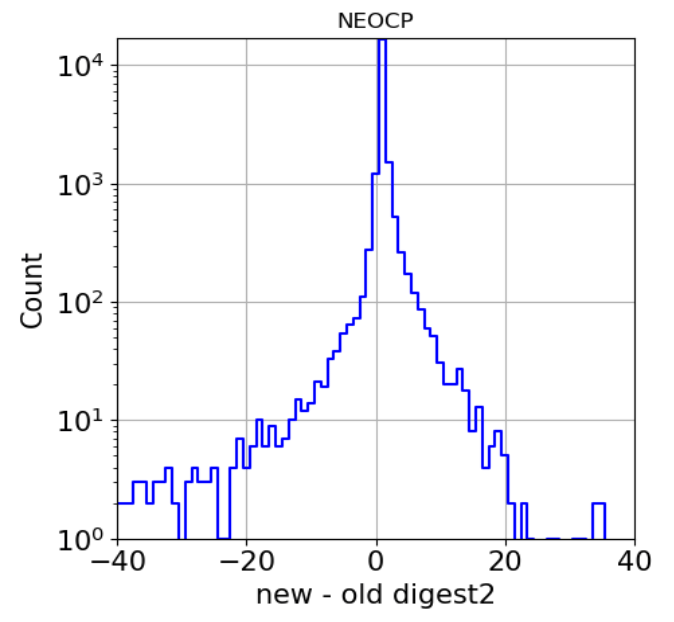
The MPC has recently updated the population model used by digest2. Historically, the updates were infrequent because of the slow increase of the number of discoveries. In recent years, the updates have become more frequent because the number of discovered objects has rapidly increased thanks to the dedicated effort of the large surveys, bringing the current population model to include 1.3 million orbits. We expect the updates to be even more frequent when Vera Rubin Observatory (LSST) and NEO Surveyor will start their operation.
We have compared the current and previous digest2 values for NEOCP tracklets reported between 2019 and 2023. The results are reported in Figure 3. For 76% of the reported tracklets there is no change in digest2 score and for 96% of the tracklets the digest2 score changed by less than 5 in total.
As part of this update, the MPC is also improving the MPC.config file. It contains a set of observatory codes with assumed uncertainties that are used in the computation of the digest2 score. The previous version of the file contained a list of 35 observatory codes, while the current version includes 140 stations.
Both the MPC.config file and the population model (digest2.model.csv) can be downloaded from https://bitbucket.org/mpcdev/digest2/downloads/ (d2model.tar.bz2).
We encourage observers to update both the population model and the configuration file in order to match the MPC's configuration. A missing update could result in discrepancies between your own digest2 score computation and the one done at the MPC. The MPC will switch to the new model on August 4, 2023 at 14:00 UTC.
Add a comment: