
Newsletter - October 2023
2023 OCTOBER 01
In this month’s issue:
New packed provisional designations
What’s new?
Meetings
Did you know?
1. New packed provisional designation
The Minor Planet Center (MPC) uses packed provisional designations to communicate designation information within the observations and orbits format for objects that have yet not been numbered.
The standard unpacked provisional designation (e.g. 2023 AB12) consists of:
A 4-digit number indicating the year (2023 in our example);
A space;
A letter to show the half-month (A in our example);
Another letter to show the order within the half-month (B in our example);
If the second letter is repeated, then the subsequent number indicates the number of times the second letter has been repeated in that half-month period (12 times in our case).
The standard packed provisional designation contains the same information, but in a more compact form, in order to fit within 7-characters. See https://minorplanetcenter.net/mpcops/documentation/provisional-designation-definition/ for more details.
The packed version of our previous example would thus be K23A12B, where:
The first two digits of the year are packed into a single character in the first column
(I=18, J=19, K=20)The second and third column contain the last two digits of the year (23 in our example);
The fourth column contains the half-month letter (A in our example);
Column seven contains the second letter for the order within the half month (B in our example);
The cycle count is coded in column five and six, using a letter in column five when the cycle count is larger than 99 (in our example, the number is 12).
By definition, the packing-format originally chosen for the packed provisional designations is limited to supporting only 15,500 new designations per half month (the standard unpacked provisional designations have no such restriction). When the Vera Rubin LSST commences operations, it is estimated that during its most productive months, approximately 250,000 objects will be discovered.
To allow the community to continue using the MPC 1992 80-character format while accommodating the predicted volume of LSST discoveries, the MPC is extending the packing-format. The MPC is not proposing any change or extension to the standard/unpacked provisional designation format.
New definition of extended packed provisional designations
When more than 15,500 objects are designated within a half-month, designations will be indicated as follows:
The first column must contain an underscore ‘_’, indicating (a) the use of the extended packed provisional format, and (b) that the first two digits of the year of discovery are 20;
This implies that the extended packed provisional designation format will not be applied to objects discovered prior to the year 2010 (see bullet point below for the encoding of the last two digits of the year);
The character in the second column must be a capital letter, indicating the last two digits of the year of discovery (e.g. P=25, Q=26, etc.);
This implies that the extended packed provisional designation format is not expected to be employed beyond the year 2035 (as Z=35);
The third character is the capital letter for the half month;
This implies that the letter for the half month has been moved from the fourth to the third column;
Columns from four to seven will contain four alphanumeric characters [0-9A-Za-z] used as a base62 representation of the order of designation after 15,500.
A few examples
The 15,500th object designated in half-month “C” of 2026 will be 2026 CZ619 = K26Cz9Z, still following the not-extended format for the packed provisional designation;
The 15,501th object designated in half-month “C” of 2026 will be 2026 CA620 = _Q0000;
The 154,775th object designated in half-month “C” of 2026 will be 2026 CZ6190 = _QC0aEM;
The final object that can be designated in half-month “C” of 2026 and that can be accommodated in this extended format will be number 14,791,836, i.e. 2026 CL591673 = _QCzzzz. We believe that this would be sufficient to cover all the new discoveries from Vera Rubin LSST.
The MPC will not publish any designations using this extended packed provisional designation format before June 2024. After that date, the MPC will begin publishing designations in the extended format as necessary in any publications.
We encourage the community to adopt the use of the ADES format, as the ADES format allows for the communication of far richer data, including but not limited to observational uncertainties. For further information about the ADES format, please check our August 2023 Newsletter.
All the information is also available on our website at the following link: https://minorplanetcenter.net/mpcops/documentation/provisional-designation-definition/.
2. What’s new?
A new API for the WAMO tool
The Where Are My Observations (WAMO) service is very appreciated and used by our community. Towards modernizing our website, and in particular our services, we have developed a new API for the WAMO tool, while preserving the functionalities of the original service.
For information on the usage of the new API, please see https://minorplanetcenter.net/mpcops/documentation/wamo-api/. The same link can also be found on the original WAMO page.
More features for the orbit comparison tool
Our orbit comparison tool for NEO orbits has been created with the goal of allowing the community to visualize and compare orbits among the largest orbit computing centers. See our May 2023 Newsletter for a description of the tool. In June/July of 2023, we have also added additional features to the tool, such as the possibility of selecting different Y-axis and the possibility of showing the uncertainties related to the orbital elements. See our July 2023 Newsletter for further information.
But that’s not it! We have added more features to the tool that we hope will help the orbit comparison.
The reference epoch
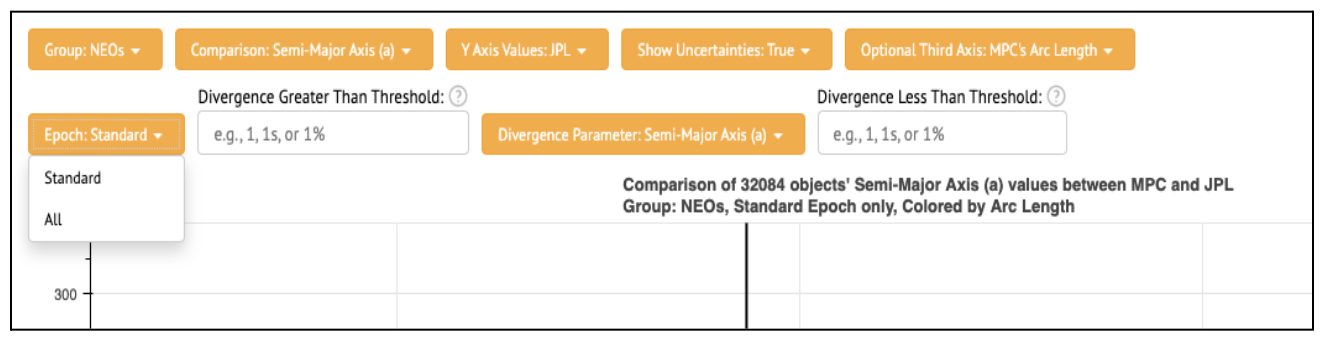
The MPC propagates all the orbits to the current standard epoch (exceptions might happen). Other computing centers have made different decisions, for example they have decided to not propagate to the standard epoch the orbits of those objects with very short arc and very uncertain orbital elements. As a result, we realized that we could not compare orbital elements obtained at different epochs. On the other hand, having the possibility of using all the available orbits could be useful in the case of the comparison of arc lengths or number of observations. We have now added the possibility of filtering the output using the epoch value (see Fig. 1).
Divergence thresholds
It is now possible to filter the results using different divergence parameters and different associated divergence thresholds. For example, you are now able to only select all the objects for which the uncertainty in the semi-major axis is between 1 and 2 sigma. Or to select all the objects that differ by more than 100 observations (see Fig. 1).
3. Meetings
The MPC will be present (virtual and in person) during the next 55th Annual DPS/EPSC meeting in San Antonio (TX) and the next ADASS XXXIII meeting in Tucson (AZ). Please use these opportunities to come and talk to us if you have any questions/concerns/suggestions.
4. Did you know?
All the past Newsletters are available on the MPC website at the following link: https://minorplanetcenter.net/mpcops/new/newsletters/. A short description of their content is also visible on the same page.
Add a comment: