
Newsletter - May 2023
2023 MAY 01
In this month’s issue:
MPC Orbits
The orbit comparison tool
We are hiring!
Request to submitters.
1. MPC Orbits
In recent years, the MPC has transformed many aspects of the way in which data is handled, including the software used for the orbit computation.
Observations are now fitted using the MPC’s customized version of the OrbFit software (http://adams.dm.unipi.it/orbfit/). As a result, uncertainties in the orbital parameters are now available, as well as a new orbit format that contains all the information needed to understand and reproduce the orbit fit.
Thanks to this change, we have also been able to include in our orbital adjustments radar data and/or non-gravitational parameters, such as the Yarkovsky effect or solar radiation pressure. Please note that:
At present we download radar data directly from JPL, but those data are not yet available nor in ADES format neither in our replicated observation table;
We use non-gravitational perturbations in our dynamical model when needed, but the current orbit format does not allow us to publish them. This is going to change very soon (see the “A new orbit format” section below).
MPC Customized OrbFit version
The MPC maintains a customized version of the OrbFit software. This version contains all the features included in the original OrbFit software package (http://adams.dm.unipi.it/orbfit/) plus additional aspects that are strictly related to the MPC processing system. We are planning to release the MPC version to the public in the next months through a Docker container.
A new orbit format
Over the last year, the MPC has worked to develop a new standardized format for the exchange of data on the best-fit orbit for solar-system bodies, including minor-planets, comets, irregular satellites, and interstellar interlopers. The new format uses JSON files for the exchange of data, and is referred to as the mpc_orb.json format.
Among other features, the format can communicate orbital elements for each object in both Cartesian and Cometarian coordinates at the current standard epoch, uncertainties on the orbital elements and additional information about the dynamical system used in the fit, such as (i) the presence of non-gravitational perturbations and their detected values with uncertainties, (ii) the ephemerides used, (iii) statistics on the orbit fit. A more detailed description of the format and its functionality is available on the github repository https://github.com/Smithsonian/mpc-public/tree/main/mpc_orb (see also The github repository section below).
There are several reasons behind this change, but of most significance is that the current MPC orbit format (https://www.minorplanetcenter.net/iau/info/MPOrbitFormat.html) cannot support the additional information that we want to share with our users, such as the uncertainties in the orbital parameters, the dynamical model used in the fit or non-gravitational perturbation values (e.g. the Yarkovsky effect or the solar radiation pressure).
As of May 2023, the latest version of the defining schema for the mpc_orb.json format is version 0.4. While the schema versions are numbered < 1, the format should be considered beta. We actively encourage the community to familiarize themselves with the new format and to report any feedback or suggestions for improvement through Jira or by raising a GitHub Issue. Once feedback has been incorporated, we will update the defining schema and notify the community.
NB: The MPC intends to continue distribution of the current orbit format for a number of years.
The GitHub repository
The repository currently contains code and documentation related to:
A description of the "mpc_orb.json" format, and an associated defining JSON schema.
Python code to demonstrate the validation of files in the "mpc_orb.json" format.
Python code to facilitate the parsing of files in the "mpc_orb.json" format.
We note that the mpc_orb python code in the mpc_orb GitHub repository is also available as a pip-installable python package.
New postgres tables
A new mpc_orbits postgres table is now available for replication through the Small Body Nodes (SBN). Among other fields, this table contains a mpc_orb.json format JSON object for each orbit.
We remind you that the instructions on how to replicate the tables from SBN are available on their Wiki page.
As discussed above, the mpc_orb.json format should be regarded as being a work in progress, and hence this mpc_orbits postgres table should also be considered to be a beta version. This means that the content of the table and the format may change pending feedback from the community.
We are releasing this beta version to allow users to familiarize themselves with the new format, and to provide time for community feedback.
To facilitate understanding of the new mpc_orbits postgres table and how it fits-in with the other database tables, the MPC will next month release (a) a detailed database schema, and (b) a tips-and-tricks page to help users understand how to perform certain queries expected to be of interest. To this end, we would be interested to receive feedback from the community regarding the types of query that they would hope to be able to perform on the database.
2. The orbit comparison tool
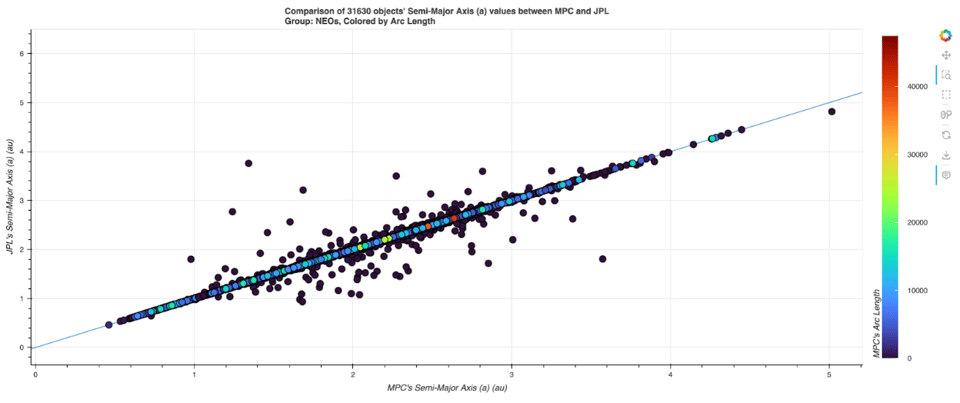
We are very pleased to announce the first beta version of another new tool: the orbit comparison tool.
The orbit comparison tool is now available.
Our goal was to create a tool that would allow the community to visualize and compare orbits computed by the largest orbit computing centers, such as the MPC, JPL/CNEOS, Lowell Astorb, and the ESA NEO Coordination Center.
Current features
In this first iteration of the comparison tool, we focus on comparing NEA orbits in the MPC and JPL datasets. Data is downloaded weekly: MPCORB.dat is used for MPC orbits, the JPL APIs are used for JPL objects.
The comparison is highly customizable. The options include, but are not limited to:
Different subcategories of NEAs can be chosen;
Different axes (e.g. eccentricity, absolute magnitudes);
Points can be colored using different parameters (third axes);
Data can also be downloaded in a csv format;
Different filters are also possible.
More information about the tool and the plots is available here.
Current limitations and future work
The orbit comparison tool is being actively developed, and over the cooking months we intend to:
Add data from different sources, including NEO Fixer.
The current format in MPCORB.dat does not contain all the necessary digits in the orbital elements for a meaningful comparison, especially when the uncertainties are very small. In future versions we will add data from our internal database table in addition to MPCORB.dat.
Thanks to a recent collaboration with S. Chesley and D. Farnocchia (JPL) we realized that JPL does not propagate to the current standard epoch the orbits of the objects with a short arc. We will include the possibility of filtering out those sources.
We will include a list of objects that are not in common between the chosen datasets.
We will add all additional classes of objects (e.g. Main Belt).
While we continue to develop this service, we would be delighted to receive feedback from the community that can help further improve it.
3. We Are Hiring!
The MPC is hiring.
The open positions are:
Come and work with us!
4. Request to Submitters
The MPC encourages submitters, especially those searching through archival astrometry, to carefully examine any marginal detections. Astrometry should be reported only for detections with a sufficiently high signal-to-noise ratio to withstand external independent review of the images. We note that synthetic tracking software, such as Tycho Tracker, often requires significant experience to avoid submitting stacked noise in sky location of the expected position of an object.
The MPC reminds submitters that while reporting magnitudes is optional it is highly desirable.
Lastly, we encourage everyone to submit their astrometry in the ADES format, as this allows submitters to communicate more information, such as uncertainties in astrometry, photometry and time.
Add a comment: