
Newsletter - June 2023
2023 JUNE 01
In this month’s issue:
63 new natural satellites of Saturn
Documentation
Suggestions for Users
Meetings.
1. 63 New natural satellites of Saturn
The Minor Planet Center recently designated and announced 63 new natural satellites of Saturn. Saturn now has the most known natural satellites with 146 known natural satellites, 122 of which are irregular satellites. This large set of announcements was triggered by a 2019-2021 survey conducted by a team led by Dr. Edward Ashton using the Canada-France-Hawaii Telescope. The measurements had been submitted in small batches to the MPC since 2020, but it was only recently that measurements from different years were successfully linked together, allowing the MPC to create reliable orbits and designate these objects.
In many cases, once an orbit was fit to the submitted astrometry from Dr. Ashton et al., additional observations of the same objects were found in the MPC database. These observations were mostly obtained by Dr. Sheppard’s group in 2003-2007 using the Subaru Telescope in Hawaii. Most of these satellites were near/beyond the limit of that 2003-2007 survey and were thus only seen on a few nights; the objects were therefore not linked and designated at the time. Identifying such linkages is computationally time consuming, but was significantly simplified by the quality, quantity and cadence of the Ashton et al. astrometry. Based on the 2019-2021 astrometry, most satellites had ephemeris uncertainty in 2003-2007 smaller than 60 arcseconds, minimizing false positives and human intervention when searching for additional measurements.
In connection with these announcements, the MPC has improved the existing natural satellite processing system to increase automation and minimize manual steps, and also implemented new code to better manage satellite orbits. For example, the Natural Satellites Ephemeris Service is now automatically updated every night, including the addition of newly designated objects.
MPEC 2023-J23 erroneously reused a designation that was already assigned to a different satellite; this MPEC was promptly retracted (in MPEC 2023-J28) and replaced by MPEC 2023-J34.
The MPC does not have immediate plans to assign permanent roman numeral designations to these new satellites, but those objects that have sufficiently constrained orbits will likely get numbered at some time in the coming year. Once the satellites are numbered, they can be assigned names by the IAU Working Group Planetary System Nomenclature.
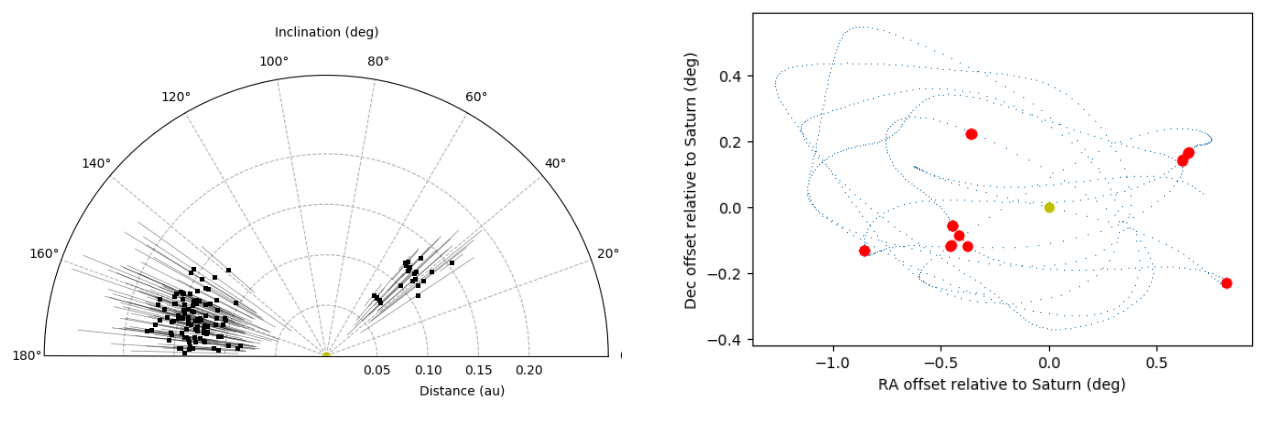
Right panel: Path of a Saturnian satellite around the planet (yellow circle). S/2004 S 45 was chosen for this illustration, as it has observations in 2004, 2006, 2007, 2019, 2020 and 2021. Small blue dots show the ephemeris of the satellite at 7 day intervals; large red dots show actual observations. A high-quality orbit is needed in order to successfully link observations across a many-year gap.
2. Documentation
Further guidance on the MPC database tables
The MPC makes its PostgreSQL database of observations and orbits available for replication, as already explained in the March 2023 newsletter. The database is published via the Small Bodies Node (SBN). Detailed instructions on establishing replication are available from the above link and via a wiki page. The MPC now provides a description of the database schema and an information page with the intent of helping new subscribers to understand the database replica and how to perform some basic operations, such as querying all the NEO observations. If users have suggestions for additional information that could be supplied, we would be happy to receive them via the Jira Helpdesk.
Reasons for removing objects from the NEOCP
When objects are removed from the NEOCP, the MPC maintains a page listing the designations assigned to the object on removal, or the reason for removal if no designation was assigned. The reasons for removal are free-form text descriptions added by MPC staff, but a list with the most commonly used default values is now available here, along with a detailed description of the intended meaning.
3. Suggestions for Users
Astrometry header keywords
MPC encourages observers to use the correct keywords in the observational header, particularly when it comes to rapid processing of NEOs or comets. Without the correct keyword, tracklets could end up in a wrong or slower queue. In addition, please submit new NEOs separately from NEOCP followup and/or incidental astrometry (see https://www.minorplanetcenter.net/iau/info/Astrometry.html#separate for more information). Lastly, please follow the instructions on how to format other elements of the header. Issues such as omitting space between initial and last name slows down the process of the submitted astrometry since the automated program code assignment will not be possible.
Reporting cometary activity
MPC welcomes reports on activity of PCCP comet candidates and also of known comets and minor planets. Activity reports should be submitted by the form: https://minorplanetcenter.net/mpcops/submissions/cometary.In addition to positive reports, observers are also strongly encouraged to submit negative reports of cometary activity for PCCP candidates.
Naming of minor planets or comets
Asteroid naming is handled by IAU Working Group on Small Body Nomenclature (WGSBN) and not by the MPC. We encourage users to visit the WGSBN website at https://www.wgsbn-iau.org, or contact the Working Group at [email protected] for all matters related to the naming (and associated citation) for all minor planets and comets.
Naming of natural satellites of planets
The MPC is not responsible for naming the natural satellites of planets. Naming is handled by the IAU Working Group Planetary System Nomenclature.
4. Meetings
The MPC User Group (MUG) meeting
The MPC Users' Group is composed of representatives from the major NASA-funded NEO surveys, the NEO follow-up community, the dynamics community, and the simulations community. The goal of the MUG is to provide feedback to the MPC about its current status and future developments. The MUG members and the MPC staff usually meet twice a year. The next meeting will take place on June 7-8 at the Center for Astrophysics, in Cambridge (MA). The MPC welcomes any feedback from the asteroid community (including positive ones!) and we encourage the users to share their thoughts before June 5th with two of the MUG representatives: Eric Christensen ([email protected]) and Rob Weryk ([email protected]).
Asteroids, Comets and Meteors 2023
The MPC is trying to increase its presence (virtual or in person) at some of the major conferences for planetary science. The goal is to have a continuous interaction with the users and the community and to improve our communication. Staff members were present during the Planetary Defence Conference in Vienna last April and they will be available during the next Asteroids, Comets and Meteors Conference in Flagstaff (AZ) in June.
Add a comment: