
Newsletter - March 2023
2023 MARCH 01
In this month’s issue:
The latest impactor 2023 CX1
Observations
ID pipeline
What’s New
1. 2023 CX1
At 20:18:07 UTC on February 12, 2023, Krisztián Sárneczky, a Hungarian astronomer, reported a new NEOCP candidate observed at GINOP-KHK (observatory code K88). Thanks to the rapid follow-up from multiple sites, imminent impact monitoring services such as JPL’s Scout, ESA’s Meerkat and MPC’s internal warning system were all able to indicate an impact with the Earth’s atmosphere on February 13 at 3:00 UTC, near the coast of Normandy, France. The fireball event happened at the predicted time and was visible from southern England, northern France and Belgium, as well as the Netherlands and Germany. Operations took place smoothly and automatically on the MPC’s side, with the object being left on the NEOCP up until the impact to facilitate its follow up. The object was then designated by the MPC as 2023 CX1, and the published MPEC included astrometry taken up to just 10 minutes before the impact.
2. Observations
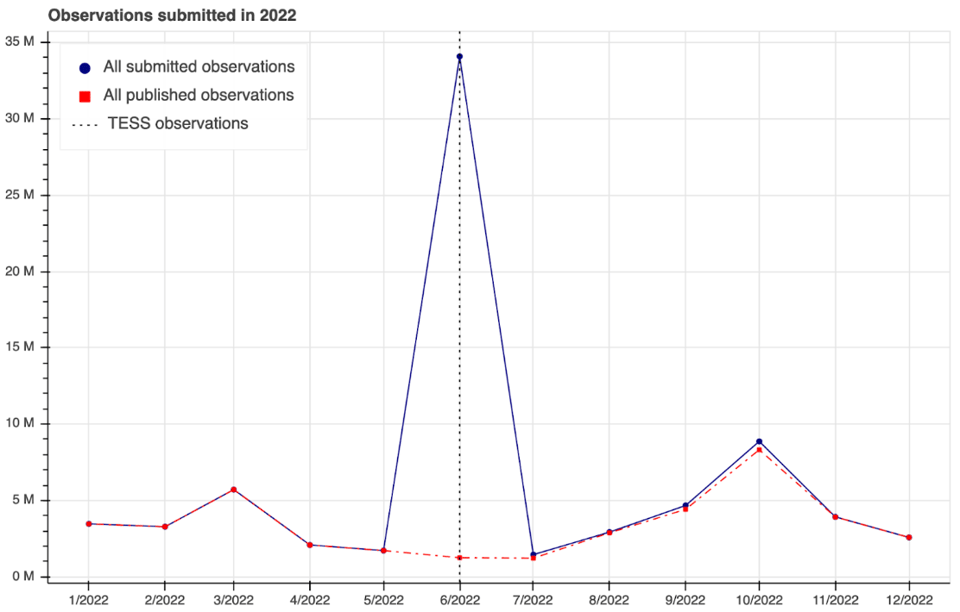
As of today, the MPC database contains a total of more than 376 million published observations. This includes observations of minor planets, comets and natural satellites. More than 9 million of those observations are part of the so-called Isolated-Tracklet File (ITF), which contains all the observations that we could not link to any known object. In 2022 alone, we received almost 75 million observations.
The observations are stored in a PSQL database table that is available for replication through the Small Bodies Node (SBN). More details about the replication can be found on the SBN StatusDB web page and on the corresponding SBN Wiki Page. Additional tables, such as the orbit table, will be soon added for replication.
Stacking images
If you are stacking images, remember that the stacks have to be independent. As such, individual image-frames cannot be used in more than one stack. Please do not submit astrometry to the MPC in which images have been reused in multiple stacks.
What happens when we receive many observations of the same object from the same observatory?
As a general rule, when pursuing high precision astrometry, it is preferable to obtain small quantities of deep, high SNR data. As such, the MPC typically recommends taking a few observations over a period of an hour or so per object, per night. Additional astrometric positions are typically not helpful for the determination of the orbit. However, we recognize that there might be cases in which more observations are needed, e.g. for photometric purposes, or for an object during a close encounter with the Earth. Even though the MPC always encourages the acquisition of high quality astrometry, we emphasize that it is not our place to discard large numbers of observations when they get sent to us. There will be cases in which objects are going to have hundreds of published astrometric and photometric measurements. While the MPC already de-weights these measurements for our orbit fits, it is up to the end user to decide what they want to do with them.
3. The Identification Pipeline
The MPC uses the term identification to refer to the situation when two or more designated orbits are discovered to be the same underlying object and hence an identification is made between their designations. There are different types of possible identifications:
ITF-to-ITF: different tracklets in the ITF are linked together to form a new object;
ITF-to-DES: tracklets from ITF are added to a known designation;
DES-to-DES: two designations are linked together;
NEOCP-to-NEOCP: different objects on the NEOCP are linked together;
NEOCP-to-DES: an object on the NEOCP is linked to a known designated object;
ITF-to-NEOCP: tracklets from ITF are added to NEOCP objects.
Who can submit an identification and what are the rules?
Identifications can be directly submitted by our end users following the procedures described on our website (N.B. Our internal pipelines also use the same service to assess and verify potential identifications). Irrespective of who submitted the identification (external user or internal pipeline), the data then flows through the same identification pipeline and all the identifications are subject to the same process of validation-via-orbit-fitting. We have recently updated our documentation, including some additional information on the identification pipeline and the recent upgrades to the pipeline to allow submission of comets and natural satellite identifications (for manual processing only). A summary of the 2022 identification submissions can be found at this link.
4. What's New?
This section includes major highlights from the past months and some new developments that will be available very soon, at least in beta versions.
Observations removed from circulation
A new data file is now available containing a list of all observations that have been removed from circulation since the most recent version of the MPC Circular. This includes any observations that will be formally deleted in the following Circular, but also observations removed from the ITF (but not linked with an object), published in an MPEC but then deleted, and those that were marked as “pending” publication in our database but removed before publication occurred. A list of observation status codes is also now available to indicate the reason the observation was removed. The file is updated daily in conjunction with the DOU.
TESS observations (observatory code C57)
Since the week of Feb 20, 2023, the MPC has begun publishing minor planet observations taken by the TESS spacecraft. The data includes more than 30 million observations for 65,000 objects (a small fraction of which are NEOs), and spans from 2018 - 2023. The MPC is commencing with the publication of data from 2018 - 2020 that were taken at a 30-minute cadence. At the time of writing, the orbits of 227 numbered NEAs and a few thousand MBAs have been published, and more will follow in the coming days and weeks.
N.B. TESS observations fell into the category discussed above, in which every object is going to have hundreds of astrometric and photometric measurements. The MPC already de-weights these measurements for the purpose of orbit fitting, and we leave it up to the end users to decide how they want to handle these observations.
More website improvements
We are continuing to work on improving our website. Please use Jira to contact us for any issue or suggestion.
Add a comment: