
Newsletter - December 2023
2023 DECEMBER 01
MPC Wrapped
Our year in review.
1. Observations
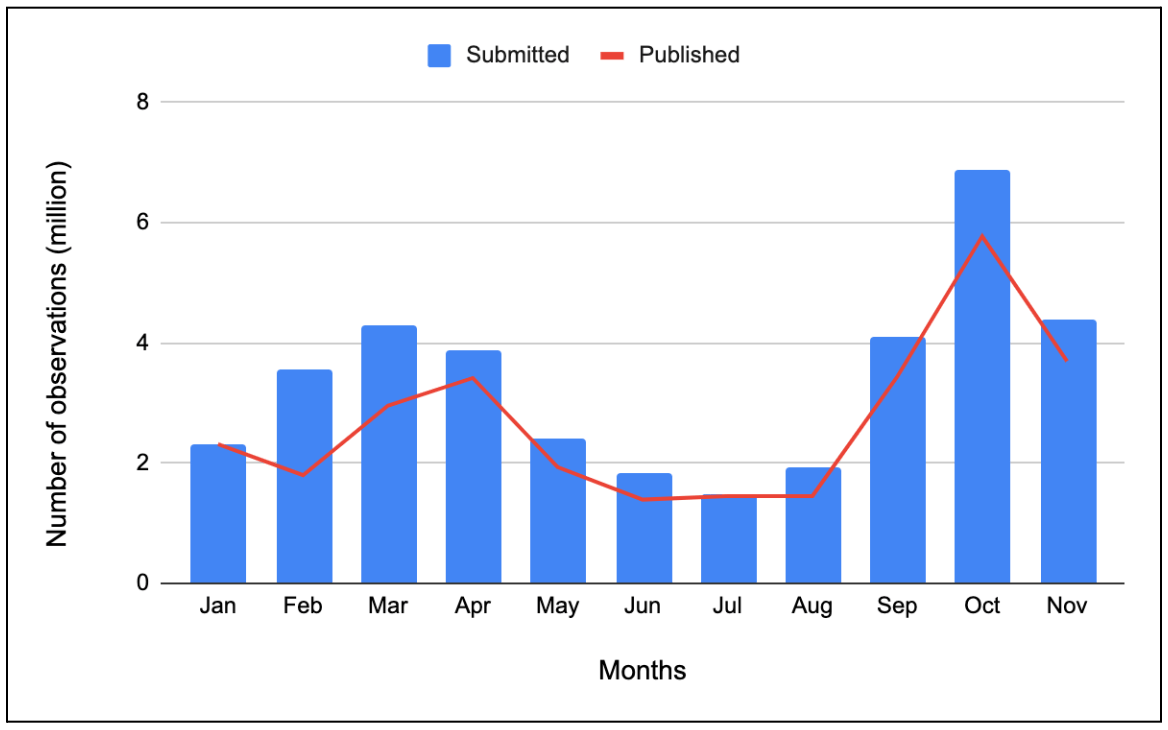
As of November 26, 2023 the MPC received a total of 37 million observations in 2023. Among those, 30 million have been published or sent to ITF, the other 7 million have been deleted for different reasons, such as poor quality or problems in the submissions. This brings the total number of observations available from the MPC database to 422 million.
If you want to know more about how the MPC receives and publishes the observations, please check out our Newsletters from March 2023, May 2023, and September 2023.
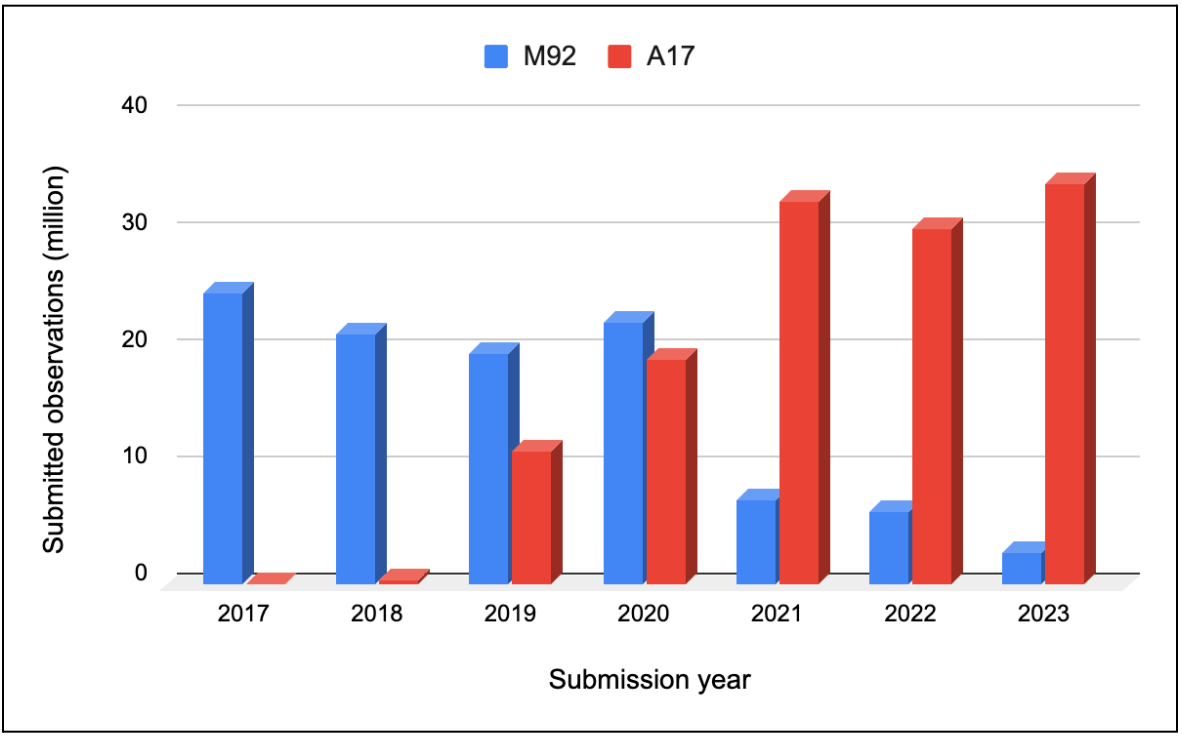
An updated version of the histogram from our August 2023 Newsletter (Figure 2) shows that the majority of observations have been sent to MPC in ADES 2017 format. We also note that the number of observations sent in the MPC1992 format (obs80-columns) is decreasing every year. We want to thank the observers for their efforts in using the ADES format as we strongly believe that a wider use of the ADES format will produce larger benefits for both the observers and the orbit computing centers.
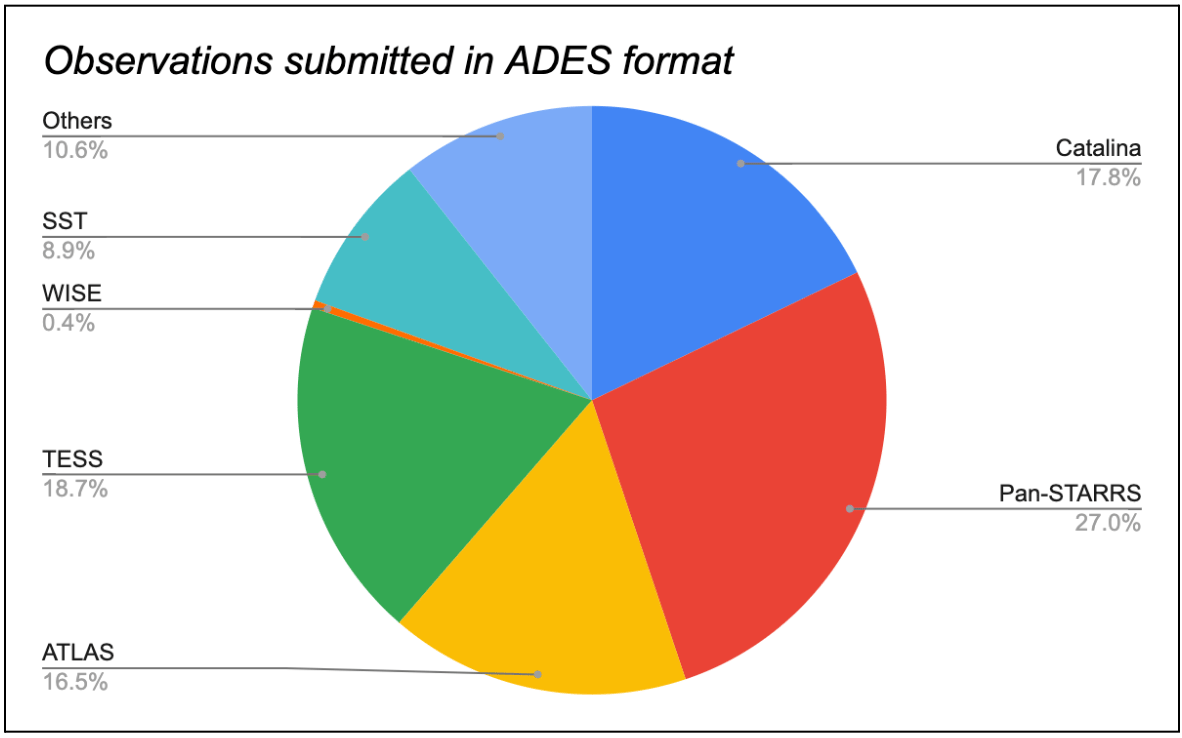
We have also recreated a pie chart similar to the one published in our August 2023 Newsletter. This time we only focused on the observations submitted in 2023 in ADES format, and the percentage of the observations submitted by some of the largest surveys.
2. NEO Confirmation Page
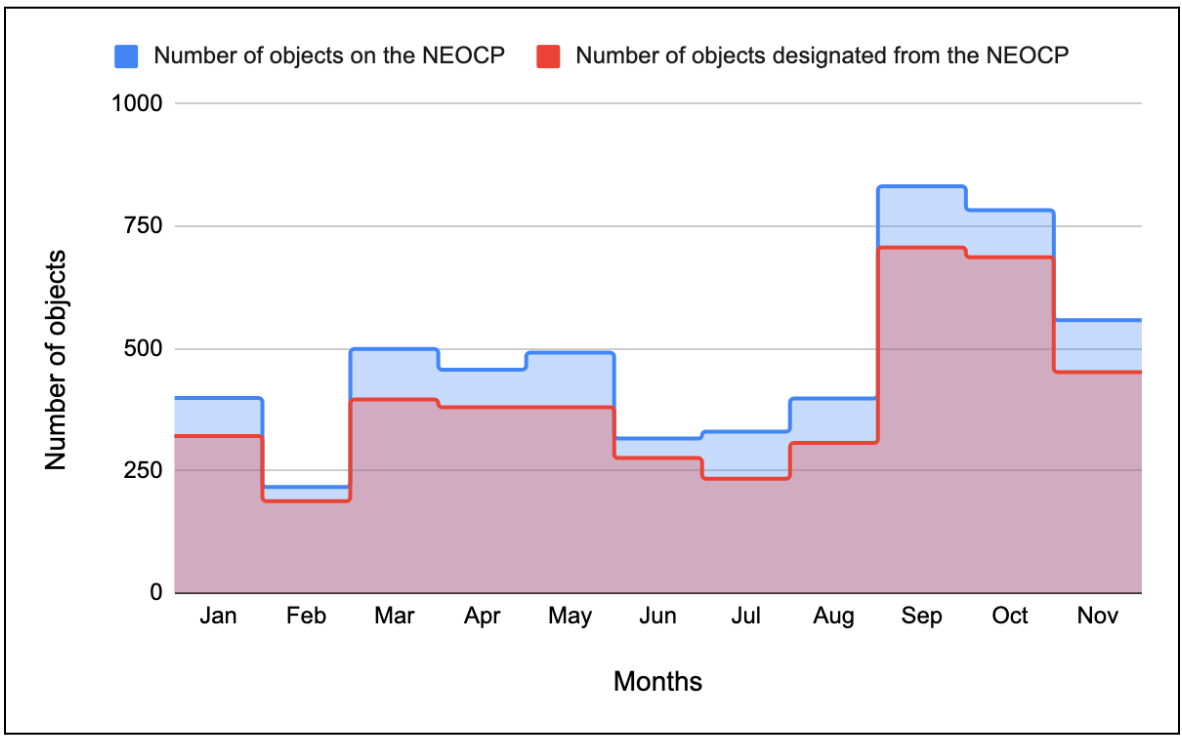
The NEO Confirmation Page (NEOCP) gives access to ephemerides for newly-discovered fast-moving (or other unusual) objects in need of confirmation. The objects listed there have not yet received official provisional designations from the Minor Planet Center; such objects are referenced by their temporary designations. As of November 27, 2023, 5281 objects have landed on the NEOCP, with a mean of 480 objects per month and a few peaks with over 700 objects per month. Among those objects, 4328 have been designated ( a mean of 393 objects per month). The statistics refers to all the designated objects, and this includes Near-Earth Objects, Comets and Main Belt Asteroids. The designations can be done manually by MPC staff members or automatically by our new code for NEOCP Automatic Processing (NAP, see our April 2023 Newsletter). All the criteria for removing objects from the NEOCP are described in the NEOCP Notes webpage.
2023 CX1: the impactor
Among the reported NEOCP objects, at 20:18:07 UTC on February 12, 2023, Krisztián Sárneczky, a Hungarian astronomer, reported a new NEOCP candidate observed at GINOP-KHK (observatory code K88). The object impacted with the Earth’s atmosphere around 03:00 UTC on February 13, near the coast of Normandy, France. The object was designated as 2023 CX1. For more information on this particular object, please see our March 2023 Newsletter.
Close approaches
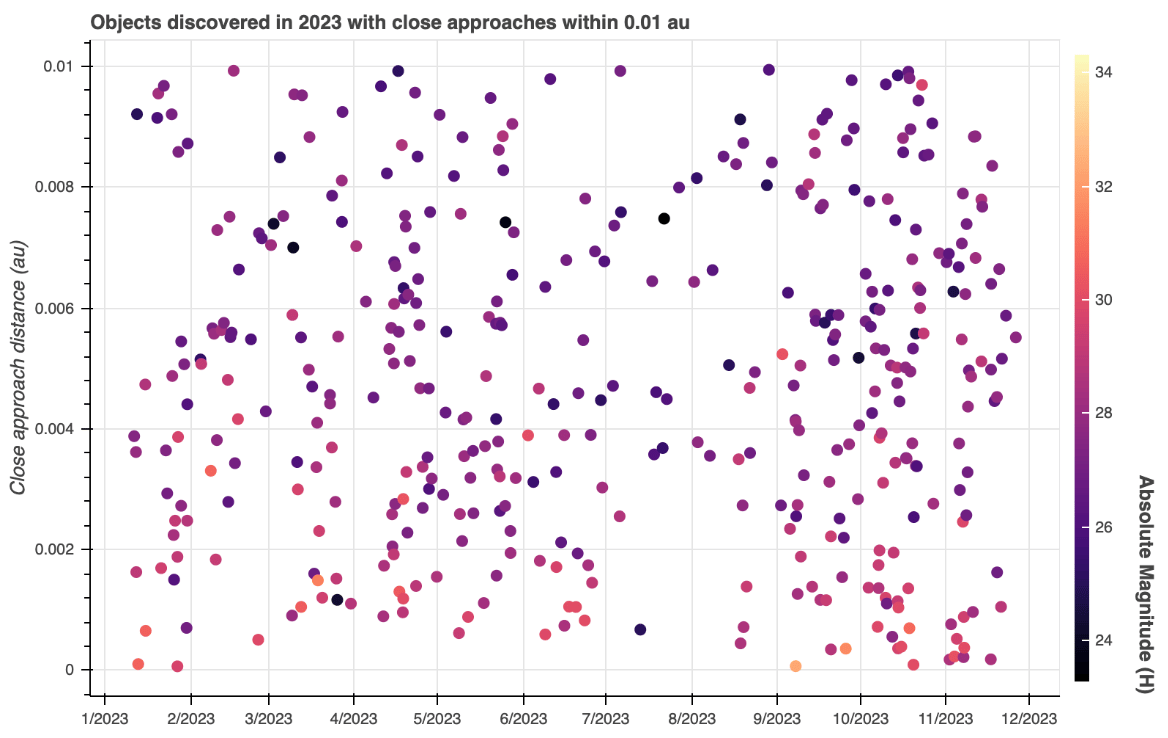
Almost 10% of the objects that ended up on the NEOCP have had a close approach with the Earth within 0.01 au. A few objects, such as 2023 RS and 2023 BU, have had a really close approach with the Earth at less than 0.0001 au, in September and January 2023, respectively. Figure 5 shows when and at what distance those objects have had a close approach with the Earth. The color code represents the absolute magnitude of the objects. As a feature of our observing capabilities, smaller objects are discovered during their close encounters.
We always encourage the observers to prioritize quality over quantity when observing, but especially in cases of very close encounters, when the observation could be affected by timing errors.
3. Identifications
The MPC uses the term “identifications” to refer to the situations when (a) Two or more tracklets are discovered to be the same underlying object and hence a new designation is created (ITF-to-ITF); (b) A tracklet is discovered to be the same underlying object as an existing designated object or of a NEOCP object (ITF-to-DES or ITF-to-NEOCP); (c) Two or more designated orbits are discovered to be the same underlying object and hence an identification is made between their designations (DES-to-DES); (d) Two or more objects on the NEOCP are linked together (NEOCP-to-NEOCP). More information about how to submit identifications to the MPC is available on our website. Every year, we create a report of all the identifications that have been submitted to MPC, accepted by our pipeline, and then published.
For this year, the total number of distinct submissions that we have received is 115,396. Among those:
ITF-to-ITF counts 67,676 linkages: different tracklets in the ITF were linked together to form a new object. The five major contributors are listed in the Table below:
Name | Number of linkages |
|---|---|
A. Doppler | 42,656 |
R. Weryk | 9,370 |
P. Veres (MPC) | 8,201 |
D. Rankin, D. Bamberger, B. Gray | 3,315 |
O. Rodrigues, G. Gronchi, G. Bau, R. Jedicke | 2,000 |
ITF-to-DES counts 42,176 linkages: tracklets from ITF are added to a known designation. The five major contributors are listed in the Table below:
Name | Number of linkages |
|---|---|
A. Doppler | 27,756 |
P. VanWyler | 6,647 |
R. Weryk | 4,651 |
A. Lowe | 969 |
MPC | 855 |
DES-to-DES counts 2,871 linkages: two designations are linked together. The five major contributors are listed in the Table below:
Name | Number of linkages |
|---|---|
A. Doppler | 1,532 |
P. VanWyler | 1,024 |
R. Weryk | 200 |
F. Manca | 70 |
A. Lowe | 26 |
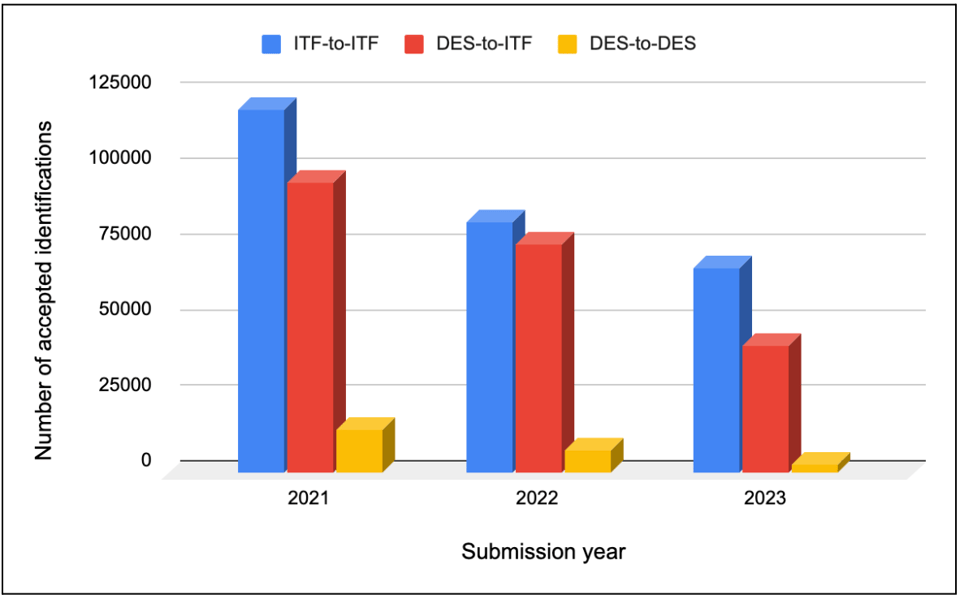
Figure 6 shows the total number of identifications submitted and consequently accepted by the MPC over the last three years. 2021 is the year in which the identification pipeline was developed. The total number of submissions went down from 230,695 submissions in 2021 to 166,155 in 2022 and 115,396 in 2023. The trend in Fig. 6 definitely represents a good sign, because it means that:
We are removing from the Isolated Tracklet File (ITF) the tracklets that can be associated with known objects or linked together;
The MPC orbit database contains fewer objects that need to be linked together, meaning that our attribution and linking algorithm that is used when we first analyze submitted observations is working well.
More statistics that also include NEOCP linkages are available on our website: 2023 - 2022 - 2021.
We’d like to thank all the users who have contributed to these great results and are helping us with their submissions.
4. Recovery Page
The recovery page provides new unpublished observations of NEOs (q<1.3 AU) and TNOs (distant objects, q>5.6 AU) that are extending the arc from one opposition to multiple oppositions. Once new observations provide at least two distinct nights on the second apparition, a recovery MPEC will be issued and observations will be removed from this page. The NEO part is automated and issues MPECs daily at 14:00 UT. More information can be found on the Recovery Page.
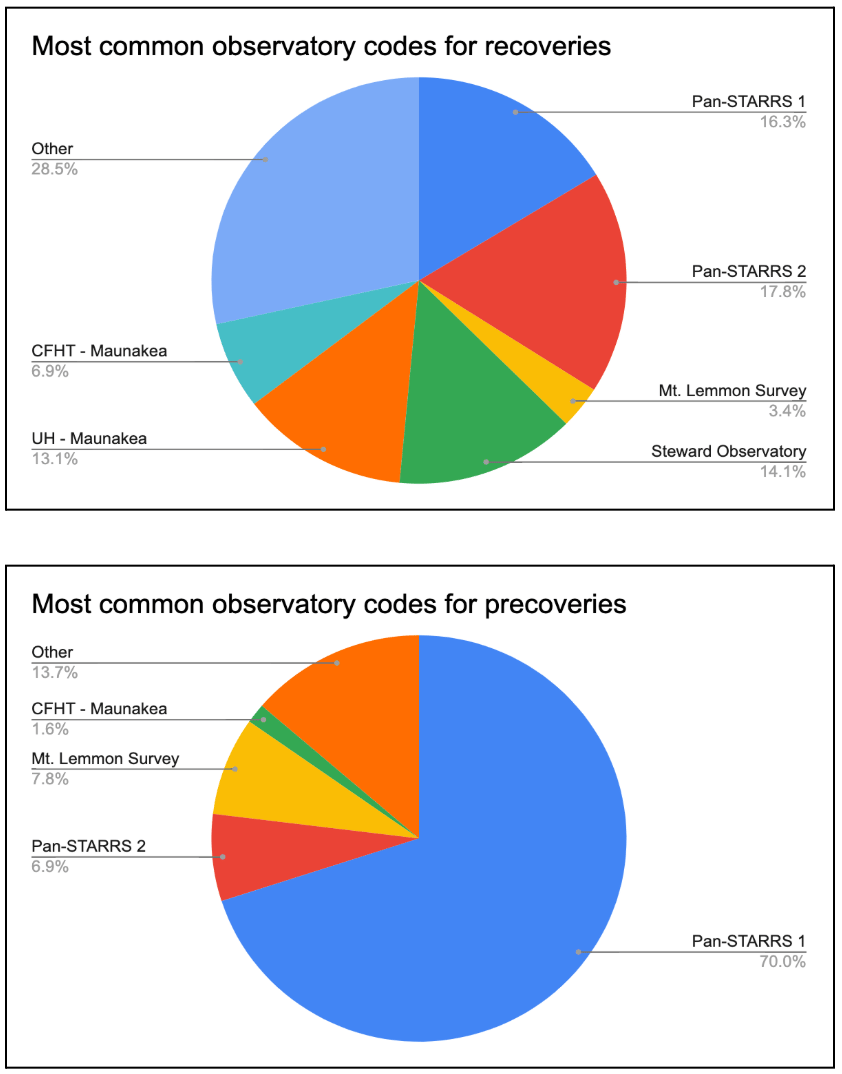
Observations linked to the object on the recovery page can be of two different type:
The observations can have dates that come before the discovery date of the object itself, on a previous apparition (e.g. they come from archival searches). In this case we refer to them as ‘precoveries’.
The observations can have dates that follow the date of the discovery (on a following apparition). In this case we refer to them as ‘recoveries’.
Since December 2021, 734 NEOs have had a recovery MPEC issued by the automated recovery pipeline. Please note that the term ‘recovery MPEC’ includes both recovery and precovery observations.
5. What else?
We have designated and announced 63 new natural satellites of Saturn. Saturn now has the most known natural satellites with 146 known natural satellites, 122 of which are irregular satellites. (June 2023 Newsletter). Keep these numbers in mind, they might turn out to be useful in case you are playing trivia games over the holidays!
We have developed and made available to the community new tools that we hope might be helpful to navigate through our data:
The summary WAMO - SWAMO (see our April 2023 Newsletter)
The orbit comparison tool (see our May, July and October 2023 Newsletters)
We defined a new schema for the packed provisional designations (all the information is in the October 2023 Newsletter).
We have tried to improve our documentation and we are consistently working on that. We are also trying to better explain the processes that take place at the MPC and how we handle all the different data that we receive (see our Newsletters; almost every one of them contains explanations on how to use pieces of our data products).
We are now able to ingest observations in both ADES 2017 and ADES 2022 versions. This was a huge step forward towards the possibility for the users to submit very high precision astrometry, such as the occultations and Gaia data (see our August and November 2023 Newsletters).
We are creating more APIs to facilitate access to our data. One example is given by the API for the WAMO service (see our October 2023 Newsletter).
The MPC is continuously working to improve our current services and to create new ones using new available technologies. We're also staying focused on the upcoming surveys that will likely transform how we approach working with the data. We at the MPC are very excited about being able to host such data and we look forward to the community being able to use them in the easiest way possible.
We wish you all happy holidays and the best for the new year!
Add a comment: