
Newsletter - March 2024
2024 MARCH 05
In this month’s issue:
MPC Explorer
Observations API
Comets automation
MPC's updated services
1. MPC Explorer
MPC Explorer
In our February 2024 Newsletter, we introduced our MPC Explorer service. The MPC Explorer is intended as a future replacement for our db_search functionality. We have been very happy about all the positive feedback we have received and to see that the service is now widely used.
Following some suggestions we have received via Jira, we have now added the possibility of querying for natural satellites, using either their packed or unpacked designations. This represents the first big difference between the MPC Explorer and db_search: the old db_search functionality does not support natural satellites.
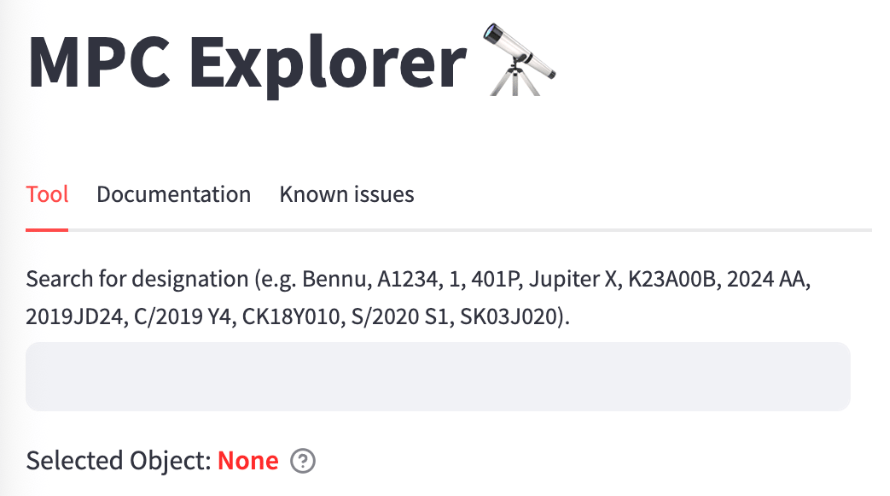
Figure 1 shows that the MPC Explorer main page has now three different tabs:
The Tool tab (we may change this name in the future) represents the main search page. The box allows the users to search for any designations and the data returned are given in the Designation and Observations tabs.
The Documentation tab contains some of the useful information about the data returned. Please see the subsection Documentation page for more information.
The Known issues tab has been recently added to include all the (MPC) known issues about inconsistencies in the PostgreSQL observations table. The same problems apply to the replicated obs_sbn table. Please see the subsection Known issues for more information.
Documentation page
The MPC Explorer has also a documentation page that explains the content of the data available in the Designation and Observations tabs. In the same page we have also tried to collect some useful information about ADES related allowed lists of values. The page is still a work in progress, but we hope it represents a good step forward towards a more uniform and consistent type of documentation. As we already mentioned several times, our goal is to make our website more user friendly and easy to use.
Known issues
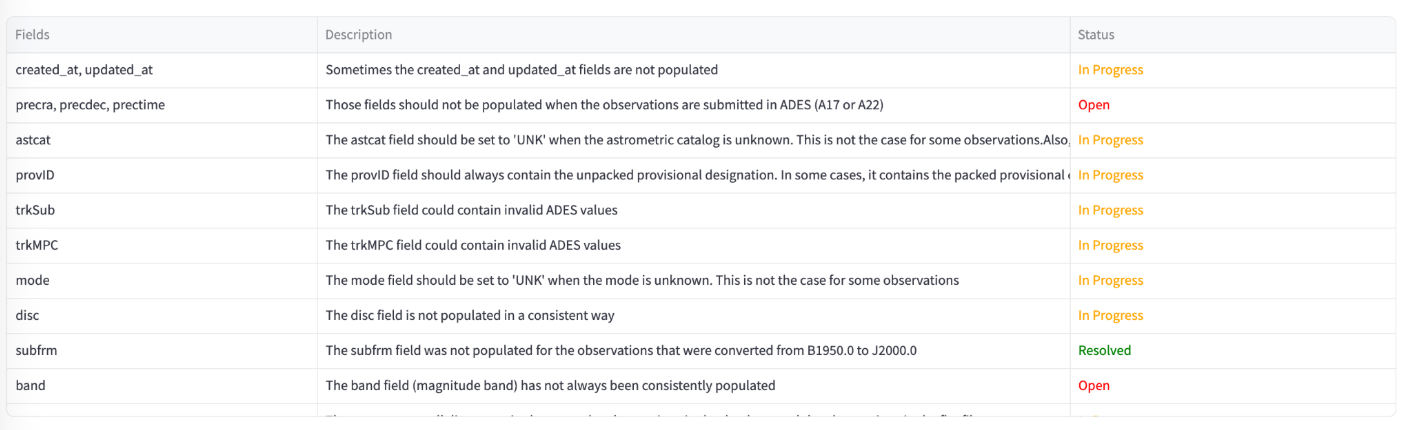
Those of you that are using both the MPC Explorer and the replicated copy of our PostgreSQL table may have noticed some small discrepancies. This is because we are still in the process of removing some inconsistencies from our observation table. We would like to stress that the number of discrepancies is very small with regards to the total number of observations (now more than 400 million). The list of known discrepancies that we are working to resolve is listed in the Known issues tab of the MPC Explorer. The page includes two different tables:
The first table (Fig. 2) collects the known issues. Each issue is described with the name of the fields that are affected, a short description of the problem and its status. Open means that we know that the problem exists but we haven’t started working on it; In Progress means that we are currently working on the issue; and Resolved means that the issue has been completely resolved.
The second table (Fig. 3) is related to ADES consistency checks. When we create ADES files, we do so using version 2022. However, a small number of old submissions contained values that are invalid under ADES 2022. We will not alter their values in our database, because this would involve changing the original submission, but instead we have added additional checks to the MPC Explorer to ensure that the XML file produced by the service will validate under ADES. The second table contains the fields affected by these problems and a brief explanation of the issue. If you are using your own replicated copy of our PostgreSQL table and you want to recreate your own valid ADES files, we encourage you to carefully review the Known issues section and to ask questions if something is not clear.

While working on the data validation, we have noticed that there are observers that are still submitting observations without specifying the stellar catalog used for the astrometric reduction. We know that this is allowed by the 80-column format, but we strongly encourage you not to do that and to always report the astrometric catalog: it represents fundamental information used by the orbit computer centers. Also, please make the effort to start submitting the observations using the ADES format.
2. Observations API
The MPC Explorer is completely API driven, and we have been working to make the underlying APIs public. In February 2024, we presented our designation-identifier API. We are now very excited to introduce you to our new Observations API.
At present, you can search for any single permanent or provisional (primary or secondary) designation: both packed and unpacked formats are supported. In the future we may relax the single designation restriction to allow users to query limited lists of designations.
The default output format is XML, but you can also request observations in MPC1992 80-column format, as well as in a JSON format containing a dataframe of either ADES or 80-column format data. Multiple formats can also be requested with a single query by providing a list of formats.
Check the documentation for more information and examples of how to use the API.
Please, query responsibly! And let us know if you have any issues with the API.
3. Moving towards Automated processing of New Comets
Increased numbers of reported Comets
As the number of reported comets per day has increased dramatically, the previous manual processing of comets requires significant resources at the MPC. This can also result in delays in announcing or publishing comets around busy periods of time for the MPC or the IAU Working group on Small Body Nomenclature, which decides on comet names. It is our goal to automate a significant fraction of the processing and publication of MPECs announcing new comet discoveries, starting with simpler cases and increasing the fraction of automatically processed objects over time, as has been done for NEOCP objects. Undertaking this automation will require that the MPC implement a number of changes over the coming months, commencing with the standardization of comet MPEC components.
Standardizing MPEC Components
Currently, the information at the start of comet MPECs describing the comet reports is parsed and revised manually by MPC staff members. This includes the tail and coma report table. There are benefits to automatically parsing this information, particularly that it will eliminate the possibility of human error and omission of reports. An important side effect, however, will be that the user’s reports will be reproduced exactly as they are reported, not fixed for formatting or scrutinized by staff. We encourage MPC users to keep this in mind as you submit comet reports moving forward. We expect to begin using this automatically parsed version of the comet reports in the next few weeks, but with human validation. If that process reveals no major issues with the automated parsing, we will move to fully automated generation of the activity reports within the next few months.
4. MPC’s updated services
We have been working on updating some of our services.
Recovery page
The MPC has introduced a new subsection on the recovery page. In addition to second apparition NEOs and TNOs, it now includes unnumbered periodic comets observed during their next return. The page provides details such as comet designations, new apparition observations, and the current predicted ephemerides. Unlike NEOs on the recovery page, the processing (including MPECs) of the data for comets is done manually.
Furthermore, concerning second apparition NEOs undergoing automated processing and publication from the recovery page, we have refined the definition of a night for automated publication. A minimum requirement of at least two detection tracklets is now essential for the night to be considered distinct. MPC emphasizes that single positions remain exceptions, and we encourage observers to report tracklets comprising at least two detections, revealing the motion vector.
New rule added for the identifications pipeline
The Identification Pipeline has been supporting the community since May 2020, processing nearly 750,000 linkages to date. MPC is introducing a new rule for new multi-opposition linkages identified as new orbits in the ITF (ITF-to-ITF). The objective is to eliminate linkages with a limited number of nights per apparition, as linkages supported by multiple single-night apparitions may be false. The new rule mandates at least two multi-night apparitions or at least one three-night apparition in new multi-apparition ITF-to-ITF linkages. The documentation has been updated accordingly.
Orbit comparison Tool
We are always very pleased to see when our tools receive favorable feedback from the community and to receive suggestions for new features.
In the case of the orbit comparison tool:
We have just included the Mars Crossers in the total sample of objects;
We have added the ability to select threshold values for the comparison and third axis parameters. Please Note that objects with no reported magnitude data are assigned an H magnitude of 99.99.
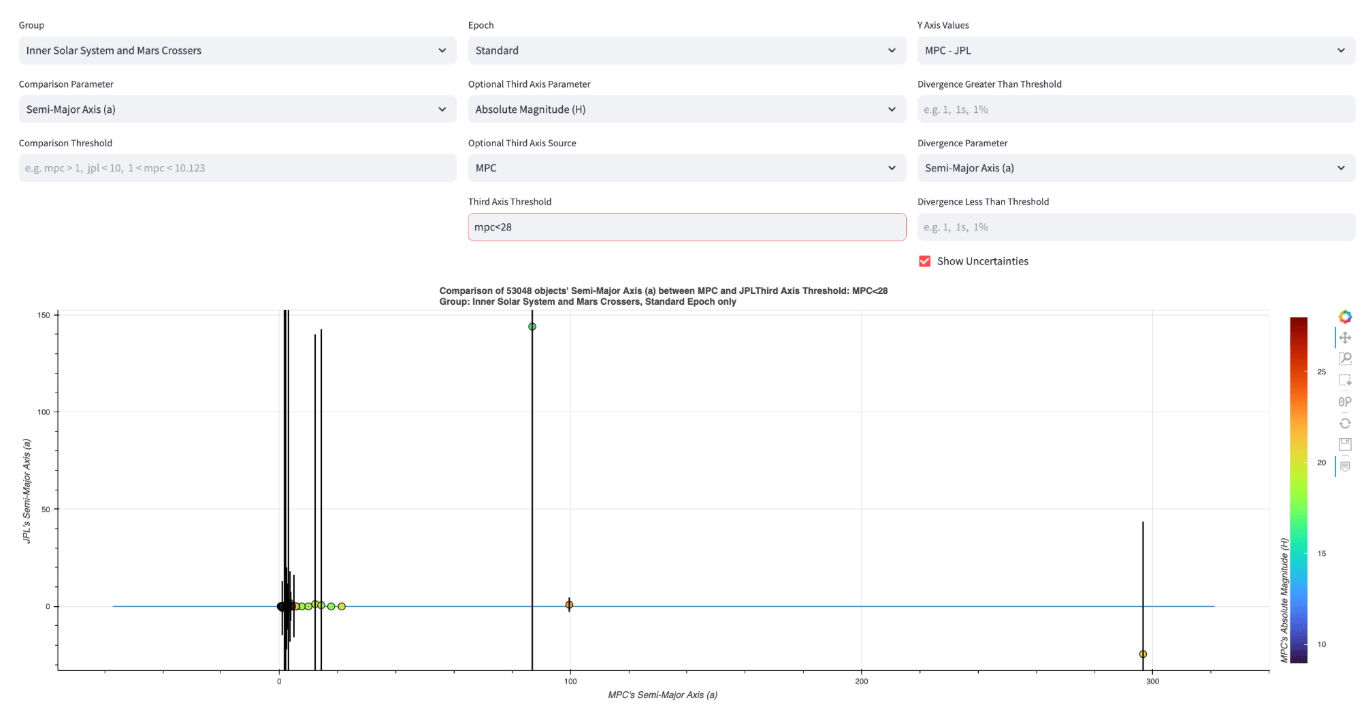
Figure 4 shows an example of a possible request for the orbit comparison tool, where the user can ask for all the NEOs and Mars Crossers and they can also add a threshold on the third axis (in the case we are asking to see all the objects with MPC absolute magnitude less than 28).
Add a comment: