
Newsletter - July 2024
2024 JULY 31
In this month’s issue:
A new addition to the MPC Explorer
Switching website host server
Recent problems with MPChecker
Thank you, Chris!
1. A new addition to the MPC Explorer
NEOCP observations now available
The MPC Explorer is our service intended as a future replacement for the db_search functionalities. We plan for the MPC Explorer to include all the information about observations, orbits, statistics, discovery and ephemerides for every single object in our database (minor planets, comets and natural satellites). Prior to this announcement, the Explorer contained information about designations and observations for already designated objects (see MPC February 2024 and March 2024 Newsletters). N.B. All the data available through the MPC Explorer are also accessible via dedicated APIs (Designation Identifier and Observations).
We are excited to present you with our latest additions: NEOCP observations (Fig. 1).
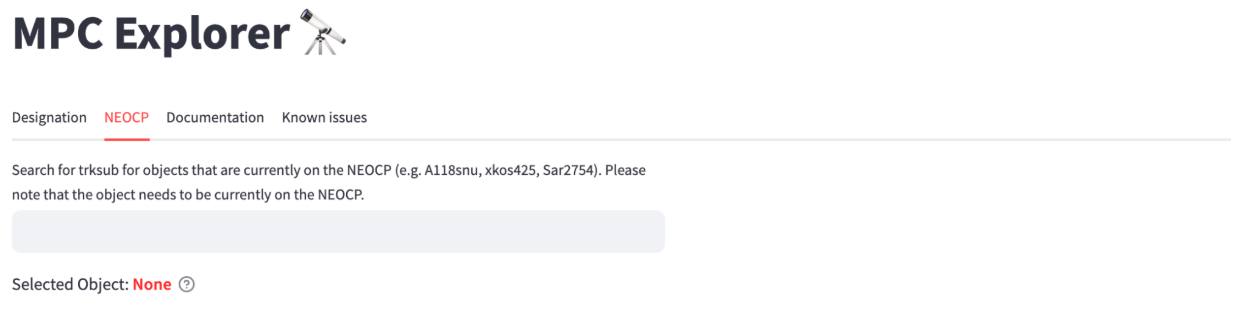
It is now possible to use the MPC Explorer to retrieve observations for objects that are currently on the NEO Confirmation Page.
What to expect?
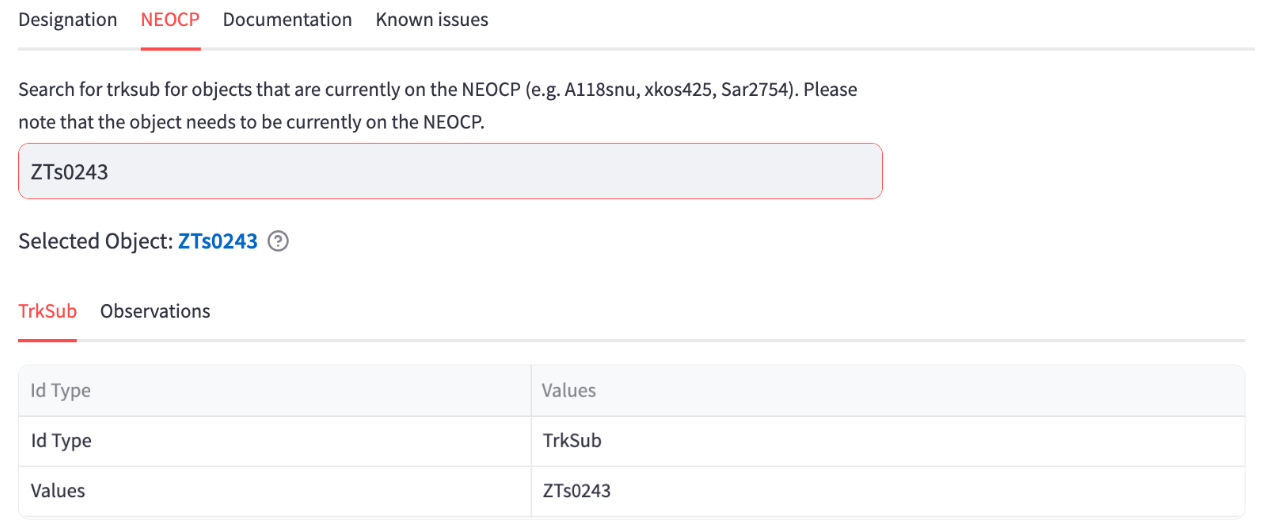
If the object is currently on the NEOCP, the MPC Explorer will return the requested trksub in the TrkSub tab (see Fig. 2).
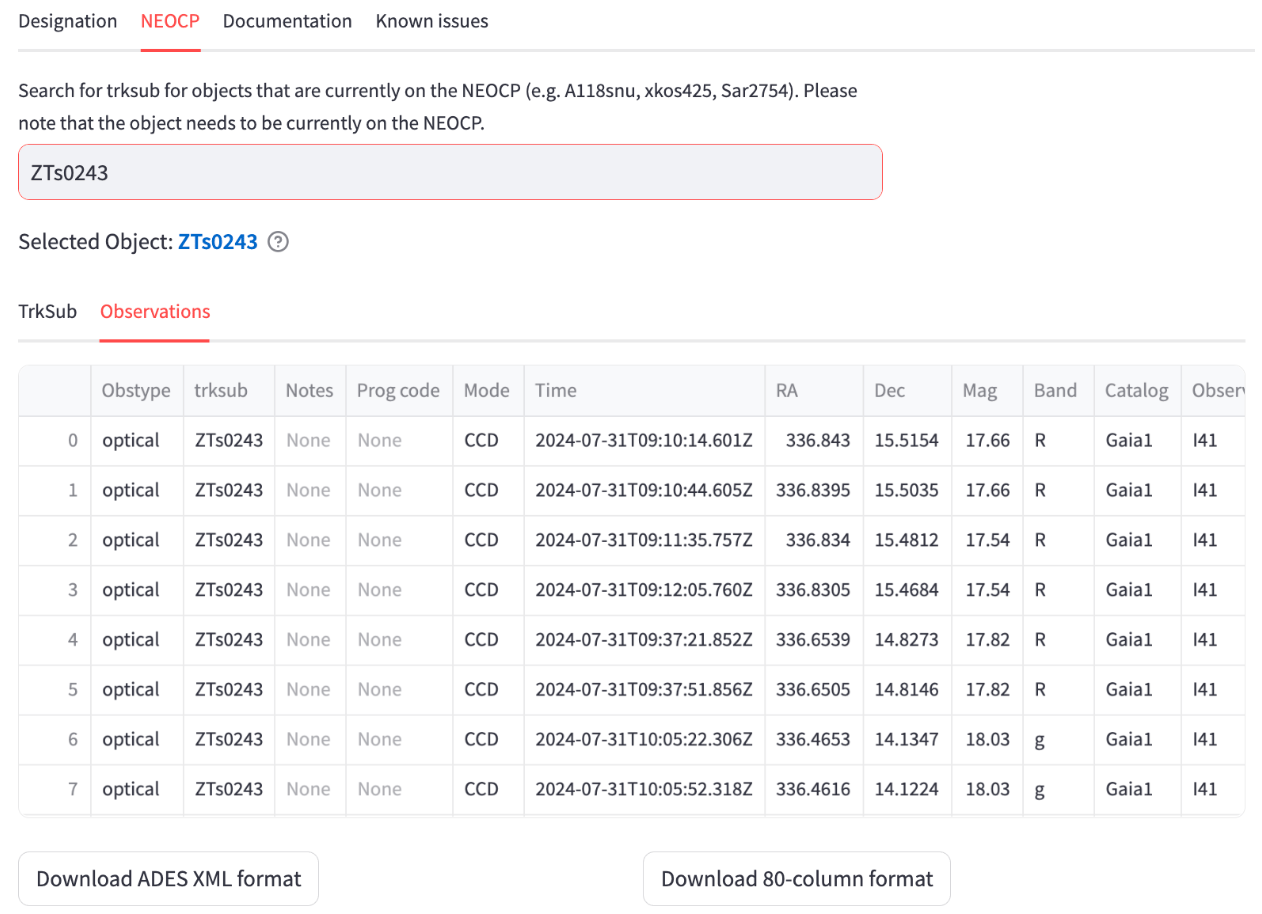
The Observations tab returns all the observations that are currently associated with the requested NEOCP object (see Fig. 3). The observations format is the same as that already available via Designation searches. And, as in the designation case, the format can be downloaded in both ADES XML and MPC-1992 80-column format.
If the object is currently not on the NEOCP, the MPC Explorer won’t return any observations associated with the object. This is also true in the case of objects that were recently designated.
NEOCP Observations API
The NEOCP observations available through the MPC Explorer are also accessible using the new NEOCP Observations API. The documentation is already available on the MPC Documentation Page and it is also easily accessible via the Documentation tab on the MPC Explorer.
As in previous cases, the NEOCP Observations API is a REST endpoint: you can use your language of choice to send GET requests to the following URL:
https://data.minorplanetcenter.net/api/get-obs-neocp
At the moment you can search for any single trksub currently available on the NEOCP. For further information or examples, please check our documentation.
We always appreciate any feedback and suggestions.
2. Switching website host server
Over the past week, the MPC has been in the process of replacing the server that hosts our website. In preparation, we performed multiple tests to ensure that the possible disruption to current services caused by the switch between the two servers was minimum.
We had planned to fully switch to the new server during the last week of July (July 29th - Aug 2nd). The actual switch happened on Wednesday July 31st.
While we didn’t envisage major disruptions, we still experienced some issues. Here in after there’s a short summary of everything that has been fixed in the last couple of days:
Many of you might have received multiple copies of ACK emails that were already sent. Please ignore those emails. Our processing scripts picked up again some old observations that were already processed. As a consequence, for a very short period of time, some old objects ended up on the NEOCP again. We have cleaned everything up and we have been monitoring both submissions and processing. Everything seems to be working fine on our side.
The configuration of the two services is slightly different and this created some issues with the SSL certificates for both www.minorplanetcenter.net and www.minorplanetcenter.org. While the problem is resolved for www.minorplanetcenter.net, we are still working on the certificate for www.minorplanetcenter.org.
A few web services briefly stopped working, mostly due to some permissions that changed during the switch over. This problem affected in particular the creation of the uncertainty maps, the creation of ADES XML files on the NEOCP page, the comet activity and the pointing reports.
MPChecker experienced an unusual amount of requests, requiring us to pause the service for the night to be able to set up an internal script blocking all the unreasonable requests (see below for further details). Now everything is back to normal.
We believe that all the necessary data have been copied over to the new server, including the databases. Please let us know if you notice that something is missing. This may include data for the db_search, MPChecker, the Ephemeris Service, the NEA Planning Aid. All the new APIs run from a different server and they were not affected by this switch.
If needed, more information is also available on the MPC Status page. Please keep informing us if you are still experiencing any new issues in the next few days/weeks.
3. Recent problems with MPChecker
The MPC recently experienced issues with the main website. Commencing Saturday July 27, 2024 the MPC was hit by a large number of queries from thousands of different IP addresses requesting very similar and very specific checks using MPChecker. While we already had checks in place to stop some fraction of these queries, the performance of the server hosting the website degraded over the night. As a result, we took MPChecker offline for a day in order to improve our checks and make them more strict.
The same happened when we switched over to the new server. MPChecker is now back online and everything is working as expected. While working on it, we have also reported the issues on the MPC Status Page. Please let us know if you are still experiencing any issues.
4. Thank you, Chris!
Chris Moriarty is the MPC Technical manager. He joined us in October 2021.
Chris received a B.S and M.S in Computer Engineering from the University of Central Florida in 2005 and 2007, respectively, with graduate research in artificial intelligence. He has been working as a professional software engineer since 2007, with industry experience in both the corporate and small business worlds. He made a transition to astronomy in 2012, taking a Senior Systems Software Engineer position at the Space Telescope Science Institute, gaining a deep understanding of continuous integration, systems engineering, integration and testing and project management. He brought these skills to the Smithsonian Astrophysical Observatory in 2018, where he led the software development efforts at the Submillimeter Array, and put in place new project management processes for all aspects of development, engineering and maintenance for the observatory.
At the MPC, Chris led the development and design of our new software, including but not limited to the new data.minorplanetcenter.net subdomain, our GitHub repository (internal and public), and our new APIs. In the last months, Chris focused his work on virtualizing the MPC, creating a completely new infrastructure of physical and virtual machines that will be part of the MPC internal cloud system.
Chris has recently decided to step out from his Technical Manager role to pursue other dreams, but he will keep working part-time with the MPC as an external contractor.
The whole MPC is very thankful to Chris for the technical skills that he brought to us, for his patience while teaching academics how to properly code and write unit tests and for how he helped the MPC step out of our comfort zone and explore a better version of software development.
For this and for a lot more:
Thank you, Chris!
Add a comment: