
Newsletter - August 2024
2024 AUGUST 30
In this month’s issue:
- Documentation updates!
- Identification pipeline updates
- Switching website host server updates
- Meetings
1. Documentation updates!
There’s a new Section in the Documentation Page
The Documentation page now contains a new Section called “MPC Guide to Minor Planet Astrometry”. The goal of this section is to collect all the information on how submissions and processing of observations work. At present, the information is available on the website, but very scattered throughout different sections. It will take some time to collect all the different pages, but if you have any requests for pages that you’d like to see appearing on the new Section sooner rather than later, please let us know.
How to request an observatory code
Observatory codes are intended for "permanent" (repeated usage) observing sites. It is not necessary that your telescope is associated with any existing building in order to apply for an observatory code; setting up your portable telescope in your backyard is permanent enough to obtain an observatory code from the MPC. We encourage all observers to apply for an observatory code.
To facilitate the application for an observatory code, we have modified our form. Now all the requests arrive to the MPC via the Jira helpdesk, where the tickets get automatically assigned to the staff members.
We have also updated our documentation for how to obtain an observatory code, with the goal of making it more clear.
To apply for an observatory code, the user must complete the following tasks (preferably on the same day or very close in time):
- Complete and submit the new Observatory Code Request Form.
- Submit astrometric measurements to the MPC.
The astrometric measurements need to satisfy the following criteria:
- Astrometric measurements must be submitted for at least seven numbered minor planets (one of which needs to be a Near-Earth Asteroid);
- All the objects need to be fainter than magnitude 14;
- Every object must be observed on two different nights with three to five observations per object (please do not report single submissions in a night because they will be automatically rejected);
- At least one observation per object per night needs to include photometric measurements;
Please use ‘XXX’ as station code when you submit measurements to obtain an observatory code (do not use any other code). The position of your telescope needs to be included in the header.
Observations can be submitted in the MPC1992 80-column or ADES format. We always encourage our users to always submit observations in ADES format.
A lot more information is now available on our webpage. We have tried to answer all the most common questions and we have tried to include explanations for all the common issues.
If you fail in submitting the request form or the astrometry, an observatory code won’t be assigned. We process submissions in batches, usually once per week. Please keep in mind that you can always use the same Jira ticket that has been opened with your request to ask for clarification or for any comments. The MPC will use the same ticket to ask questions or for more data, if needed, and to reply to you with your new observatory code when/if it is assigned. Therefore make sure that this email does not go in your spam filter.
How to submit astrometry to the MPC using Tycho Tracker
Tycho Tracker is a very powerful tool developed by Daniel Parrott to facilitate the detection of moving targets, such as asteroids, comets and variable stars. Thanks to the use of synthetic tracking, Tycho Tracker is able to detect faint moving objects by stacking data from multiple exposures to increase the signal-to-noise ratio (SNR). The MPC now receives an increasing volume of stacked observations obtained using Tycho Tracker, most of which are correct, but a significant minority contain false detections. That is why, in collaboration with the Catalina Sky Survey (CSS) Team, in particular David Rankin and Carson Fuls, we have decided to add a new page to our documentation to try to explain the challenges in using Tycho Tracker and how the users can improve their submissions.
It is important to understand that false detections can be a problem, especially in the case of NEOCP objects. Submitting a single NEOCP false tracklet or a false tracklet for a short-arc designated object can erroneously change the orbit of the object and result in the object being lost.
The most significant issue at the moment concerns the inappropriate use of Tycho Tracker to pull out phantom detections from random noise in sets of images. The best way to avoid this problem is for users to acquire sufficient images to get a good SNR on the object (usually 20 or more) and also for users to dither their images. According to the CSS Team, dithering is absolutely essential when using synthetic tracking as there are many different forms of pattern noise that can be stacked into detections that look a lot like positive signals instead of noise. It also always takes some experience to weed out the noise from the positive detections.
It is important to understand that completely erroneous observations can easily fit to a short discovery arc as long as they fall within the uncertainty range. It is not always true that if the observations fit in FindOrb or similar orbit determination tool, then that it has to be a positive detection: most points within the uncertainty ellipse moving at the right rate of motion will produce a realistic-looking orbit fit.
To avoid the recurrence of these problems, the MPC wants to encourage their users to:
- Not submit marginal or noisy detections, especially if they are discovery tracklets;
- Not use publicly available orbit determination tools as a substitute for a good SNR with high confidence in the reality of the detection.
The SNR should always be such that there isn’t much question if the detection is real or not.
In our June 2024 Newsletter we have introduced the Subcommittee for singletons and archival observations, which is a committee of impartial external experts created to help review individual cases, and to develop policy recommendations for vetting and publishing singletons and archival observations. If you are in doubt about your observations, please ask the MPC for a review.
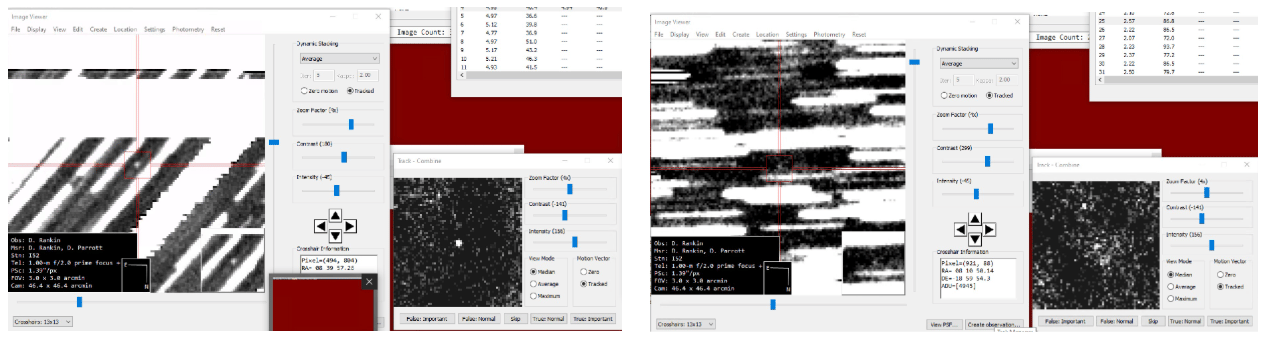
Thanks to David Rankin (CSS), our new web page also includes examples of different detection scenarios: good detections with high SNR, marginal or very noisy detections with low SNR. Figure 1 shows two examples: a very good detection with high SNR and a very noisy detection with low SNR.
2. Identification pipeline updates
The MPC uses the term identification to refer to the situation when two or more designated orbits are discovered to be the same underlying object and hence an identification is made between their designations. There are different types of possible identifications:
- ITF-to-ITF: different tracklets in the ITF are linked together to form a new object;
- ITF-to-DES: tracklets from ITF are added to a known designation;
- DES-to-DES: two designations are linked together;
- NEOCP-to-NEOCP: different objects on the NEOCP are linked together;
- NEOCP-to-DES: an object on the NEOCP is linked to a known designated object;
- ITF-to-NEOCP: tracklets from ITF are added to NEOCP objects.
Identifications can be directly submitted by our end users following the procedures described on our website. Our documentation already contained a description of the pipeline, instructions on how to submit identifications to our pipeline, limitations and the recent upgrades to the pipeline.
We have recently added a new feature for our users. In the case of failures, the identification pipeline can now send an automated message to the user with the reason for the failure.
If you'd like to receive an automated message when your submitted linkage fails in the ID pipeline, please add REPLY_EMAIL in the comment section, and don't forget to submit your email address in the submission header. A list of reasons for failures is listed on our identification page. Please contact us if you have any further questions.
3. Switching website host server updates
On Wednesday, July 31st, 2024, the MPC changed the host of our web server. During and after the switch we experienced some issues that have been promptly reported to the users via email and in the past July 2024 Newsletter.
We have been monitoring the performance of the website in the past month and we can confirm that from our side all the issues seem to have been resolved. Please let us know if you are still experiencing any new issues.
4. Meetings
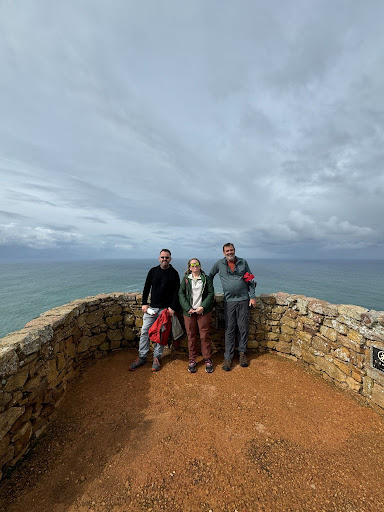
The MPC attended the IAU General Assembly in Cape Town (South Africa) on August 6-15, 2024. In the photo you can see a tag-up meeting between MPC and JPL/CNEOS representatives happening while visiting Cape of Good Hope. In the photo, from left to right: Matthew Payne, Federica Spoto, Steve Chesley. Photo courtesy of Allyson Bieryla (CfA, Harvard and Smithsonian).
Add a comment: