
Newsletter - September 2025
2025 SEPTEMBER 30
In this month’s issue:
Public archives
MPECs in the MPC Explorer
Summary of MPC APIs
1. Public archives
Singletons and Archival submission Committee
In our June 2024 and July 2025 Newsletters, we introduced the Singletons and Archival submission Committee (SARC). The goal of the committee is to help the MPC review some specific submissions, especially singletons and archival observations.
In addition to the six initial members:
Tyler Linder, chair of the committee
Larry Denneau from ATLAS
Joe Masiero from WISE/NEOWISE and NEO Surveyor
Rob Weryk from PanSTARRS
David Rankin from Catalina Sky Survey
Marco Micheli from the ESA NEO Coordination Centre
Two new members are now part of the committee:
Mario Juric from Vera Rubin Observatory / LSST
Steve Chesley from JPL
And experts can always be added on a case-by-case basis.
In the last few months, the Committee has been helping with the implementation of the MPC’s new policy for program codes.
New Program Codes Policy
The Minor Planet Center (MPC) has historically used program codes to identify different observers observing from the same telescope (see our program codes page for further documentation).
As of today, September 30, 2025, the MPC has assigned a total of 2,648 observatory codes (you can use our Observatory Code API to get the current list of Observatory codes). Program codes have been assigned to only 134 observatory codes.
Public archives
Space missions, as well as several major and minor telescopes and surveys have their observations publicly archived by data centers like IRSA, the NASA/IPAC Infrared Science Archive or the PDS Small Bodies Node.
The goal of having public archives is to archive data files with sufficient documentation and ancillary information (e.g. flat fields, instrument parameters, etc.) that the data will be useful, meaningful and accessible to astronomers in future generations.
Public archives have been used throughout the years to find precoveries, which by definition are observations found in images or photographic plates preceding the discovery of the object. Precovery observations are most often found for minor planets, but sometimes they are also found for comets, natural satellites or even stars. Precovery observations are very important for orbit determination, because they can extend the observation arcs from days to years, allowing the orbit computing center to improve the orbit of the objects, the risk analysis if the object has any impact probabilities and the eventual detection of non-gravitational perturbations (e.g. the Yarkovsky effect).
The increase in the scale and accessibility of public data archives in the last few years, as well as in the availability of new software tools to search and extract data from said archives, has significantly lowered the barriers to finding, extracting and submitting archival data to the MPC. While this represents a huge opportunity for the community to better utilize extant data, and for the MPC to improve the orbit catalog, it also presents the MPC and the community with some challenges related to ensuring that the quality of the submitted measurements remains high.
Single measurements can be especially problematic when reported for an opposition for which no other observations are available. These single observations have the power to change the orbits and, especially in the case of objects that are already on the risk lists, they can influence the impact probability computation.
That is the main reason why the MPC and the MPC User Group have decided to create the SARC Committee and to develop an extended use of the program codes.
Program codes
The MPC has collected a list of all the known observatories that have a public archive. The list is available on the SARC webpage. Some of those observatory codes already have assigned program codes.
If you are planning to submit archival observations from one of these archives, please contact the corresponding SARC member before submitting the data to the MPC, even if you already have an assigned program code for that telescope. The SARC member will be able to provide guidance on how to best extract and vet the data, and will also be able to help review the submission before it is sent to the MPC. This process only needs to be completed once, when you first submit your observations. After your submission is approved and a program code has been assigned, you may continue submitting observations as usual.
Please note that the list is not exhaustive, and that other archives may be added in the future as needed. If you are planning to submit archival observations from an archive that is not on this list, please contact the MPC directly for guidance.
Please note that the SARC members volunteer their time to help the community and the MPC, and the time of response may vary depending on the availability of the SARC members. If you need or if you are planning to submit archival observations, please reach out to the corresponding SARC member well in advance of your planned submission date.
In the next few weeks/month, the MPC will assign a program code to every telescope in the list. As a consequence, the use of the note Z to identify the astrometry from a survey reported by a non-survey measurer/pipeline will be deprecated.
If your telescope is part of the list, you’ll be contacted by the MPC and you’ll be asked to provide a contact that you’re going to use at the time of submissions and that we can use for the program code assignment.
If you’re planning to submit archival observations from one of the telescopes, you need to contact the corresponding SARC member. Please note that the submissions of archival observations and singletons is a different process and as such it needs to be validated in different ways. When contacting the SARC member, please specify the type of submission. Once your submission is approved and your program code is assigned, you will not need to repeat the verification process.
2. MPECs in the MPC Explorer
We are continuing to expand the services available from the MPC Explorer. Now, when searching for a specific designation, a new MPECs tab will appear (Fig. 1).
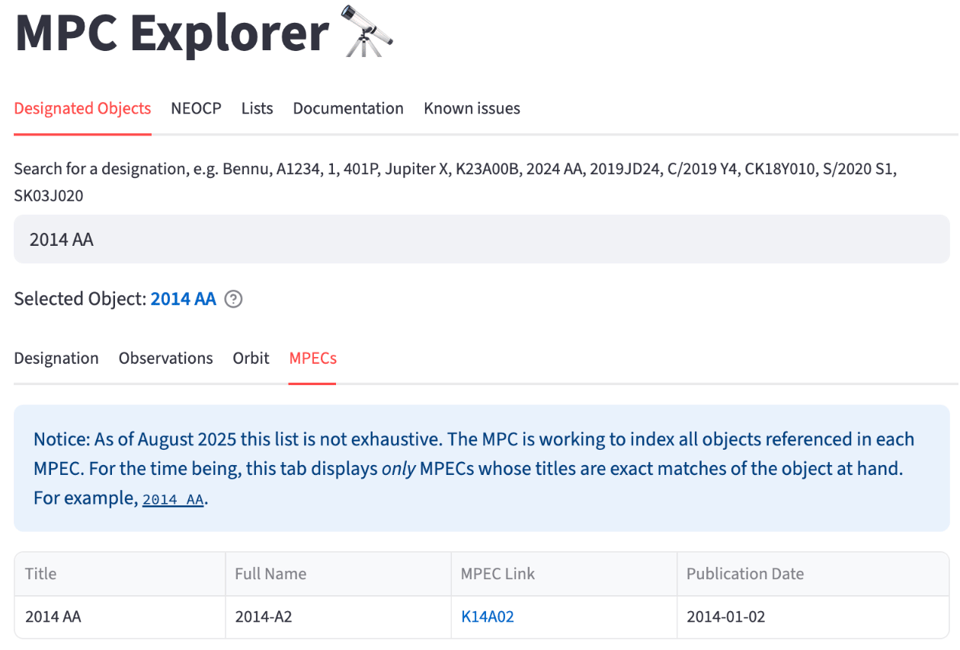
As clear from Fig. 1, as of today the list is still not exhaustive. The MPC is working to index all the objects referenced in each MPEC.
We’d also like to remind our users that we have available the MPEC search service, and the corresponding MPEC API.
3. Summary of MPC APIs
In case you missed some of our Newsletter and latest news, this is a summary of all the APIs that we have released. The documentation page for all the MPC API is available at the following link:
https://minorplanetcenter.net/mpcops/documentation/#apisDesignation identifier API: to resolve any MPC designations (minor planets, comets, natural satellites). The API returns both packed and unpacked designations, in addition to all the primary and secondary designations for the requested designation.
Observations API: to retrieve all the published observations for a given designation. Various output formats are available.
NEOCP Observations API: to retrieve all the observations on the NEO Confirmation Page (NEOCP) for a given trksub that is currently on the NEOCP.
Orbits API: to retrieve the orbit in the mpc_orb JSON format for a given designation.
Observatory Codes API: to obtain the information for a given observatory code, for all the observatory codes (in json format) or to recreate your version of the ObsCodesF.html page (without the header).
MPEC API: to retrieve all the information for a given list of MPECs.
Action Codes API: to resend the action codes to the original email address the submission was made with.
WAMO API: to help our users to investigate the status of their individual observations.
Add a comment: