
Newsletter - October 2025
2025 OCTOBER 31
In this month’s issue:
IAWN’s Comet Astrometry Campaign
MPC User Group Meeting
Clarification on Program Code Policy
Recovery Page
Circulars header change
1. IAWN’s Comet Astrometry Campaign
Nov. 27, 2025 – Jan. 27, 2026.
Comets present unique challenges for accurate astrometric measurements and orbit predictions.
Cometary bodies are extended with morphological features (comae and tails) that can systematically pull their centroid measurements off their central brightness peak, presenting challenges to estimate comet trajectories.
The International Asteroid Warning Network (IAWN) has announced a comet campaign from November 27, 2025, through January 27, 2026 to introduce methods for improving astrometry from comet observations.
The campaign will target comet 3I/ATLAS (C/2025 N1) to exercise the capability of the observing community to extract accurate astrometry. To prepare for the campaign, we will hold a workshop on techniques to correctly measure comet astrometry.
Registration is required by November 7th for the workshop and only those participants that attend the workshop can participate in the campaign.
The Campaign Schedule is provided below:
Comet Campaign Workshop, Nov. 10, 2025, 15:00 UTC
Campaign Kick Off: Nov. 25, 2025, 15:00 UTC (1 hour)
Observing Window Opens: November 27, 2025
Mid-Campaign Check-in Telecon: December 9, 2025, 15:00 UTC.
Observing Window Closes: January 27, 2026
Close-out Telecon: February 3, 2026, 15:00 UTC.
IAWN had been planning to do a Fall 2025 comet campaign since 2024 to exercise capabilities for measuring the position of comets, which pose additional astrometric challenges as they appear as fuzzy extended objects compared to point-like asteroids in a telescope’s field of view. The discovery of comet 3I/ATLAS clearly presented a great opportunity for the IAWN community due to its prolonged observability from Earth and high interest to the scientific community.
IAWN has conducted several campaigns and they can all be found on the IAWN website:
https://iawn.net/campaigns.shtml2. MPC User Group Meeting (MUG)
The MPC Users' Group is composed of representatives from the major NASA-funded NEO surveys, the NEO follow-up community, the dynamics community, and the simulations community. The goal of the MUG is to provide feedback to the MPC about its current status and future developments. The MUG members and the MPC staff usually meet twice a year. The next meeting will take place on Dec 3-4, 2025 at Caltech.
The MUG and the MPC welcome any feedback from the community (including positive ones!) and we encourage users to share their thoughts before November 25 with the MUG representative Rob Weryk ([email protected]).
For those of you who are not familiar with the MUG or would like more information, please check the MPC User Group Page maintained by SBN.
3. Clarification on Program Code Policy
It has come to our attention that the explanation of the new program code policy in the September 2025 Newsletter may not have been entirely clear. We apologize for any confusion and would like to take this opportunity to provide a more detailed clarification.
What is a program code?
As explained in our Program Codes page, the Minor Planet Center (MPC) has historically used program codes to identify different observers observing from the same telescope. To identify the contact corresponding to a specific program code at the time of ingestion, we look at the CON line for observations submitted in MPC-1992 80-column format or at the submitter line for observations submitted in ADES (XML or PSV).
Example of MPC-1992 80-column submission including the submitter line (the example is from https://minorplanetcenter.net/iau/info/ObsDetails.html):
COD 500
CON S. Holmes, 221B Baker Street, London NW1 4JW, England [[email protected]]
OBS H. Poirot, P. Mason, L. Columbo, C. Chan
MEA J. Watson
TEL 0.50-m f/3.0 reflector + CCD
NET GSC-1.0
ACK Batch 001: five new tnos
AC2 [email protected]
The MPC will only record as a contact anything that is before the first comma, e.g. in this case S. Holmes. Examples of ADES submissions, like this one below, can be found in the ADES documentation.
<obsContext>
 <observatory>
  <mpcCode>568</mpcCode>
  <name>Univ. Hawaii</name>
 </observatory>
 <submitter>
  <name>I. M. Submit</name>
 </submitter>
 <observers>
  <name>I. M. Observit</name>
  <name>A. N. Astronomer</name>
 </observers>
 <measurers>
  <name>I. M. Measurit</name>
  <name>A. N. Skywatcher</name>
 </measurers>
 <telescope>
  <design>reflector</design>
  <aperture>2.2</aperture>
  <detector>CCD</detector>
 </telescope>
 <fundingSource>Name of Funding Agency</fundingSource>
 <comment>
  <line>This is the first comment.</line>
  <line>This is the second comment.</line>
 </comment>
</obsContext>
Publicly available archives
The MPC, in collaboration with the Singletons and Archival Committees, has identified several archives that are already public or will soon be made publicly available (see Table 1 and the SARC webpage). Program codes have now been assigned to all the archives in Table 1.
The complete and up-to-date list of all assigned program codes can always be found on our website.
Archive | |
|---|---|
ATLAS | M22, R17, T05, T08, W68 |
Catalina Sky Survey (CSS) | 703, G83, G96, V00 |
Cerro Tololo | 807 |
DECAM | W84 |
ESA various telescopes | 033, 204, 246, B63, J04, J75, L80, Q12, W57, W98, Z33, Z58, Z84 |
Euclid | 273 |
European Southern Observatory | 262, 309, 809 |
Gemini North | T15 |
Gemini South | I11 |
Haleakala-NEAT/GEODSS | 566 |
Hubble | 250 |
Kitt Peak | 695 |
JWST | 274 |
La Palma | 950 |
LCO | E10, F65, K91, K92, K93, L09, Q58, Q63, Q64, T03, T04, V37, V38, V39, W85, W86, W87, W89, W97, Z17, Z21, Z24, Z31 |
Lowell Observatory Near-Earth Objects Survey | 699 |
MaunaKea | 568, T09, T10, T11, T12, T13, T14, T16, T17 |
Near-Earth Asteroid Tracking (NEAT) | 644 |
NEOSSat | C53 |
New Horizons | 266, 267 |
NEO Surveyor | C58 |
Palomar | 261 |
Pan-STARRS | F51, F52 |
SDSS | 645 |
Siding Spring | 413 |
Siding Spring DSS | 260 |
Siding Spring - Skymapper | Q55 |
SOAR | I33 |
SOHO / STEREO | 249, C49, C50 |
Spacewatch 0.9m Mosaic Camera Survey | 291, 691 |
Spitzer | 245 |
TESS | C57 |
Vera Rubin Observatory / LSST | X05 |
VLT | X11 |
WISE/NEOWISE | C51 |
ZTF | I41 |
How to Submit Archival Observations
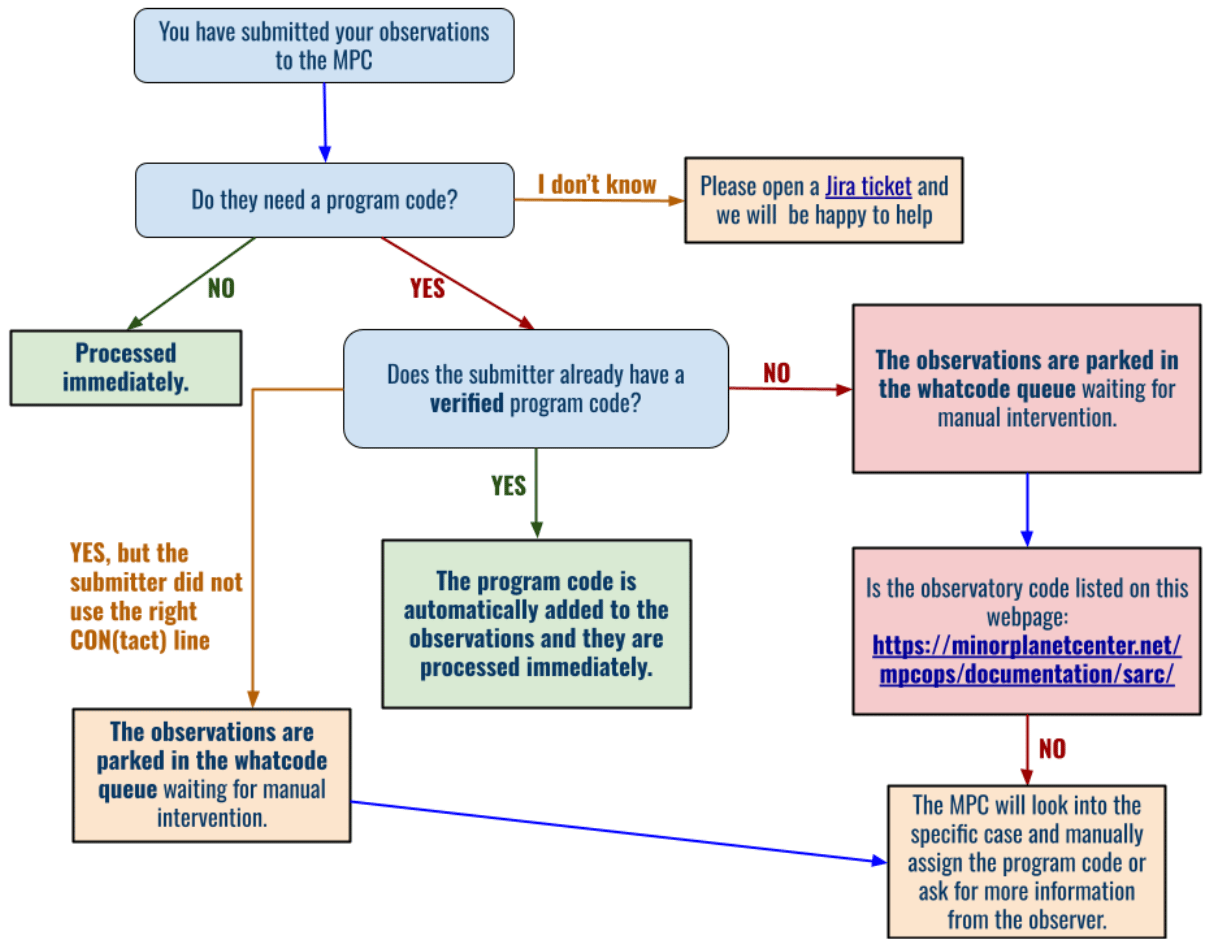
To assist in determining the correct submission pathway, the decision flowchart below (Flowchart 1) provides a hopefully quick visual guide to what happens to your observations after they have been submitted, in case they need a program code. Please keep in mind that this is only one of numerous checks we perform on your submitted observations before even processing them.
If you already have a verified program code, you can continue submitting observations as usual using the contact information you provided to the MPC;
If your observatory code doesn’t need a program code for now, please continue submitting observations as usual;
If your observatory code is listed on the SARC page and your program code has not been verified, please contact the corresponding email address provided there or open a Jira ticket if you have any particular requests;
If the observatory code is not listed on the SARC page, but you are planning to submit archival observations, please open a Jira ticket for the MPC and contact the SARC Committee at [email protected];
If you are unsure which category applies, open a Jira ticket and we will be happy to assist.
FAQs
1. What if I already had a program code?
It is true that some observatory codes already had program codes assigned to them. However, if you wish to submit archival observations, please note that prior assignment does not automatically imply verification. You will still need to be verified by the SARC Committee before submitting. You can always submit your observations to us, but they will be parked in the whatcode queue until your program code is verified by the committee (see Flowchart 1). Please open a Jira ticket if you have any further questions.
2. What if I want to submit singletons?
In this context, singletons refer to tracklets consisting of a single observation. The MPC defines a tracklet as a set of observations from the station code obtained in a six hours interval. Please note that being verified for a program code does not automatically grant permission to submit singletons. If you intend to include singletons in your submissions, make sure to specify this in your application to the SARC Committee when requesting program code verification.
3. What happens after the verification process?
After the verification process, if you don't have a program code, the MPC will assign you an official program code. If you already have a program code, your program code will be considered “verified”. Then you may resume submitting observations, but you need to include the contact information linked to your program code. The MPC will automatically apply your assigned program code to all relevant observations upon receipt.
4. What if my observations are stuck in the whatcode directory?
If you have submitted the observations and from WAMO you notice that they are stuck in the whatcode directory, there are a few possible scenarios:
a. You still have to apply for a program code (see Flowchart 1). The observations will remain in the whatcode directory for the entire verification period.
b. You have applied for a program code but you are waiting for the result of the verification process. This case is like the previous one, the observations will remain in the whatcode directory for the entire verification period.
c. You have been verified. It is possible that the MPC has not updated the program codes list. Please open a Jira ticket.
d. You have submitted the observations using the wrong contact field. In that case, the MPC should be able to rectify the error and assign the program code, but please let us know if we haven’t noticed that.
e. If you thought you had a verified program code, but your observations are stuck in the whatcode directory, please let us know and we should be able to help.
As we already mentioned, the SARC committee might not reply as fast as the MPC staff usually do. Please submit your requests in advance to be sure that you can submit your observations when you need to.
If you need a quicker turnaround, like for example you need the observations to be published and available because you are writing a telescope proposal, please let us know and we will try to speed up the process.
Please note that you need to go through the verification process only once for each observatory code. Once you are approved for one station code and you get your program code, you are free to submit your observations. If you need a program code for a different telescope, then you need to go through the process again.
We appreciate your patience as we implement this new system. We understand that this is a significant change for all observers, and for the MPC as well, and that it requires considerable effort from everyone involved. We’re confident that once the system is fully in place, the process will become much smoother for all.
Please let us know if you have any questions.
4. Recovery page
The Recovery Page provides new, unpublished observations of NEOs (q < 1.3 AU), TNOs (q > 5.6 AU), and unnumbered periodic comets whose new data extend their orbital arcs from a single opposition to multiple oppositions. In these cases, additional observations are highly desirable.
Once new data provide at least two distinct nights of observations at a subsequent apparition, a Recovery MPEC is issued, and the unpublished observations are removed from the page. The page also describes the rules used to determine when it is appropriate to issue a Recovery MPEC.
Until now, the system that generates Recovery MPECs for NEOs operated once per day, publishing at a fixed time. Please note that this automated process does not apply to TNOs and comets.
Beginning Monday, November 3, 2025, the MPC will increase the cadence of this process removing the 24 hours waiting time. The monitoring code will now run more frequently, and as soon as an object satisfies all the required conditions, a Recovery MPEC will be issued.
5. Circulars header change
As part of our legacy system, the MPC maintained a general contact email address ([email protected]) that users could use to reach us. With the implementation of our new Helpdesk Portal, we now strongly encourage all users to communicate with us through Jira rather than by email. We thank all our users that are already using Jira and that have been doing that for a while. We really appreciate your help.
Jira offers several advantages, including centralized tracking and weekly review of tickets, which helps minimize the risk of oversights. In contrast, responses to direct emails may experience significant delays.
We also recognize that some members of our user community may not yet be aware of these updates, and we are working to make these changes more clearly visible.
To help reduce the use of the legacy MPC email address, we plan to remove it from all official circulars, beginning with the MPECs. We do not anticipate that this will cause any issues for users who parse MPECs, as the email field will simply be replaced by a blank line.
This change will take effect on Monday, January 5, 2026. The first MPEC to include the updated header will be an editorial MPEC announcing the transition.
Add a comment: