
Newsletter - August 2025
2025 AUGUST 29
In this month’s issue:
- MPC Publications - Users’ feedback
- MPChecker speed-up
- Action codes API
- MPC Explorer: Observatory codes list and plot
- MPECs for distant objects
- MPC summer students
1. MPC Publications - Users’ feedback
In May 2025 we asked for feedback from our users to better understand which MPC products are most valuable to the community and to ensure that key information is accessible through our replicated MPC database tables or related APIs on the MPC website.
We’d like to thank all of our contributors who took the time to fill out the questionnaire and to leave a comment for us. The totality of comments and feedback have been very positive, encouraging and extremely helpful to understand what products are the most used.
Sometimes it is good to see that the work we are doing is appreciated by our community.
And now, as promised, here’s the results.
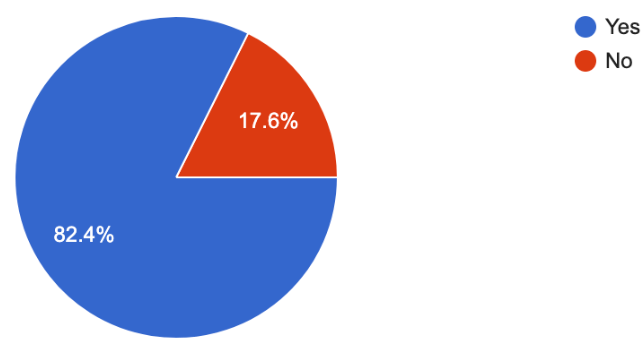
We received 36 responses in total (including the ones via e-mail).
The pie chart in Figure 1 indicates that MPC publications are still the primary data source for most users.
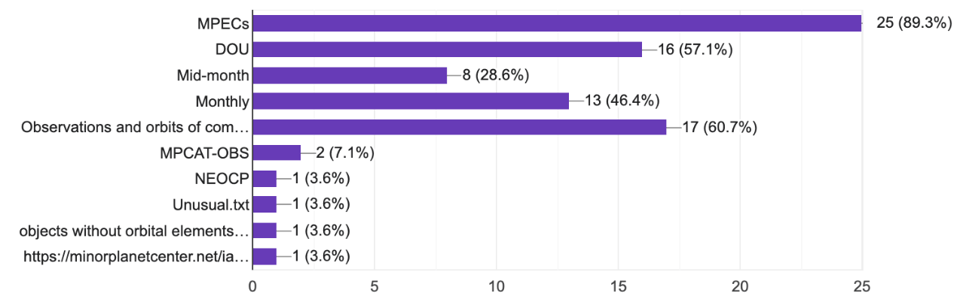
Survey responses show that the most-used publications are the MPECs, Observations and Orbits of Comets, and the DOU, with the monthlies next (Fig. 2).
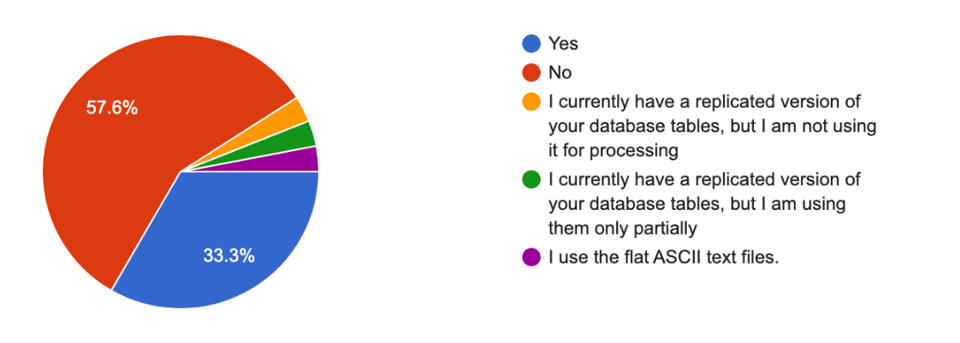
Consistent with expectations, few users maintain local replicas of MPC tables (Fig. 3). For context, refer to the April 2024 Newsletter on replicated PostgreSQL tables.
Minor Planet Electronic Circulars (MPECs)
Minor Planet Electronic Circulars (MPECs) remain widely used. Users requested access to high-precision orbital elements and added context, such as non-gravitational parameters, which we’re actively developing. A majority also support publishing fewer MPECs focused on “more interesting” objects.
Daily Orbit Update (DOU)
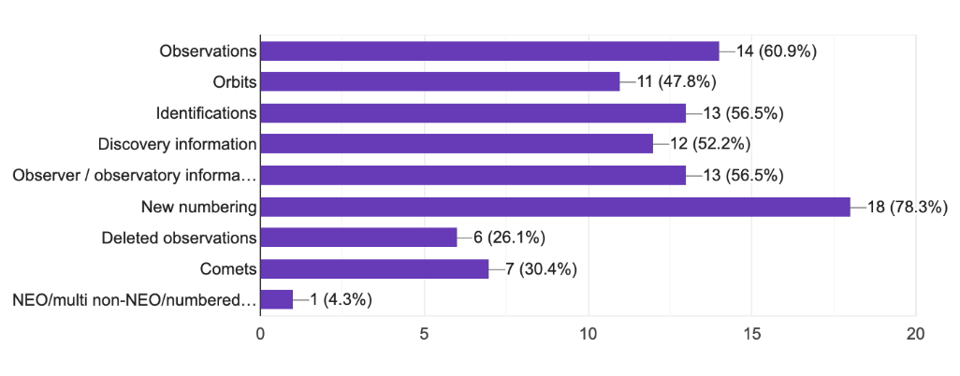
The histogram in Fig. 4 shows how our users are mostly interested in identifications, observations and designations from the DOU.
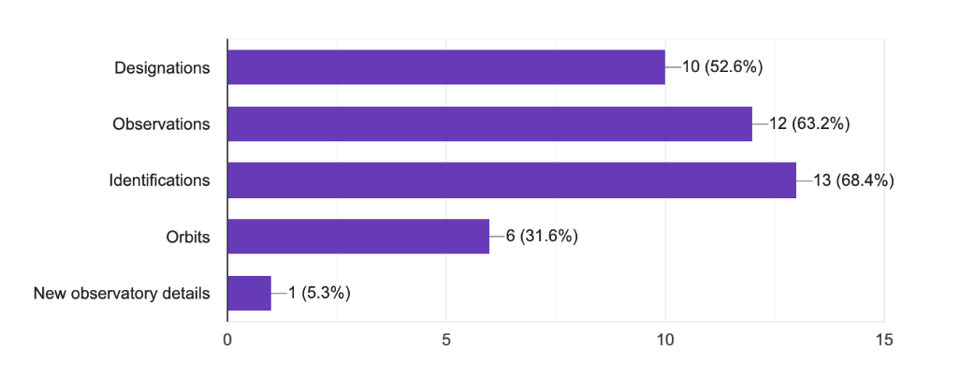
Several users requested that we provide post-fit residuals and a list of deleted observations; we’ve started development on both.
Monthly products
We were particularly interested in your feedback on the monthly products, since producing the monthly circulars is among the MPC’s most complex workflows.
Modernizing both the process and its underlying code is now a high priority to improve efficiency and ensure long-term sustainability. This includes the derivation of all the main products from our database table.
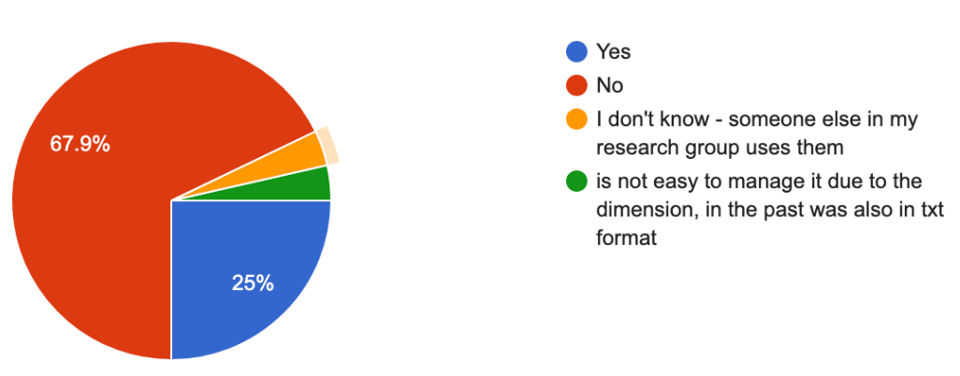
According to Fig. 5, most of the data included in the monthly circular seems to still be used, but PDFs are not considered necessary by the majority of the responses (Fig. 6).
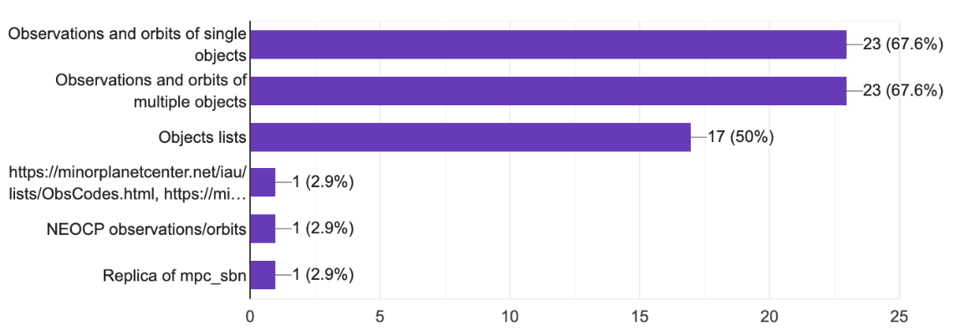
Outside of the major publications, data for single objects are still very much required, such as orbits and observations (Fig. 7). We are glad to see that our users are slowly migrating towards the use of the new APIs and of the MPC Explorer, even though the flat files still remain the major source of data at the moment.
As a reminder, the documentation for all the APIs is available from our Documentation page and all the APIs have been detailed in various sections of the Newsletters.
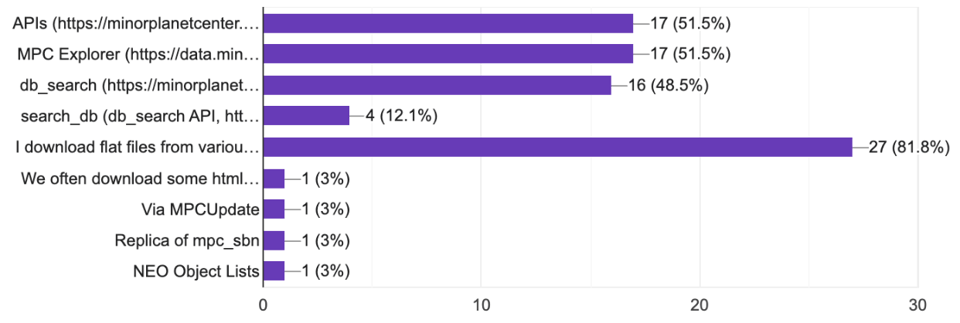
In our February 2025 Newsletter we also explained how the MPC Explorer is considered a replacement for db_search and the corresponding search_db API. We hope that as soon as all the data will be available in our postgreSQL table, we should all be able to seamlessly switch to the use of the new services.
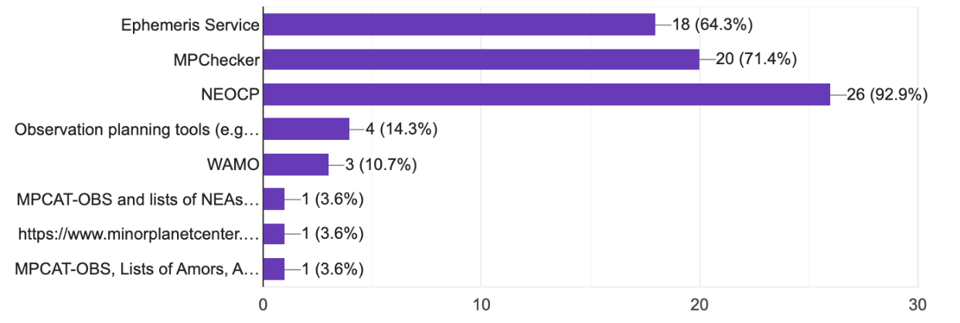
When asked what the most used MPC services are, the survey shows NEOCP, MPChecker, and the Ephemeris Service in the top spots. We’re currently upgrading each of these services.
In the next months we will share how we are going to improve the publication system and some of the new services related to this development.
2. MPChecker speed-up
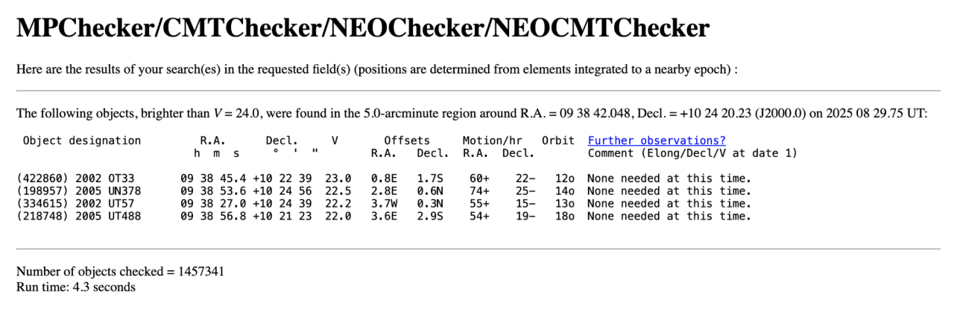
Some of you might have already noticed that the speed of MPChecker dramatically improved in the last few days. Recent development done on the code has changed the run time from being ~48 seconds to ~4 seconds, as you can see in Fig. 10.
3. Action codes API
Action codes are 20-character string codes, automatically generated and sent to the submitters of new NEO and new comet candidates as well as to the NEO/NEOPC follow-up reporters.
The action codes can be submitted to the MPC and used to automatically perform actions such as deletion of the submitted observations, labeling of the object as a comet, etc.
Action codes can be submitted via the online form or by curl and the action will be executed within a few minutes.
Action-code emails do occasionally get lost. The new Action Codes API lets you resend your code to the email address used at submission. The documentation explains how to request codes and interpret the response.
4. MPC Explorer: Observatory codes list and plot
We are continuing to expand our list options, now including a dedicated Observatory codes list.
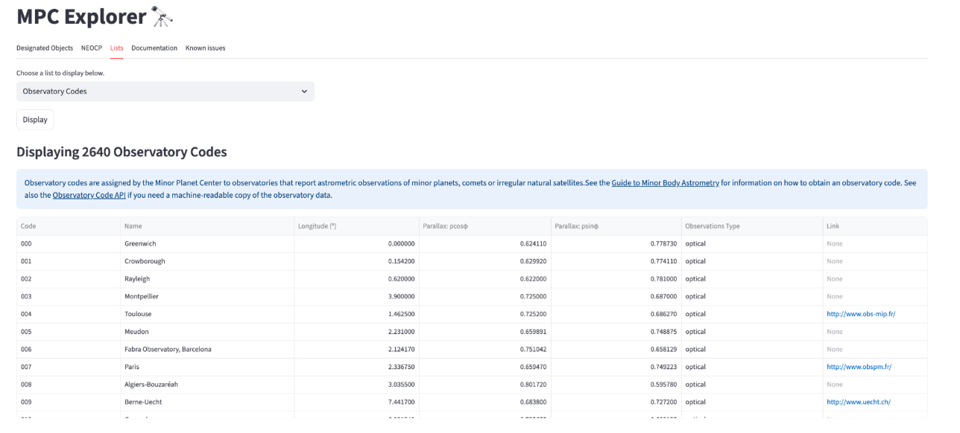
The page also includes a world map of the locations of all the observatory codes. The map (here below) is downloadable and everyone is free to use it. Both the list and map get their information from our Observatory Codes API and the data are continuously updated.
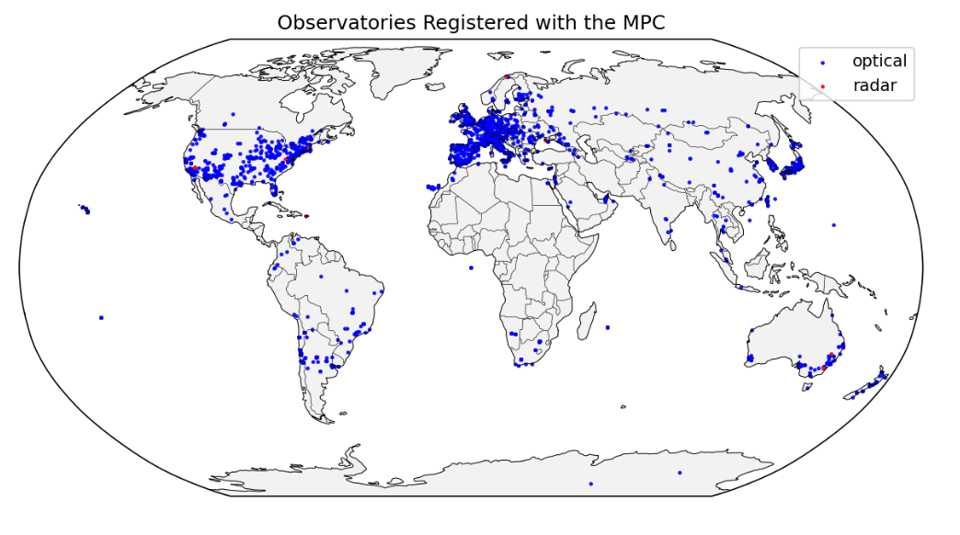
Please don’t forget to check “How do I credit the MPC in my publications?” from our FAQs page in case you use this map or any of our data.
5. MPECs for Distant Objects
As mentioned in the April 2025 newsletter, the MPC is changing the criteria that distant objects (Centaurs, Trans-Neptunian Objects, etc.) need to meet in order to warrant a Minor Planet Electronic Circular (MPEC). The new criteria, as described in the April newsletter, will take effect at the time of an editorial MPEC within the next week.
6. MPC summer students
The MPC is very proud to introduce our two summer interns: Mei Lin and Yvette Nyamhere. Both Mei and Yvette spent 10 weeks working with us on different projects.
Mei Lin

Hello! My name is Mei Lin, a rising sophomore at Harvard studying Astrophysics and Government with a secondary in Studio Arts. Outside of class and research, I love painting, sketching live portraits at local cafes, and preserving plants. I've been working with Federica Spoto and the Minor Planet Center since this past October, but just recently completed a summer research internship working to optimize the NEO Surveyor's data processing pipeline. I can be reached via email at [email protected].
Yvette Nyamhere

Yvette Nyamhere is a Harvard undergraduate from Zimbabwe in the class of 2028. She is studying Astrophysics and Applied Physics. Currently, she enjoys doing research related to black holes, dark matter and asteroids and how they shape the structure and evolution of the universe. She also cares deeply about increasing African representation in the space sciences and hopes to contribute to both global research efforts and science development on the continent. After earning her undergraduate degree, she plans to pursue a Ph.D. in Astrophysics to continue on the path of research and one day contribute to large-scale space missions or observatory collaborations. Yvette can be reached via email at [email protected].
Add a comment: