
Newsletter - April 2025
2025 APRIL 30
In this month’s issue:
Observatory codes API
Automation of comet processing
MPECs for Trans-Neptunian Objects and other Distant Objects
MPC Explorer: retired designations list
MPC User Group Meeting
1. Observatory codes API
We are thrilled to introduce our latest API: the observatory codes API.
The API presently supports queries for a single observatory code or can return information for all observatory codes (currently 2,610 in total). The output is provided in a JSON dictionary format. In the future, we will introduce the option to return the data in the same format as the existing observatory code files already available on the MPC website, enabling the eventual deprecation of those files.
For more details, including usage examples, please visit the API documentation.
Please, query responsibly!
We encourage you to please let us know if you encounter any issues.
2. Automation of comet processing
Standardizing MPEC Components
We are making some updates to the comet MPEC generation process as part of our transition towards a fully automated comet processing. We have now completed the implementation of the automated generation of MPEC text details, as described in the March 2024 Newsletter. This process now fully relies on activity reports submitted directly to the MPC. The instructions for submitting reports can be found here. Please note that we are unable to ingest comet activity reports shared via external mailing lists or private communications. To ensure that your activity reports are correctly included in the comet MPECs, please submit the reports directly to the MPC following the provided guidelines.
Comet naming
Comet names are determined by the International Astronomical Union's Working Group on Small Body Nomenclature (WGSBN). Previously, designating a comet, and thus assigning its name, required back-and-forth communication between WGSBN and MPC. This coordination was one of the major manual steps remaining in the MPC’s preparation of comet announcements.
In agreement with WGSBN, the MPC can now announce new comets without names, with WGSBN subsequently publishing the official names, following a process similar to that used for numbered asteroids. This change removes one of the main obstacles to streamlining the comet processing workflow.
The MPC has already issued two electronic circulars under this new process: MPEC 2025-H88 (April 23, 2025) and MPEC 2025-H113 (April 24, 2025), in which the new comets appear with their designation but without names. Once the WGSBN announces the official names for these objects, the MPC will ingest them following the same procedure currently used for minor planets.
Comet numbering
The MPC is working on a long-term project to fully restructure our monthly publications. More information on the current status and future development of this project will be shared in upcoming newsletters. As part of the restructuring, we would like to separate the process of numbering of comets from the monthly publications.
We are moving toward assigning comet numbers at the time their recovery MPEC is issued. When the orbit quality is sufficient, numbering will occur simultaneously with the processing of the recovery observations. Details of the comet numbering policy can be found here.
Users can expect the MPEC to look similar to a standard comet recovery MPEC, where instead of an identification line, it will include the new number, for example 499P = P/2019 Y3. Sample formats will be provided soon, and the change will be also announced in an upcoming Editorial to ensure users have time to adjust their pipelines accordingly.
We appreciate your patience as we work on streamlining the comet processing and reducing the processing time for all comet observations.
3. MPECs for Trans-Neptunian Objects and other Distant Objects
The number of known distant objects has grown dramatically in the past years, and we expect an even larger increase in discoveries by the Rubin LSST. Distant objects, currently identified as non-comets with perihelion q>5.6 au, currently always receive an MPEC when they become multi-opposition (either at first recovery or at discovery if the initial arc is already multi-opposition). Continuing to provide MPECs for all objects that meet these criteria will result in an overwhelming number of circulars, from which it will be challenging for users to identify unusual objects.
Thanks to the feedback received by the distant object community during the last TNOs meeting in June 2024, the MPC will be changing the MPEC criteria for distant objects.
To receive an MPEC, a Distant Objects must meet at least one of the following conditions in addition to the existing q>5.6 au and the multi-opposition requirement:
semi-major axis a>150 au, or
perihelion q>50 au, or
inclination i>50 degrees, or
absolute magnitude H<5
There are currently 4,633 multi-opposition distant objects in the MPC database. Of these, 94 meet the a criteria, 145 meet the i criteria, and 11 meet the q criteria, and 114 meet the H criteria, for a total of 330 objects, or ~7% of the known TNOs. (Note that many objects meet multiple criteria.)
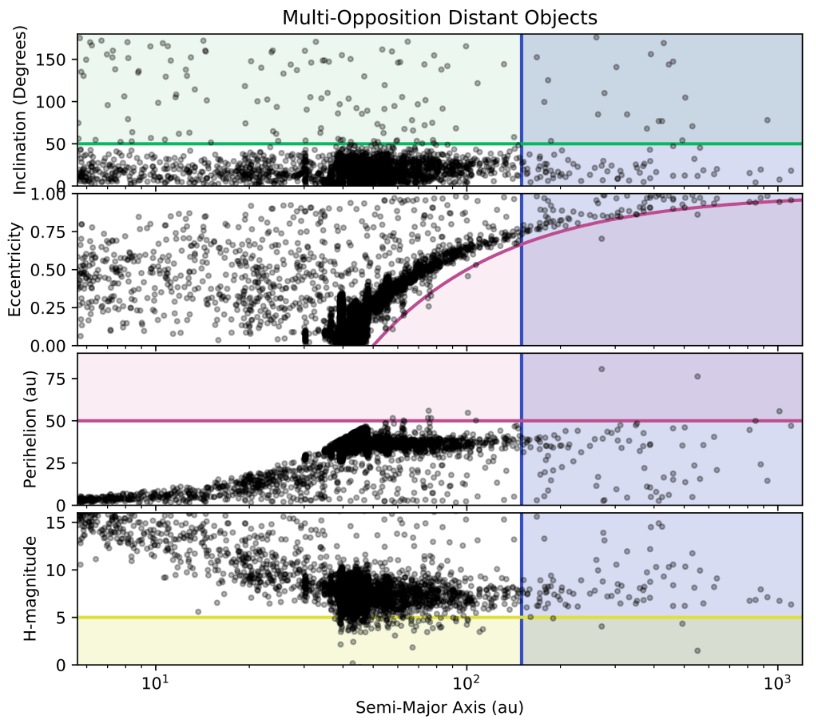
These changes will take effect by the end of May, and will be announced in an editorial MPEC just before implementation. The MPC will then continue to MPEC the unusual distant objects indicated in the shaded regions in Figure 1. These criteria are selected in order to identify the unusual distant objects for MPECs. The number of discoveries will still increase dramatically in the next few years, but this change will significantly reduce the fraction of distant objects which receive MPECs.
If you find a distant object that met the previous MPEC criteria, but does not meet the new criteria and you believe it is interesting enough that an MPEC should be issued, please reach out via the Jira Helpdesk before submission.
4. MPC Explorer: retired designations list
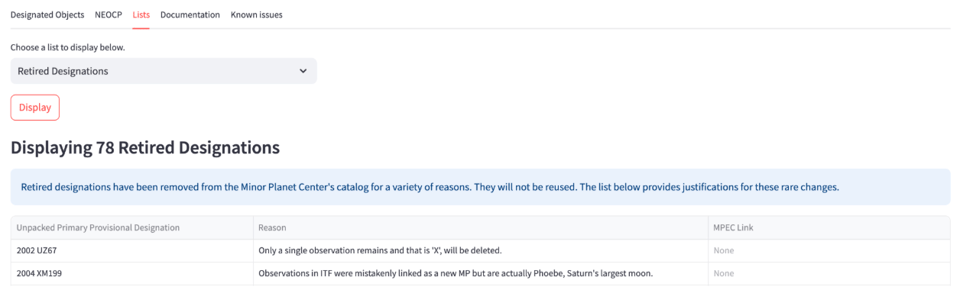
As promised in our March 2025 Newsletter, we have continued to expand our list options including the retired designations (see Fig. 2). These are designations that have been removed from the MPC’s catalog for a variety of reasons. Note that these designations will not be reused.
You may find it quite fun reading why and how the MPC designated the wrong object!
5. MPC User Group Meeting
The MPC Users' Group is composed of representatives from the major NASA-funded NEO surveys, the NEO follow-up community, the dynamics community, and the simulations community. The goal of the MUG is to provide feedback to the MPC about its current status and future developments. The MUG members and the MPC staff usually meet twice a year. The next meeting will take place on May 20-21, 2025 at the Center for Astrophysics, in Cambridge (MA).
The MUG and the MPC welcome any feedback from the community (including positive ones!) and we encourage users to share their thoughts before May 16 with the MUG representative Rob Weryk ([email protected]).
For those of you who are not familiar with the MUG or would like more information, please check the MPC User Group Page maintained by SBN.
Add a comment: