
Newsletter - March 2025
2025 MARCH 28
In this month’s issue:
MPC Explorer: recent improvement and new developments
128 New Saturnian Satellites
ID pipeline rule change
1. MPC Explorer: recent improvement and new developments
We are always very excited to announce new improvements to our MPC Explorer.
Streamlit known issue
The MPC Explorer is built with Streamlit, an open-source app framework. Over the past month, some users (us included) have experienced intermittent issues with loading CSS or JavaScript modules. This problem stems from Streamlit’s internal libraries; it is known to the developers, and typically resolves with a page refresh.
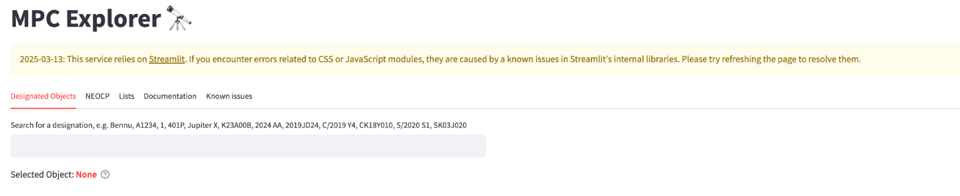
We’re actively monitoring the related discussion on the Streamlit forum. In the meantime we’ve added a notice to the website (Fig. 1) advising our users to refresh the page if they encounter the issue.
Past impactors list
Figure 1 also highlights the addition of the new List tab on the main landing page. At the moment, it can only display the list of past impactors (Fig. 2), which are objects detected in space just hours before entering the Earth’s atmosphere. Our goal is to expand this feature to include more list options, such as dual-status objects, retired designations, and many more. It will eventually replace all the various lists that we already provide on our Lists webpage: https://minorplanetcenter.net/iau/lists/Lists.html.
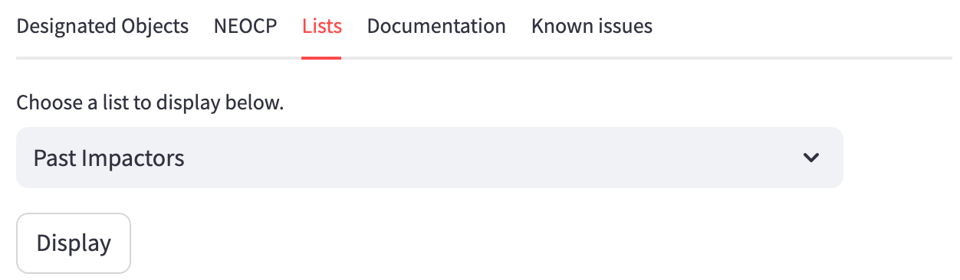
We think the new page turned out pretty cool! To avoid spoiling the surprise, we’re not including a screenshot of the actual content, so go check it out for yourself and let us know what you think. As always, we welcome your feedback and hope you enjoy it as much as we do!
New layout and observations display
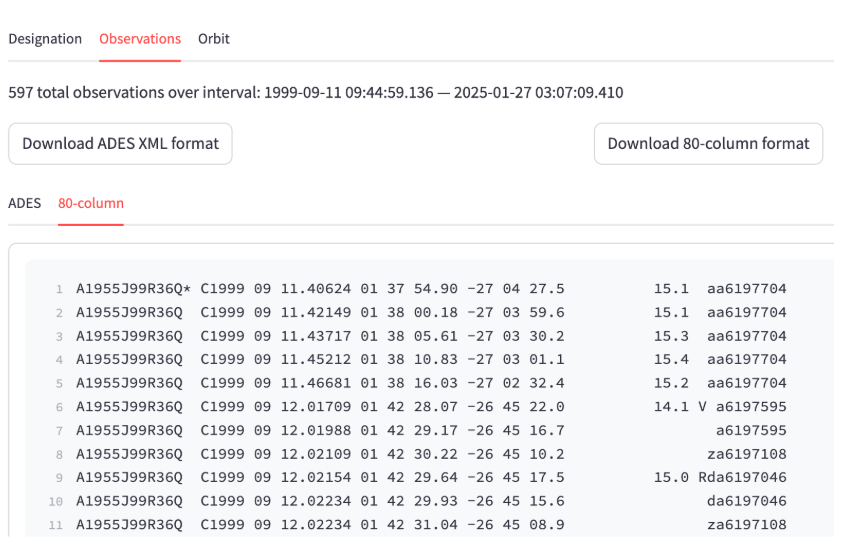
Based on user feedback, we’ve improved the layout of the entire service—especially the Observations page.
You may also notice a new feature: the option to display observations in the classic MPC-1992 80-column format, alongside the ADES data (Fig. 3).
Please keep the feedback coming: it’s a big help as we continue to improve our services!
2. 128 New Saturnian Satellites
More exciting news!
On March 11th, the MPC confirmed the discovery of 128 additional natural satellites of Saturn. These add to the 146 previously known, including 64 announced just two years ago in May 2023. Saturn has gone from having fewer known satellites than Jupiter to now hosting nearly twice as many as all the other planets combined.
Both announcements were both made possible thanks to measurements from a survey conducted by Dr. Edward Ashton, a postdoctoral fellow in the Institute for Astronomy and Astrophysics at Academia Sinica (Taiwan), using the 3.6-meter Canada-France-Hawaii Telescope's 1-square-degree MegaCam.
Most of the 128 newly announced satellites had been tracked for at least two years, allowing Dr. Mike Alexandersen, MPC Astronomer, to search the MPC database for earlier observations. As a result, 35 of these objects were successfully linked to data from a 2004–2007 survey led by Dr. Scott Sheppard.
Although these objects were detected at the time, they hadn’t been tracked long enough to confirm them as satellites. Discovery credit for 21 of these satellites goes to the 2004–2007 observers, while 62 are credited to the Ashton’s survey.
The remaining 45 objects currently have only two-month observational arcs, enough to make their status as satellites fairly certain, but making their positions in the 2004–2007 timeframe too uncertain to identify precoveries. Once these objects are recovered during a second opposition, further searches for past observations will be possible. However, given that these are the faintest satellites, it is very unlikely that many would have been detected earlier.
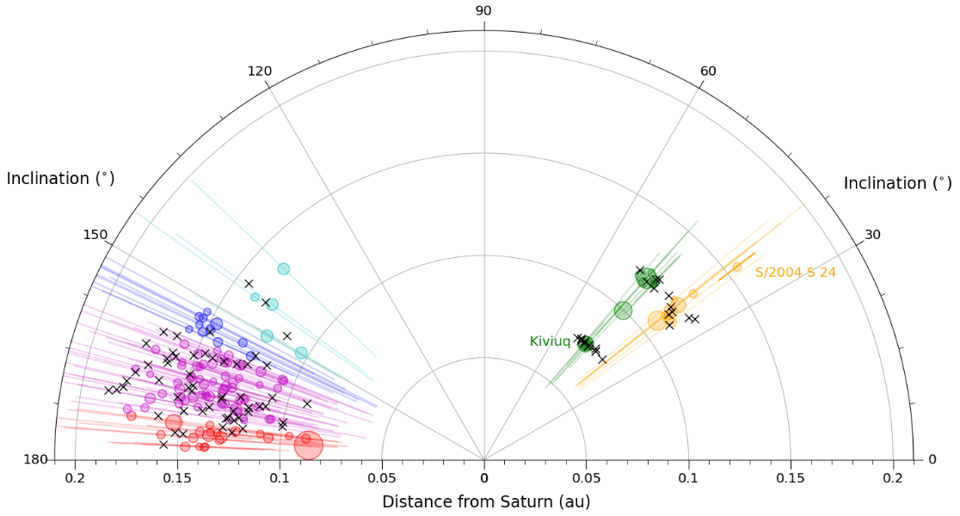
Figure 4 displays the orbital elements of the 83 multi-opposition objects from the recent announcement. These new additions appear to confirm the existence of three sub-groups among the prograde satellites (those with inclinations i < 90 deg), as previously suggested in the literature; particularly the tightly clustered Kiviuq group, which is likely the result of a recent collisional event.
In Figure 4 the orbital elements are time-averaged for the coloured objects, while they are osculating (instantaneous) elements for the new objects. Once the orbits of the new satellites are numerically integrated and averaged, the new objects are expected to cluster even more closely, further supporting the proposed groupings.
The discovery has attracted widespread media coverage, from the New York Times and New Scientist, to Nature daily briefing and many more. The scientific paper detailing these findings is also available in RNAAS. Minor Planet Electronic Circulars 2025-E153, 2025-E154 and 2025-E155 contain the MPC’s published orbits for the 128 new satellites.
A common question is why we know of more moons of Saturn than the much closer Jupiter, and whether a new search for additional Jovian satellites might be on the horizon.
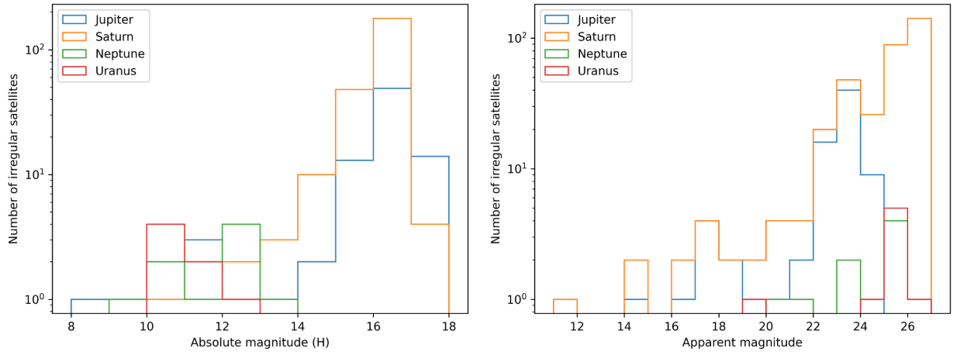
Figure 5 shows the absolute magnitude (left panel) and apparent magnitude (right panel) distribution of the known satellites of the four giant planets. The absolute magnitude plot reveals how Saturn has significantly more satellites than Jupiter across nearly all sizes beyond H>12. The apparent magnitude plot shows that the faintest known Jovian satellites are 1-2 magnitudes brighter than many of the known satellites of all three of the other planets.
Jupiter is closer and more massive, so the area of sky where moons can exist is much larger. While Neptune and Uranus' satellite region can be mostly covered by a single field of view and Saturn's can be fairly efficiently covered using two fields (as Ashton did), Jupiter’s vast area of sky requires many more fields, increasing the telescope time needed for a complete survey. In addition, the wider range of motion rates and angles among Jovian satellites greatly increases the complexity of digital tracking/shift+stack techniques, adding significantly computational demands.
So while it’s certainly possible that many more Jovian satellites remain to be discovered, doing so would require a lot of observational and computational resources. As a result, Saturn will likely continue to hold the record for the planet with the most known satellites (at least for now).
3. ID pipeline rule change
The MPC has recently reduced the maximum allowed arc length for 3-night ITF-to-ITF linkages from 40 days to 15 days. We adopted this more conservative approach in response to an increased number of false linkages that were being accepted and designated by our pipeline. Full details on our criteria for accepting or rejecting identifications are always available on our identification page.
Add a comment: