
Newsletter - January 2026
2026 JANUARY 30
In this month’s issue:
Check near-duplicates API and corresponding MPC Explorer page
More improvements to the MPC Explorer
Comet C/2026 B2
3I/ATLAS: IAU global outreach campaign
TESS Observations of 3I/ATLAS
ADES submissions
1. Check near-duplicates API and corresponding MPC Explorer page
The MPC defines observations that are close in time or position (right ascension and declination) as near-duplicates. These are typically resubmissions of observations that have already been submitted, and, in most cases, published. Such resubmissions may occur as part of an effort to improve previously reported astrometry, or they may arise accidentally.
In practice, it is often difficult for users to determine whether they are submitting remeasurements of previously submitted observations. To help address this issue, we have developed a new tool: the near-duplicate check. As with our other services, this tool is available both via an API and as a new page on the MPC Explorer.
The API is a standard REST endpoint and allows users to search for up to 10,000 observations at a time. The endpoint takes as input a JSON object containing a list of observations in the MPC-1992 legacy format. Future work will extend this functionality to allow searches using the ADES format.
In addition to the observations themselves, users can specify a temporal separation threshold (in seconds, with a default of 60 seconds) and an angular separation threshold (in arcseconds, with a default of 5). An optional flag also allows users to omit the angular and temporal separation values from the returned results (disabled by default).
The same options are available in the MPC Explorer.
Both the API and the MPC Explorer return a list of near-duplicate observations (if any), together with the corresponding temporal and angular separations when requested. The search is limited to observations that have already been published.
2. More improvements to the MPC Explorer
Until now, the MPC Explorer had a major limitation: unlike the db_search, it did not allow users to share a direct link to a specific object. This was a limitation of Streamlit, the platform on which the MPC Explorer is built.
We have now overcome this limitation, and the MPC Explorer provides object- and page-specific URLs, allowing users to easily bookmark and share links to specific objects and pages.
Some examples:
- https://data.minorplanetcenter.net/explorer/?tab=Designated
- https://data.minorplanetcenter.net/explorer/?tab=Designated&search=2026+AB
- https://data.minorplanetcenter.net/explorer/?tab=Documentation
Etc.
3. Comet C/2026 B2
In MPEC 2026-B203, we announced the discovery of a new comet, C/2026 B2. As some users immediately noticed, the published orbit was incorrect, with an eccentricity of much larger than 1. We have since corrected this error and issued a new circular, MPEC 2026-B205, with the revised orbit. In addition, the orbit in the original MPEC has also been updated.
The MPC does not normally modify the content of published MPECs. However, in rare cases, when the published information is significantly incorrect, we have determined that issuing a correction is preferable to leaving an erroneous record unaddressed. In this instance, publishing an incorrect hyperbolic orbit could have led to potentially misleading interpretations of both the object’s nature and the broader situation.
We apologize for this issue. While we continue to automate large portions of our systems, some validation checks still require improvement. Following this event, we have strengthened the checks related to comet orbit eccentricities.
4. 3I/ATLAS: IAU global outreach campaign 2025-2026
For the past month, the MPC has been collaborating with the IAU’s Office for Astronomy Outreach (OAO) on a global outreach campaign for 3I/ATLAS.
As you can also read on their website, the International Astronomical Union's Office for Astronomy Outreach (OAO) was established in 2012 as a legacy of the International Year of Astronomy in 2009. This international year highlighted the profound impact that astronomy can have when shared with society, inspiring the creation of a dedicated office, the OAO, to strengthen the connection between the academic and scientific community and the public.
The OAO works to break down barriers between professional astronomers and society, fostering inclusive engagement and encouraging dialogue about the Universe and humanity's place within it. By opening the doors of the scientific community, we aim to make astronomy accessible to everyone, inspiring curiosity, discovery, and a sense of shared wonder.
The results of the campaign are now officially available to everyone at
Comet 3I/ATLAS
3I/ATLAS is an interstellar object a small body that does not belong to our Solar System and is passing through it from elsewhere in the Milky Way. It is only the third confirmed interstellar object ever observed. In terms of appearance and behaviour, 3I/ATLAS looks and behaves like a typical comet from the outer Solar System.
We encourage the community to make use of the provided materials on 3I/ATLAS, particularly for teaching activities and public-outreach talks.
5. TESS Observations of 3I/ATLAS
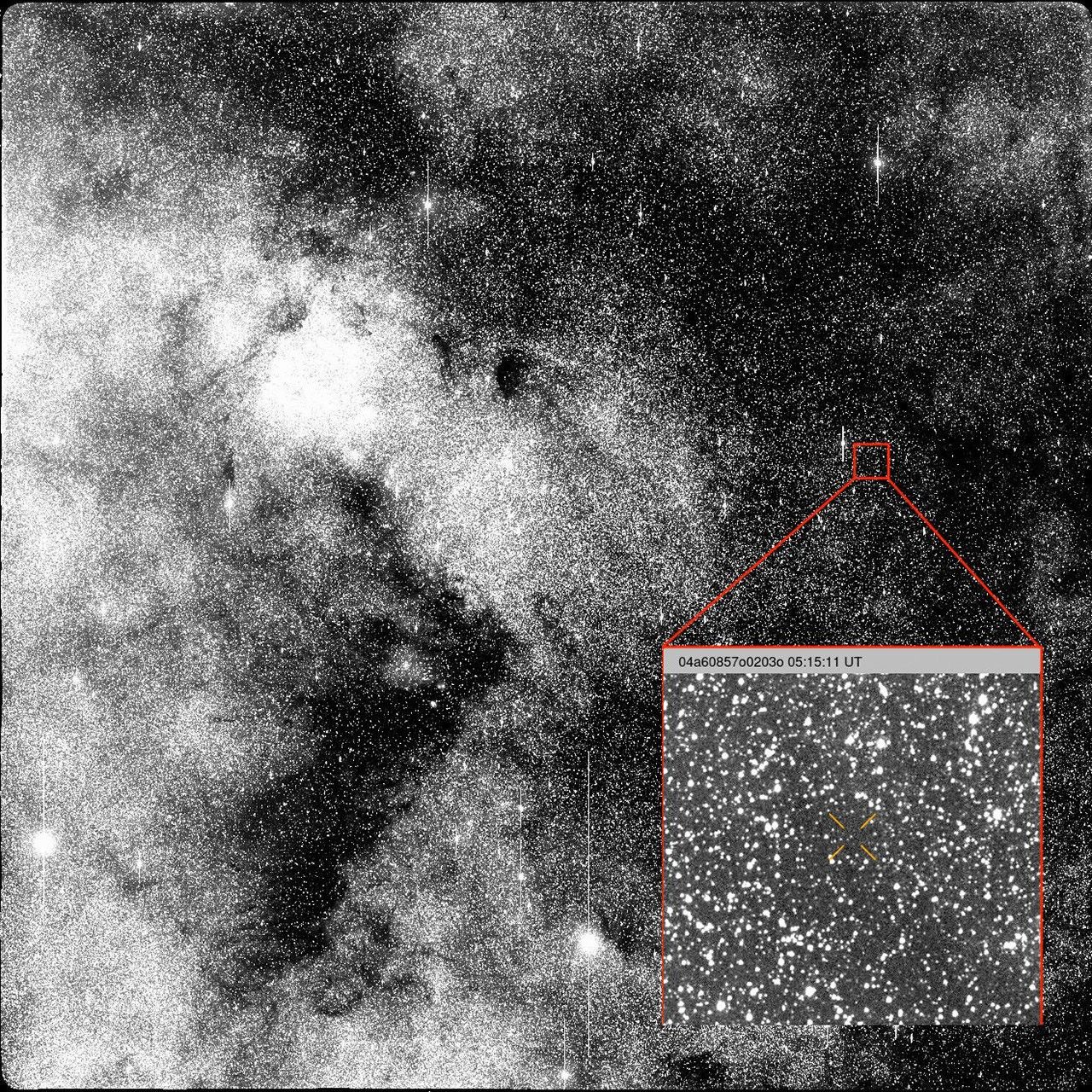
On behalf of NASA’s Transiting Exoplanet Survey Satellite (TESS) team, we announce the availability of the first data from the TESS’s observations of interstellar comet 3I/ATLAS, collected over 15-22 January 2026.
TESS is a wide-field imager (21 arcseconds per pixel over a 96 degree x 24 degree field of view) with a broad optical bandpass (600-1000 nm) collecting precise and stable photometry at fast cadence (20-s, 120-s, and 200-s).
TESS data are calibrated and publicly archived with no proprietary period at MAST, with the first set of 3I/ATLAS data products from the initial 18 hours of observations taken during January 15 available now. Additional data taken during January 18-22 will be archived at MAST as soon as that data is downlinked from TESS and calibrated.
For more information, including resources to help new TESS users get started with this dataset, please see recent posts on the TESS Science Support Center website: TESS or email their help desk at [email protected].
6. ADES submissions
This is our monthly reminder to please submit your observations in ADES format, using ADES version 2022. For most users, the only required change is updating the version number.
The MPC does not plan to maintain support for the MPC 1992 80-column format indefinitely, and ADES was approved more than ten years ago. We therefore strongly encourage observers to learn how to submit observations in the ADES format sooner rather than later.
Information about the ADES format can be found in our past Newsletters as well as on our documentation page. For any questions about the format or its usage, please contact the MPC via the Jira Helpdesk. If you have suggestions for improvements to the ADES format, we encourage you to open a GitHub issue on the ADES repository.
Add a comment: