
Newsletter - February 2026
2026 FEBRUARY 28
In this month’s issue:
Recent submissions from Vera C. Rubin Observatory New MPC’s public documentation
New digest2 repository and package
Mid-month and monthly publications
NASA Infrared Telescope Facility - Semester 2026B - Call for Proposal
1. Recent submissions from Vera C. Rubin Observatory
On the night of February 5, 2026, the Rubin team submitted a large batch of approximately 20,000 candidate discoveries, corresponding to roughly 246,000 individual observations.
The MPC successfully processed the entire submission.
This unusually large batch provided a valuable end-to-end stress test of our pipeline and allowed us to identify a few bottlenecks and areas where performance and automation can be improved.
One minor bug affected the daily publication and prevented the correctly computed orbits from being exported in the next day’s Daily Orbit Update (DOU). It is important to emphasize that the orbits themselves were computed correctly and were available internally, including in the MPC Explorer (for example, object 2025 MU100), and that the issue was limited to the final step in the DOU publication.
We have updated the necessary files to ensure that all affected orbits would appear in the DOU as expected, and we resolved the underlying cause to prevent recurrence.
At the time of the submission, Rubin was not submitting single tracklets, but they submitted their own internal linkages. The Rubin team has accumulated significant experience in tracklet linking, and the links they submit are intentionally conservative; this approach reflects a collaborative strategy developed jointly by the MPC and Rubin/LSST to minimize false associations and preserve orbit integrity while maintaining high discovery efficiency.
As a result of this long collaboration, Rubin’s internal associations do not pass through the standard identification pipeline, mostly because of the long time it would take to the pipeline to process this vast amount of data. Instead, the MPC has developed a dedicated processing pipeline This separate workflow is optimized to ingest large volumes of pre-linked data, rapidly fit preliminary orbits, and validate the results at scale.
These submissions currently receive an extra stage of manual vetting that goes beyond that applied to typical submissions.
In particular, for Rubin submissions of candidate discoveries, every tracklet is checked against the orbits of known objects:
If a positive match is found in any of the constituent tracklets, the tracklet is routed to a dedicated vetting queue.
If no match is identified, we compute a preliminary orbit from the submitted observations and perform a full orbital fit, using this as the basis for acceptance / rejection.
When the fit is satisfactory, residuals are consistent, and the object appears to be new, we check if the orbit belongs to any known object or if ITF tracklets from the ITF can be linked to the object:
If the object appears to be new, we designate it and update the relevant databases and flat files;
If the orbit is determined to correspond to a known body or we find some possible matches with ITF tracklets, then the observations are automatically linked to the known body and the orbit of the known body is updated (no new designation is created).
If the fit is not acceptable, the proposed link is rejected.
This architecture allows the MPC to process Rubin’s high-volume submissions efficiently while maintaining strict quality control and orbit integrity. It also allows us to keep the identification pipeline available for daily standard submissions.
In this particular submission, the MPC identified several hundred cases in which Rubin tracklets may correspond to known objects, and these cases are currently under analysis as part of ongoing efforts to further automate and scale this component of the pipeline.
If you want to know more about how the MPC transitioned to a new ingestion and processing system, you can read our February 2025 and and November 2025 newsletters.
Single tracklet submissions
On the night of February 24, 2026, NSF–DOE Vera C. Rubin Observatory, released its first alerts documenting astronomical events spotted by the observatory. Rubin issued 800,000 alerts. Among the first alerts are detections of supernovae, variable stars, active galactic nuclei, and asteroids. To find out more about the alerts, please check the Vera C. Rubin Observatory’s press release.
As a result, two objects with high digest2 scores were submitted to the Minor Planet Center and ended up on the NEO Confirmation Page: RL00TZ3 and RL00TZ2. RL00TZ3 was designated 2026 DO14 in MPEC 2026-D197.
Some users have noticed that the MPEC did not include information for observatory code X05 (Vera C. Rubin Observatory). This was due to a small bug in our code. The issue has been identified and corrected, and the updated code will be deployed shortly. We thank the community for bringing this to our attention.
2. The MPC’s new public documentation
The MPC documentation has grown organically over decades and now spans a wide range of formats, legacy pages, technical notes, and operational guides. While this reflects the breadth and complexity of MPC services, it has also made the documentation increasingly difficult to navigate and maintain. To improve clarity, consistency, and long-term sustainability, we have begun migrating the documentation to a unified framework based on MkDocs. The new site (https://docs.minorplanetcenter.net) provides a cleaner structure, improved search functionality, and a more maintainable workflow for ongoing updates as our systems continue to evolve.
The migration will take place gradually. Over the coming months, we will continue moving existing material into the new framework, revising outdated content, consolidating duplicate information, and expanding sections related to new services and APIs. During this transition period, some information will remain in its original location, but our goal is to centralize all documentation in a single, coherent, and fully searchable resource. We welcome feedback from users as we refine the structure and content.
As part of this effort: we have also begun developing a series of Jupyter notebooks that provide hands-on examples of how to use MPC services and data products. These notebooks will include practical demonstrations of working with our APIs, tools such as digest2, and accessing and analyzing MPC datasets. Our aim is to make it easier for users to integrate MPC services into their workflows and to lower the barrier to entry for new community members.
We welcome feedback, suggestions, and contributions from the community as we continue this effort, and we are grateful for your input in helping us improve the accessibility and usability of MPC services.
3. New digest2 repository and package
digest2 is the MPC’s near-Earth object (NEO) classification tool, designed to evaluate newly submitted tracklets and provide a probabilistic score indicating the likelihood that an object belongs to a dynamically interesting population, particularly NEOs. It is widely used by survey teams and follow-up observers to prioritize candidates for rapid confirmation.
The digest2 repository has been migrated from Bitbucket to the mpc-public GitHub repository (https://github.com/Smithsonian/mpc-public/tree/main/digest2). On May 1st, 2026, the MPC is going to fully deprecate the Bitbucket version. We strongly recommend the community to switch to the use of the new repository as soon as possible, before May 1st.
As part of this transition, we have modernized the distribution by packaging digest2 as an installable Python package, making it straightforward to incorporate into automated workflows and analysis pipelines. We have also developed a Jupyter notebook that demonstrates how to install, configure, and run digest2, with practical examples illustrating how to interpret its output. This effort is aligned with our broader documentation and infrastructure modernization, as already explained in the MPC’s new public documentation section.
We also addressed a bug in digest2 that was reported by a member of the community, and we thank them for bringing it to our attention. In the process of reviewing the code, we improved the magnitude conversions to the visible V band to ensure greater consistency and accuracy in the scoring procedure.
In addition, the migrated code makes available the upgrades to digest2 announced in Veres et al (2023), that allow data to be ingested in the ADES format, and for the evaluation of observation-level uncertainties as input in ADES format data.
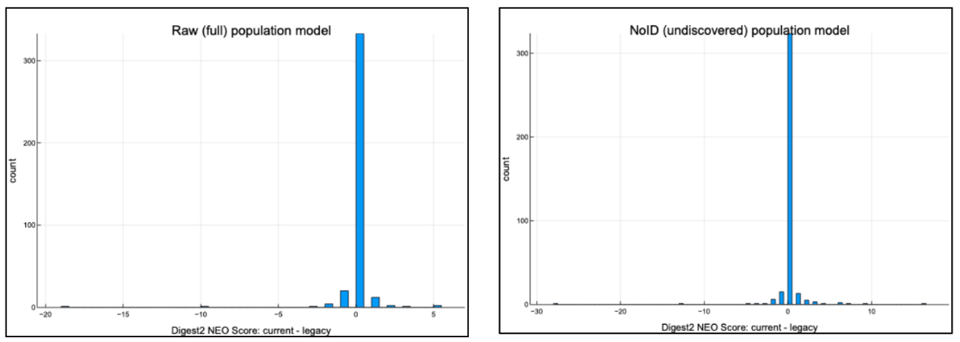
To validate the updates, we performed a systematic comparison between the previous and revised implementations. The differences in the resulting scores are summarized in two histograms in Fig. 1, which illustrate the overall impact of the changes and confirm that the updates behave as expected. The few visible differences are to be attributed to the improved band conversions.
4. Mid-month and monthly publications
The preparation of this month’s publications has been particularly complex, largely due to the ongoing transition to the new ingestion and processing system. While the new infrastructure is already improving robustness and scalability, the migration has required significant internal adjustments and validation efforts. The MPC is actively working to streamline its publication workflows to ensure greater reliability and timeliness. As part of this effort, we are planning to deprecate the mid-month publications and instead increase the frequency of the monthly releases, with the goal of providing more regular and consistent updates to the community.
We have made every effort to carefully validate the data prior to release, and the next batch of publications is expected to be issued within the next couple of days. We apologize for any issues encountered during this transition and welcome feedback from the community as we continue to improve our processes.
5. NASA Infrared Telescope Facility - Semester
2026B - Call for Proposals, Open till April 1 The Call for Proposals for the NASA Infrared Telescope Facility (IRTF) is open March 1 until April 1, 5pm Hawaii Standard Time. https://irtfweb.ifa.hawaii.edu/observing/callforproposals/
Add a comment: