
Newsletter - June 2025
2025 JUNE 30
In this month’s issue:
New interstellar comet: 3I/ATLAS
Vera C. Rubin Observatory (Rubin) first look
New extended packed provisional designation
1. New interstellar comet: 3I/ATLAS
Sometimes being late is not that bad! Thanks to this Newsletter being released a few days after the end of June, we’re excited to include the news of the discovery of a new interstellar comet: 3I/ATLAS.
On July 1, the NASA-funded ATLAS (Asteroid Terrestrial-impact Last Alert System) survey telescope in Rio Hurtado, Chile, first reported the observations of a comet that originated from interstellar space. Rapid follow-up and precovery observations by Q.-Z. Ye (I41) and S. Deen (W68, M22), including data from June, revealed a highly eccentric, hyperbolic orbit (e ~ 6). Tentative reports of cometary activity have been reported from X09 (S. Deen), G37 (Q.-Z. Ye) and T14 (R. Weryk), who noted a marginal coma and a short 3" tail at a position angle of 280 deg.
The comet, arriving from the direction of the constellation Sagittarius, has been officially designated 3I/ATLAS, as announced in MPEC 2025-N12. Additional observations are strongly encouraged to better constrain both its orbit and physical characteristics.
For more information, see:
2. Vera C. Rubin Observatory (Rubin) first look
The Vera C. Rubin Observatory (Rubin) released its first images and data last Monday (June 23, 2025) during a global event. With its 8.4-meter telescope and 3,200-megapixel camera, the primary goal of Rubin is to conduct a 10-year study called the Legacy Survey of Space and Time to capture the changes that will take place each clear night across the sky. Rubin will deliver an unprecedented volume of high-quality observations; in particular it will dramatically increase the discovery rate of asteroids, comets and other moving objects.
On Monday, June 23, 2025, while the entire astronomical community, and beyond, was focused on the release of the first images from the Vera C. Rubin Observatory, the MPC team was busy behind the scenes ingesting the first Solar System data products from Rubin. This milestone marks the culmination of years of intense preparation, including the development of new algorithms and the overhaul of our internal infrastructure to handle the unprecedented volume of data Rubin will deliver in the coming months and years.
Rubin First submission: asteroid observations and new designations
The MPC and the Rubin Observatory’s Solar System Processing team have been working closely over the past months to ensure a smooth and successful first data submission.
As is often the case when systems go live, a few unexpected issues emerged, but overall the process was a success from the MPC’s perspective.
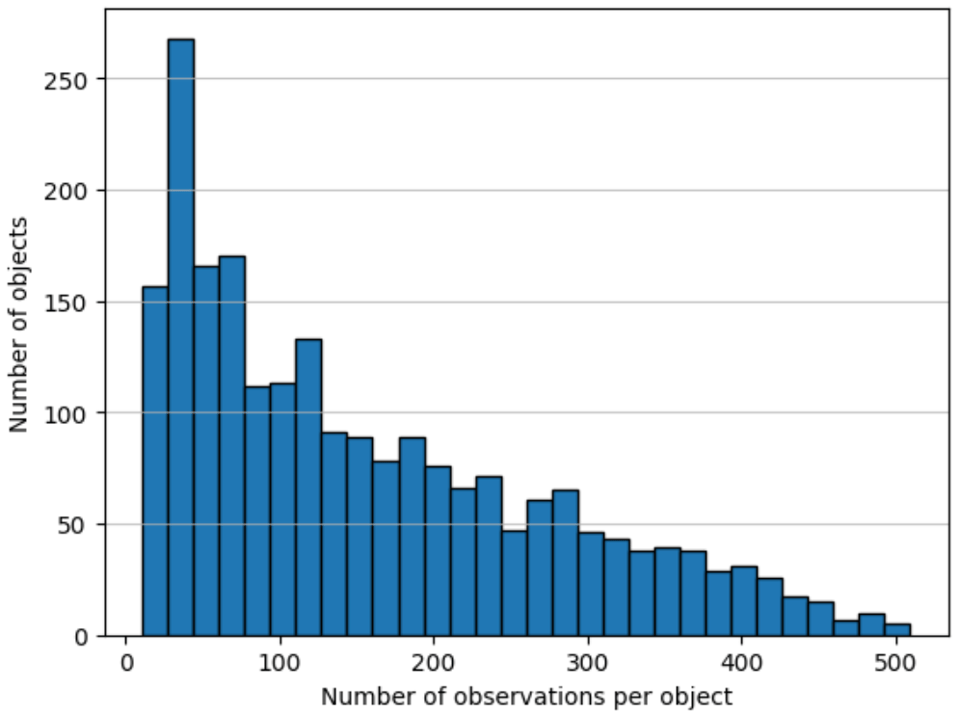
From this first submission, the MPC ingested and published 343,760 observations under station code X05, corresponding to 2,103 unique objects. The number of observations per object in this submission varies widely (Fig. 1), with some objects reaching over 300 individual measurements. This is not representative of expectations for standard Rubin data submissions, but rather the result of the detailed commissioning observations during which these objects were observed.
At the time of submission, five objects were identified by our internal pipeline as known objects, and their observations were successfully linked to their existing entries (2014 HZ261, 2017 OS138, 2017 PF92, 2017 SO299, 2021 BA22). The remaining 2,098 objects were designated and published as new minor planets. Due to a minor issue in our pipeline, now resolved, the designations were assigned using the orbit fitting date rather than the date of the discovery observation, as is our standard practice. As a result, all new designations appear as ‘2025 M*’, reflecting the fitting date. Given the amount of attention the new designations had already received by the time the issue was identified and resolved, we have decided not to retire them.
Rubin First submission: asteroid orbits
From the original submission, we designated seven Near-Earth Asteroids (NEAs). Two of these were subsequently linked to previously known objects. In Table 1 below, we provide the orbital parameters for each NEA, including semi-major axis (au), eccentricity, inclination (deg), perihelion distance (au), absolute magnitude, orbit classification, and any applicable linkage information.
Unpacked provisional designation | Semi-major axis(au) | Eccentricity | Inclination (deg) | Perihelion distance (au) | Absolute magnitude | Linked designations | |
|---|---|---|---|---|---|---|---|
2010 MO19 | 1.317569 | 0.118909 | 3.372177 | 1.160917 | 24.9 | Amor | |
2025 MR32 | 1.335582 | 0.142547 | 9.871866 | 1.145199 | 24.7 | Amor | |
2025 MU34 | 1.147983 | 0.196136 | 4.569041 | 0.922889 | 24.4 | Apollo | |
2025 MK42 | 1.830205 | 0.308730 | 6.560963 | 1.265166 | 20.2 | Amor | |
2025 MJ71 | 2.060241 | 0.371350 | 6.761553 | 1.295170 | 22.7 | Amor | 2022 CJ2 |
2025 ME74 | 1.293032 | 0.102718 | 23.75032 | 1.160214 | 23.8 | Amor | |
2025 MU85 | 2.050721 | 0.560998 | 2.445224 | 0.900272 | 23.3 | Apollo | 2022 SM20 |
The rest of objects are then divided into Main Belt (the majority) and other classes, as shown in Tab. 2 and Fig. 2.
Number of objects | |
|---|---|
Mars-crossers | 16 |
Main Belt | 1830 |
Jupiter Trojans | 11 |
Jupiter Coupled | 5 |
Middle Solar System: Other | 35 |
TNOs | 5 |
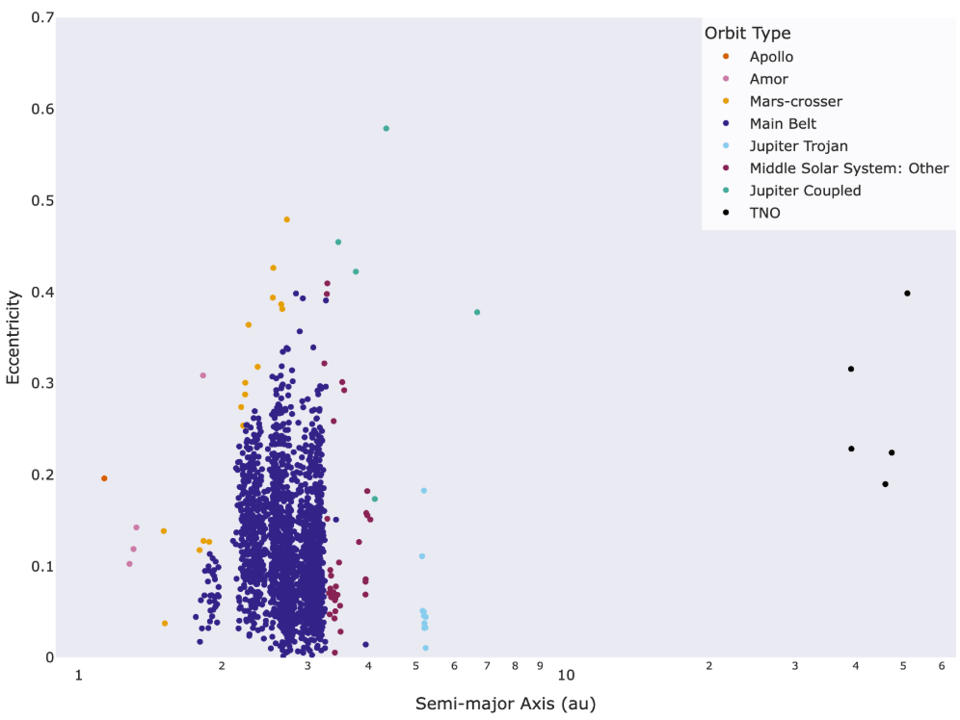
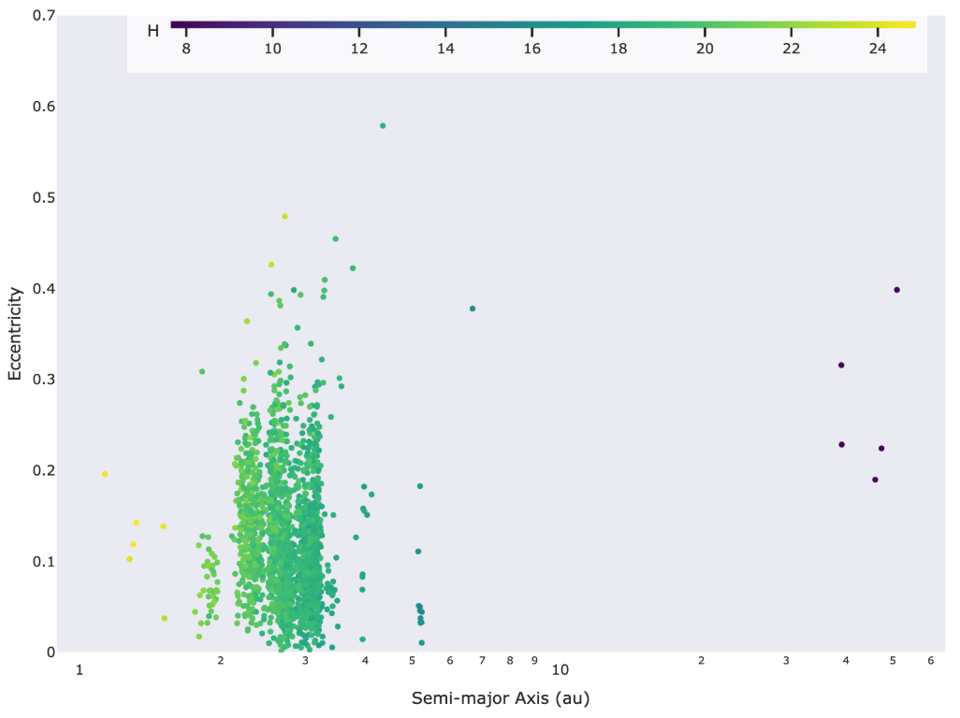
Fig. 3 shows the distribution of absolute magnitudes (H) as computed by our orbit determination code. The magnitude values for the different asteroid populations in Fig. 3 shows a clear concentration toward fainter objects, with the majority of asteroids in the Main Belt having magnitudes between 16 and 22. The sparse population of darker TNOs is also clearly visible. NEAs have magnitudes between 23 and 24, with the only exception of 2025 MK42, which has an estimated absolute magnitude value of 20.
How can you access the data?
All the data are publicly available via our MPC Explorer and our replicated Postgres Table. If you want to know more about all the work behind the scenes done in the past years and months, please take a look at our February 2025 Newsletter.
What’s next?
On Friday, June 27, 2025, the MPC received a second, smaller submission from the Rubin Observatory, consisting of 2,229 observations corresponding to 93 new objects. The processing went smoothly, with only a minor internal issue identified and promptly resolved. To distinguish the quality of the data, the MPC has assigned two different program codes: 00 for the data submitted on June 23, 2025 (V. Rubin PreopsLSSTCam) and 01 for the data submitted on June 27, 2025 (V. Rubin PreopsComCam). All the program code information is available on our documentation page.
This successful test further reinforces our confidence in the MPC's readiness for the daily ingestion and processing of Rubin data in the coming months. In the meantime, we continue to refine our systems and conduct additional testing in close collaboration with the Rubin team.
3. New extended packed provisional designation
In the October 2023 Newsletter we introduced the new format for the extended packed provisional designation. The packing-format originally chosen for the packed provisional designations is limited to supporting only 15,500 new designations per half month (the standard unpacked provisional designations have no such restriction). However, with Rubin Observatory expected to discover up to 250,000 new objects per month during peak activity, the existing packing scheme is no longer sufficient.
To ensure continued compatibility with the MPC’s 80-character record format while supporting the high volume of LSST discoveries, the MPC has developed an extended version of the packed designation format. Full details are available in our Documentation webpage and in the October 2023 Newsletter.
In the coming weeks and months, we will begin assigning designations using this new format. As we did with the introduction of the new packed permanent designation format (e.g., ~0000), we will start by assigning a single object. This controlled rollout will allow us to test all downstream services, including those involved in the monthly publication pipeline. We will then proceed with a small batch of designations (a few dozen objects) before scaling up to support the full volume expected from Rubin.
If you have any questions, please contact us using the Jira Helpdesk.
Add a comment: