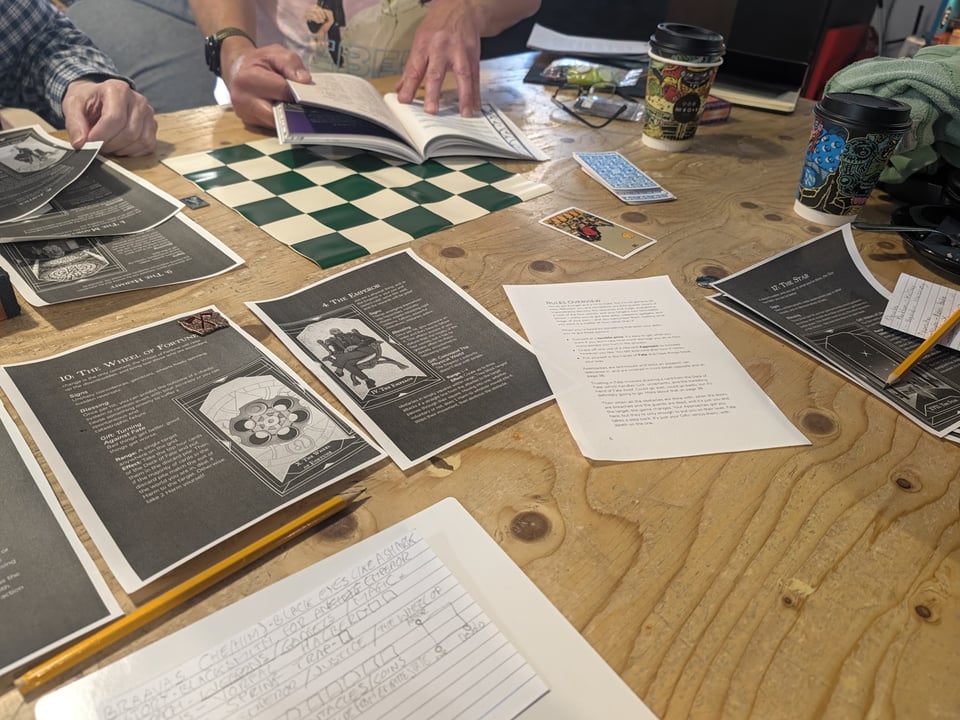
Off we set to a new venue, the cosy Bad Moon Cafe in Borough, London. GrogLaw is the sister/brother of GrogLove, the brainchild of Jim Jim the Grim, Big Dave Paterson and Alex. Approximately forty or so Grogs and younger RPGers gathered outside, awaiting the 10 am opening.
GrogLaw
Morning session: Threadcutters - To Kill the King (Coins)
GM Carl introduced us to a game with no dice. The premise was that we’d survived a cataclysmic event that had destroyed our world and were chasing the perpetrators to exact revenge on a modern-day Earth-like dimension. This action was to be called The Hit.
There's something rather comforting about an English country house murder. A wealthy family, a cast of suspicious relatives, a generously stocked medicine cabinet, and, inevitably, someone who ends up in a rather sticky situation.
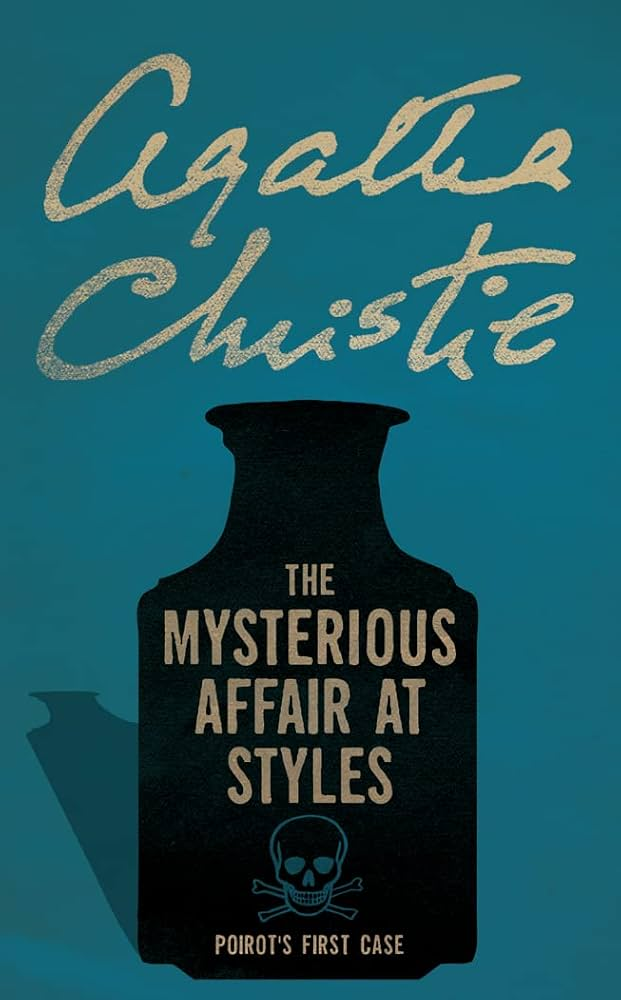
The Mysterious Affair at Styles by Agatha Christie
The Mysterious Affair at Styles was Agatha Christie's first published novel, introducing the world to Hercule Poirot, the frankly annoying and hysterical Belgian detective with an extraordinary talent for noticing what everyone else has overlooked. And, for a debut, it's an impressively inventive piece of detective fiction. Apparently, Christie’s sister Madge challenged her to write a detective novel, where the reader has access to the same clues as the detective but would still struggle to identify the murderer.
Christie constructs an intricate puzzle, scattering clues, red herrings and suspicious behaviour with considerable skill. When you think you've worked out what's going on, another revelation casts doubt on your carefully assembled theory. It's entertaining stuff, and you can certainly see why Christie went on to become such a formidable name in crime fiction.
I’m glad I read Ice. I’m not entirely sure I enjoyed reading Ice.
Massive thanks to The Grognard Files Bookclub and its members for an entertaining morning discussing this, from which I took a lot of inspiration for this review.
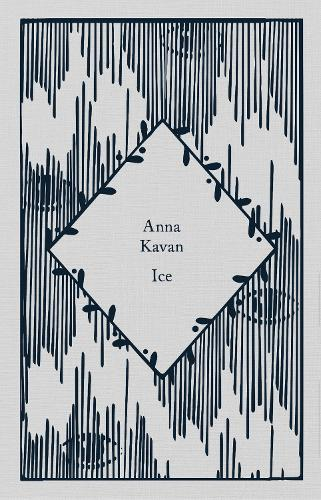
Ice by Anna Kavan
Anna Kavan’s 1967 novel is one of those books that feels less like a story being told to you and more like a dream or nightmare experienced.
A fitting finale as backs are stabbed and King makes his ploy to change Steaming Rock forever.
Apache Reservation
Late at night, Cody, Winston, Dutch Daan and Diago met Curtis Mortimer, Philem Quinlivan and his men at the Homestead Inn.
Word had reached them that Clarence King was planning an atrocity at the Apache reservation. They all wanted to prevent it, some for good and noble reasons, others for personal gain.
In our game of Coriolis: The Third Horizon, one character has built up quite a ridiculous amount of dice (ten) in Data Djinn (hacking computers). It’s got to the point where, along with a push (84% to 97%), it’s nearly impossible for them to fail, so much so that every opportunity and problem is turned over to this PC for some hacking to solve it.
I don’t want this to become combative, whereby I, as a GM, try to stop this, but I do need to recognise I’m being a bit generous in terms of what information I give from a hack. Mostly, I ignore the Limited Success (1-2 sixes) vs Full Success (3+ sixes), treating them as the same, but I think I need to give more or more specific information for one vs the other. Also, I need to introduce complications or consequences in the event of a Limited Success or more extreme for a failure - it shouldn’t just be that you get no information. It may take longer, you may trigger alarms, you may be traced.
A recent game of Coriolis: The Third Horizon filled me with a certain pride. The PCs had just completed a major mission and were recovering in hospital, a bit unsure of where they were, how they’d got there and what was next. The Horizon had heard of their exploits; they’d encountered a certain something that gave them both notoriety but also had many factions after their services.
The aim of the session was simple: present them with a series of patrons and get them to choose one for a series of missions which would make up part three of The Last Cyclade (book two of the Mercy of the Icons).
Labour: The thing you are most willing to work on for a game
Labour
The main item I think I feel I need to work on when running games is the believability of the scene and the characters. I can be quite matter-of-fact when it comes to running a game, and I often need to remember to put on the brakes and give players the descriptive elements, the nuances of a GMC, so that they can react and get into the roleplaying elements. A great example is some of The Dee Sanction scenarios by Paul Baldowski; his one-to-two-page adventures always have a few sights, sounds, and smells that immediately give you a feel for each location or the nature of an adversary. Super simple, but incredibly effective at the table.
The other element I need to work on as a player is my engagement with a game. I can easily drift off as a player, as I enjoy the banter between other characters, or as the information from the GM soaks in and I ponder and wonder about the clues or information. I definitely need to immerse myself in my character and have a consistent and proactive approach to doing something in each scene, also building off of what the other players do and generally being a better player rather than just an observer.
I’ve long been a fan of Gumshoe and horror, so I was wildly excited when Scott Malthouse announced the release of The Terror Beneath (TTB), a Gumshoe Quickshock investigative roleplaying game of weird folk horror, published by Osprey Games.
Arthur Machen, The House of Souls
The Terror Beneath
The game itself is built on the Gumshoe Quickshock rules, which, like Gumshoe “vanilla”, focuses on investigative RPGs, but this incarnation simplifies combat, “cardifies” Shock & Injury pools and removes investigative pools in favour of Pushes. Cardification is a new term that I’ve coined, meaning you receive cards that explain a condition the PC has and how to remove it. Too many cards of a type means death or madness.
I have loads and loads of opportunities to try most games; if I’ve not tried a game, it’s usually qualified by… not yet. When I look at all the games going on on The Raspy Raven, I do think, though, could I squeeze just one more wafer-thin night of gaming in (monsieur)?
Two games spring to mind: firstly, Ars Magica, seemingly incredibly complex and embedded in historical influences, but the bit that gets its hook into me is the dedication to magic, the rituals that may take many weeks, months, years to come to fruition. Whole campaigns set around learning a new spell or discipline of magic. The troupe of GMCs that gather around these events and the players can puppeteer different levels of influence. But I know I’m not to be trusted around a game like this; it would soak up my time like a sponge, send me down the deepest of rabbit holes, and I’d not be satisfied with just skimming the surface. One for deep into retirement, I think.
GUMSHOE. Which may sound odd to people who know me. I play a lot of Gumshoe. Recently, The Yellow King RPG and, soon, a return to Trail of Cthulhu. A Trail of Cthulhu campaign in the Bookhounds of London setting, using The Armitage Files as the campaign basis. I’ve been reading and playing Gumshoe games since 2007, almost twenty years, but I’ve never got bored of them, and I always feel I’m learning something new. Partly, it is due to their simplicity; you can interpret how the core system works in many different ways. Also, it’s the many iterations of Gumshoe; any genre can be satisfied. But mainly, it is the quality of writing and inventiveness of the supplements and scenarios.
Bookhounds of London transplants the investigators into 1930s London. They all play greasy, grubby, greedy booksellers, buyers, and collectors. Centred around their shop, they take on various roles: analysing ancient tomes, searching for new ones, connecting collectors to them, and even attempting to repair or recreate them.
Your preferred distance in any type of RPG conflict?
Distance
I like getting up close and personal in RPG conflict, not necessarily because every fight should be fought at arm’s length, but because danger is most exciting when it feels immediate, specific and personal.
I have only played The Walking Dead Universe RPG once, so this is very much a first impression, but I struggled with its swarm mechanic. It sensibly abstracts hundreds of individual walkers into Swarm Size and Threat Level. As the dead close in, the Threat Level rises, your choices narrow, and the consequences become increasingly lethal.
During our Coriolis: The Third Horizon campaign - Mercy of the Icons, the players accumulated an utterly ridiculous 41 Darkness Points and counting.
Darkness Points are a sometimes dubious way of messing with players: players may push their rolls, praying to the Icons for good fortune, granting them a re-roll, but each time they do, they hand the GM a point with which to make their future considerably less fortunate.
An enjoyable moment of grit PCs did or did not tough out
Grit
In By Endurance We Conquer by Harald Eckmüller, Willem was fleeing a mechanical horror beneath the Arctic ice. A complication meant he could escape, but only by knocking another crew member back into its path.
His player chose instead to fail, accepting almost certain death or dismemberment rather than sacrifice someone else. He invoked one of his Burdens, made the roll a complete success, and both men escaped.
Share an RPG charity, past or present, that moved you.
Charity
I’m going to link to Dirk’s page on the Mike Hobbs Memorial Fund. I never knew Mike - more the pity by the sound of it - but at many grog cons I go, his name lives on. We browse his and his friends’ collection, whilst contributing to a wonderful charity to keep schools and youth groups in RPGs for many years to come.
In Dragonbane, our group started as decent sorts, always willing to talk to mild NPCs and discuss various turnip-related gossip.
We’ve killed a lot of monsters in the intervening sessions, and maybe those that weren’t really monsters, but they perhaps stuttered when we asked them probing questions, or they just had a look in their eyes.
We’re going to follow Nantz, a character played by Nantz in our mini campaign, Into the Dust, The Electric State RPG. A frankly odd idea for an RPG: a road movie RPG. We travel through a post-Civil War USA that is rapidly regressing to a broken, messed-up society anesthetised by its technological advancements. Nothing like the real world then.
Directness: A fast introduction of a new PC or player?
Directness
This is always a question in OSR games. How do you introduce a new character in a seamless and immersive way when the expectation is that at least one person is having his curtains measured, about six feet by two, every session?