One thing that will cause a character to lose their composure?
Composure
I’ve just done a session zero of Stonetop, and my character Eadgyð (Edith or ED-Yith) is a fox - a criminal with a conscience. Brought up in a nearby town by gangs and unlawful filth after she lost her parents at the age of five. Betrayed by her best friend, left for dead in the fens. She survived. She is tough and resilient; she made her way to the rural town of Stonetop. Trying to make a new home, forget old ways, but what could ruffle that composure?
For now, I’m considering her poised on the knife-edge of settling down versus the chaos that can destroy all of that, her past both her own personality and the people she hopes she escaped from.
What is a game held in high regard that you have yet to play?
Regard
I’ve never played a Without Number game, and people that I respect in the hobby always sing their praises. In particular, Stars Without Number, seemingly a definitive Space anything, sci-fi anything game. Am I being snobby about a game with such a corporate, dull-sounding name? I also have many sci-fi games that I love: Those Dark Places, that I enjoy playing; Mothership and that I’m nostalgic about; Star Frontiers or have a love/hate relationship with; Traveller.
So is another, however highly rated sci-fi game, needed?
So far, what is the heaviest set of RPG things you have carried to play?
Strain
Well, easy one: Haunted West. I picked it up at Dragonmeet a few years back, a super deal from Leisure Games. It is a humungous tome, a two-handed RPG rulebook. I really should delve into it more as I’ve been loving Tales of the Old West and I am sure there are many things to mine from within Chris Spivey’s book; he of the amazing Harlem Unbound, how can it not?! But maybe it could have been split into a few volumes for ease of use and protection of my back muscles.
More recently, I’ve realised that Blade Runner requires a solid duffel bag to lug around grog cons. Firstly, if I’m running, as I have been with Blade Runner: Replicant Rebellion, see issue No. 59 of Never Mind the Dice Rolls for my review, then I need those rules, plus I also have to take the original rules AND the Asset Pack AND the GM screen. Oh, and the fancy eye/unicorn dice.
Most things end. What is one RPG loss you still feel?
Loss
I have an ambivalent feeling towards RPGs, especially when looking back. I enjoy them more in the moment; the memories fade quickly. This doesn’t mean I don’t take them seriously or want the players to have fun, just that to me, they are games; there are many other things in life more important. So this theme was a little difficult.
I suppose I could list unfinished campaigns - Eternal Lies, Cassilda’s Song. There is a bit of a completer-finisher in me that regrets not getting to the end, but then again, you need to sometimes cut your losses if the games aren’t giving you what you need.
A character made great by having or not having tact
Tact
Our forever GM on a Sunday- well, it is a shame he is a forever GM, because his characters are always in your face and have a variety of UK accents.
Their character may start quiet, even timid, with no inkling of what is to come. They work well within the party, performing their designated role, stepping forward into danger as required.
Or came out about a character. When playing Eternal Lies, the epic Trail of Cthulhu campaign, we unfortunately had to say goodbye to three of the players. I asked them all how they wanted to go out. The vicar decided on an image of him standing on top of the Griffith Observatory as liquid fire ran down his hands from a Mythos tome above his head, just as the sunset. The criminal decided it was time to take everyone out, so she was loaded down with grenades, and our professor was open to anything.
That night, we had one new player join. At the end of the session, the vicar was a steaming pile of ash, the criminal was scattered to all corners, and the professor lay on the ground with a fatal knife wound, as the remaining PCs gathered around, open-mouthed and shell-shocked.
Give one reason why it is a privilege to play with your group
Privilege
Privilege is playing with people who follow the fiction to develop a story and maximise the fun.
By that I mean they don't spend every moment asking, "What's the highest modifier?" or "How do I beat this encounter?" Instead, they ask, "What would my character do?" and "What makes the most interesting story?"
A moment when a character kept or broke their resolve?
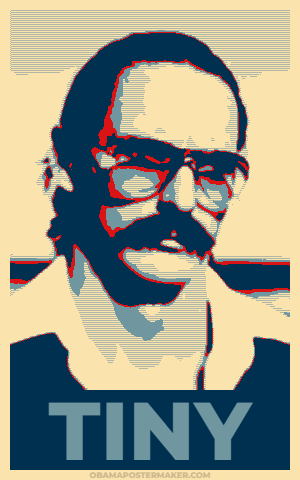
Vote Tiny
Tiny was played by Jon in our Yellow King RPG campaign, Cassilda’s Song. Not yet released. Jon was playing in the Aftermath setting; see Day 3 for details.
In this particular setting, we had to define a Goal, a political goal for the group. The group decided on Get Tiny Elected! Tiny was a somewhat focused and brutal character, and as the setting progressed, his methods became more agricultural, wiping aside opponents or enemies with his gun.
The title isn't just evocative, as it captures one of the campaign's central paradoxes. The Order of the Pariah, known throughout the Third Horizon as the Samaritans, are feared and distrusted by many. Yet on Coriolis Station they offer free medical care to anyone in need, regardless of wealth, status or faith. The people many see as villains are also those who heal without asking for anything in return. It's a wonderful reminder that mercy often comes from the places we least expect.
What burden is a character willing to carry until the end?
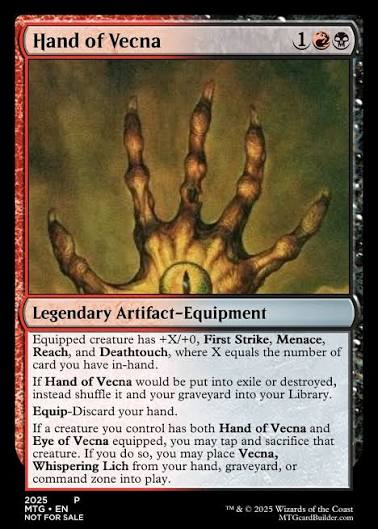
The Hand of Vecna
Takes me back to something my character was burdened with, but it was nothing but his own fault. Wigjack was the name of my character, nothing but a simple farm boy to begin with. I remember we used Four Against Darkness, a solo RPG that also had some quite decent rules for randomly constructing dungeons from dice rolls; our GM used this to create a crypt near our village. Well, after vanquishing the skellybones and others, we inadvertently awakened a great evil and headed off to the big city to see what we could put right. The system itself was Dungeons and Dragons 5e, but a homebrew within the Eberron setting.
Here it was that Wigjack was offered an artefact of wondrous magic (and great evil, though the GM neglected to mention this). Wigjack was entranced and performed the various surgeries and painful invocations to have the above artefact attached.
A cut down session as we focus on Sheriff Cody Joyce and Reverend Diago Carter, due to unavailability of others and line up our finale on the 31st August.
We join as Diago makes his way to Caleb Burrows’ General Store. He waits for a quiet moment and then approaches Caleb, he needs guns, lots of guns. Caleb takes him into the back and gets young Tom to man the front. They partake in a fresh bottle of whiskey.
Caleb looks disappointed, “All our guns and ammunition have been purchased by Mr King, next stock's due end of the month. Sorry, Diago.”
I have to plump for Yineve, Yineve Dol-Gara, an operative (spy) in our Mercy of the Icons campaign for Coriolis: The Third Horizon. She has excellent skills in manipulation and culture, and she is the “captain” and mouthpiece of our group.
An immediate reminder of Graham’s character, Arthur, in our The Yellow King RPG campaign and playtest, Cassilda’s Song. Cassilda’s Song is a multi-setting campaign that has not yet been released, but I believe, at this point, art is being commissioned and who knows - maybe a 2026 or more likely 2027 release from Pelgrane Press; they have a lot of stuff coming out.
We were playing in the Aftermath setting, which posits that a fictional version of the USA had undergone a rebellion, overthrowing an evil dictatorship that had existed for a hundred years. So the PCs were all ex-insurgents, trying to rebuild a fair and democratic government, whilst the influence of the old regime remained, along with evidence of it dabbling with alien powers.
What does one character’s stature in their community mean to them?
Stature comes in all shapes
Back to Tales of the Old West, it’s fertile ground for RPG thoughts. Now, how the community relates to a character in this game is of prime importance. It can define the growth of the settlement through settlement points dolled out at the end of each season. Also, through the Turn of the Season, the players become more and more invested in the town; their stature grows. They choose the amenities to build; they may even buy up or invest in businesses and buildings. They’re invested. When gangs come to town looking to cause chaos, they’ll need no prompting to get involved.
This is what I’ve loved about this campaign: each of the characters has come to be a focal point of the community, and in return their growing stature means they are finding it difficult to just run away and leave the townsfolk to their fate. Genius system and setting.
Share a character or fellow player who is a strong example of discipline.
Sheriff Cody Joyce
When I think of discipline, I think of Cody, once Deputy and now Sheriff of Steaming Rock, New Mexico. He's part of our Tales of the Old West campaign, The King of Santa Fe, and is brought to life by Gemma, one of the players in my excellent Monday night gaming group.
Cody shows discipline alongside a flawed humanity. He's done several terrible things, but he's always there in his Sheriff's office, serving the townsfolk. He navigates the town's politics, rival gangs and deadly shoot-outs with quiet determination. Yet he never shirks his duty. Even after murdering a down-at-heel embezzler to clear his debts, Cody doesn't run from the consequences or abandon his responsibilities. The next morning he's back in the Sheriff's office, trying to hold the town together.
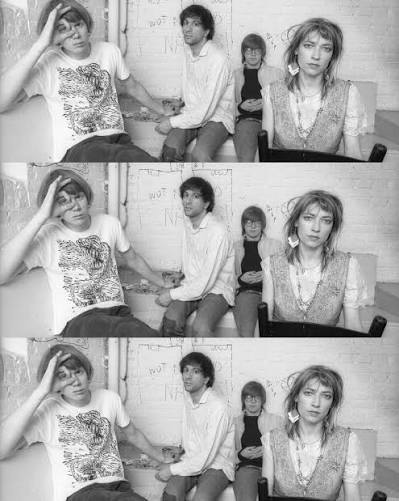
The life and times of singer and guitarist Thurston Moore, from the band Sonic Youth. An important band for me for many years. I’d lost touch with their output after Experimental Jet Set, Trash and No Star in 1994. But there have been seven albums since this, so an opportunity to catch up and find out what they’d been working on.
As of July 2026, they are still on hiatus, and everything points to it being permanent, but you never know.
Sonic Youth
This is, at turns, a deeply personal book, whilst missing out a lot of personal details. I don’t remember many, if any, anecdotes that showed Thurston’s interaction with his other bandmates, apart from Kim. Was Steve Shelley even in the band? I get no sense of either his or Lee Ranaldo’s personality. I suspect this is intentional; there are moments when Thurston jousts with the press, proud that he’s discombobulated a journalist enough so that they got zero copy or at least, no juicy gossip from an interview.
Unfortunately life has intervened and two of our players are missing the final, two-three sessions. So we begin with Diago, Cody and Winston.
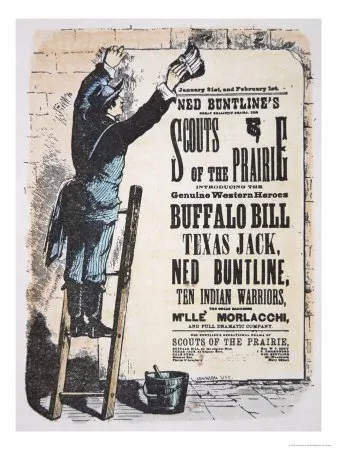
Winter is coming to an end. The Scouts of the Prairie have been a big success, drawing crowds from across the towns and villages of this remote area of New Mexico.
The idea came about when I was on holiday up in Yorkshire, seeking respite from the brutal summer temperatures. A few weekends previously, I’d been talking to my cousin about their kidney stones. It sounded miserable, and they’d bemoaned whatever they’d done in a past life!