Off we set to a new venue, the cosy Bad Moon Cafe in Borough, London. GrogLaw is the sister/brother of GrogLove, the brainchild of Jim Jim the Grim, Big Dave Paterson and Alex. Approximately forty or so Grogs and younger RPGers gathered outside, awaiting the 10 am opening.
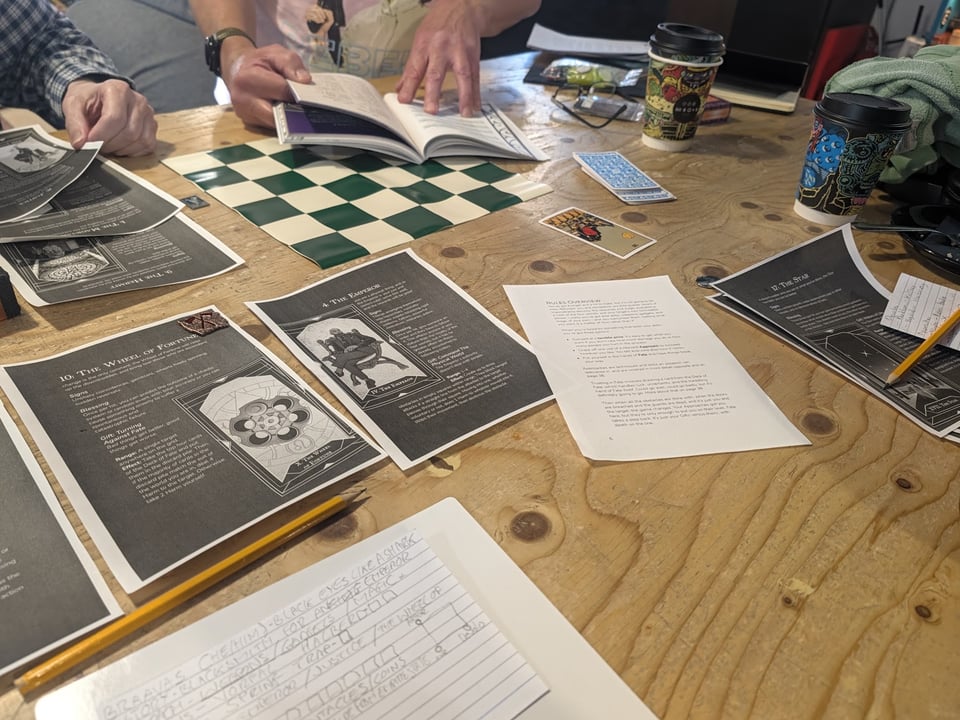
Morning session: Threadcutters - To Kill the King (Coins)
GM Carl introduced us to a game with no dice. The premise was that we’d survived a cataclysmic event that had destroyed our world and were chasing the perpetrators to exact revenge on a modern-day Earth-like dimension. This action was to be called The Hit.
Threadcutters is a simple system that uses a Tarot Card in place of dice. But it can become very complex in its interpretation. Our characters had a name/pronouns - Braavas (he/him), a unique feature - black, shark-like eyes and a history. I originally thought this was classic fantasy, so I went for Braavas being a blacksmith to the emperor of the dimension that he’d escaped from.
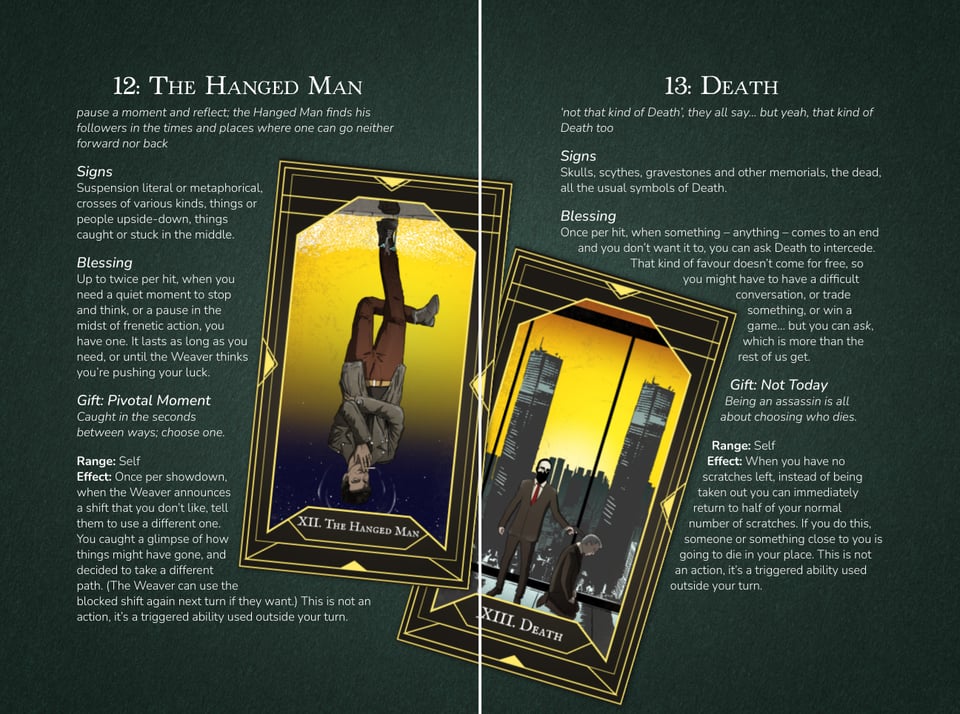
Then we chose our approaches - weapons, magic or gadgets. I went for two slots of weapons, a vorpal halberd, and one slot of gadgets - a razor spring trap.
We were given 8 scratches (hit points) and selected three arcana - these were essentially tarot cards - Justice, The Emperor, etc. They had multiple elements - keywords that would be used if we drew them; more of that later and blessings, a special ability that could be used in a limited capacity in the hit. Separately was The Gift, but this was for a secondary part of the scenario.
With our characters created, we introduced them and then a bit of card setup by Carl that included the tarot cards we’d selected and our hit - The Queen of Pentacles, aka Cups, also aka Gloria, but we find that out later.
Carl set the scene, and then I embarrassingly realised I’d created some leather-clad, wronged Blacksmith with a big weapon and placed them into modern-day New York. So I swapped the leather for a sharp, 1960s grey zoot suit and some shades to cover the shark eyes. The halberd and spring trap went into a large tradesman’s toolbag.
We were told that the hit was in an impenetrable skyscraper, adjacent to the Empire State Building; the starting situation was to make our way to the top of the Empire State, paraglide down to the hit’s building and search for her on the rooftop penthouse. Easy.
First challenge: overcome the security guards to get into the lift. We handed things over to Devolo, played by Lloyd, who was some kind of protoplasmic amoeba in human form and had the gift of seduction. Devolo had also placed small lumps of them into each of our ears. A perfect comms headset, if a bit slimy.
We headed up in a lift, our team completed by Arthur - played by Andy, a gadget geek. Halfway up, the doors opened, and we saw, from our service lift, the express lift doors opening and a series of armed guards eyeing us and talking into walkie-talkies. Braavas shouted out the lift’s cable, and it plummeted to the bottom with an almighty explosion.
It’s worthwhile pointing out the core mechanics at this stage: no dice, so how do we know if something risky succeeds or fails? Well, we decided, sort of. There are always three choices in this situation: 1. Success but accept a terrible consequence; 2. Use an Approach (tick off a Gadget, Weapon or Magic slot); 3. Use our Blessing from one of our three Arcana / Tarot cards, or 4. Put yourself in the hands of Fate by drawing a Tarot card. Mostly we went for 4, trying to twist the description in the card to our advantage to narrate the success, which sometimes the GM is convinced by and other times not - Devolo, “I turn into my amoeba form and spread myself across the whole of the skyscraper to monitor the comings and goings of all threats.” GM, “Ah, no.”
The game then progressed through a series of challenges and scenes thrown up by the GM, and we did our best to thwart or avoid them. A few memorable ones included Braavas bringing down the Empire State Building onto the Hit’s skyscraper to neutralise Gloria’s own hit squad, then burning through four floors to find out which panic room Gloria was hiding in - each floor was full of precious works of art or irreplaceable historical artefacts. By this time, my PC had been rechristened the Monster.
As we finally found Gloria, we switched to a tactical game - a grid with ourselves and Gloria, with a few obstacles. We could only move orthogonally and not diagonally. Only one space at a time. We could now use the Gifts of the three arcana/tarots we had chosen. It was close; Braavas was eventually taken out, but Arthur and Devolo completed the hit, avoiding the various powers that Gloria threw at them.
An overall excellent and entertaining game, Carl explained there was a campaign wrapped into this and bemoaned the lack of a specialist Tarot deck, but it didn’t detract from the fun, and a big thanks to Carl and my excellent fellow hit men: Andy and Lloyd.
Afternoon Session: Trail of Cthulhu - Exit Wound
Trail of Cthulhu has a second version, a recent backerkit, and backers have just received the PDFs, with print soon to follow, so this has excited me enough to start rerunning Trail con scenarios and campaigns. Exit Wound is a dark, hopeless scenario for the supplement Cthulhu City. Great Arkham is the city we speak of, but an Arkham that has been overtaken by eldritch forces and whose citizens can never escape and live in fear of the rulers of this grim place. Think a Warsaw Pact city during the Cold War.
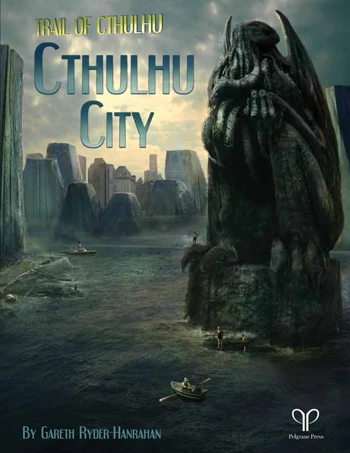
I wouldn’t want to give too much away; it’s a cracking adventure, with difficult moral choices and fantastic opportunities for epic action scenes, but an overarching feeling of dread as you navigate the various districts and meet the grim inhabitants of Great Arkham.
Gumshoe itself, the core system of Trail of Cthulhu, is simple enough. Investigative abilities define your character; use these by telling the GM what you are doing in a scene, if there is a relevant clue, or sometimes, with a munificent GM, the ability is not relevant but sounds plausible and cool, then you get the clue. No dice rolling. The fun then begins in deciphering what the clue means and figuring out which set of breadcrumbs to follow.
The other side of Gumshoe mechanics is action. A simple six-sided die is used to decide an outcome; a four or more is usually good enough, and you can spend pool points from a range of General abilities to load things in your favour, until you run out.
Cthulhu City expands the mechanics slightly with Suspicion, a heat mechanic, bringing the investigators’ mistakes into the light of the police and authorities. I decided not to use this for a one-shot, as it probably works best in campaign play. Secondly, Cthulhu City expands on the Investigative Abilities, giving PCs intimate knowledge of Old Arkham, Kingsport, Innsmouth or other districts.
Suffice to say our diligent investigators: a Professor of folklore, a Journalist investigating Barnabas Marsh and his business, a Detective specialising in missing persons and a clerk with an iron will to follow procedure progressed without hiccup through the mystery. Until the final scenes, Professor Lake decides that betraying your friends for a way out of Great Arkham was an opportunity not to be missed. Our journalist may or may not have saved the day, but they ended up in the sewers under the Marsh Refinery, hoping against hope they could find a way out, whilst something slithers in the dark. The Clerk and Detective did make good their escape, a hail of bullets missing them, as they plunged into the darkness.
They never got to meet Jenkins, their police liaison, which is maybe just as well.
A big thanks to Howard, Carl, Dave and Jon for throwing themselves into the setting and their characters.
The Venue
We have shifted around, trying to find a suitable and reasonable venue in or near central London, and the latest choice is, in my opinion, a good one.
It’s a 20-minute walk from London Bridge, or hop on the No. 21 Bus that drops you a couple of minutes from the venue.
We entered at 10 am and found a large, bright space; the front area was reserved for us, with around 12 tables for 4-6 people. Behind us was a smaller reserved area for a birthday party of well-behaved youngsters, and beyond that, 3-4 long tables and stools for wargamers. There was even a painting and craft area right at the back, with large stocks of board and war games, less so RPGs.
Tea and coffee plus some lovely fresh cakes and an array of tuck were on display, and for lunch: toasties and pizzas, all freshly made and excellent. In the afternoon, I tried the excellent IPA.
Toilet facilities were limited: two single loos, one for disabled visitors and a single sink, but I never had to wait.
At the table, whilst it was busy and I had to raise my voice, it was better than many venues - and according to others, away from the larger tables we were on, the sound wasn’t a problem. The whole vibe was welcoming, with really friendly and knowledgeable staff.
It’s a real task to find a good venue in London, but I do think that GrogLove/GrogLaw is on to a winner here with Bad Moon Cafe. It cost each of us £15 for the day, 10 am to 6 pm, which I think is excellent value.
Thanks again to the organisers, GMs and players for a great day of gaming; roll on GrogLove in Feb!
You just read issue #212 of The Raspy Raven Rag. You can also browse the full archives of this newsletter.
