
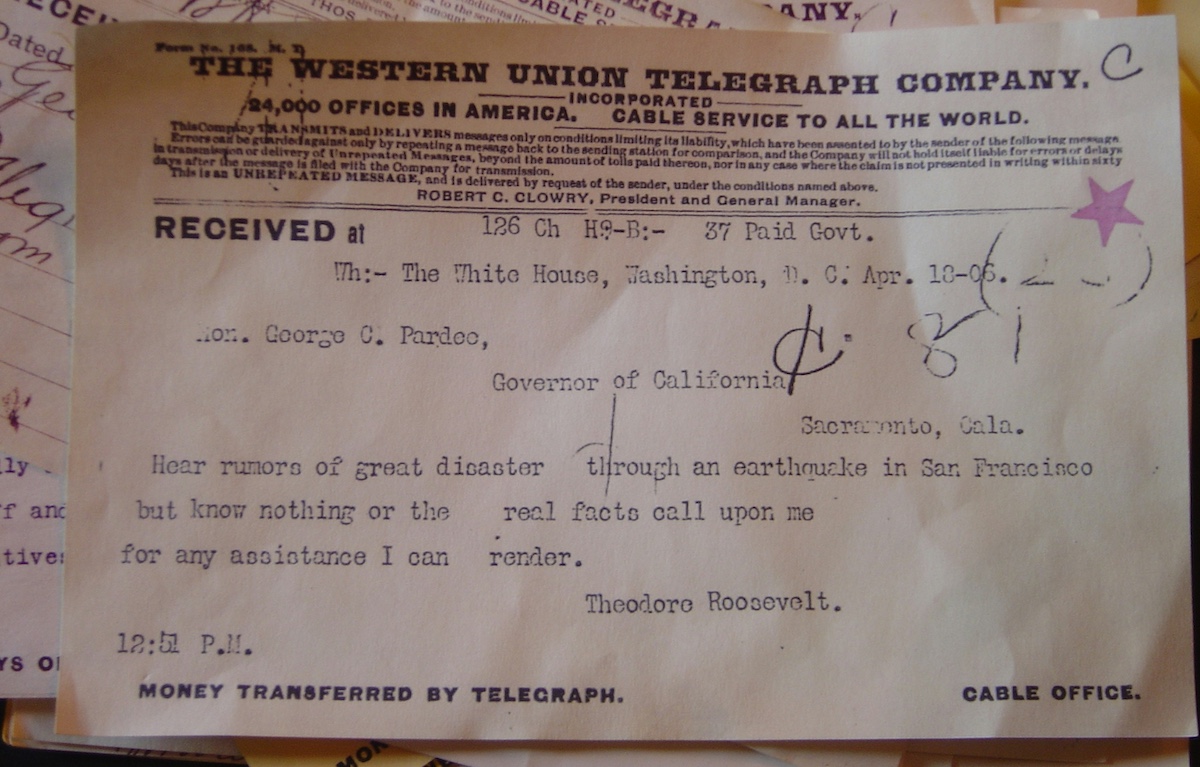
By the time California learned that Abraham Lincoln won the presidency in 1860, after the news traversed the continent on Pony Express for eight days after the election, South Carolina had already declared the election a “Hostile Act” and Georgia had appropriated $1 million to arm the state. The West Coast was in blissful ignorance of the unfolding cataclysm. News, in those days, ran on something closer to The Economist’s weekly schedule.
The next year compressed time and space down to the speed of light, or nearly. The transcontinental telegraph linked the continent by wire, and in 1861 a message sent at 7:40 PM from California was received by the White House by 11:30 AM the next day, after being rekeyed and retransmitted by the dozens of stations along the route.
No more waiting a week for news, now that we had a way to write (graphe) from afar (tele).
“This mode of instantaneous communication must inevitably become an instrument of immense power,” quipped its inventor, Samuel Morse, “to be wielded for good or for evil.” The government rebuffed his overtures to sell the telegraph to the Postal Service for $100,000. What use had the government for a network, when it could deliver letters on paper more profitably?
Little did it know that electric bleeps, dots and dashes, would shape the dawning Information Age, that the telegraph would teach the world how to live online, decades before computers, that the government would one day fund the research that built the early internet and in so doing spell the death knell for the technology that first made the world a smaller place. That email would, one day, bring instantaneous communication and its immense power to your pocket, filled with lingering hints of its telegraphical roots.
On a shorter, faster note
Email, at its birth in 1971, was a revelation. Here was a way to put a message on someone else’s computer, instantaneously. We’re social creatures who like to talk. Little surprise, then, that email accounted for over 75% of ARPANET’s traffic, a half decade after it was invented.
But email, for all of its novelty, did not invent real-time communications. That honor lay with the telegraph, with a message sent instantaneously to a recipient 44 miles away, at its inception in 1844.
The telegraph was spartan, utilitarian. It worked on the simple principle of closing a circuit. The same way you close a circuit when you flip a light switch, sending current through the now-connected wire into a lightbulb, the telegraph’s key closed a loop and sent a pulse that powered a buzzer on the other side. Morse, in an early approximation of binary 1’s and 0’s, abstracted the alphabet into dots (quick buzzes) and dashes (longer buzzes). They and the silence between turned a circuit into a communications system.
All that was left to do was to string copper wire around the world, and it’d be theoretically possible to message anyone, anywhere in the proximity of a telegraph station, almost instantly.
As long as you didn’t have too much to say, that is. Each letter required 3-4 taps; it might take a minute to type out a ten-word sentence. The standard fee for a telegram thus included 10 words, then charged extra for each additional word. Not surprisingly, at the turn of the century, 56% of telegrams contained 10 words or less; a mere 4% included more than 25 words.
Email, decades later, did not need to inherit telegram’s brevity, as there’s more-or-less no character limit to emails. It was, however, born into a more casual world accustomed to doing away with niceties and speeding things up with acronyms and abbreviations, a trend that started with telegrams.
fwd was used for forward, for example, at least by 1901 in The Telegraph Instructor, an abbreviation that email would adopt in forwarded email subject lines. msg stood for message, only decades later for SNDMSG to be one of the first email agents and msg one of the earliest all-in-one email applications. mk stood in for make, shorthand familiar to any early email sender and any modern Terminal user. And the r shortcut for reply in Gmail and other email apps? That was the default way to write received in a telegram, as a one-letter read receipt reply, later to be vocalized as “roger” in audio read-outs and on radio (re, the common reply prefix in email subject lines, it turns out, wasn’t from telegrams, but rather was an older shorthand from the Latin “in re” meaning “in the matter of”).
Some other less-email-specific abbreviations entered the vernacular thanks to telegrams. POTUS for one, that and SCOTUS which was first used in an 1879 book of telegram codes to stand for Supreme Court of the United States. Telegram code books were a whole industry, for a time, with a 1948 piece mentioning hundreds of thousands of abbreviated codes, including a private code for a business with over 400,000 five-letter combinations that took two years and $100,000 to complete.
“The telegraphic style banishes all the forms of politeness,” bemoaned French author M. de Courcy. Businesses could hardly care. One could save politeness for formal letters and the boardroom.
When every word was literally worth its weight in gold, it was worth investing in ways to say fewer of them. Codes went so far that some stood in for complete sentences, something early email would adopt in a sense with Subject is message header acronyms. And the habit would live on in tech’s love of shortened lingo, and in modern tools like TextExpander to quickly enter sentences or complete template emails from a quick keystroke.
A message, if you can keep it
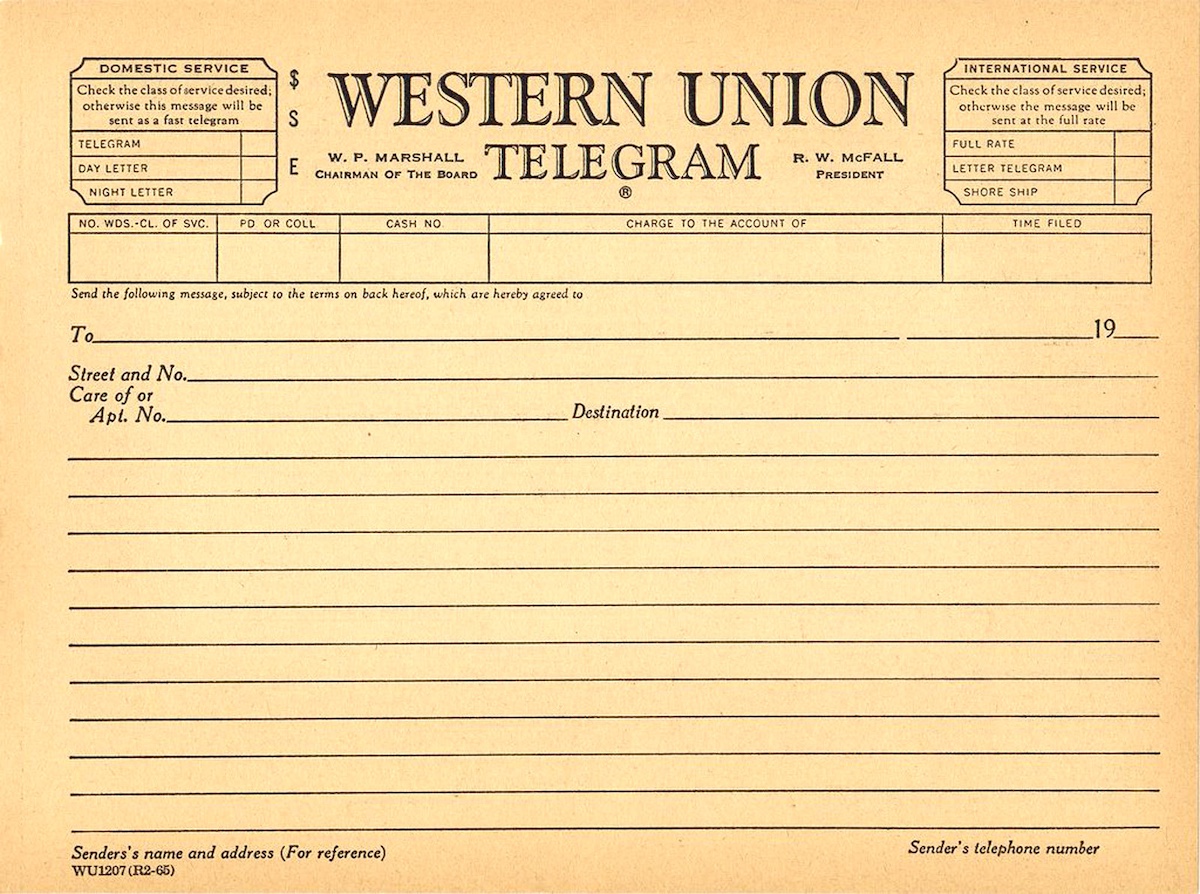
Telegrams at one level were just letters, with a message and recipient’s address. But they held the promise of more.
One year before the telegraph’s popularity peaked with over 200 million telegrams sent in 1929, the book How to Write Telegrams Properly listed the many ways in which one could do more with a telegram than you could with a letter.
You could get notified when your telegram was delivered, by requesting “Report Delivery” when sending your message, something email would later copy with delivery and read receipts.
You could telegraph a person anywhere, without a specified location, as the “Messages for persons on trains” section outlined. You’d send the message to, say, someone riding from Chicago to LA, and the telegram would be delivered the next time their train pulled into a station.
And you could use an early form of carbon copy to start a newsletter, with telegram’s “Multiple messages” option. “If you wish to send the same telegram to 20 different persons, or 200, or 2,000, it is not necessary to prepare 20, 200 or 2,000 separate telegrams at considerable cost of time and money,” the book suggested. “At no additional expense, the telegraph company will prepare the messages for separate handling, with as much speed and accuracy as if only a single message were filed.” It went on to claim that the largest mass telegram mailing included 200,000 recipients—a rather large mailing list even for today.
Telegraphic messages, organized with early header info and broken down into distinct dots and dashes, also provided inspiration for the earliest of information science. Claude Shannon, in his Mathematical Theory of Communication, used the telegraph as his basis for quantifying what we’d come to call data. “Teletype and telegraphy are two simple examples of a discrete channel for transmitting information,” opens the first section. He suggested that “one could save about 50% in time by proper encoding of the messages,” in approval of both telegraphic short-codes and future compression algorithms.
The dots and dashes inspired a logical way to count information: “If the base 2 is used the resulting units may be called binary digits, or more briefly bits, a word suggested by J. W. Tukey,” concluded Shannon. Little could he imagine that a century later, Gmail messages could include as many as 200,000,000 of those bits.
Businesses built around telegraphs were some of the earliest to embrace email, in an attempt to disrupt themselves before their dots-and-dash business disappeared. The American Telephone and Telegraph Company—what we know now as AT&T—incubated many of the technologies that led up to email, including the UNIX operating system and its original mail command, at Bell Labs.
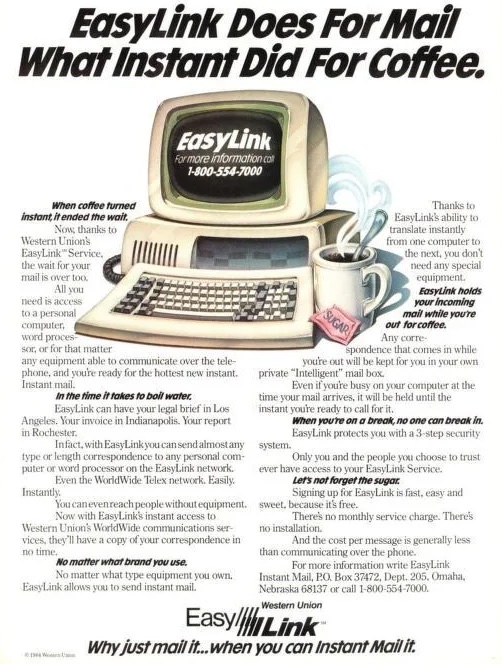
Western Union, the money transfer service that got its start as the original telegraph service, was early to digitize albeit in a less research-driven manner. It had automated sending telegraphs with Plan 55-A as early as 1948. It was the main contractor building AUTODIN, a pre-ARPANET network, for the US military. And it even invested $150 million to build its own email network, EasyLink, in 1982.
EasyLink included features that email, mercifully, still doesn’t include today. Live typing, for one. “Under the new system, a message will appear on a recipient's screen as the sender is typing it - unless the recipient is using the computer terminal for another purpose,” mentioned a New York Times editorial about the service. More importantly, it was built to deliver mail between otherwise incompatible systems. Not just computers, but also “E-COM, TELEX, electronic mail, International Cablegrams, and Mailgrams (telegrams over the mail),” for over 70,000 customers, said a PC Week article in 1984.
It was too much, and not enough, all at the same time. Growth was “substantially less than some have predicted,” said analyst H. Paris Burstyn. The reason? “People just seem to like paper. Habits are hard to break.”
That, and by the time people truly adopted email, it was on personal computers on their desks and later in their pockets, a world difficult to plan for by a company that for a century had turned electronic dots and dashes into paper messages.
.-.. . --. .- -.-. -.--
42 years after the first email was sent, the life, universe, and everything of telegrams came to an end. Western Union shuttered its service in 2006 after sending only 21,000 telegrams the prior year; India’s was the last telegraph standing, until it too folded in 2013. The telegraph wires that once ran alongside railroads had long since fallen silent. The last few decades worth of telegrams were sent digitally, first on teletypes then computers, delivered in the end for the princely sum of $10 a message.
Left in its wake were societal changes, the always-on news cycle, abbreviated lingo, and instant messaging to anyone, anywhere. We’d learned to live with corporate-intermediated privacy, where your message to another was somewhat private but also read by operators. “Our inventions are wont to be pretty toys, which distract our attention from serious things,” worried Henry David Thoreau in Walden, concerns that apply as equally to modern communications as they did to the telegraph in his day. “We are in great haste to construct a magnetic telegraph from Maine to Texas, but Maine and Texas, it may be, have nothing important to communicate.”
The telegraph’s descendants allowed more verbosity (except for original Twitter, and even its early 140-character limit was generous compared to a telegram’s 10 words). But it was easier to be succinct, when life had you running to and fro. “As if the main object were to talk fast and not to talk sensibly,” sighed Thoreau.
We’d connected the whole world, “annihilated both space and time in the transmission of intelligence,” as the Transatlantic telegraph cable, in 1868, was said to have done.
Nothing would ever be the same.
| Image | Credit |
|---|---|
| Header photo | Chris Boyer via Unsplash |
| EasyLink ad | |
| Telegram blank | James Vaughan via Flickr |