

Sending a telegraph from downtown to uptown Manhattan took up to an hour, according to an article from 1897. That same message carried across town by courier could make the journey in 33 minutes. There was a third option, though. One that was eight times faster than hand delivery and 15 times faster than a crosstown telegraph.

A postcard placed atop a pile of 500 letters tucked inside an 8-inch diameter tube, sealed and loaded by a “Rocketeer” from the Tubular Dispatch Company, could be whisked away by 8psi of air pressure into a network of tubes buried five feet beneath New York City sidewalks. This pneumatic mail carried letters and postcards along at 35mph, traveling from origin to destination in under five minutes.
Pneumatic tubes, like email, were touted as the quintessence of human communication. Postmaster General Charles Emory Smith couldn’t imagine anything better and, in 1900, predicted the tubes would one day link every household to each other. There were plans to build a connection across the Atlantic, where pneumatic dispatch already handled mail in London, Paris, and Berlin. At NASA, air-powered tubes were used to send messages from backoffice support to mission control. The CIA’s pneumatic tubes ferried more than 7,500 intraoffice messages back and forth, every day. And as recently as 2011, the soft hiss of a pneumatic tube would accompany the arrival of your child’s Happy Meal at a McDonald’s in Minnesota.
Like a Swiss Army knife that can handle any job poorly, pneumatic tubes thrived for nearly half a century as the go-to solution for all the wrong problems. And I think that’s interesting, in part, because of all the things email and pneumatic mail have in common, including their frequent misappropriation.
Sending over-the-air email
While telegraphs charged extra for messages longer than 10 words, pneumatic mail was mostly flat rate. It didn’t matter whether there was one word or one thousand scrawled on your postcard. Anything that fit into the standardized container was OK to send, even if it wasn’t even text. Reminiscent of the tongue-in-cheek barbershop quartet audio file that marked the first-ever email attachment, the inaugural demonstration of pneumatic mail in New York shipped a Bible wrapped in an American flag, followed by an oversized toy peach, and concluded, sadly, with the underground journey of a live cat (allegedly unharmed by the journey).
Telegraphs could never match the scale of “mail shot from guns” (as one USPS described the tubes) because telegraphs required two people for every message: one person to convert it into morse code and type it out, then another person to receive and decode it. Pneumatic tubes–once in the ground, connected to air pressure, and lubricated by a perforated “decoy projectile” filled with oil–needed only two people for every 500 messages. Running at full tilt, Rocketeers could sling five full canisters per minute, with one source claiming that the New York system ran 95,000 canisters during a typical 5am to 10pm shift.
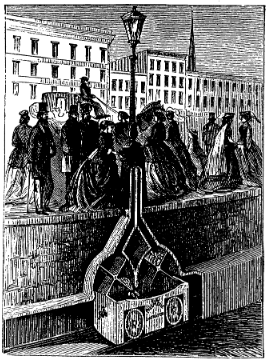
From the average citizen’s perspective, sending mail along the tubes wasn’t all that different from traditional post. Sometimes it wasn’t even something you chose or paid extra for. In the earliest designs, a letter dropped into a public mailbox on the street would be collected automatically when a pneumatic cars that passed beneath, slamming into a lever that opened a chute and dumped out accumulated mail before the car carried it along to the final stop. And a report from the Postmaster General in 1921 noted that 55 percent of all mail that passed through a tube-connected post office traveled by pneumatic tube, almost purely due to economies of scale.
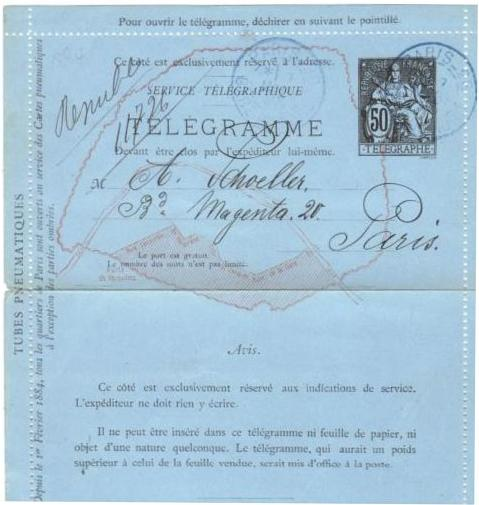
In some places, like Paris, you could specifically pay for this form of conveyance. Anything that fit on one of the "petits bleus" would travel across town, examined and timestamped at each relay station (almost identical to email’s bang paths and trace routes), before arriving at a destination station for pickup or last-mile courier. It was an extremely reliable technology, but not without deliverability problems of its own.

While public pneumatic mail systems were the largest and most extensive networks, they were orders of magnitude harder to maintain than more localized variants. When there was a particularly bad leak somewhere along one of New York’s tubes, a four-man team was called in to fix it. Nicknamed the Saturday Afternoon Grunters because air-driven mail only ran until 10am on Saturdays, a Des Moines Register article from 1950 explained how “One man holds a stopwatch. Two others listen sharply. The key man is the Grunter. He grunts into the tube which carries the rockets. By timing the echo from the stalled tube, they can locate the leak.” Sometimes they just fired a gun into a tube and timed that. Almost makes diagnosing email deliverability issues sound easy.

Vacuum-powered mail systems limited to a single building or city block solved several of the biggest downsides. Tubes at the CIA’s Original Headquarters Building, for example, had a 99% delivery success rate, despite letting regular officers pop canisters into the tubes themselves. Every four-inch-diameter fiberglass cylinder was topped with three rotating brass rings to indicate one of the 150 stations spread across the building’s eight floors. You’d click the destination address into the pneumatic To: field, slide the whole contraption into a color-coded tube and electronic sensors would route it to the right place.

Unsurprisingly, self-directed tubes were not without their own problems. Take the Residenz-Casino nightclub in Berlin, which had pneumatic table-to-table delivery available at every table. “On request, waiters brought gift-menus. Lovestruck customers selected from a list of 135 pocket-sized presents, like a bottle of perfume, cigar-cutter, or travel plan for a secret weekend (encased in leather),” according to one description. “The luxury item was then placed in a sealed container, rocketed through hidden pneumatic tubes, and finally landed with a dramatic whoosh in a basket at the edge of the intended’s table.” Between the attempts to send cocaine and unwanted advances, a team of female censors were hired as a sort of 1920s content filter.
The people who placed live animals and drugs in pneumatic canisters didn’t kill the technology. They were a necessary nudge to regulate and police the system more, like CAN-SPAM for email senders. Some people argue that the tubes died because Eisenhower wanted to stimulate the US auto industry and so ordered the switch to General Motors postal trucks (not unlike a newsletter platform trying to make more money by telling you to read issues in an app instead of an email client). But I don’t think that’s the case.

The tubes were simply the wrong solution to transporting written correspondence across a swelling city. Adding new stations, upgrading degraded tubing, the things required to keep a pneumatic network growing don’t scale. New York City’s system closed in 1953 because trucks were cheaper than digging up sidewalks to lay down more underground tubes. The CIA decommissioned its vacuum-powered mail in 1989 because adding email to the New Headquarters Building was easier than weaving oil-slicked pipes into the walls and foundation.
There are plenty of places where pneumatic tubes endured as the most sensible tool for the task at hand. Transporting airplane parts at the Denver airport, passing book requests to librarians in the New York Public Library, fast-tracking blood and tissue samples at the Mayo Clinic, and handling irradiated material at nuclear reactors, these are all tube-shaped nails in search of a pneumatic hammer.
Every single day people try to contort email into a solution for which it doesn't fit. Sorting out project details in a never-ending chain that should have been a meeting. Selling a product to people who have zero connection to it. Dumbing down nuanced conversations into vague text. But if there’s one thing email is good for, it’s reaching people who want to hear from you, without interference from blackbox algorithms or rampant advertising. Email isn’t perfect. It isn’t the one tool you should use for every form of digital communication. But when used correctly, there’s simply nothing like it.
“No medium is excessively dangerous if its users understand what its dangers are,” Neil Postman wrote in Amusing Ourselves to Death. “This is an instance in which the asking of the questions is sufficient. To ask is to break the spell.” It took 100 years to ask the right questions about pneumatic tubes. For email, we have a chance to cut that number in half.
| Image | Credit |
|---|---|
| Header photo | A pneumatic post office in New York City, via Smithsonian Magazine |
| Lamppost mailbox diagram | Pneumatic Dispatch, With Illustrations, via Wikimedia |
| “Petit bleu” pneumatic postcard | Wikipedia |
| Mail destroyed by pneumatic transport | Untapped Cities |
| CIA pneumatic canister | CIA.gov |
| Club Resi poster advertisement | Babylon Berlin |
| A USPS pneumatic tube-powered post office in 1953 | Smithsonian Magazine |
