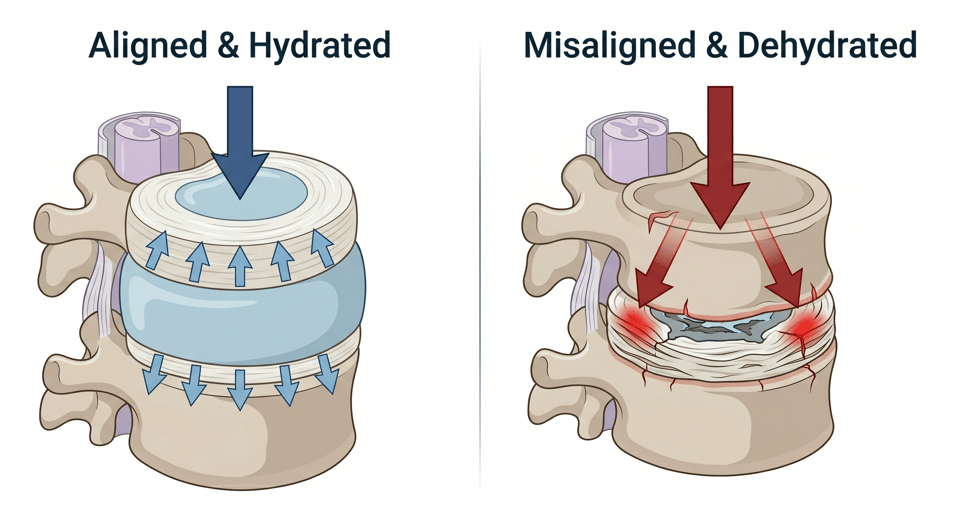
75% of Americans are chronically dehydrated. That stat gets thrown around for water bottle ads. But from a spinal perspective, it means something far more specific and far more damaging.
Your spinal discs live between each vertebral joint. They carry your bodyweight against gravity. They give your spine mobility. They absorb shock. The jelly-like nucleus inside handles that load remarkably well.
Here's what you don't see.
Every day, that fluid leaks out. Normal activity. Normal loading. Gradual and quiet loss. That's not the problem. The problem is what happens when it doesn't rehydrate itself.
Rehydration requires two things: (1) available fluid and (2) spinal movement.
When either is missing, the disc starts to shrink. The load (bodyweight against gravity) doesn't disappear, but it shifts.
It moves to the outer ring (the annulus), the tough, fibrous part of the disc that was never designed to be a primary weight-bearer. It was built to contain, not carry.
Now compound that with misalignment. Uneven distribution across an already compromised disc. You're not just adding stress. You're concentrating it.
That's not just wear and tear. That's the accelerated degenerative process.