|
Eight continuation vehicles were closed, launched or put in process between Monday and Friday, from a book of European loans to a fleet of Norwegian wellboats, and in each of them the size was the least interesting number. Two other numbers tell the week better: how much larger the vehicle was than the fund that held the asset, and how many of that fund's investors chose to stay. The first went above two times the fund. The second went below one in twenty. Five days, one trade: the sponsor keeps the company and somebody else's fund pays for it, and to my mind that is now the shape of the exit rather than an alternative to it.
Sized to the company, paid for by the buyer
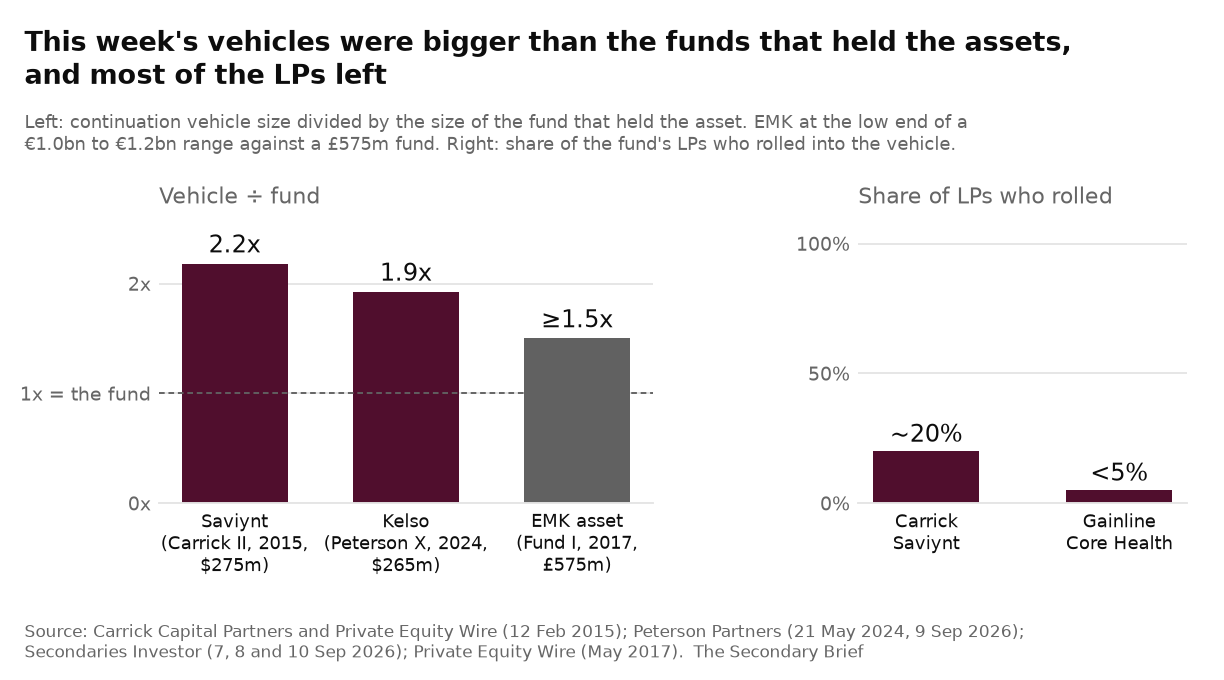
The continuation vehicle was sized to the company this week, and it came out larger than the fund that held it. Carrick's $600 million vehicle for Saviynt sits on a second fund that closed at $275 million in 2015. Peterson's $510 million vehicle for Kelso Industries sits on a tenth fund of $265 million. EMK's process for a Dutch industrials company seeks €1 billion to €1.2 billion of new equity out of a debut fund of £575 million. The reason is arithmetic, not fund life. A company in the middle of a buy-and-build needs more equity than the fund that owns it can produce, and a fund past its investment period cannot raise more, so the money has to come from a new vehicle with a new investor in it. For the GP the vehicle is a financing before it is an exit, and the buyer is underwriting the next five years of the plan rather than the last five.
The investors mostly took the money, and where they did the reason was the sponsor's calendar rather than the company. About one in five of Carrick's Fund II investors rolled into Saviynt at 10x net. Fewer than one in twenty of Gainline's stayed in Core Health & Fitness, seven weeks after Gainline filed for its third fund. A selling investor in that position is not judging the asset. It is choosing between the same manager's old company and the same manager's new fund, and the new fund is where the relationship lives. The exception was EMK, where a significant rollover is planned for a company that has just added fifty businesses in one acquisition. The GP sizing a vehicle this autumn should plan for the Gainline case and treat the EMK case as a bonus: assume the LPs leave, and raise the whole amount from the buyer.
The money to pay for all of it is being raised, and it arrives in shapes the market did not have three years ago. CVC closed its sixth flagship at $10 billion with half of its investors new to the strategy. HarbourVest has $2.4 billion for credit secondaries, in the week Pantheon led two credit vehicles in two days. Antin sold 30% of Sølvtrans to a pension pool in July and launched the continuation vehicle in September, so the price inside the vehicle has a real trade to answer to. Evercore's half-year review puts buyers' capital at about one year of volume, so the bid is there but no longer indiscriminate. For the LP whose election letter arrives this autumn, the question is not whether there is a buyer. It is what price reference the buyer used, and whether a third party ever paid it.
Chart of the week
Five things that mattered
- CVC Secondary Partners closed its sixth flagship at $10 billion, above target, while Evercore's overhang fell to about 1.0x of trailing volume on the LP-led side (Monday).
- Pantheon led two private credit continuation vehicles in two days, €1.2 billion of Bridgepoint loans and $745 million of PennantPark's, in a market where GP-led credit prices at about 99% of NAV (Tuesday and Wednesday).
- Oregon cut its private-equity target to 19% of a fund that holds 23%, and Aon's liquidity analysis in the same board book names the secondary market as a lever (Wednesday).
- NorthSands Capital, founded in 2023, took more than $450 million of Peterson Partners' $510 million vehicle for Kelso Industries as sole lead (Thursday).
- EMK is seeking €1 billion to €1.2 billion of new equity for one Dutch company out of a £575 million debut fund, and Antin launched a Sølvtrans vehicle six weeks after agreeing to sell 30% of it to GLIL (Friday).
-
Seen before the press, the week's finds
Four filings this week had no press behind them when the letter found them, and none has since. The three "Wavebreak Secondaries Fund I" notices filed from General Atlantic's address remain unreported as of this morning, and are most probably the $1 billion growth secondaries fund it said in March it would raise with Clipway. Gainline's "Zenith Equity Fund", filed on 21 August with William Blair as agent, is most probably the Core Health vehicle under a project name, and the announcement followed eighteen days later. Hunter Point's "Whitecoat" co-invest sits under its preferred financing strategy and reads as one financing too large for the fund alone. GenNx360's "Platinum III Wholesome Fund", with Evercore as agent, is a second single-asset vehicle from a sponsor whose first took sixty days from filing to press release.
On the radar
- Monday 14 September, Sacramento. The CalPERS Investment Committee takes Meketa's private equity and private debt trust-level reviews in open session, then the pipeline reports from Anton Orlich and Mascha Canio in closed session. If the largest US pension is buying or selling this autumn, that closed session is where it is decided.
- Monday 14 and Tuesday 15 September, Los Angeles. SuperReturn US West at the Four Seasons Beverly Hills, with continuation vehicles and evergreens on the program. The GPs on stage have this week's sizing rule in front of them: how much rollover to plan for.
- Tuesday 22 September, London. Informa's Global Secondaries Summit has sessions on credit secondaries and on single and multi-asset GP-leds, with Ares, Hamilton Lane and HQ Capital among the speakers. Pantheon's two credit vehicles will be the case study.
- Tuesday 22 to Thursday 24 September, West Sacramento. The CalSTRS board meets, opening with a half-day closed session on the Tuesday, where any change to the private-equity book would be discussed first.
- Tuesday 29 September, New York. ILPA's Continuation Vehicles for the Limited Partner course on economic terms, governance and alignment, ahead of the final version of its CV guidance due later this year. Gainline's election is the kind ILPA wants LPs to make with more time and a price reference.
-
|