|
The week opens in Sacramento with a consultant's memo saying the largest US pension holds more private equity than its policy asks for, then moves to a Beverly Hills stage for continuation vehicles and to Hudson Yards for credit secondaries and BDC gates. For the longer read I have gone back to the half-year report nobody quotes, Setter Capital's survey of buyers, because it puts LP-led volume ahead of GP-led when two of the three advisors' counts say the opposite. Four houses counted the same six months, and the one number they cannot agree on is the one everyone repeats.
Number of the day 19.4% CalPERS' private equity NAV as a share of the total fund at 30 June, against a 17% long-term target, in Meketa's review for Monday's investment committee. |
On the radar, the week of 14 September
- Monday 14 September, Sacramento. The CalPERS Investment Committee takes Meketa's private equity review in open session before the closed pipeline session. The memo puts private equity at $123.6 billion after $26.1 billion of net new commitments in a year, and growth equity at 33% of the portfolio, above a range that the total portfolio approach abolished on 1 July. The private debt review has that program at 4.3% of the fund against an 8% target. A pension over its equity target and under its credit target, which has just taken the limits off, is not a seller this autumn. If it reaches the secondary market it is as a buyer of loan books.
- Monday 14 and Tuesday 15 September, Los Angeles. SuperReturn US West at the Four Seasons Beverly Hills. Monday's continuation vehicle panel at 11:55 puts Ardian's Grace Lloyd, Hamilton Lane's Jeff Straus, JPMorgan's Chelsea Wang and Warburg Pincus's Vishnu Menon on one stage, in the week after fewer than one in twenty of Gainline's investors rolled, so the question for all four is what roll rate they plan for.
- Tuesday 15 and Wednesday 16 September, New York. The PDI New York Forum at Convene Hudson Yards has a credit secondaries panel on Tuesday at 2pm with Generali's Marco Busca and Eurazeo's Nicolas Nedelec, a NAV lending session at 3:20 with 17Capital, and a closing keynote on Wednesday on BDC redemptions. After Pantheon's two credit vehicles and HarbourVest's $2.4 billion, the credit panel is the one with an insurer on it, the kind of holder the dedicated credit buyers raised their money to buy from.
- Tuesday 22 September, London. Informa's Global Secondaries Summit has sessions on credit secondaries and on single and multi-asset GP-leds, with ICG's Vivien Blossier among the speakers, and a GP-led session that will have this month's roll rates, from one in five to under one in twenty, to explain.
- Tuesday 29 September, New York. ILPA's Continuation Vehicles for the Limited Partner course, ahead of the final version of its CV guidance due later this year. Wednesday 30 September is quarter-end, the reference date for any process a seller wants priced on Q3 marks.
-
The longer read: four counts of one half-year
The four first-half reports agree on LP-led volume and disagree on GP-led, and the disagreement says how each house counts. Setter Capital's H1 2026 Volume Report, out on 6 August, is the one nobody quotes because its total is the lowest: $107.74 billion, against $118 billion at Jefferies, $121 billion at Evercore and $124 billion at Lazard. Setter asks buyers what they bought, 90 of the 144 most active answered, and volume is the exposure purchased in deals signed during the half, with sovereign funds and venture-backed shares left out. Side by side, the LP-led figures sit within $7 billion of each other. The GP-led figures run from Setter's $49.65 billion to Evercore's $65 billion, and that range is where the "GP-led overtook LP-led" headline lives: Jefferies and Evercore have it ahead, Setter and Lazard have it behind.
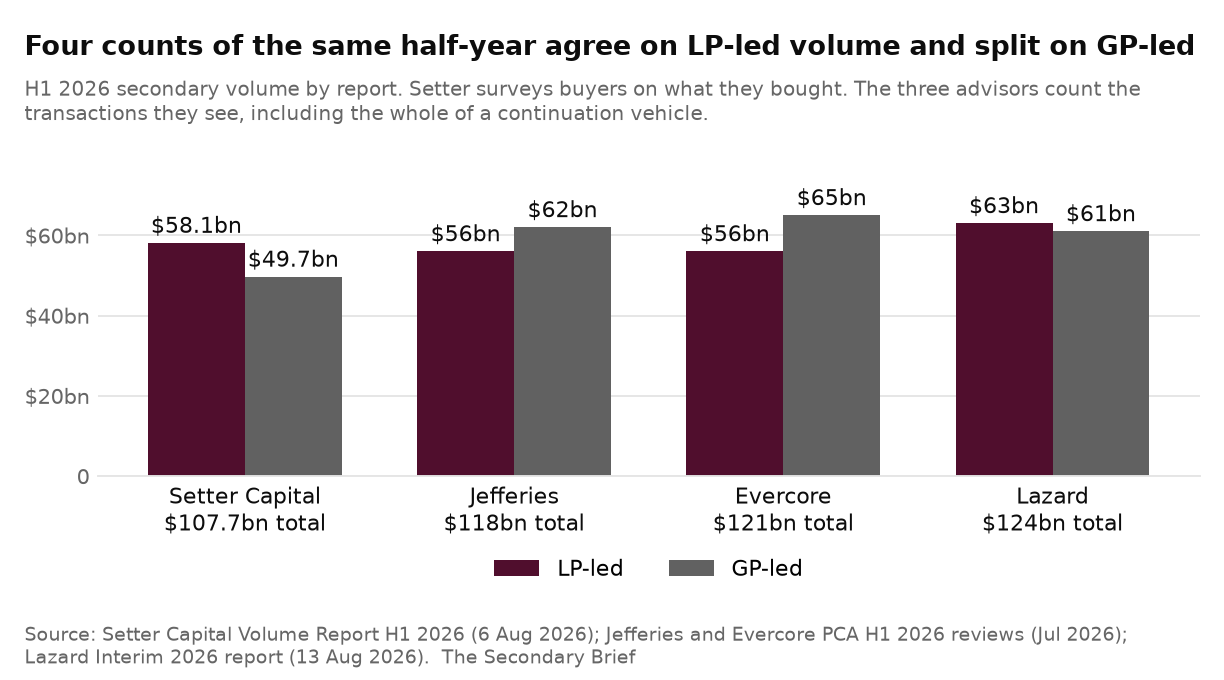 |
The gap has a mechanism. A buyer survey can only count what buyers bought, and the investors who roll into a continuation vehicle buy nothing, so their share of the vehicle is not in Setter's number, while an advisor counting the vehicle it ran counts all of it. The GP-led figure everyone repeats therefore measures what changed hands and what stayed put in one number.
What the buyers said is more useful than what they bought. They paid an average of 89.1% of NAV for fund interests and 94.8% in GP-led deals, and they underwrite the two to a 17.0% target IRR on buyout fund interests and 20.1% on GP-led deals.
The GP pricing a vehicle this autumn should read the two targets together. The buyer paying close to par in a GP-led deal is underwriting to a higher return than it asks of a fund portfolio bought at a discount, so the higher price is not a compliment to the asset but a claim on its plan.
|