|
The investment committee sits in Sacramento this morning and SuperReturn opens in Beverly Hills, and the story on the delegates' phones is a Financial Times piece relayed this morning: senior dealmakers saying that most of the funds raised between 2019 and 2021 will miss their targets. Next to it sit a package of Bakken oil wells that a 2013 fund has just moved into a continuation vehicle, and a $23 billion credit fund whose investors asked for more than twice what it will give back this quarter. Liquidity has a price in each case, and my point this morning is that the seller is not the one setting it.
Number of the day 7 to 8% The average net IRR one senior executive expects from buyout funds of the 2019 to 2021 vintages, against the high-teens those funds were sold on, in the Financial Times report relayed by Private Equity Wire this morning. |
The tape
- Lime Rock Resources closed a $340 million continuation vehicle on 31 August for the remaining Bakken assets of its 2013 third fund, with Goldman Sachs' Vintage Strategies as lead investor and Perella Weinberg advising, and the vehicle's Form D landed on Friday evening showing $240 million sold to 18 investors.
- CVC has set an initial €26 billion target for its tenth Europe/Americas flagship, with formal fundraising to begin in January, AltAssets reported on Monday.
- BlackRock's HPS Corporate Lending Fund received repurchase requests for about 11.5% of its shares this quarter and will buy back 5%, about $600 million, according to Friday's filing.
-
Par is not on offer for a fund that will make 8%
The investors in the 2019 to 2021 funds want their money back without a discount, and if their own managers are right about those vintages, the discount will widen rather than close. The Financial Times reported, and Private Equity Wire relayed on Monday, that estimates from five experienced private equity investors and executives put the share of funds from those years that will miss their initial return targets at between two-thirds and 90%. One senior executive expects average net IRRs of 7% to 8%, two others expect low double digits, against the high-teens the funds were raised on. Advent's James Brocklebank said "very few" of them were likely to hit their targeted IRRs. Roger Vincent of Summation Capital, who ran private equity at Cornell's endowment, put the seller's position in one sentence: "Fund investors are clamouring for liquidity, but they are also telling managers they won't accept a discount to current marks."
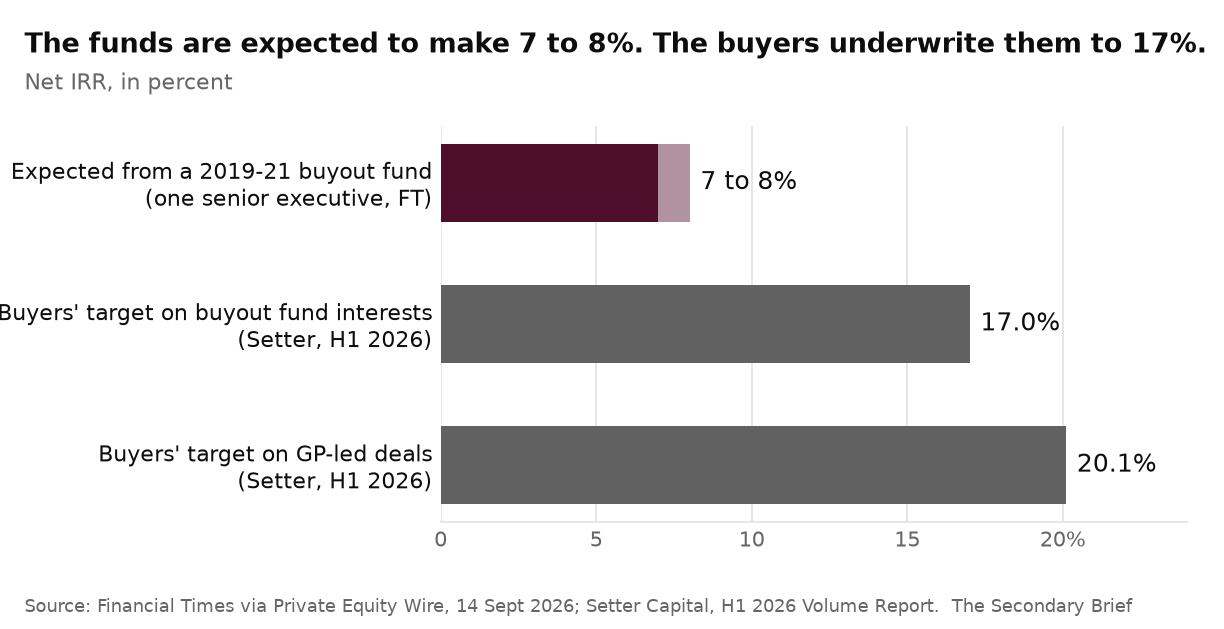 |
The two halves of that sentence cannot both hold, and the reason is arithmetic rather than sentiment. A secondary buyer's discount is the gap between what the sponsor's mark implies the fund will return and what the buyer needs to earn from the price it pays. Setter Capital's survey of buyers, read here yesterday, has them paying 89.1% of NAV for fund interests in the first half and underwriting buyout fund interests to a 17.0% target IRR. A buyer paying 89 cents on a fund that will compound its own marks at 7% to 8% from here does not reach 17%, so either the mark comes down or the bid does.
For the LP holding a 2019 to 2021 fund, the choice on the table this autumn is therefore not between a discount and par. It is between today's discount and a 7% to 8% outcome held to the end, and "no discount" is a decision to hold.
The other continuation vehicle is smaller than its fund
Last week's vehicles were larger than the funds that held the assets. Lime Rock's is less than half the size of its fund, and it is the older, quieter kind of continuation vehicle that the market was built on. Lime Rock Resources III closed in October 2013 on $750 million to buy and operate producing oil and gas properties. On 31 August the firm closed a continuation vehicle of $340 million in aggregate transaction value for the fund's remaining assets, a portfolio of properties located entirely in the Bakken, most of them operated by Lime Rock. Vintage Strategies at Goldman Sachs Alternatives anchored it as lead investor, existing and new institutions filled the rest, and the release says syndication demand exceeded the capacity available. No secondaries outlet has covered it.
| Asset | Remaining assets of Fund III: Bakken oil and gas properties, mostly Lime Rock-operated | | Sponsor | Lime Rock Resources, Fund III (2013, $750m) | | Lead buyer | Vintage Strategies at Goldman Sachs Alternatives, with existing and new institutions | | Size | $340m aggregate transaction value | | Advisor | Perella Weinberg (financial), Morgan Lewis (legal) | | Price | n/a | | Rollover | liquidity or continuation offered, share n/a | | Structure | Multi-asset CV of a fund's tail |
The filing adds what the release leaves out. Lime Rock Resources III-CV filed its Form D on Friday from Lime Rock's Westport, Connecticut address, with Eric Mullins and co-founder John Reynolds among the officers, a first sale on 28 August and $240 million sold to 18 investors. The filing does not say what makes up the gap to $340 million. The most probable reading is that rolled interests and any debt at the vehicle sit outside the Form D's count of securities sold. The alternative, a second closing still to come for a syndicate the release says was oversubscribed, is possible and nothing published rules it out.
Why a thirteen-year-old fund ends this way is a matter of what is left in it. The release does not say why the assets were not sold outright, and the likeliest reason is the one the portfolio describes: a fund that started buying producing wells in 2013 has sold what the market would take, and what remains is acreage in one basin that pays out through production and has not found a buyer at the price the fund wanted. For the buyer, Goldman is underwriting decline curves and an oil price rather than a buy-and-build plan, which is the reverse of the Saviynt and Kelso vehicles of last week. For the GP holding a 2012 to 2014 energy fund with a tail nobody has bid for, Goldman's check says there is a price for it, and the deal card above is the one to compare against.
Five percent a quarter is what the wealth channel calls liquidity
The semi-liquid credit funds sold to private wealth are working through a queue, and the queue is the stress test for the evergreen secondaries vehicles being sold to the same clients. BlackRock's HPS Corporate Lending Fund, HLEND, said in a filing on Friday that it received repurchase requests for about 11.5% of its shares outstanding for the third quarter and will repurchase 5.0%, about $600 million, after $1.7 billion of repurchases across the three prior periods. Reuters, relayed by Investing.com, puts the fund at $23.1 billion and the prior quarter's requests at 13.3%.
The mechanism is the same in every one of these vehicles, and it is worth stating plainly. A semi-liquid fund offers to buy back 5% of its shares each quarter. When requests exceed that, every request is cut back pro rata and the unfilled part goes back in the queue for the next quarter. At 11.5% against 5%, more than half the money asked for stays in the fund this quarter, and it takes two more full tenders to clear even if nobody else joins the line. The fund has returned 9.9% a year net since inception on its Class I shares, so the queue formed on sentiment about software loans and underwriting, not on results.
That matters to secondaries because the buyers are building the same product. Lazard's interim report in August found 40% of the buyers it surveyed managing evergreen or '40 Act vehicles, and said that '40 Act and evergreen capital "continue to scale check sizes for GP-led deals". Those vehicles offer the same quarterly tender, typically 5% of NAV. For the buyer raising one for the wealth channel, HLEND's two quarters are the case to plan against: a fund that made its investors money still saw more than a tenth of them ask for the door two quarters running, and a secondaries evergreen holding continuation-vehicle stakes cannot sell those to meet a tender the way a lender collects a repayment.
On the radar
- Monday 14 September, Sacramento. The CalPERS Investment Committee opens at 8:45 Pacific with the trust-level review, where Meketa's memo puts private equity at 19.4% of the fund against a 17% target, then takes the private equity and private debt pipeline in closed session. Anything the largest US pension does on the secondary market this autumn is decided in that room.
- Monday 14 and Tuesday 15 September, Beverly Hills. SuperReturn US West puts Ardian's Grace Lloyd, Hamilton Lane's Jeff Straus, JPMorgan's Chelsea Wang, Warburg Pincus's Vishnu Menon and Davis Polk's Leor Landa on the continuation vehicle panel at 11:55 today, and a Tuesday roundtable on technology in secondaries seats Clipway's David Enriquez next to Forge's Sanjay Gupta. The panel has this morning's FT story to answer: what a vehicle is worth when the fund behind it will make 8%.
- Thursday 17 September, Olympia. The Washington State Investment Board votes at 11:45 on private equity commitments to Clayton Dubilier & Rice XIII and GTCR XV. The re-ups are what put the 2019 to 2021 funds on the secondary market, because an LP funds the new commitment by selling the old one.
-
|