|
Three continuation vehicles closed on Monday and Tuesday, and the interesting number in each is not the size. In Stamford, a mid-market firm with a fitness-equipment maker to keep found that more than nine in ten of its investors preferred the money. In Miami, PennantPark moved a $745 million book of loans into a vehicle led by Pantheon, its second credit book in two days. In Oregon, a $107 billion pension wrote a lower private-equity target into policy while sitting three points above the old one. I read them together because they are one question asked from the seller's chair: do I want this exposure for another five years? This week the answer keeps coming back no.
Number of the day 95% More than 95% of the investors in the Gainline fund that held Core Health & Fitness took the liquidity option in the StepStone-led continuation vehicle rather than roll ( Secondaries Investor). |
The tape
- Gainline Capital Partners moved Core Health & Fitness, the fitness-equipment maker it bought in 2020, into a single-asset continuation fund led by StepStone, with William Blair advising.
- PennantPark closed a $745 million private credit continuation fund led by Pantheon, with PGIM, advised by Evercore.
- Hudson Hill's InXpress vehicle has its buyers: Barings and Ardlussa Capital led and Quilvest joined.
- TrueBridge closed its second venture secondaries fund at $508 million, more than double the $230 million it raised in 2024.
- Secondaries Investor's deal log counts 64 continuation vehicles closed in the first half, against 39 a year earlier.
- The Oregon Investment Council adopted a new policy portfolio that cuts the private-equity target from 20% to 19% and creates a 7.5% credit allocation.
-
Ninety-five percent is a verdict
The rollover rate is the price of an asset in the eyes of the people who know it best, and this week it is low. Gainline Capital Partners bought Core Health & Fitness in February 2020, out of a first fund that had closed at $155 million the year before. Six years later the company sells StairMaster, Nautilus and Schwinn equipment in more than 75 countries, and Gainline has moved it into a single-asset continuation fund with StepStone as sole lead, syndicate investors behind it, and follow-on capital for expansion. The investors in the first fund were not sentimental about it. Secondaries Investor reports that over 95% of them took the liquidity option.
| Asset | Core Health & Fitness (commercial fitness equipment, bought February 2020) | | Sponsor | Gainline Capital Partners, Fund I | | Lead buyer | StepStone Group (sole lead), syndicate investors | | Size | n/a | | Advisor | William Blair (financial), Willkie Farr (Gainline), Proskauer (StepStone) | | Price | n/a | | Rollover | under 5% of LPs | | Structure | Single-asset CV with follow-on capital |
Why so few stayed has more to do with the sponsor's calendar than with the company. Gainline is raising its third fund: Gainline Equity Fund III filed its Form D on 22 July, three years after Fund II closed at $400 million. An investor in the 2019 fund who takes StepStone's cash today has the money to re-up in Fund III tomorrow. For that investor the continuation fund is not a judgment on Core. It is a way to recycle a relationship, and StepStone is paying for the recycling. One filing suggests the vehicle was ready well before the announcement: a "Zenith Equity Fund LP" and a parallel "-A" vehicle filed Form D notices on 21 August from Gainline's address, with William Blair, the continuation fund's advisor, as placement agent. Nobody has reported the name. It is most probably the continuation fund under a project name, though it could also be a parallel sleeve of Fund III.
Gainline is not an outlier. Secondaries Investor's H1 deal log, out on Monday, counts 64 continuation vehicles closed in the first half against 39 a year earlier, and the two roll rates reported this week point the same way. About one investor in five stayed in Carrick's Saviynt vehicle at 10x, reported yesterday. Fewer than one in twenty stayed at Gainline. The GP planning a vehicle this autumn has its sizing rule: assume the LPs leave, and raise the whole amount from the buyer.
Pantheon's second credit book in two days
The continuation vehicle has become a portfolio-management tool for direct lenders, and Pantheon is buying the tool. A day after the €1.2 billion Bridgepoint Credit vehicle, PennantPark Investment Advisers closed a $745 million credit secondary fund led by Pantheon, with PGIM and reinvesting limited partners, for a mature, diversified portfolio of private credit investments in service-oriented industries. Bloomberg broke the deal on Monday. LPs get liquidity, the manager gets fresh capital for follow-on financings and new investments, and Rakesh Jain, Pantheon's global head of private credit, pointed to "continued deal flow in the private credit secondaries market." Evercore advised and Kirkland & Ellis was counsel, the same pair as on Bridgepoint.
| Assets | Mature, diversified private credit portfolio, service-oriented industries | | Sponsor | PennantPark Investment Advisers | | Lead buyer | Pantheon (lead), PGIM | | Size | $745m | | Advisor | Evercore (financial), Kirkland & Ellis (legal) | | Price | n/a | | Rollover | reinvesting LPs, share n/a | | Structure | Credit CV with new capital |
The market this sits in is the one Evercore described in its H1 credit review in July: $20.4 billion of credit secondaries in six months, already more than all of 2025, with GP-led deals at $17 billion, about 83% of the total, priced at "approximately 99% of FMV on average." Evercore's explanation reads like PennantPark's release: "2021 and earlier vintage funds well into their harvest period looked to use the secondary market as a portfolio management tool before concentration increases and extensions beyond the original fund term become necessary."
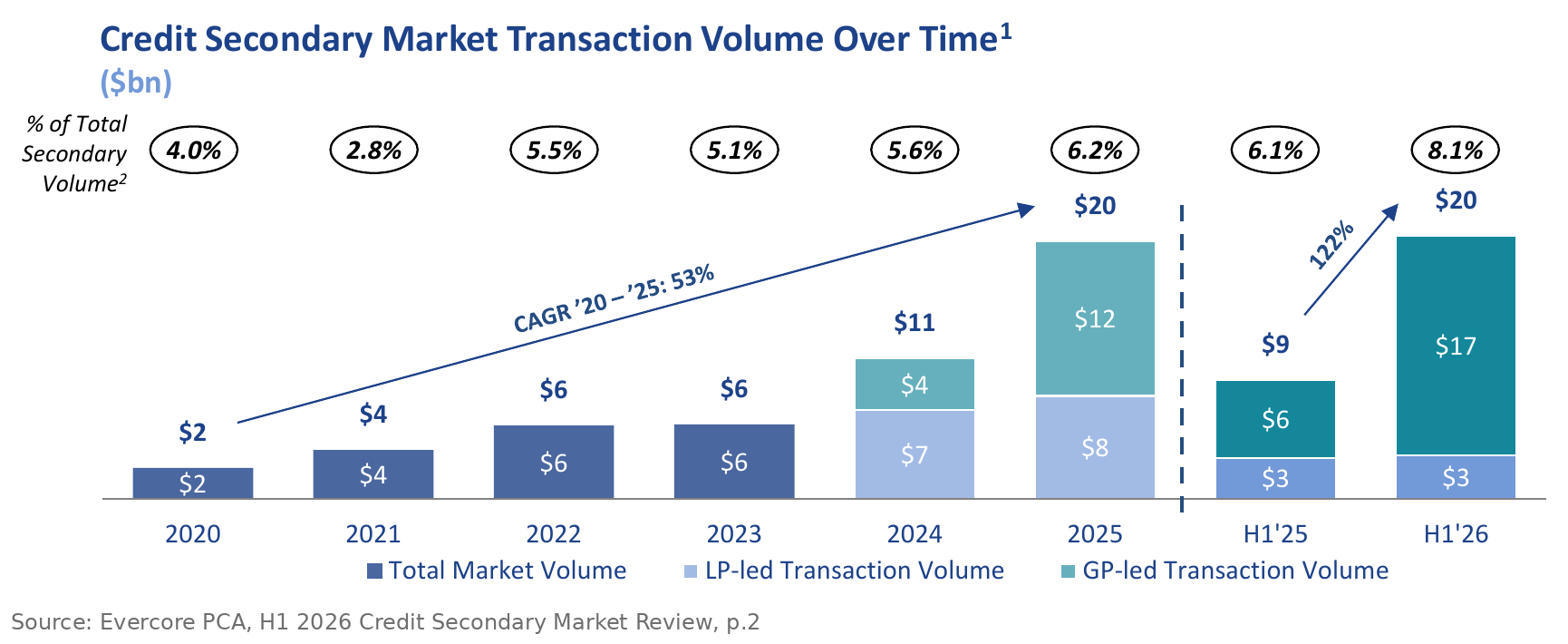 |
Ninety-nine cents is the number to hold on to, because it explains why credit vehicles clear so easily. A loan has a contractual coupon and a repayment date, so the buyer of a performing loan book knows most of what it will get back and pays close to face value. A buyout fund's NAV is the sponsor's estimate of a sale price that has not happened yet, so the buyer discounts it. For the selling LP the difference is practical: taking cash from a credit vehicle costs almost nothing against waiting for repayment, which is why so many take it. For a direct-lending LP in a 2019 to 2021 vintage, the election letter is coming. This week the name on it has been Pantheon twice.
Oregon writes the sale into the policy
An LP-led sale starts as a line in a consultant's deck, and Oregon's deck now has the line. On 2 September the Oregon Investment Council adopted the option its consultants called Portfolio D: private equity down from 20% to 19% of the fund, real estate from 12.5% to 10%, fixed income from 25% to 20%, and a new 7.5% credit allocation where there was none. The actual portfolio, as of 24 July, held 23.0% in private equity, some $24 billion, and the second-quarter review says private equity "was the only major category to decline, reflecting valuation adjustments reported during the quarter." State treasurer Elizabeth Steiner, per Chief Investment Officer, agreed with "reducing allocation to better align with 20% target." Buyouts' headline on Tuesday: more private credit "at the expense of its overweight private equity assets."
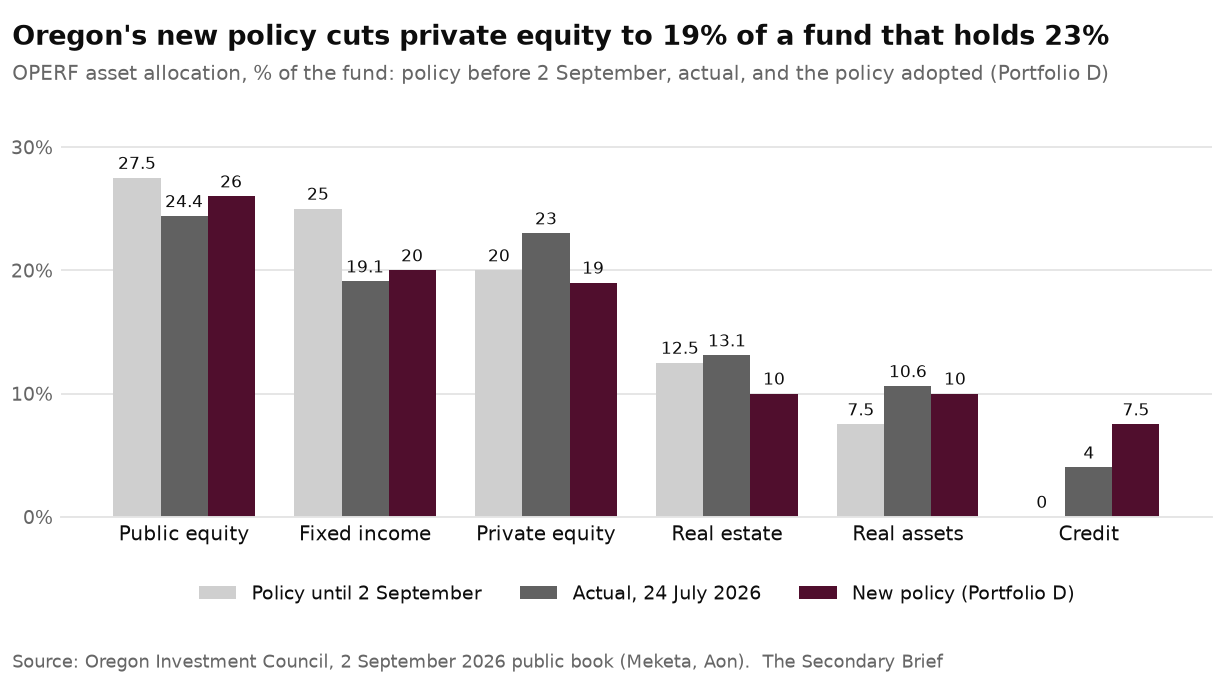 |
The line a secondaries reader should mark is in Aon's liquidity analysis in the same book. If public equities fell by about half over three years, Aon's "Dark Skies" case, illiquid assets would rise to 70% of the fund under the new policy and 77% at today's allocation. For that case Aon lists three levers, and one of them is "reducing commitment pacing and/or utilizing the secondary market." Oregon has not announced a sale, and slower commitments will do most of the work of bringing $24 billion of private equity down to 19% of the fund. But a secondary sale is now written into the plan, in a public document, at a pension that was 28% private equity in 2023. That is how LP-led supply announces itself: not with a mandate to an advisor, but with a sentence in a consultant's appendix.
Venture's buyers keep doubling
The day's one fund close was in the corner of the market where sellers are most plentiful and buyers fewest. TrueBridge Capital Partners closed TrueBridge Secondaries II at $508 million, oversubscribed, against $230 million for its first in 2024, to buy venture fund interests and direct positions in venture-backed companies. Read with the nine entities StepStone filed for its seventh venture secondaries fund, flagged on Monday, the capital raised to buy from venture LPs is doubling at every size. For an LP holding 2020 and 2021 venture funds, that is more bids to collect this autumn. What they will pay is the question TrueBridge's release does not answer.
On the radar
- Monday 14 September, Sacramento. The CalPERS Investment Committee takes the trust-level review as of 30 June in open session, then the private equity and private debt pipeline report in closed session.
- Monday 14 and Tuesday 15 September, Los Angeles. SuperReturn US West with continuation vehicles and evergreens on the agenda. The question for any GP on stage is what roll rate it planned for and what it got.
- Tuesday 22 September, London. Informa's Global Secondaries Summit has a credit secondaries session and a GP-led session, with ICG's Vivien Blossier and Hamilton Lane's Jan Verstraete among the speakers. Pantheon's two credit vehicles will be the case study.
- Tuesday 29 September, New York. ILPA's Continuation Vehicles for the Limited Partner course on CV economics, governance and alignment. The 95% at Gainline is the kind of election ILPA's updated guidance, due later this year, wants LPs to reach with more time and better information.
- Wednesday 30 September. Quarter-end, the reference date most sellers want on a Q4 process. Portfolios priced off Q2 marks will be re-marked once more before bids are final.
-
|