|
Everyone is back at their desks, and the deals signed over the summer are coming out of the drawer. Three continuation vehicles landed in the first two working days of the month, and on paper they have nothing in common: a book of European loans in London, a ten-times growth bet in California, a parcel franchisor in Manchester. I read them together because they tell the same story from three angles: the continuation vehicle is no longer a product, it is how funds end now. Underneath all three sits a benchmark that came out on Monday, and it says software is quietly pulling the marks down.
Number of the day 20% Roughly the share of Carrick Capital Partners' Fund II investors who chose to roll into the $600 million Saviynt continuation vehicle rather than take a 10x net realization, according to co-CEO Jim Madden ( Secondaries Investor). |
The tape
- Bridgepoint Credit moved €1.2 billion of senior secured loans from its 2017 fund into a continuation vehicle led by Pantheon, with Evercore advising.
- Carrick Capital Partners closed a $600 million single-asset continuation vehicle for Saviynt, led by Coller Capital with HSBC Asset Management as co-lead.
- Hudson Hill Capital closed a continuation vehicle for InXpress, the logistics franchisor it bought in 2020, eight months after the vehicle's Form D.
- Netley Capital has $1.2 billion of committed capital for tertiaries, stakes in secondaries funds, after its debut fund closed at an extended hard cap.
- HarbourVest's global buyout benchmark returned -1.6% in the first quarter, with software and services at -6.4%.
-
Direct lending has found its exit
The continuation vehicle has become the way a first-generation direct-lending fund ends, and a European print now sits next to the American ones. Bridgepoint Credit transferred €1.2 billion of senior secured loans to European mid-market companies out of Bridgepoint Direct Lending II, its 2017 vintage, into a new vehicle led by Pantheon. Investors could take cash or roll, the process was competitive and the vehicle was oversubscribed, and Bridgepoint Credit stays on as manager through realization. Bloomberg had flagged the process on 4 August at about €1 billion, and 9fin had Pantheon as the likely lead by 11 August.
| Assets | Senior secured loans to European mid-market companies from BDL II (2017) | | Sponsor | Bridgepoint Credit | | Lead buyer | Pantheon | | Size | €1.2bn ($1.4bn) | | Advisor | Evercore (financial), Kirkland & Ellis (Bridgepoint), Proskauer (Pantheon) | | Price | n/a | | Rollover | cash or roll, share n/a | | Structure | Multi-asset credit CV |
The quote that matters is Paul Johnson's, Bridgepoint Credit's deputy managing partner: "some investors would have expected the underlying investments to have been monetised after roughly three years." A 2017 direct-lending fund was sold as self-liquidating. Nine years on, the loans are still there, and the secondary buyer has become the amortization. Pantheon's Toni Vainio put the buyer's side plainly: secondary transactions "can provide both managers and investors with a route to liquidity before funds need to be extended." Pantheon has deployed about $4.6 billion across 63 European private credit secondaries since 2018, and led the $3.2 billion Crescent Capital vehicle in January, a 40-company portfolio from a 2016 fund.
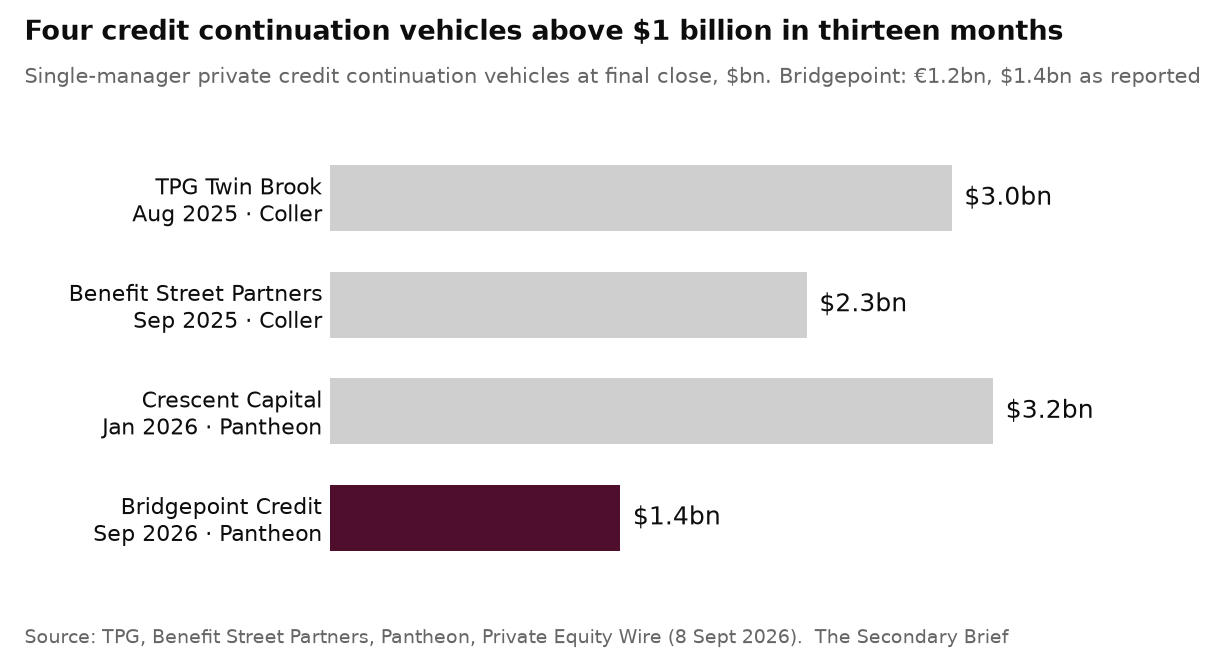 |
Put the four closes side by side and the pattern is a vintage, not a manager: TPG Twin Brook's $3 billion vehicle took loans from 2016 and 2018 funds, Benefit Street's $2.3 billion from a 2016 fund, Crescent's from 2016, Bridgepoint's from 2017. Two buyers, Coller and Pantheon, led all four. Jefferies Credit Partners is in market with a €1 billion staple that buys its own loans and writes new ones. For an LP holding a 2016 to 2018 direct-lending fund, the election letter is no longer a possibility. It is a calendar item.
At 10x, four in five took the cash
The second lesson of the week is that in a GP-led the rollover is the vote, and even a ten-bagger loses it. Carrick Capital Partners closed a $600 million single-asset continuation vehicle for Saviynt, the identity-security company it backed with a $35 million Series A when it was the only institutional investor. Coller Capital led, HSBC Asset Management co-led, and the vehicle put $255 million of new money into Saviynt as part of a $700 million Series B at about a $3 billion valuation that also funded an employee tender. Investors in Carrick's Fund II who sold got 11x gross and 10x net. Those who rolled, per Jim Madden in Secondaries Investor, were about one in five. Coller closed this the same day it became Coller EQT.
| Asset | Saviynt (identity security, $300m+ ARR) | | Sponsor | Carrick Capital Partners, Fund II | | Lead buyer | Coller Capital (lead), HSBC Asset Management (co-lead) | | Size | ~$600m, of which $255m new capital | | Advisor | Baird (financial), Proskauer (CV), Latham & Watkins (investment) | | Price | 11x gross / 10x net to selling LPs | | Rollover | ~20% of Fund II LPs | | Structure | Single-asset CV with primary and employee tender |
At the other end of the size range, Hudson Hill Capital closed a continuation vehicle for InXpress, the Manchester franchisor of parcel and freight services it bought in November 2020, when it had close to 400 franchisees in 14 countries. Terms are not public. The paper trail is: "HHC InXpress Group CV, LP" filed its Form D from Hudson Hill's Manhattan address on 16 January, with Evercore named as placement agent and an indefinite offering size, and PE Hub reported the close today. Eight months from filing to close is a mid-market timetable, and Eric Rosen's "we have barely scratched the surface" is the sentence every CV sponsor now says about the asset it is keeping. For a GP planning one this autumn, the Carrick number is the one to plan around: a sale that works for the LPs is a sale, and the vehicle must be sized for the roll it will actually get.
The marks under the bids
The third item is not a deal but the thing every deal above prices off. HarbourVest's Q1 2026 benchmark, reported by AltAssets on Monday, has the public software repricing arriving in private marks: the global buyout investment-level benchmark returned -1.6% for the quarter, information technology, about 29% of the benchmark by value, returned -5.0%, and software and services, the largest industry group at 26.9%, returned -6.4%. Over ten years software and services is still the best-performing buyout industry at 21.9% a year. Over the trailing year it returned 0.1%, and US information technology buyouts -2.2% against 11.1% in Europe.
| HarbourVest buyout benchmark, Q1 2026 | Global buyout, all sectors | | Quarter | -1.6% | | Trailing year | n/a | | Weight | 100% |
| HarbourVest buyout benchmark, Q1 2026 | Information technology | | Quarter | -5.0% | | Trailing year | US -2.2% / Europe +11.1% | | Weight | ~29% |
| HarbourVest buyout benchmark, Q1 2026 | Software and services | | Quarter | -6.4% | | Trailing year | +0.1% | | Weight | 26.9% |
Source: HarbourVest Partners, Q1 2026 benchmark release, 31 August 2026.
Sofia Gertsberg, who runs quantitative investment science at HarbourVest, said "some of the Q1 2026 SaaS sector repricing in public markets was reflected in our buyout benchmark returns." Q1 is the mark most LP portfolios sold this summer were priced against, and the Q2 accounts arriving now will show whether the second quarter took more. For an LP launching a software-heavy portfolio this month, the discount in the bid and the drop in the reference NAV are two different haircuts, and the second one is already taken.
A secondary market for the secondary market
Netley Capital said on 2 September that it now has about $1.2 billion of committed capital for tertiaries, buying existing investors' interests in secondaries funds, after its first fund closed in July at an extended hard cap, "significantly oversubscribed." The London firm launched with $315 million a year ago and calls itself the only manager of scale dedicated to the trade. Caspar Berendsen, its managing partner, sees "tailored liquidity solutions as a natural evolution of the private markets ecosystem." A market whose flagships now close at $10 billion has LPs in those flagships who want out early, and someone has raised more than a billion to buy from them. For a buyer, that is one more reason a ten-year fund life is a formality.
On the radar
- Monday 14 September, Sacramento. The CalPERS Investment Committee takes the trust-level review as of 30 June with consultant reports on private equity and private debt in open session, then private equity and private debt pipeline reports in closed session. If the largest US pension is buying or selling this autumn, that closed session is where it is decided.
- Monday 14 and Tuesday 15 September, Los Angeles. SuperReturn US West at the Four Seasons Beverly Hills, with continuation vehicles on the agenda and an LP-only session on managing the 2021 and 2022 overhang. That overhang is the software vintage in HarbourVest's numbers.
- Tuesday 22 September, London. Informa's Global Secondaries Summit at etc.venues Monument, with speakers from ICG, Hamilton Lane and Ares and a session on credit secondaries. After Bridgepoint, expect the credit panel to be the full one.
- Tuesday 29 September, New York. ILPA's Continuation Vehicles for the Limited Partner course, on economic terms, governance and LP alignment. Its updated CV guidance is due to be finalized later this year, and the election window it proposes will set every 2027 GP-led timetable.
- Wednesday 30 September. Quarter-end. Bids on LP portfolios launched this month reference Q2 marks that are still arriving, and a seller who wants a Q3 print needs bids in within about three weeks.
-
|