|
The Q2 capital accounts are landing, Evercore PCA is collecting them for its next continuation-fund performance study, and every placement agent in London and New York has quietly opened the closing sprint that ends the week before Christmas. September is when the secondaries market stops talking about the year and starts pricing it. This first week back had one subject, and it was size. It also had a name nobody could place when it surfaced in an SEC filing on Sunday. Today we can place it.
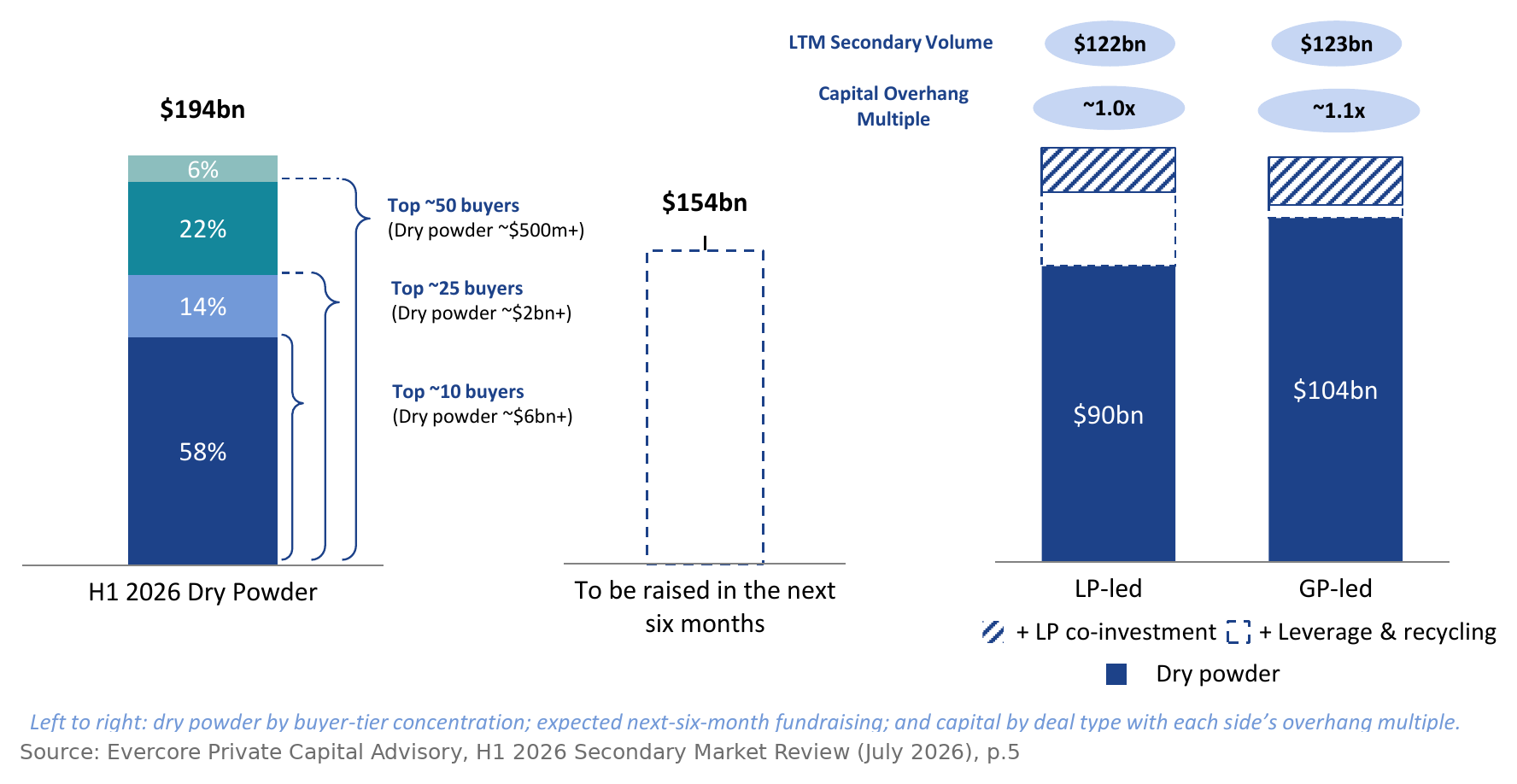
Number of the day ~1.0x Buyers' available capital over trailing-year volume on the LP-led side at mid-2026, and ~1.1x on the GP-led side ( Evercore). Eighteen months ago it was 1.8x. |
The tape
- CVC Secondary Partners closed its sixth flagship at $10 billion, above target, with half of its 200-plus LPs new to the strategy.
- Neuberger Berman led a $1 billion-plus single-asset continuation vehicle for a six-year-old Providence Equity holding.
- Alantra bought a €120 million portfolio of ten climate-tech companies from Shell Ventures to seed a new energy-transition secondaries strategy.
- StepStone filed nine vehicles for VC Secondaries Fund VII on 1 September, $1.59 billion so far.
- Lazard's interim report put first-half volume at $124 billion, up 28%, and the full year at $275 billion.
- Three Form D notices for a "Wavebreak Secondaries Fund I" were filed from General Atlantic's address between 28 August and 3 September. Unreported.
-
Ten billion is the new mid-market
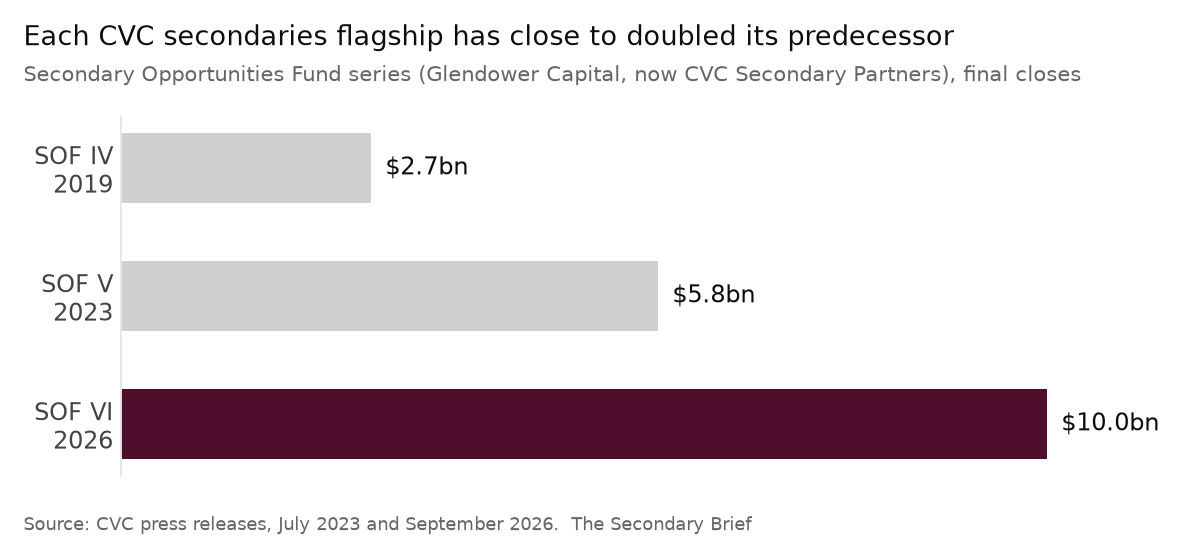
The week's headline number was not a record, and that is exactly the point. CVC Secondary Partners closed its sixth flagship at $10 billion, above target, from more than 200 LPs of whom roughly half are new to the strategy, for a fund that explicitly stays in the mid-market. Carlo Pirzio-Biroli called the close a validation of the merger with CVC, and Rob Lucas put the platform at €20 billion of secondaries AUM with "a clear runway."
 |
Read that next to the SI 50, out on 1 September, which for the first time has a new name at number one, and whose editorial line is blunt: scale is reshaping the leaderboard. The obvious read is that the big are getting bigger. The more interesting read is why the market needs them to. PitchBook's Rod James called it the capitalization conundrum in January: volume hit $225 to 240 billion in 2025, yet the capital overhang fell to 1.24x annual volume for LP-leds and 1.22x for continuation funds at Evercore, from 1.8x and 1.7x a year earlier. Evercore's H1 2026 review has since taken it to about 1.0x on the LP-led side and 1.1x on the GP-led side, with $194 billion of dry powder, down 10% since January, and $154 billion that buyers say they need to raise in the next six months. Evercore's own words: "healthy, but not abundant."
 |
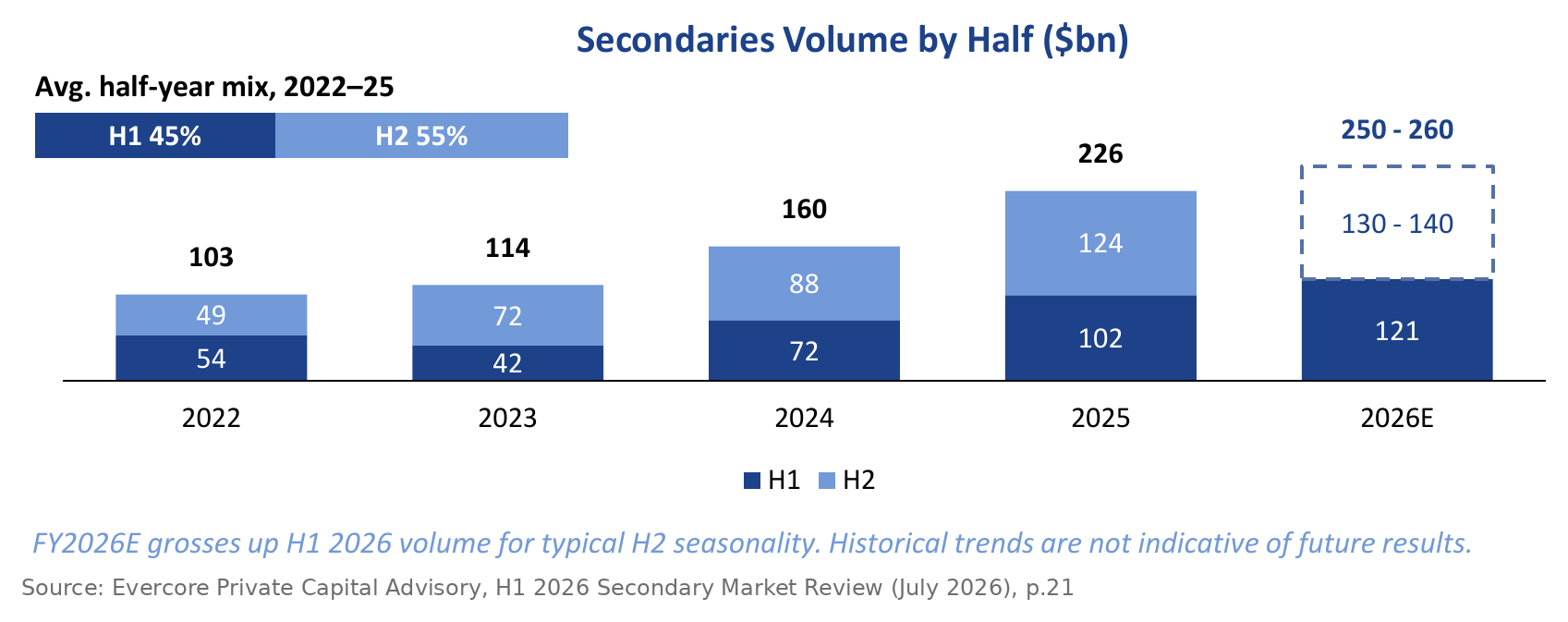
A market that grows this fast eats its dry powder faster than flagships can replace it, which is the context for the closing sprint. Lazard's interim report has H1 at $124 billion, with LP-led at $63 billion and GP-led at $61 billion, and 76% of surveyed buyers raising a flagship. Campbell Lutyens' 1H 2026 report, from 13 August, has the two sides at 45% each. Evercore's seasonality arithmetic, below, gets 2026 to $250 to 260 billion. A $10 billion mid-market fund is not hubris. It is what adequately capitalized now looks like, and for an LP thinking of selling this autumn, it means the bid is there but no longer indiscriminate.
The side doors
If the front door is scale, the week also showed how people still get in, and the most interesting entrance was hiding in a filing. The "Wavebreak Secondaries Fund I" that this letter could not place on Sunday has a parent: the three notices, one from Bermuda on 28 August and two from Luxembourg on 3 September, were filed from General Atlantic's own address, with its senior partners as officers. Given the $1 billion growth and late-stage secondaries fund General Atlantic and Clipway said in March they would raise together, and Clipway's $6.4 billion debut close in July, this is most likely that fund's legal shell opening for subscriptions. If it is not, General Atlantic is building a secondaries buyer of its own next to it. Either way, a GP that has sponsored a $3 billion multi-asset CV of its own assets is now set up to buy other people's, and nobody has reported it.
The other entrances were more classical. Alantra launched Horizon Secondaries by buying a corporate venture portfolio outright and hiring two Shell corporate-venture investors to run it. Patricia Pascual-Ramsay's line, that the energy transition has reached "a point where a growing number of high-quality companies are becoming accessible through secondary transactions," is the sentence this market used about buyout funds twenty-five years ago, which is why New Private Markets called the deal an echo of the past: a corporate seller, a captive portfolio, a specialist buyer built around it.
| Assets | 10 growth companies, North America, Europe, Asia | | Seller | Shell Ventures | | Buyer | Alantra Horizon Secondaries | | Size | €120m | | Advisor | Addleshaw Goddard (legal) | | Price | not disclosed | | Structure | Direct portfolio purchase seeding a new fund |
And StepStone filed nine entities for VC Secondaries Fund VII on 1 September, $1.59 billion so far, against a Fund VI that closed at a record $3.3 billion. The largest dedicated venture-secondaries fund ever is being rebuilt, bigger, in plain sight.
GP-leds are changing sides
The third thing the week said is that the continuation vehicle has stopped being a transaction and become infrastructure, and each new user brings a new constraint. On the buy side, five OCIOs (Cerity, Cliffwater, Marquette, Meketa, Mercer) told Secondaries Investor their smaller endowments and foundations now use GP-leds to enter private markets faster, "prioritising performance opportunities over liquidity concerns." The instrument built to let big LPs out is becoming the way small LPs get in. On the deal side, Neuberger Berman led a $1 billion-plus single-asset CV for a six-year-old Providence holding, a size that would have been a headline in 2023 and is now a Tuesday.
| Asset | Undisclosed, held ~6 years | | Sponsor | Providence Equity Partners | | Lead buyer | Neuberger Berman | | Size | $1bn+ | | Advisor | n/a | | Price | n/a | | Rollover | n/a | | Structure | Single-asset CV |
And on the plumbing side, Private Funds CFO reports that the CV boom has reached fund finance: concentrated LP bases and single assets fit badly on subscription lines, lenders are wary, and the mid-market CV may find financing harder than the mega-deal does. A GP weighing a $200 million CV this autumn should ask its lender before it asks its LPAC.
Seen before the press
One more registry find, unreported as of this morning. ICG filed a co-investment vehicle called "Gem" on 4 September under its second LP-secondaries fund, with a feeder for non-US investors. That shape usually means one specific portfolio purchase, large enough that ICG is bringing co-investors in alongside the fund. Which portfolio, and from whom, the filing does not say.
On the radar
- Monday 14 to Wednesday 16 September, Sacramento. The CalPERS board meets, with a closed session on private equity, real assets and private-debt strategy. The largest US pension has been described as a potential secondary buyer rather than a seller. If it moves either way, the board minutes will say so weeks before anyone else does.
- Monday 14 and Tuesday 15 September, Los Angeles. SuperReturn US West. West-coast GPs and their LPs in one room, ten days after StepStone filed the successor to the largest venture-secondaries fund ever. Worth listening to what growth managers say about selling positions rather than companies.
- Tuesday 29 September, New York. ILPA runs its Continuation Vehicles for the Limited Partner course. It matters because ILPA's draft CV guidance, whose comment period closed on 5 August, is due to be finalized later this year and would lengthen the minimum LP election window to 30 business days. Every GP-led timetable in 2027 will be built around that number.
- Wednesday 30 September. Quarter-end. LP portfolios launched this month price off Q2 marks that are still arriving. Sellers who want a Q3 print have about three weeks to get bids in.
- Through the autumn. Lexington and Blackstone Strategic Partners are both in market with flagships in the $20 billion-plus tier. Their closes will show whether the very top of the market can be refilled at the pace Evercore's $154 billion six-month number demands. Before that, the next thing to watch is a first close, or a press release, on General Atlantic's Wavebreak.
-
|