|
The week ends with a European single-asset process of more than a billion euros, and the asset is a Dutch installer with 7,000 employees that most people outside the Netherlands have never heard of. Two more items belong next to it: a fleet of 48 wellboats in Norway that Antin agreed to sell 30% of in July and is now moving into a continuation vehicle, and $2.4 billion raised in Boston to buy loan books from direct lenders who will keep managing them. Put bluntly, in all three the asset is not for sale. The fund is, and the secondary market is what pays for the sponsor to stay.
Number of the day €1.2 billion The top of the range of new equity EMK is seeking for the continuation vehicle of a Netherlands-based industrials company held in its debut fund, which closed at £575 million in 2017 ( Secondaries Investor). |
The tape
- EMK is running a continuation vehicle process for a Netherlands-based industrials company in its debut fund, with €1 billion to €1.2 billion of new equity, a significant rollover and Campbell Lutyens advising.
- Antin has launched a continuation vehicle for Sølvtrans, the Norwegian wellboat operator in its third flagship fund, six weeks after agreeing to sell 30% of it to GLIL.
- HarbourVest has $2.4 billion of initial commitments for its private credit secondaries strategy, with about $500 million already deployed across five deals.
- ADIA raised its private equity range to 15% to 20% of the portfolio from 12% to 17% in its 2025 review, published on Thursday.
- MCH Private Equity filed a Form D on Thursday for MCH Continuation Fund II, the Ares-led Europastry vehicle announced in the spring, reporting $159.7 million sold to one investor since February.
-
The vehicle is bigger than the fund, and this time the LPs stay
At the top of the European mid-market a continuation vehicle is now sized to the company rather than to the fund, and the investors are rolling into it. Secondaries Investor reported on Thursday that EMK, the London firm founded by Edmund Lazarus and Mark Joseph, is running a large process for a Netherlands-based industrials company in its debut fund, with €1 billion to €1.2 billion of new equity, a significant amount of rollover from existing investors, and Campbell Lutyens advising. That debut fund closed at £575 million in May 2017. The new money alone is at least one and a half times the whole fund.
| Asset | Netherlands-based industrials company (not named) | | Sponsor | EMK, debut fund (2017, £575m) | | Lead buyer | n/a | | Size | €1.0bn to €1.2bn of new equity | | Advisor | Campbell Lutyens | | Price | n/a | | Rollover | "significant amount" from existing investors | | Structure | Single-asset CV, in process |
The article does not name the company, and only one holding on EMK's portfolio page fits the description. VDK Groep, a group of technical installation and maintenance companies in the Netherlands, was bought in 2020 with the founder reinvesting. It has since become one of the larger buy-and-build stories in Europe: the purchase of Builtech, a Berlin group of 50 construction and installation companies, took it in November from €1.5 billion of turnover and 5,000 employees to €2 billion and more than 7,000, across more than 150 local companies in the Netherlands, Germany, Sweden, Austria and Switzerland. The honest alternative is that the asset is a company EMK does not list as industrial, and nothing published rules that out.
Why the investors stay here when more than 95% of Gainline's left on Tuesday is a question of what the vehicle is for. Gainline's fund was raising a successor and its investors wanted cash to re-up. A company that has just added 50 businesses in one acquisition is in the middle of its plan, not at the end of it, and an investor who sells now sells the rest of that plan to a syndicate at the syndicate's price. For a buyer bidding on this process the consequence is practical: with a large rollover the amount to buy is smaller than the headline, and the rolling investors set the floor on price as surely as the fairness opinion does.
Sølvtrans is sold twice
In infrastructure the partial sale to a third party has become the first leg of a continuation vehicle, and this time the sponsor said so on its own earnings call. On 29 July Antin agreed to sell 30% of Sølvtrans, the Norwegian wellboat operator it bought in 2018, to GLIL, the UK pension pool, with the release describing the deal as providing liquidity to the investors in Flagship Fund III. On Wednesday Antin's half-year call put numbers on it: Sølvtrans and Idex together are expected to return about €2.1 billion to fund investors, the wellboat business is a 2.4 times gross multiple in Norwegian krone, and Fund III, which closed at €3.6 billion in December 2016, is 63% realized. On Thursday Secondaries Investor reported that a continuation vehicle for Sølvtrans has been launched.
The sequence is deliberate, and the reason a listed sponsor gives is not the one an LP would. Mélanie Biessy, Antin's chief operating officer, told analysts the minority transaction "could lead to a continuation vehicle that could have a positive impact on the P&L, because there would be fees that would be charged". For the investors in Fund III the more useful fact is the order of events. A continuation vehicle's weakness has always been that the sponsor sets the price on both sides. A 30% sale to a pension pool at arm's length, agreed before the election letter goes out, gives the fairness opinion a real trade to point to, and it tells the rolling investor what a third party paid for the same shares this summer.
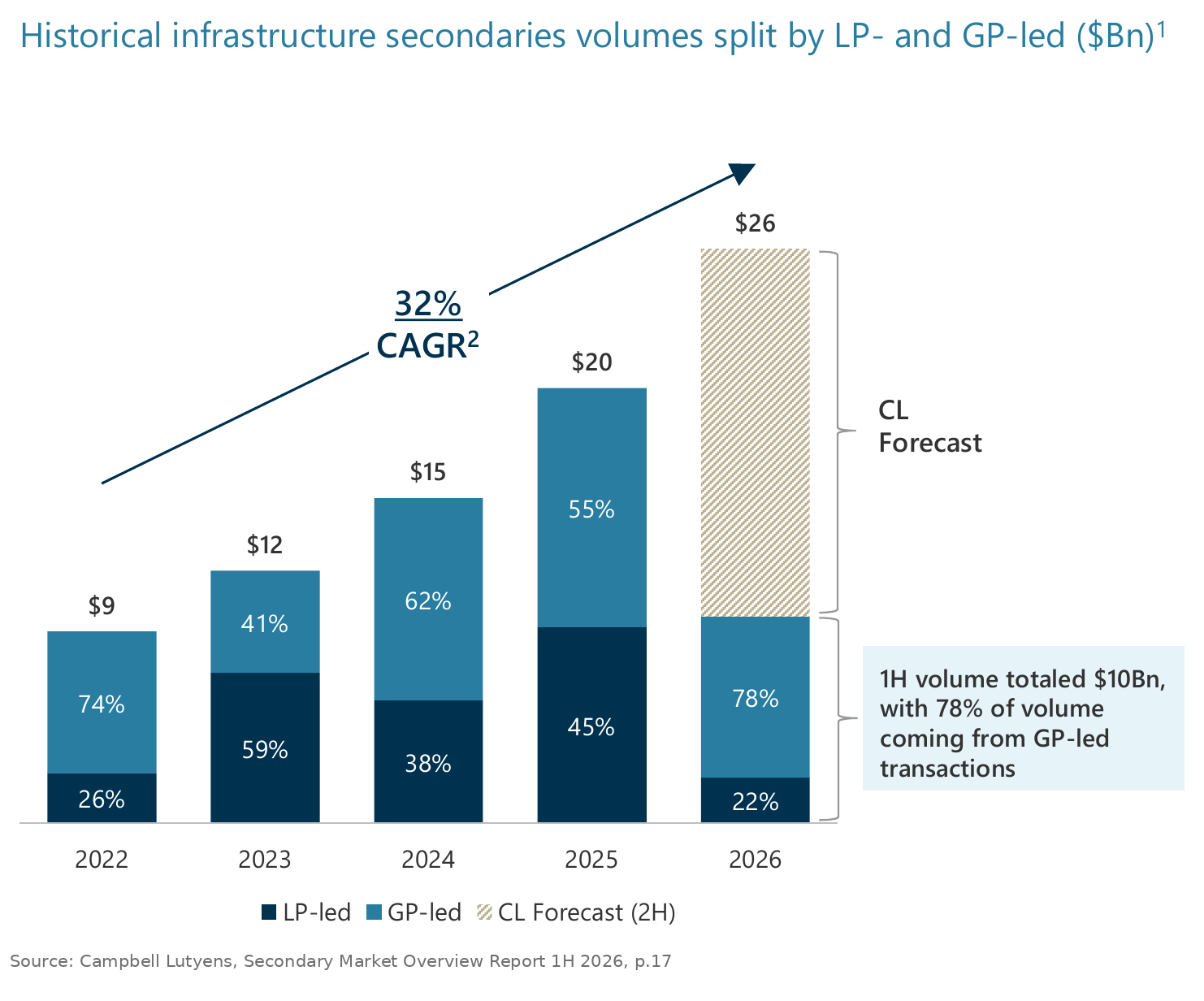 |
Campbell Lutyens' half-year report explains why this route now dominates the asset class. Infrastructure secondaries reached $10 billion in the first half, and 78% of it was GP-led, roughly double the share of three years ago, because GPs "are using CVs to hold assets longer" and LPs "increasingly prefer to stay exposed rather than sell." For an LP in a fund of Sølvtrans's vintage the question to put to the sponsor this autumn is a single one: does the vehicle pay the minority buyer's price, or a discount to it?
$2.4 billion says the loan books keep coming
The buyers are now raising dedicated money for the end of the first direct-lending vintages, and HarbourVest's first print sizes the trade. The Wall Street Journal reported, and Private Equity Wire relayed on Friday, that HarbourVest has $2.4 billion of initial commitments for its private credit secondary strategy across several vehicles, including a senior credit fund and an opportunistic one, with no target disclosed and fundraising to continue through 2027. About $500 million is already at work in five transactions, three of them GP-led and two initiated by LPs. The first vehicle the strategy led, closed on 6 August, was $730 million for Willow Tree Credit Partners as sole lead: about 130 positions, mostly first-lien loans to sponsor-backed companies, out of funds raised in late 2020 and early 2021, with Evercore advising.
Why credit needs its own pool of money is a matter of arithmetic, not marketing. A buyout secondaries fund earns its return from the discount to NAV and from what the sponsor does next. A performing loan book trades near par, at "approximately 99% of FMV" in Evercore's half-year count, so the buyer's return is the coupon plus whatever leverage it puts on the vehicle, and that is a different fund with a different return target. Campbell Lutyens' report says as much: buyers were "paying up for quality LP-led books, while taking a more cautious approach to GP-leds given concentration risk and aggressively levered deal structures", and its $9.8 billion of first-half credit volume becomes an estimated $18.5 billion once the leverage inside the vehicles is counted.
A direct-lending GP with a fund from the 2019 to 2021 vintages now has dedicated bidders on both sides of the Atlantic, after Pantheon's two vehicles this week and HarbourVest's raise today. The LP in that fund should read the leverage line before the price line: a bid near par funded by debt on the vehicle is a bid on the loans' coupons, and it is the first thing to move if defaults do.
On the radar
- Monday 14 September, Sacramento. The CalPERS Investment Committee takes Meketa's private equity and private debt trust-level reviews in open session, then the pipeline reports from Anton Orlich and Mascha Canio in closed session. The private debt review is where the largest US pension says whether it is a seller or a buyer of loan books.
- Monday 14 and Tuesday 15 September, Los Angeles. SuperReturn US West, with continuation vehicles on the program. The West Coast sponsors in the room have EMK's question in front of them: how much rollover to plan for.
- Tuesday 29 September, New York. ILPA's Continuation Vehicles for the Limited Partner course on economics, governance and alignment. Antin's minority sale before the election is the kind of price reference ILPA's updated guidance, due later this year, wants LPs to have.
-
|