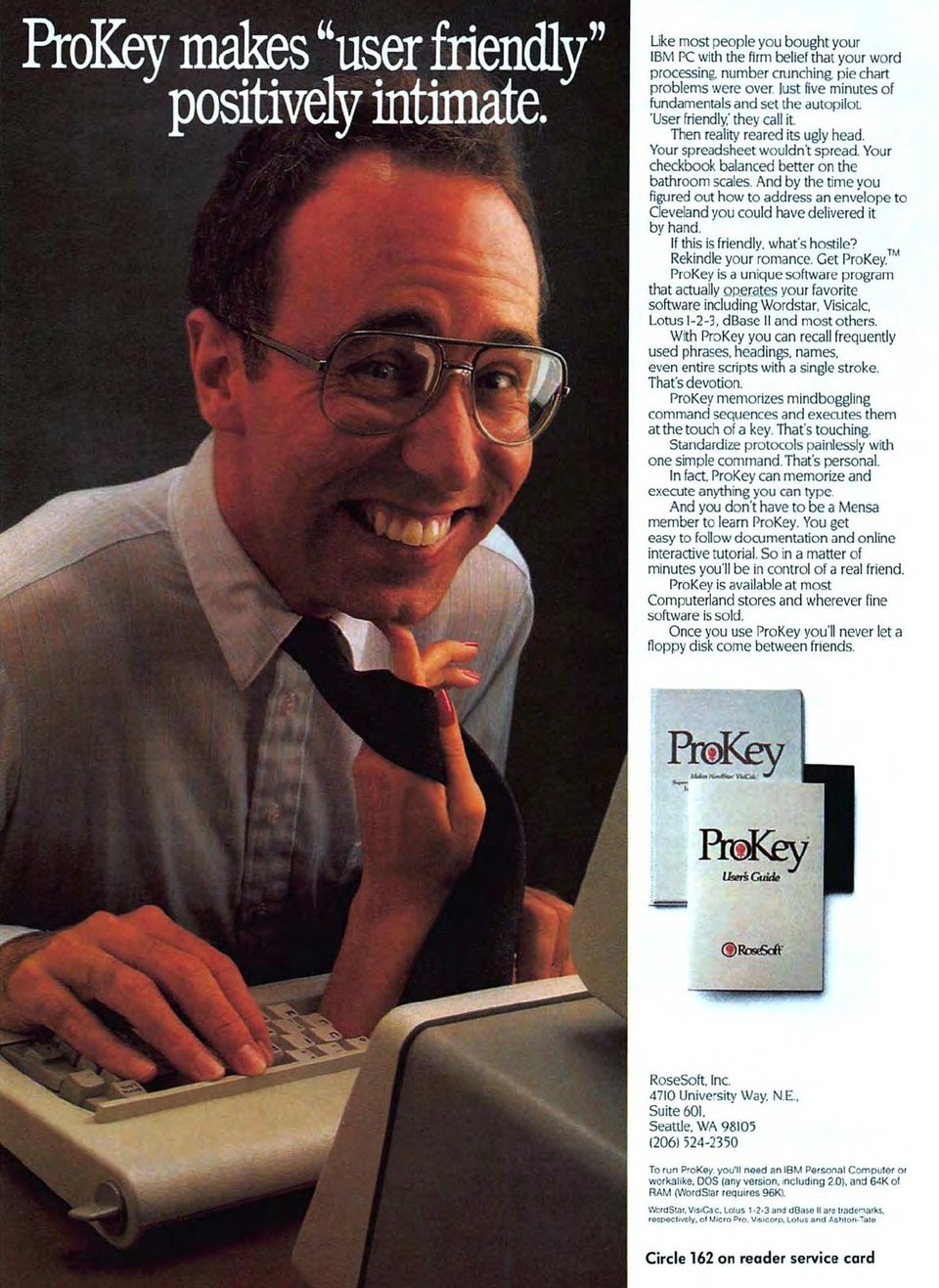
Oh, the sweet, delicious irony of long-winded, opaque copywriting for software that condenses strings of text into short, easy-to-remember shortcuts!
To be fair, ProKey was much more than a text expander. It could remap keys, enable sticky keys, and carry out multistep functions, all of which made it hard to explain in the context of 1983. Still, the keyboard in the ad above had already starred in much clearer pitches before RoseSoft cut a hole in it and shoved their marketing arm through it.
You can see what is presumably the exact same (albeit intact) IBM XT keyboard in a PC Mag ad from the month before, this one with the far more informative headline: “Save your fingers. Let ProKey do the typing!” And before that came an even better spread in PC Mag’s April ‘83 issue that included example macros and software-specific use cases for Visicalc, Volkswriter, and dBase II.
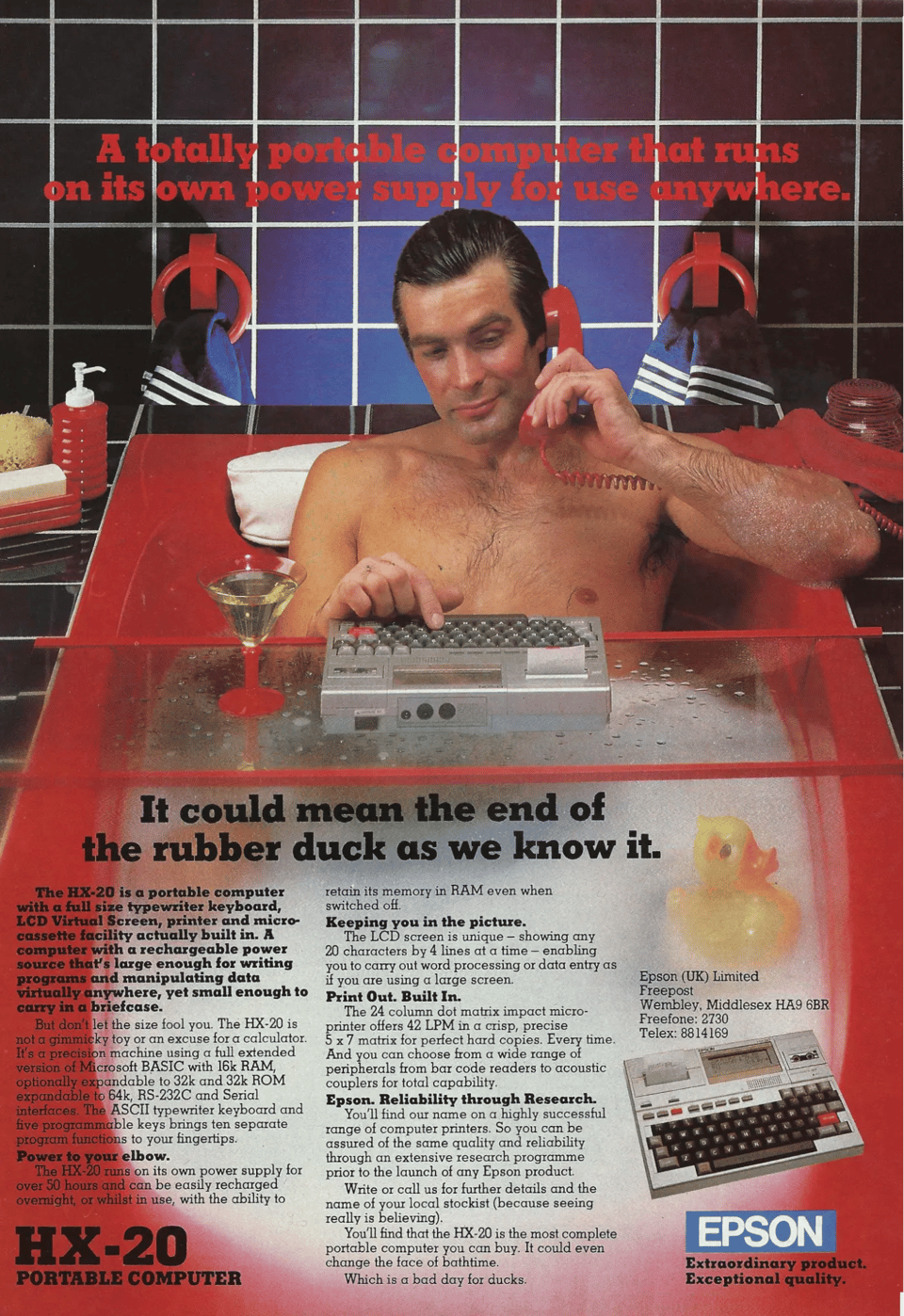
This ad never would’ve made it into the newsletter if its high-watermark headline wasn’t layered over that Leisure Suit Larry bathroom tiling. Or if it hadn’t ruined the near-perfect visual explanation with a lame-joke in an off-center subheading. And copywriting duds like “Power to your elbow” and “A bad day for ducks” didn’t exactly help. So thanks to the coked out 1980s marketer came up with this, likely the lowest costume budget for any ad I’ve covered thus far.
The HX-20 was the first keyboard-screen-printer-storage-battery combo ever sold. At less than 4lbs, it was announced years before anyone used the word “laptop,” and sold for only $795. It had two 614KHz CPUs (one handling the keyboard and display, the other taking on the printer, other peripherals, and the four-octave piezo-electric buzzer that you could program with the SOUND pD command in the onboard Epson Basic program)! But surely a few bath toy gags wouldn’t distract from the device’s historic specs…right? RIGHT?
“Among the many ads in computer magazines is one that seems odd. It is the one for the Epson HX-20, and it shows the machine perched on a water-spotted table over a bath,” one L. Paddon from Exeter wrote to Routine Inquiries in the March ‘83 edition of Personal Computer News. “It must be bad for a machine to be in such damp conditions. Am I right or should I not worry about computing in a sauna?” Good question Mr. Paddon! Let’s see what the HX-20’s own documentation has to say:
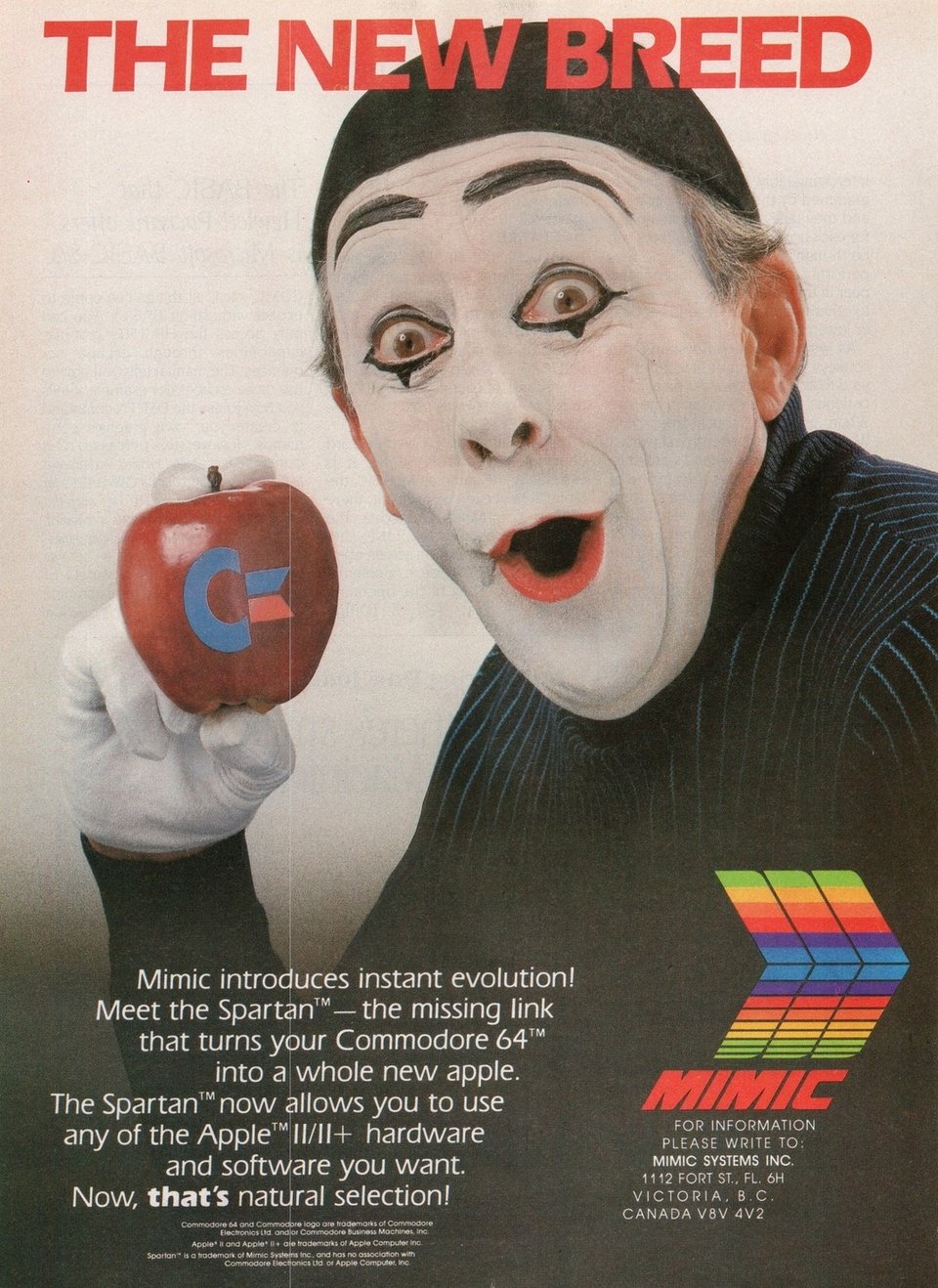
“Sir, we don’t have a prototype or a price for the Spartan ad.”
“But we do have a mime.”
Mimic Systems Inc. wouldn’t ship its first product until nearly two years after it began appearing, every month, in almost every Commodore 64 magazine. And when enthusiasts finally got their hands on the Spartan in 1986, its specs felt as old as that mime’s haunting face.
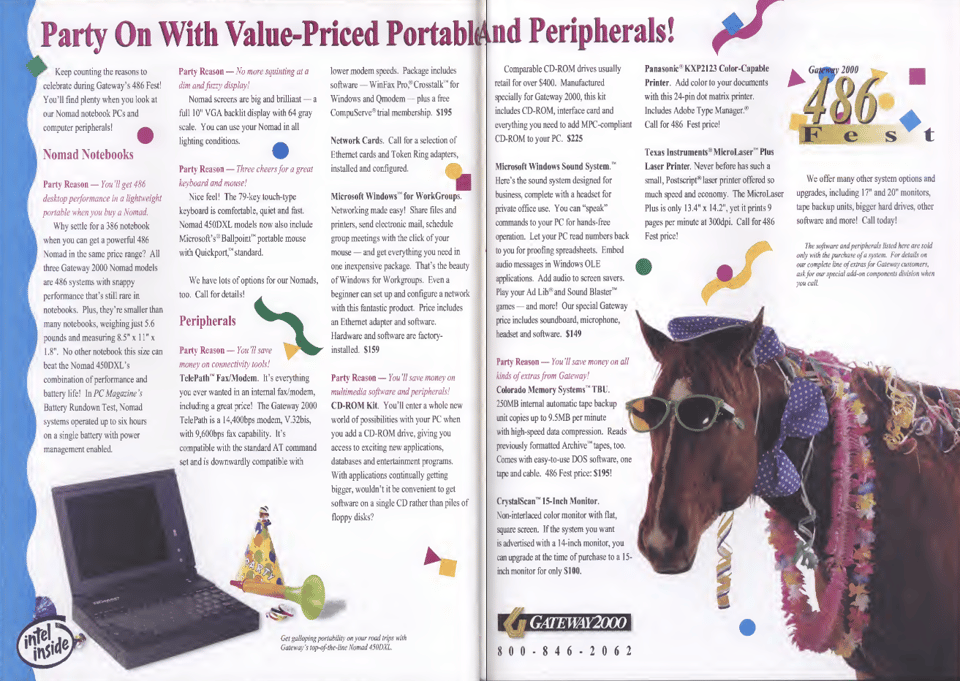
Party hats and sunglasses on animals are the fart jokes of advertising. Somehow lazy and effective, shallow yet infectious, and definitely not too tasteless for Gateway 2000 or its wunderkind president.
"I've used soap dishes as ashtrays in the best hotels in the world,” Ted Waitt bragged during one of his New York Times interviews, explaining in another article that he picked his 1990 Porsche Carrera-C4 because it was “the only car I could find that would go 160 miles an hour in the snow with the top down." Restraint didn’t rocket him or his company to $1 billion in sales over six short years. And it was never a part of the marketing strategy.
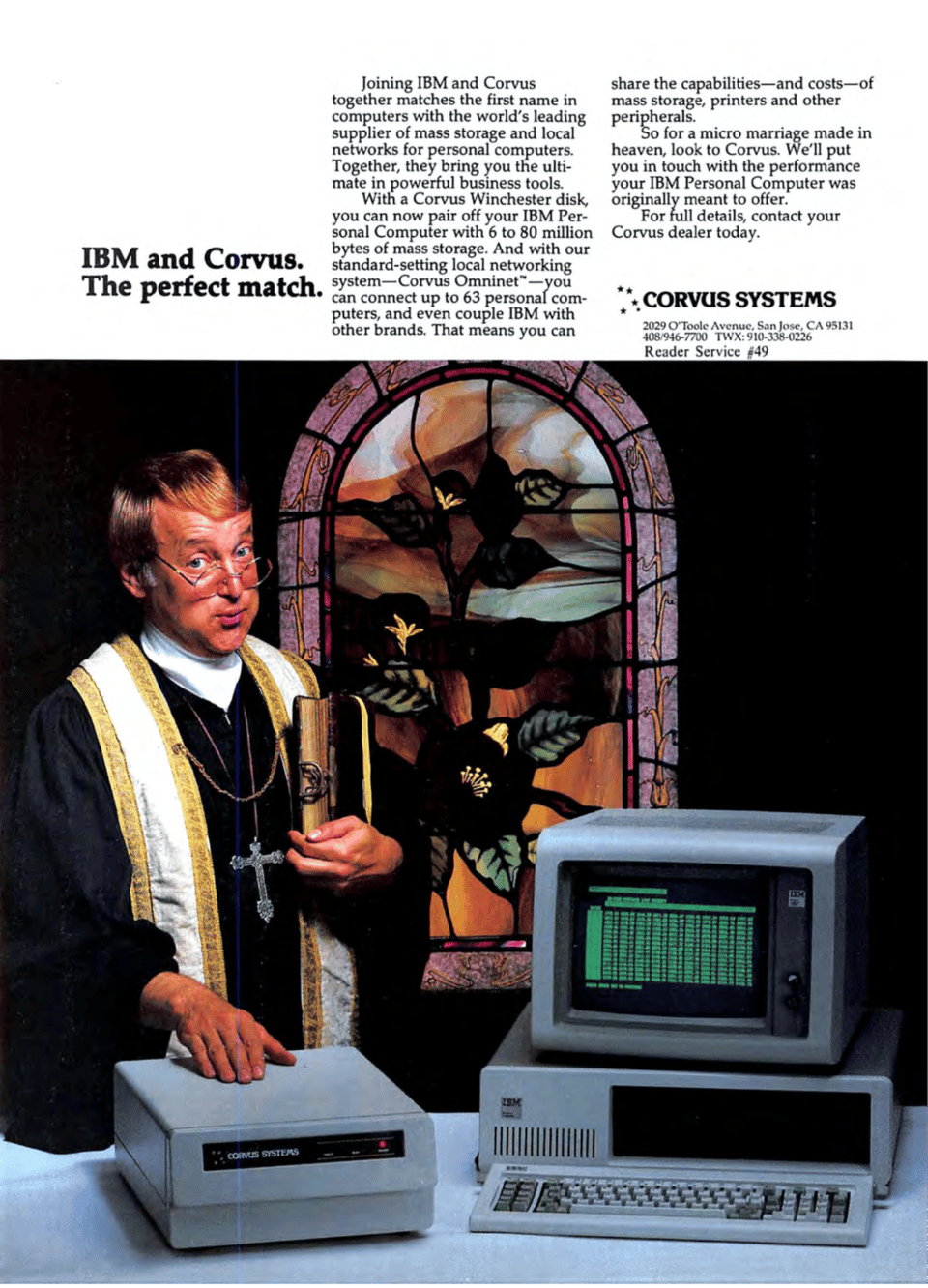
I’ve never been to a wedding where the officiant…it looks like he’s whistling? Whilst lightly caressing one of the betrothed. But maybe that’s just me.
The marriage motif is an especially strange metaphor considering one of the main selling points of Corvus drives was that everything from an Apple ][ to a TRS-80 could read and write to the disk. This wasn’t a one-vendor kind of peripheral.
“Because it's always network-ready, you can connect it to a Corvus OMNINET™ local area network. These networks let more than 60 computers of the same or different brands share the disk system, printers, and other peripherals, and provide intercomputer communication,” according to a company brochure.