
A bizarre Commodore 64 peripheral, a mime, and some pretty bad ads
Two years of nightmarish smiles and makeup before anyone laid hands on Mimic Systems' actual product.
This newsletter does not include sponsored posts, affiliate links, or ads (except the ones we make fun of together). Analytics and tracking are disabled. And there is no paid upgrade or AI-generated content. Enjoy!
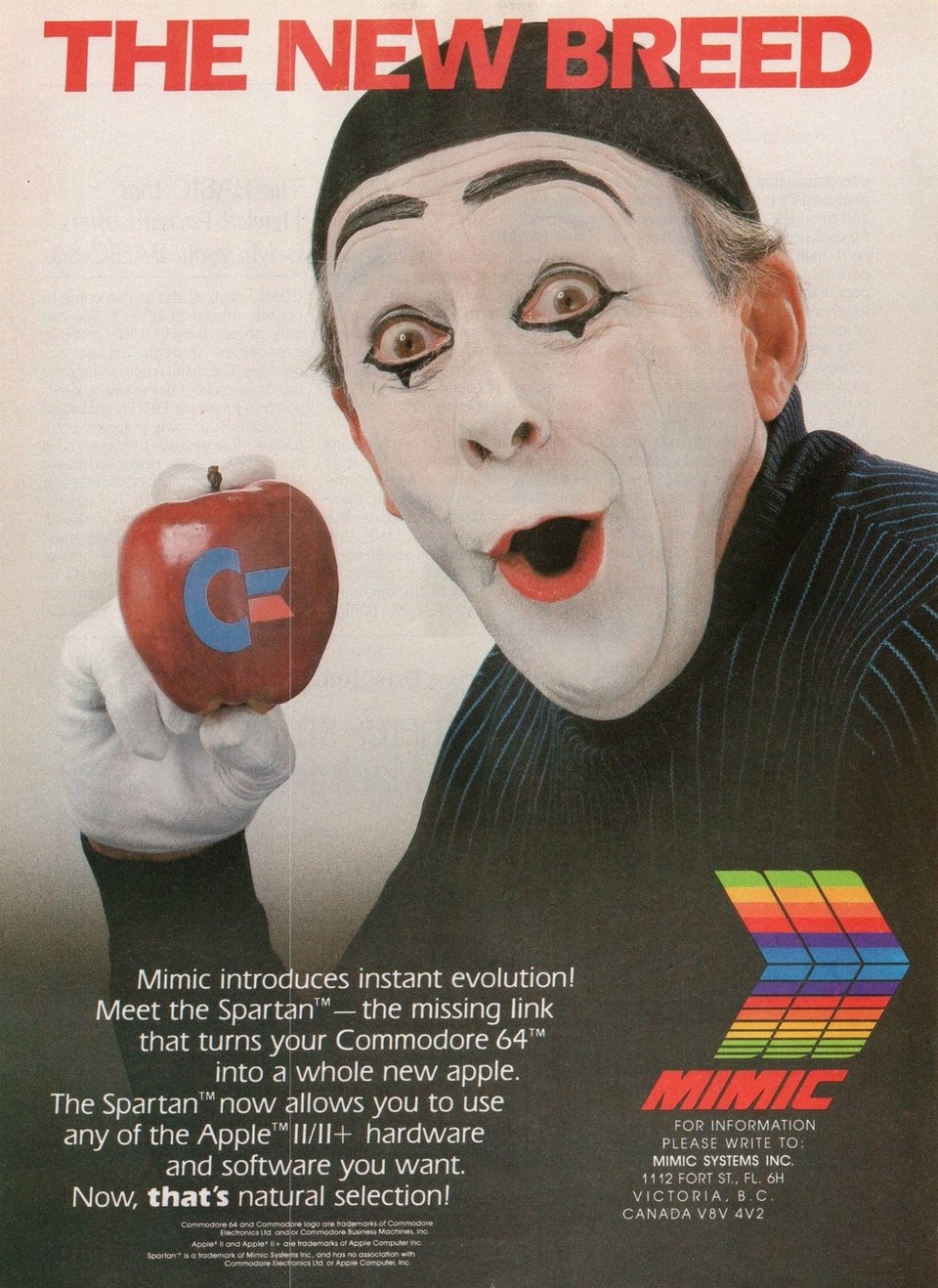
“Sir, we don’t have a prototype or a price for the Spartan ad.”
“But we do have a mime.”
Mimic Systems Inc. wouldn’t ship its first product until nearly two years after it began appearing, every month, in almost every Commodore 64 magazine. And when enthusiasts finally got their hands on the Spartan in 1986, its specs felt as old as that mime’s haunting face.
Magazine reviews were tepid at best, with Mark Brown giving it two stars in INFO Issue 12. “Mimic’s Spartan is a noble experiment that just plain took too long to get to market. With all the software available by now for the Commodore 64, the Spartan’s major purpose is gone…It is both a brave attempt at something challenging and a make-believe kind of device. Don Quixote would have loved it.”
Individual users were less diplomatic. “I used it for a month & was constantly on the phone for tech support until I got tired of all the bugs & called it quits,” someone named Phil complained in the comp.sys.cmb USENET group.
And yet, one fully kitted model went for more than $5,500 in an October 2024 auction, while multiple others also received over than half that amount from bidders.
Announced in 1984. Shipped in 1986. Product market fit in 2024. But what did the Spartan actually do when it eventually hit the market? I’ll let the mime explain.
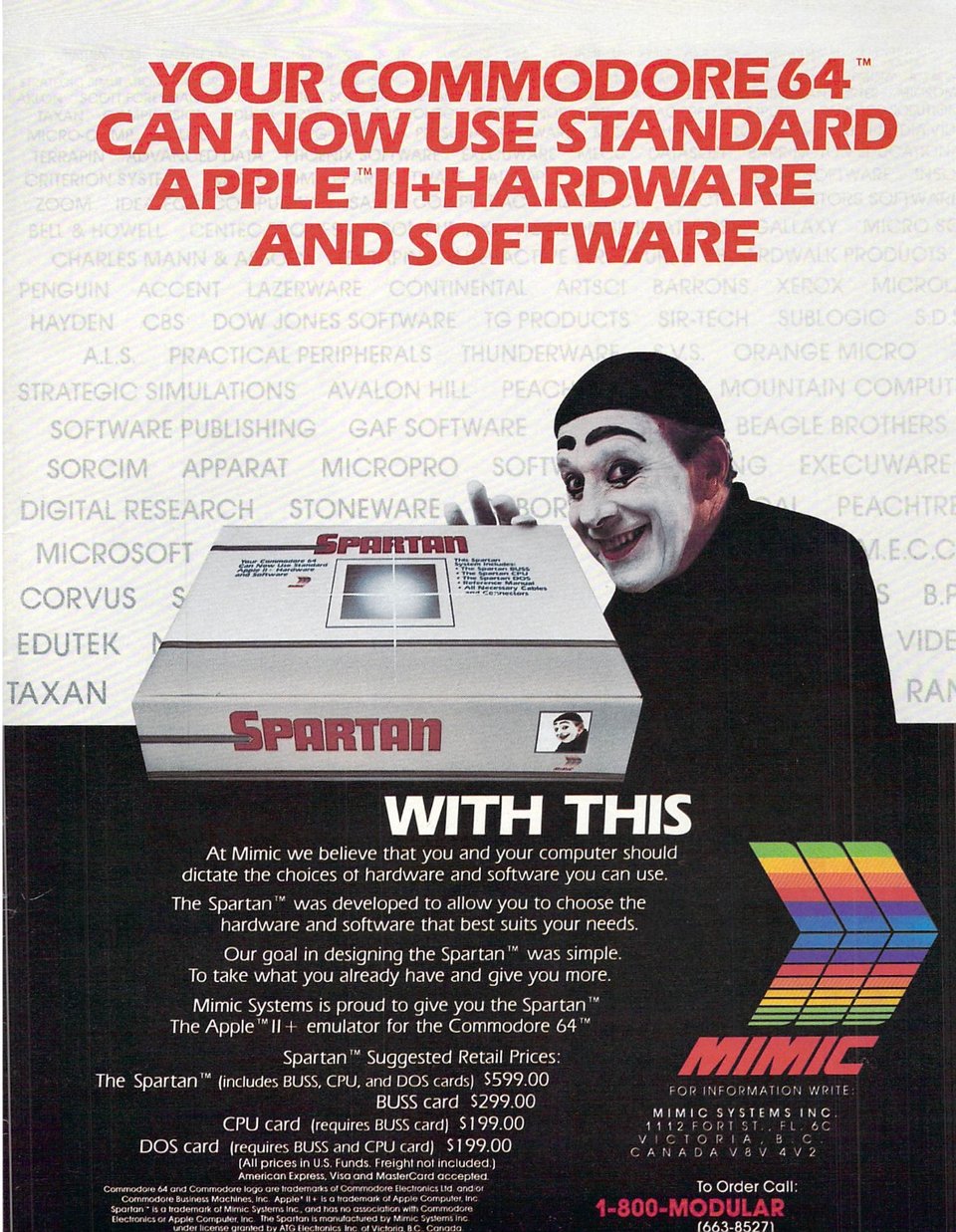
“We’ve settled on a price. But we haven’t settled on our favorite prototype.”
“But we have settled on our favorite mime.”
Like all of my favorite bad ads, this one starts off bizarre at first glance and only gets weirder the closer you look.
The lack of ellipsis and proper alignment between the red header text and “WITH THIS” is jarring but forgivable. Putting a guy in whiteface in front of a white background is a choice. Especially next to the semi transparent grey text (which is itself a hodgepodge of competitors and irrelevant hardware peripherals, including former newsletter darling Corvus hard drives). My favorite blink-and-you’ll-miss-it detail, though, is that the mime’s face is printed on the box. STOP. WHY.
[It’s worth mentioning that the guy in these photos is, based on far too much research, not Billy Scudder, the Charlie Chaplain impersonator from IBM’s not-bad tech ads.]
At least we finally know what Mimic Systems is selling: An Apple ][+ emulator for the Commodore 64. And David L. Farquhar from The Silicon Underground has an excellent explanation for why someone would even want that. The Commodore 64, which launched in September 1982, “cost half as much as any other 64K computer. But there wasn’t a lot of software for it during its first couple of years on the market…Meanwhile, the Apple II+ had thousands of software titles available for it, including the spreadsheet Visicalc.” Apple’s computer also ran for $1,195.
“If you could buy a module to give yourself both a C-64 and an Apple II+ and let the monitor and printer do double-duty, you stood to save 600 bucks. In inflation-adjusted dollars, that was $1305,” Farquhar explains. Half the price for compatibility with all of the same software* and hardware. The only problem was the ][+ was discontinued by 1983, a year before the first ad from our productless mime and two years prior to the second campaign (the one above).
[* The Spartan’s “version of BASIC was not fully compatible with Applesoft BASIC while most of the stuff on the market at that time that would run on a ][+ was still in BASIC,” according to a Usenet thread.]
Not entirely clear in either of the first two ads, Mimic Systems’ device was a full blown Apple ][+ clone. Its hardware was similar to Franklin’s Ace machines (which, remember, had their own bad ads) while its ROM was jumbled just enough–while still being mostly Apple compatible–to avoid the lawsuits Franklin faced with their more exact copies.
Ultimately, the Commodore would provide some juice to the Spartan in a few narrow applications. But in most cases, it was barely more than a passthrough keyboard, if you had the deskspace to smush the two computers together.
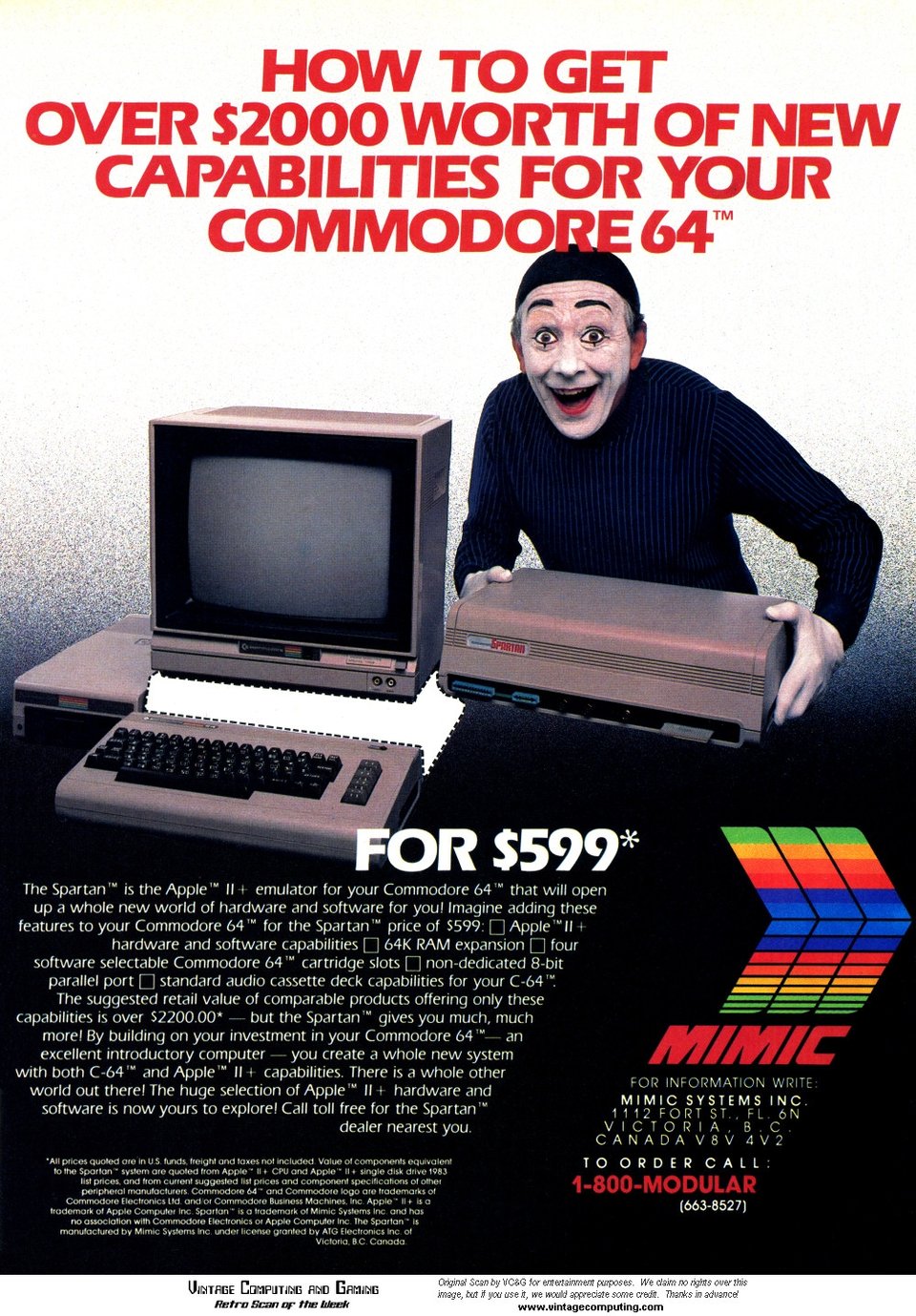
“Sir, finally, we have a finished product. How do you want to photograph it?”
“...”
“No. No, we can’t. He packed up and moved his miming to Portland. Please.”
“Give him anything he wants. Just bring him in.”
It took its sweet time but now all could see its final form. “This 12” deep by nearly 5” high C-64-gray plastic container is exactly the same width as the 64,” reads a 1986 review in Ahoy! magazine. You literally had to “mate” the two machines together, connecting the cartridge port, printer port, power input and a few others when the backplate of the Commodore bumped up against the frontplate of the Spartan. “The top surface of the box, which is easily removable to allow for internal access, is the right size and of sufficient structural strength to support a 1702 color monitor.”
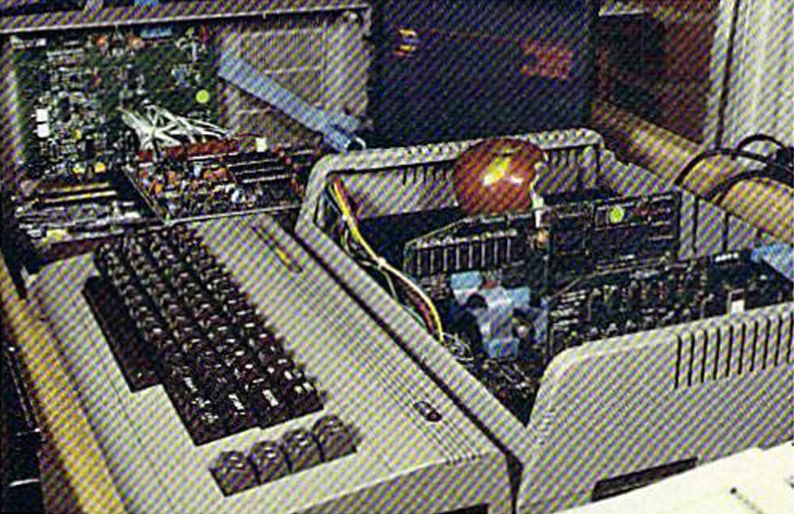
“It has the distinction of being the only 64 peripheral that when operational turned the 64 into a peripheral,” one user joked on Lemon64. The whole point was running Apple ][+ software, though, something the Spartan was still struggling with long after announcing its “instant evolution.”
Brent Marykuca remembered how, in 1985, “I (at the tender age of 19) was hired to work as the lead software developer on a product dubbed ‘The Spartan’ a Frankenstinian creation the likes of which we will not see again.” There was a button for flipping the monitor between the Commodore’s output and the Spartan’s, along with a DIY LED hanging loosely outside the case that changed color based on which was currently selected. You had to wire up dozens of jumpers. Nothing screams scary mime quite like the included DOS card, however.
The optional add-on was “installed inside the Commodore 1541 disk drive, between the drive mechanism and the 1541 logic board,” according to Brent. “In 1541 mode, the 'DOS Card' simply passed signals through from the 1541 logic, but at the flick of a switch (F6, I believe) it would take over the mechanism and turn the thing into an Apple II drive. As you can imagine, the potential for grave damage to both Apple II and 1541 diskettes was enormous and often realized.”
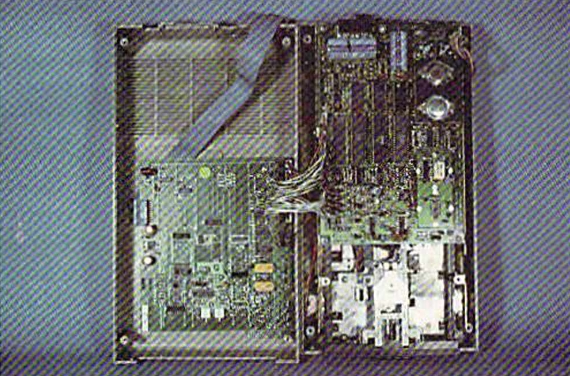
I found half a dozen reviews that mentioned the DOS card and every single one said the finished Frankenstein ran as loud as a mime is quiet. None of the reviewers could reassemble the casing after connecting the wad of cables and gluing the add-on board to the plastic with four provided sticky feet. Multiple magazine articles admitted the DOS card bricked their drives during tests. And that was after the price had been slashed.
“How Mimic managed to put a retail price of only $300 (only half what it was supposed to sell for originally) on the Spartan is unbelievable. You get at least $300 worth of parts in the thing,” based on the INFO’s two-star review. And that brings us back to comments from Mimic’s teenage lead developer about why they were so late to market.
Brent recalls how there were “weekly changes to the design by the president of the company (he would typically change it back the following week), frequent unmotivated firings of technical staff (he fired three in one day I remember, one guy because he was watching the plotter draw a circuit board design rather than working), and a draconian management style (we were paid by the hour and required to 'clock out' to go to the bathroom).” He quit shortly after the Spartan finally launched.
Before later joining Apple as a senior engineer in the early 2000s, Brent claimed that, “the president of the company wrote himself a big cheque from the payroll account and took off for South America.” His claim is quoted as fact all over forums and blogs that are still live today, despite the final four words of his story: “according to legend, anyhow.”
That bugged me. So I did some digging. There were no records of Mimic Systems’ president that I could find. But, assuming they’re accurate, there was a Conversion/Dissolve company filing on June 13, 1985 (before the sale of a single Spartan!) followed by incorporation as a sole proprietorship on October 24, 1985. It’s not hard to believe that the guy who kept putting his favorite mime in computer ads took the money and ran. I just hope the mime went with him.
Cited References:
Info Issue 12, 1986 (Mark Brown review) (Internet Archive)
Phil's complaint, comp.sys.cbm USENET group (Google Groups)
October 2024 Spartan auction listing (Facebook)
TPUG Magazine Feb '85 (Internet Archive)
Corvus Systems OMNINET (Such Bad Tech Ads)
Billy Scudder interview (Internet Archive)
Ode to the Spartan (The Silicon Underground)
BASIC compatibility discussion, comp.sys.cbm USENET group (Google Groups)
Franklin Ace 1000 (Such Bad Tech Ads)
INFO Magazine Sep '85
Spartan review, Ahoy! magazine Sep 1986 (Mike Naberezny scan)
Spartan/Commodore 64 discussion (Lemon64)
Brent Marykuca's account of working on the Spartan (Applefritter)
Mimic Systems Conversion/Dissolve filing, June 13, 1985 (OpenCorporates)
Mimic Systems sole proprietorship filing, October 24, 1985 (B2BHint)
Uncited References:
Apple II Box for C64 (Vintage Computing)
Spartan for Commodore 64 by Mimic System (Vintage Computer Museum)
Spartan manuals and drivers (Mike Naberezny)
MIMIC Spartan (Megalextoria)
Rare Apple II Clone Found! Mimic Spartan for Commodore 64 (YouTube)
Testing the Mimic Spartan Apple II Clone (YouTube)
Proud supporter of Kagi's Small Web initiative.

[If this page ever becomes unavailable, all Such Bad Tech Ads newsletters, images, and links are regularly archived in the Wayback Machine]

