The very bad ad for the world's very first laptop
The Epson marketing team had dozens of incredibly compelling, and baffling, ideas for showing off their lap computer.

This newsletter does not include sponsored posts, affiliate links, or ads (except the ones we make fun of together). Analytics and tracking are disabled. And there is no paid upgrade or AI-generated content. Enjoy!
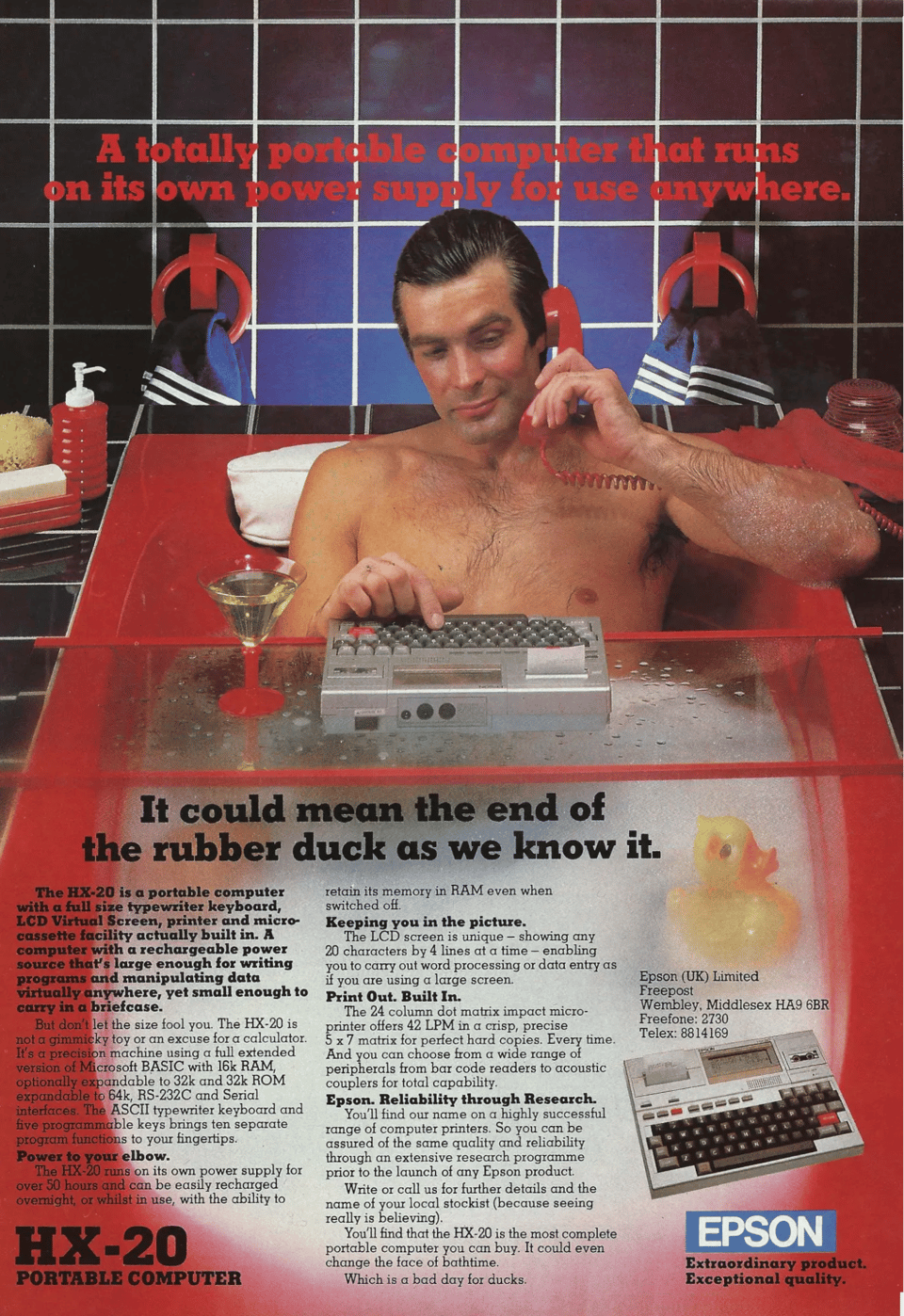
This ad never would’ve made it into the newsletter if its high-watermark headline wasn’t layered over that Leisure Suit Larry bathroom tiling. Or if it hadn’t ruined the near-perfect visual explanation with a lame-joke in an off-center subheading. And copywriting duds like “Power to your elbow” and “A bad day for ducks” didn’t exactly help. So thanks to the coked out 1980s marketer came up with this, likely the lowest costume budget for any ad I’ve covered thus far.
The HX-20 was the first keyboard-screen-printer-storage-battery combo ever sold. At less than 4lbs, it was announced years before anyone used the word “laptop,” and sold for only $795. It had two 614KHz CPUs (one handling the keyboard and display, the other taking on the printer, other peripherals, and the four-octave piezo-electric buzzer that you could program with the SOUND pD command in the onboard Epson Basic program)! But surely a few bath toy gags wouldn’t distract from the device’s historic specs…right? RIGHT?
“Among the many ads in computer magazines is one that seems odd. It is the one for the Epson HX-20, and it shows the machine perched on a water-spotted table over a bath,” one L. Paddon from Exeter wrote to Routine Inquiries in the March ‘83 edition of Personal Computer News. “It must be bad for a machine to be in such damp conditions. Am I right or should I not worry about computing in a sauna?” Good question Mr. Paddon! Let’s see what the HX-20’s own documentation has to say:
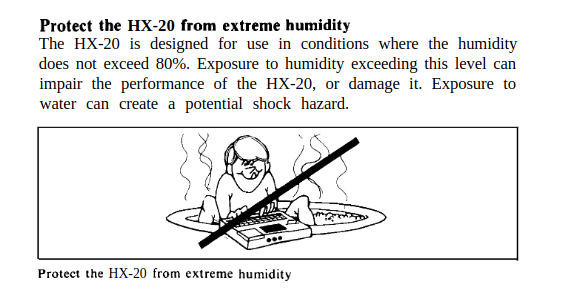
It’s like they created the ad based on what the documentation says not to do. Still, what the HX-20 fit into its extraordinarily small frame was super cool. By all accounts, the 1,100mah batteries did actually give you around 50 hours of use for basic word processing (“averaging around 0.1W and peaking at ca. 1.5W when using the printer or datasette,” based on one collector’s measurements). The printer spit out 17 characters per second and 42 lines per minute. And when you did turn the micro off, the state was saved in RAM so you could pick up where you left off the next time you powered on.
The viewable screen was only 20 characters wide and four lines tall. But it was what Epson deemed a “virtual screen” that would technically let you create up to 255 vertical lines that were 255 characters wide, with arrow keys to scroll or jump around. Although there was almost no way to take advantage of the entire possible window with the standard allotment of 32k of memory. The constraints weren’t all that big of a deal because, prior to the rubber ducky ad, the HX-20 didn’t ship with or have any commercially available word processing programs. Or any software beyond EBasic and a monitoring program, for that matter.
“After an initial spurt of interest, people began to note that no accessories or software were available for the machine. In an unusual case of Japanese marketing failure, Epson had the lap computer market to itself for almost a year and did nothing with it,” according to a September 1983 review in Byte. The early dearth of add-ons for the device make Epson’s obsession with apples-to-oranges comparisons in advertisements a lot funnier.
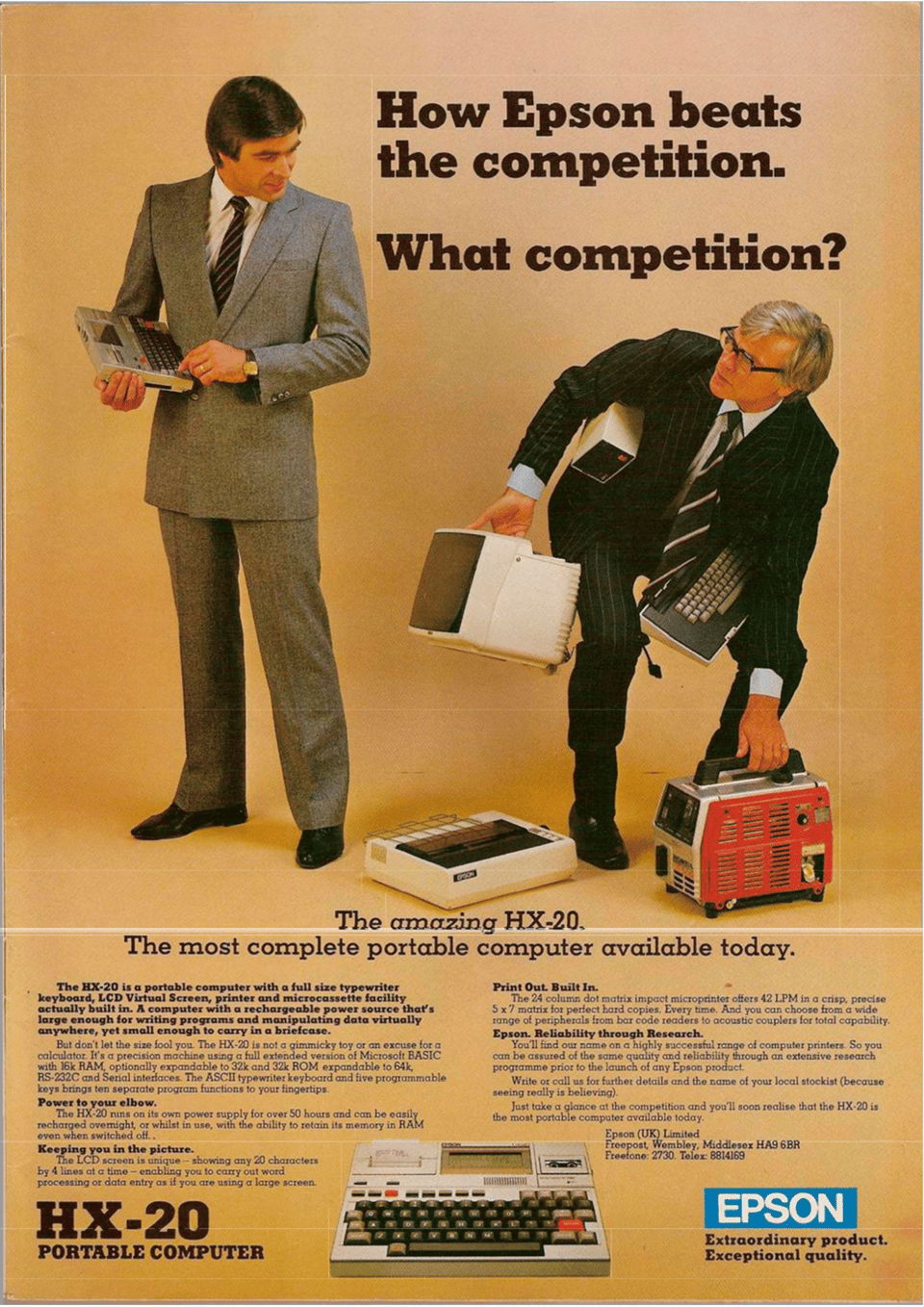
One of those computers could play games, draft documents, and edit spreadsheets while the other could keep a stack of papers from blowing away. What competition indeed.
I also love that Epson made so many different versions of the “Guy Fumbles Desktop” concept. Beyond the one above, there were at least two college-themed variations, one a Byte March 1983 ad and another this TV commercial with Stephen Furst (from Animal House) trying to use a gigantic computer on top of a tiny classroom chair. Then, there’s the full-page spread of an elderly man fishing with an HX-20 on his lap and the headline “Try this with an ordinary computer.” What, asking an octogenarian to write a program in BASIC while sitting in direct sunlight? I mean, there was a physical scroll wheel on the right side for adjusting the LCD screen’s contrast but still.
Again, the hardware itself was awesome. It’s just hilarious to market it as an alternative to a full-blown desktop before software was available for it. The situation improved somewhat by the end of 1983, when Epson upgraded the standard package to include “the formerly optional (at $160) microcassette drive and a simple word processor called Skiwriter.” That, paired with a 300bps acoustic coupler, made the device tremendously popular with journalists, sales reps, and service technicians (as shown in perhaps one of the best HX-20 ads). It was perfect for anyone who needed to type something up and send it back to the office. A workflow that apparently also mapped directly to…college pranksters and German spies?
A one-paragraph news story from Byte April 1984 describes how, during that year’s Rose Bowl, two students “used an Epson HX-20 notebook-size portable computer with an RF modem to tap into an 8086 breadboard they'd attached between the scoreboard and its operators. The students put several messages on the scoreboard’s scratch-pad area and finally changed the names of the teams to show CalTech trouncing rival MIT, instead of UCLA beating Illinois.” The New York Times claims the students’ CalTech professor approved of the prank for classroom credit.
Then, the Netherlands-based Crypto Museum of espionage-related technology claims that “the Stasi (MfS) — used the HX-20 in 1988 as a controller for its secret cross-border communication network 'GRENZE' (Border).” And even if the Berlin Wall came down before GRENZE was fully operational, “The HX-20 was chosen because it was small, consumed little power and could be purchased and used unobtrusively in Western countries. The program for controlling the agent transmitter was stored on a microcassette.”
A modem-ready computer with the exact same footprint as an A4 sheet of paper. Surely Epson could ditch the rubber ducky and come up with something better?
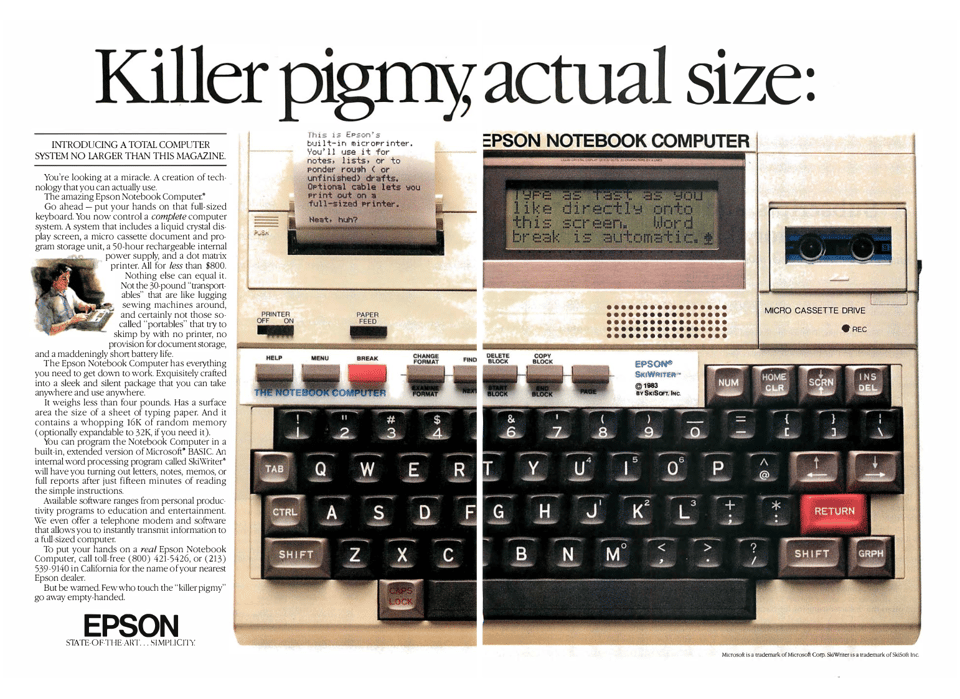
Even if you ignore the derogatory demonym, the HX-20 wasn’t exactly “a sleek and silent package you can take anywhere” because, well, saunas, but also, it “sounds like a swarm of angry hornets being driven from their nest,” according to a Creative Computing review from 1983. It’s also pretty weird that the ad italicized “real” in the penultimate paragraph, but not nearly as puzzling as the claim that “Few who touch the ‘killer pigmy’ go away empty-handed.”
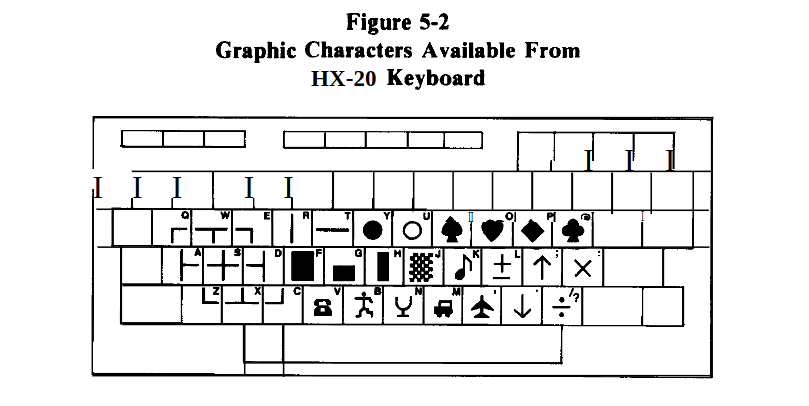
Like “Guy Fumbles Desktop,” there were at least three other, better, variations on printing the HX-20’s actual footprint on magazine pages. The spread in Computer & Electronics December 1982 was basically the same, without the anthropological comparisons. Computer Persönlich followed the same idea but also has one of the few photos of the LCD screen’s ability to draw graphs before printing them. And another variation in the same magazine, six months later. Each one provided some of the clearest views of the device’s user-programmable keys (above the number row), the CAPS LOCK key (that toggled all lower case characters, not upper case, when first pressed), and the GRAPH key for typing or printing out Epson’s 32 proto-emojis:
By the time the “Killer Pigmy” ad appeared in print, Epson had released several useful peripherals, including a barcode reader, a floppy drive, and an external display adaptor. There were games, the Epsoncalc spreadsheet program, and a database program called Personal Office. Several of the HX-20 reviews–from 80s computer magazines, modern day collectors, and Epson’s own archives–cite a BusinessWeek article calling it "the fourth revolution in personal computing." But I couldn’t find that review anywhere, at least partially due to the fact that the HX-20’s sales were abysmal and its market share was gobbled up by the better-in-almost-every-way TRS-80.
The HX-20 was popular with the people who bought one, though, both at the time of release and after models started popping up at retro meetups and on eBay. It was a milestone in micro history and the bathtub ad even shows up for a split-second in the Martin Freeman-starring BBC drama Micro Men.
Still, Epson laptops were mostly out of production by 1993 while the market for rubber duckies is essentially unchanged. What competition indeed.
Cited sources:
Your Computer Magazine, March '83 (Nosher)
Your Computer Magazine, March '83 scan (Internet Archive)
L. Paddon letter, Personal Computer News, Mar '83 (Archive.org)
HX-20 Operations Manual (Epson Archives)
HX-20 power-consumption measurements (Ganjatron.net)
Byte, Sep 1983 review (Archive.org)
Your Computer Magazine, Jan '83 (Archive.org)
HX-20 commercial with Stephen Furst (YouTube)
Crypto Museum — Stasi GRENZE network (CryptoMuseum.com)
Byte, Nov 1983 (byte.tsundoku.io)
Creative Computing, 1983 review (Atarimagazines.com)
Computer Persönlich, Jun '83 (Archive.org)
Computer Persönlich, Dec '83 (Archive.org)
Byte, March 1983 ad (byte.tsundoku.io)
"For business on the move." ad, Practical Computing, March 1984 (Archive.org)
Byte, April 1984 — Rose Bowl prank news item (byte.tsundoku.io)
Rose Bowl scoreboard prank coverage (The New York Times)
Computer & Electronics, December 1982 (Archive.org)
Micro Men clip, Martin Freeman (YouTube)
Elderly man fishing ad, Poptronics Oct '82 (Worldradiohistory.com)
Unused sources:
AD: "Where was it when I was a kid" (BambooTrading.com)
AD: "Epson HX-20: The First True Laptop Computer" (Retroguy.de)
AD: Your Computer Magazine, Dec '82 (Archive.org)
Epson 60% market share stat, Practical Computing Jan '83 (Archive.org)
Micro Men / Martin Freeman reference (StarringTheComputer.com)
HX-20 history — Yukio Yokozawa / Suwa Seikosha (ComputingHistory.org.uk)
HX-20 UK pricing, £411 (Nosher.net)
Floppy Days podcast — HX-20 part 2 with Earl Evans (Libsyn)
HX-20 carry case photo (CryptoMuseum.com)
Accounting/POS software ad, Practical Computing Feb 1984 (Archive.org)
Epson HX-20 scans and archive documents (Oldcrap.org)
"Epson HX-20 Unleashed: More Characters and Graphics for the Laptop" (Retroguy.de)
Epson HX-20 overview (Oldcomputer.info)
Proud supporter of Kagi's Small Web initiative.

[If this page ever becomes unavailable, all Such Bad Tech Ads newsletters, images, and links are regularly archived in the Wayback Machine]
You just read issue #15 of Such Bad Tech Ads. You can also browse the full archives of this newsletter.

