ProKey wrecked a perfectly good keyboard for its bad ad
Funny? Sure. Eye-catching? Definitely. Helpful or informative in any way? Not even a little bit.

This newsletter does not include sponsored posts, affiliate links, or ads (except the ones we make fun of together). Analytics and tracking are disabled. And there is no paid upgrade or AI-generated content. Enjoy!
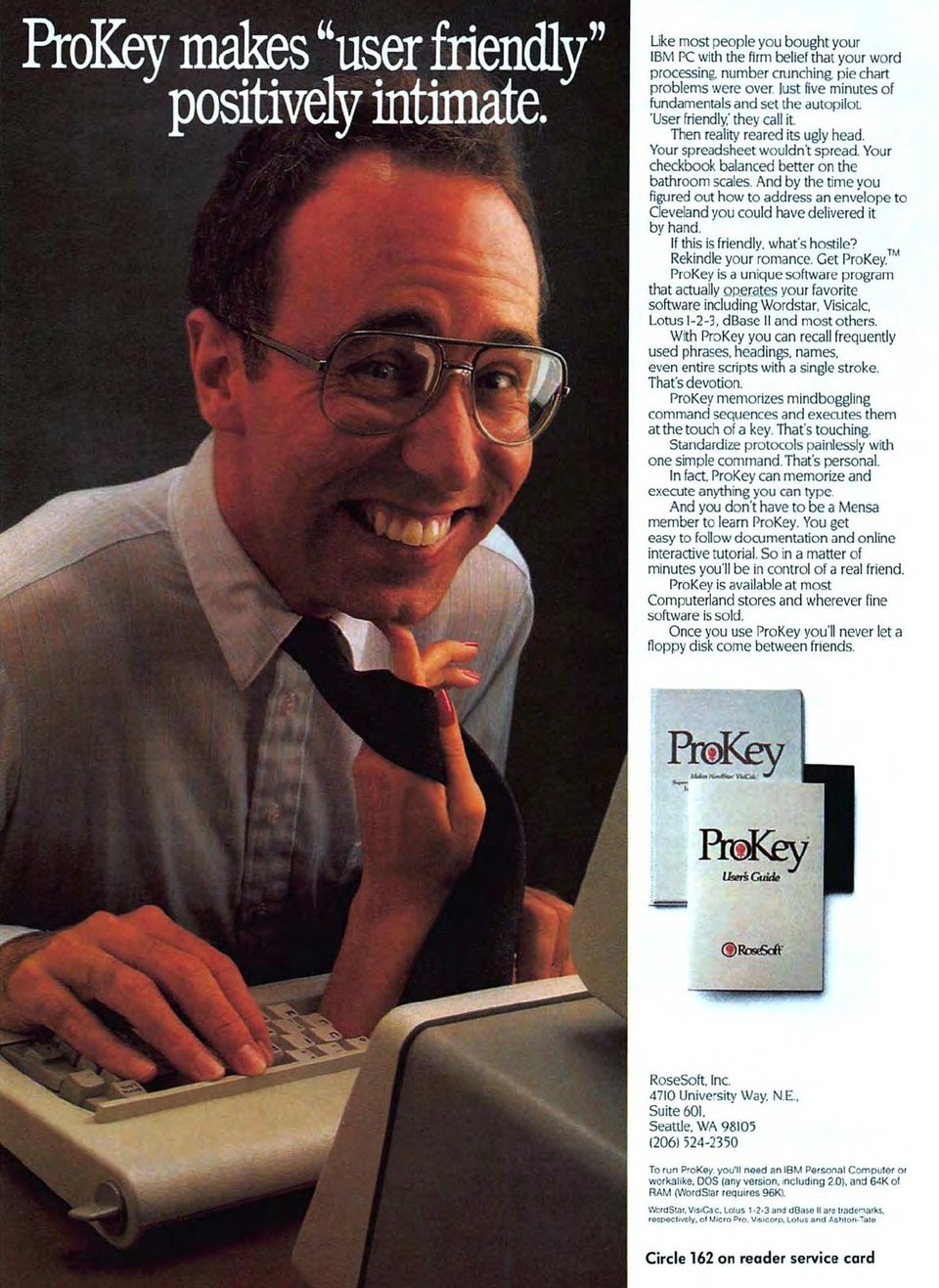
Oh, the sweet, delicious irony of long-winded, opaque copywriting for software that condenses strings of text into short, easy-to-remember shortcuts!
To be fair, ProKey was much more than a text expander. It could remap keys, enable sticky keys, and carry out multistep functions, all of which made it hard to explain in the context of 1983. Still, the keyboard in the ad above had already starred in much clearer pitches before RoseSoft cut a hole in it and shoved their marketing arm through it.
You can see what is presumably the exact same (albeit intact) IBM XT keyboard in a PC Mag ad from the month before, this one with the far more informative headline: “Save your fingers. Let ProKey do the typing!” And before that came an even better spread in PC Mag’s April ‘83 issue that included example macros and software-specific use cases for Visicalc, Volkswriter, and dBase II.
RoseSoft basically Benjamin Buttoned its marketing! The mature, sober ads from the company’s formative months regressed into sexier, but less substantive, fare. Not that it seemed to matter. In just over a year, David and Eileen Rose turned their two-person, husband-and-wife company into a million-dollar operation with a staff of 10. This despite ad concepts I still struggle to wrap my head around.
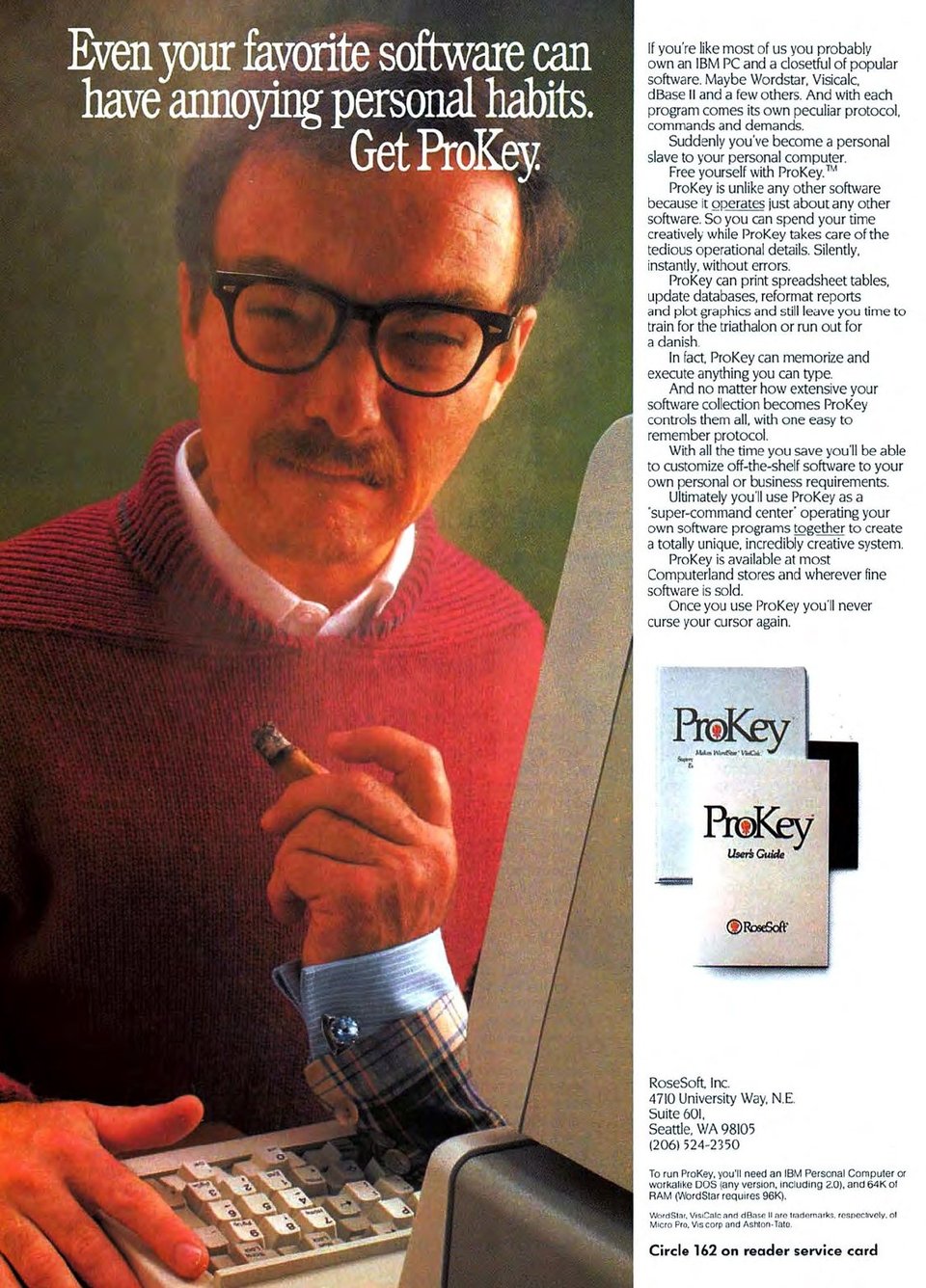
Nothing screams “our software will make you love your keyboard” like a New Jersey car salesman erupting out of your home row. At least it fits the copy, which spends its opening paragraphs trash-talking your current daily driver, then piles on vague, superlative promises that an upgrade will fix everything. From what I can tell, it was ProKey’s evangelists and reviewers who made up for this particular run of style-over-substance ads.
“‘Key-changers’ are customizing tools,” Art Kleiner wrote in the Summer ‘84 edition of Whole Earth Software Review. “They'll streamline strings of complex commands (macros) into one keystroke; they'll turn numeric keypads, like those on the Kaypro, into usable function keys; they'll toss in frequently-used bits of boilerplate text.” Another example from the same article: if Ctrl + Y deletes text in one program and restores it in another, ProKey could redefine one of them so the same shortcut does the same thing everywhere. Why couldn’t David and Eileen put explanations that straightforward in their ads? Because their backgrounds were in orbital mathematics and artificial organ research, obviously.
David left NASA's Jet Propulsion Laboratory in 1978 (after spending part of his time on Voyager’s mission control software!), with Eileen leaving her neurophysiology position at CalTech not long after. “I was getting tired of academics, and David was getting tired of the bureaucracy at JPL,” she told Softalk in late ‘83.
So in January of 1982 they founded RoseSoft, out of an apartment in Seattle’s University District. The very same “Suite 601” address in the ads. They bought an IBM PC, and “David Rose started writing ProKey itself only six months after his first look at a pc [sic], in June 1982.” He had a prototype a month later and a finished version by August.
David’s own LinkedIn claims that ProKey was the “first personal macro processor.” And when the Roses first demoed it for the Seattle PC users’ group, 20 of the 30 people there bought it on the spot for $50.
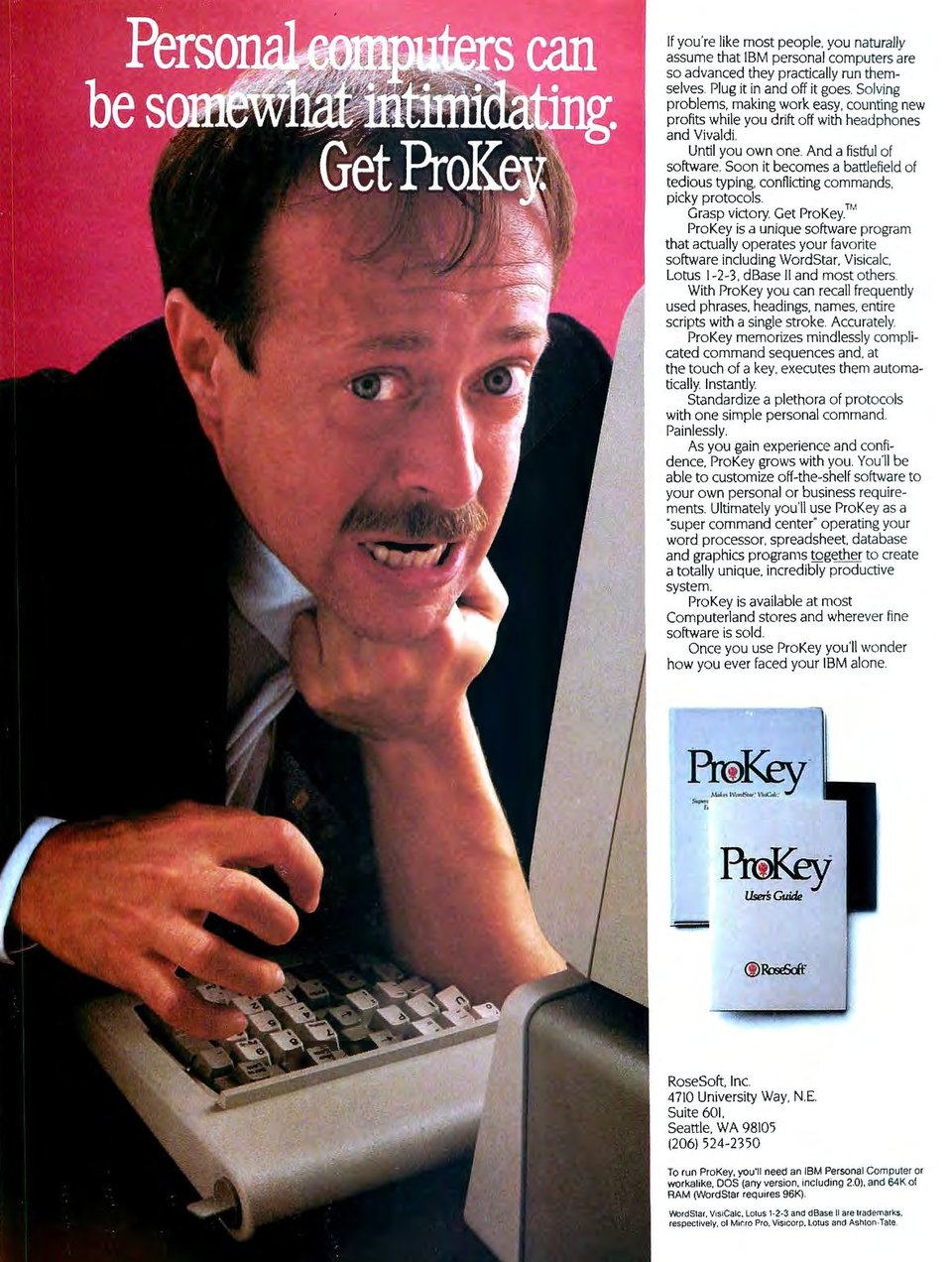
The first forearm shoved through that jagged, keycap-shaped hole was sultry and seductive. The second was repulsive. And now a third, ready to fight. Pick a lane RoseSoft! Everyone seemed to be able to plainly describe what made ProKey great except the people making it.
“RoseSoft has produced a special version of their keyboard enhancer, ProKey, which ‘remembers’ the Ctrl, Alt and Shift keys until a subsequent (nonshift) key is struck,” disabled user Michael Falconer wrote to PC World in January ‘84. “I hope that you will print this letter to inform your readers about the availability of ProKey 3.0. It provides an elegant solution to a problem that has plagued disabled computer users for years.”
Later in that same issue of PC World, Burton Alperson’s 12-page review gushed that ProKey “is easy to use, carefully written, and well documented. After using it heavily for eight months, I am hard pressed to come up with a single serious criticism.” Alperson shared nearly 200 lines of his own macros, and that personalization was a huge part of what mobilized its users. The Roses were all too happy to oblige.
David appeared on a 1984 episode of Computer Chronicles to awkwardly and laboriously demonstrate a custom vim-esque macro that found the end of a sentence in WordStar, cut it, and pasted it into another paragraph. His JPL background and engineer’s perspective was a big part of what David built into ProKey and the hackers and keyboard nerds who were most likely to use it.
A word processing operator in Palo Alto told Dvorak International Federation’s newsletter that “The RoseSoft documentation manual is excellent…its advertised ability to implement Dvorak clinched the purchase decision.” That was confirmed by yet another Dvorak newsletter, which mentioned ProKey shipping with a ready-made Dvorak “definition file.” All you had to do was enable it, or better yet, mail RoseSoft requesting the files for the one-handed Dvorak layout.
Not everyone had nice things to say about ProKey, though.
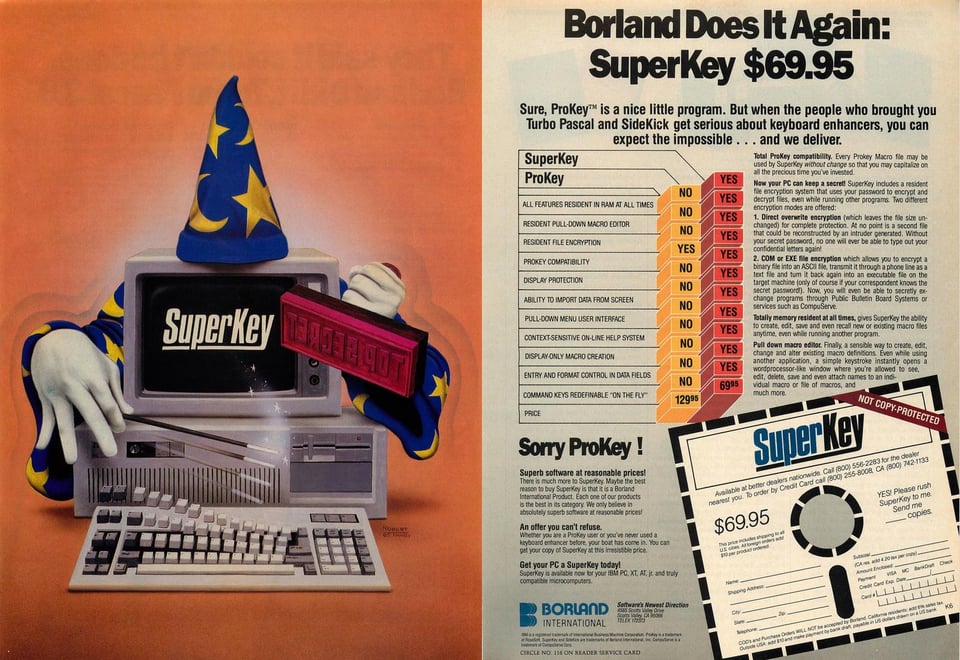
Borland, maker of the uber-popular Sidekick software, called RoseSoft out by name in an ad in the May ‘85 edition of PC Tech Journal. RoseKey responded the following month with a printed ad posing as an editorial from David Rose. “Don't be misled by the recent claims of ProKey imitators; they're comparing themselves against old versions of ProKey,” and “The difference in price will hardly pay for dinner.”
Then, a month after RoseSoft’s feisty response, Stephen Manes published a ProKey vs. SuperKey comparison in PC Magazine, declaring “A championship bout is shaping up,” before concluding, “Ultimately, this matchup represents capitalism working as it should. Competition gives the market better products at lower prices, and the customers come out winners. ProKey is better than ever; SuperKey is about to take its place in my AUTOEXEC.BAT file.” But when all was said and done, the feud and its impact on RoseSoft’s 50,000-user base didn’t seem to matter nearly as much as the evolution of how computers evolved.
In the late 80s, programs that were loaded into memory were growing in number and unable run parallel with other macros. You could run ProKey or Sidekick, for example, but not both. David claimed he was working on the issue, but as software UIs evolved and computer mice became more ubiquitous, users seemingly moved on from programs like ProKey before he could develop a solution.
RoseSoft continued on, taking on the contract to write MS-Key, the macro tool bundled with Microsoft Works. And the company's ads settled back into the informative, example-laden pitches that were so much better at describing the product than their Lovecraftian keyboards. But the market for keyboard macros was clearly shrinking and David and Eileen left RoseSoft at some point in ‘89, just before the company was acquired by Intergy.
In 1992, Intergy sold RoseSoft to the maker of QuicKeys, who continued selling ProKey into the mid 90s, until it quietly and unceremoniously released its grip and retreated back through the hole it punched through a decade earlier.
Cited sources:
“User friendly” ad, PC Mag Oct '83 (Internet Archive)
History of sticky keys (Assistiv Labs)
"Let ProKey do the typing!" ad, PC Mag Sep '83 (Internet Archive)
ProKey macro examples spread, PC Mag Apr '83 (Internet Archive)
ProKey ad, PC Mag Nov '83 (Internet Archive)
Art Kleiner on "key-changers," Whole Earth Software Review Summer '84 (Internet Archive)
RoseSoft profile with David and Eileen Rose, Softalk Dec '83 (Internet Archive)
RoseSoft's University District apartment (Google Maps)
David Rose's profile (LinkedIn)
ProKey ad, Softalk Dec '83 (Internet Archive)
Michael Falconer letter, PC World Jan '84 (Vintage Apple)
Burton Alperson ProKey review, PC World Jan '84 (Vintage Apple)
David Rose on Computer Chronicles, 1984 (Ohnitsch.net)
Quick Strokes #41, Dvorak International Federation (Internet Archive)
Dvorak Developments #43 (Internet Archive)
Borland SuperKey ad, PC Tech Journal May '85 (Internet Archive)
David Rose "editorial" ad, PC Mag Jun 25 '85 (Internet Archive)
Stephen Manes, ProKey vs. SuperKey comparison, PC Mag Jul 23 '85 (Internet Archive)
Unused sources:
AD: ProKey ad, PC Mag Jun '83 (Internet Archive)
Whole Earth Software Review No. 3, Fall '84 (Whole Earth Index)
1988 ProKey promo mailer (eBay)
ProKey mention, PC Mag Oct 2 '84 (Internet Archive)
PC Mag Dec 25 '84 (Internet Archive)
Proud supporter of Kagi's Small Web initiative.

[If this page ever becomes unavailable, all Such Bad Tech Ads newsletters, images, and links are regularly archived in the Wayback Machine]
You just read issue #16 of Such Bad Tech Ads. You can also browse the full archives of this newsletter.

