A doomed marriage and a bad ad for Corvus Systems' drives
Cool product, weird marketing, and really, really poor timing for a proprietary solution.

This newsletter does not include sponsored posts, affiliate links, or ads (except the ones we make fun of together). Analytics and tracking are disabled. And there is no paid upgrade or AI-generated content. Enjoy!
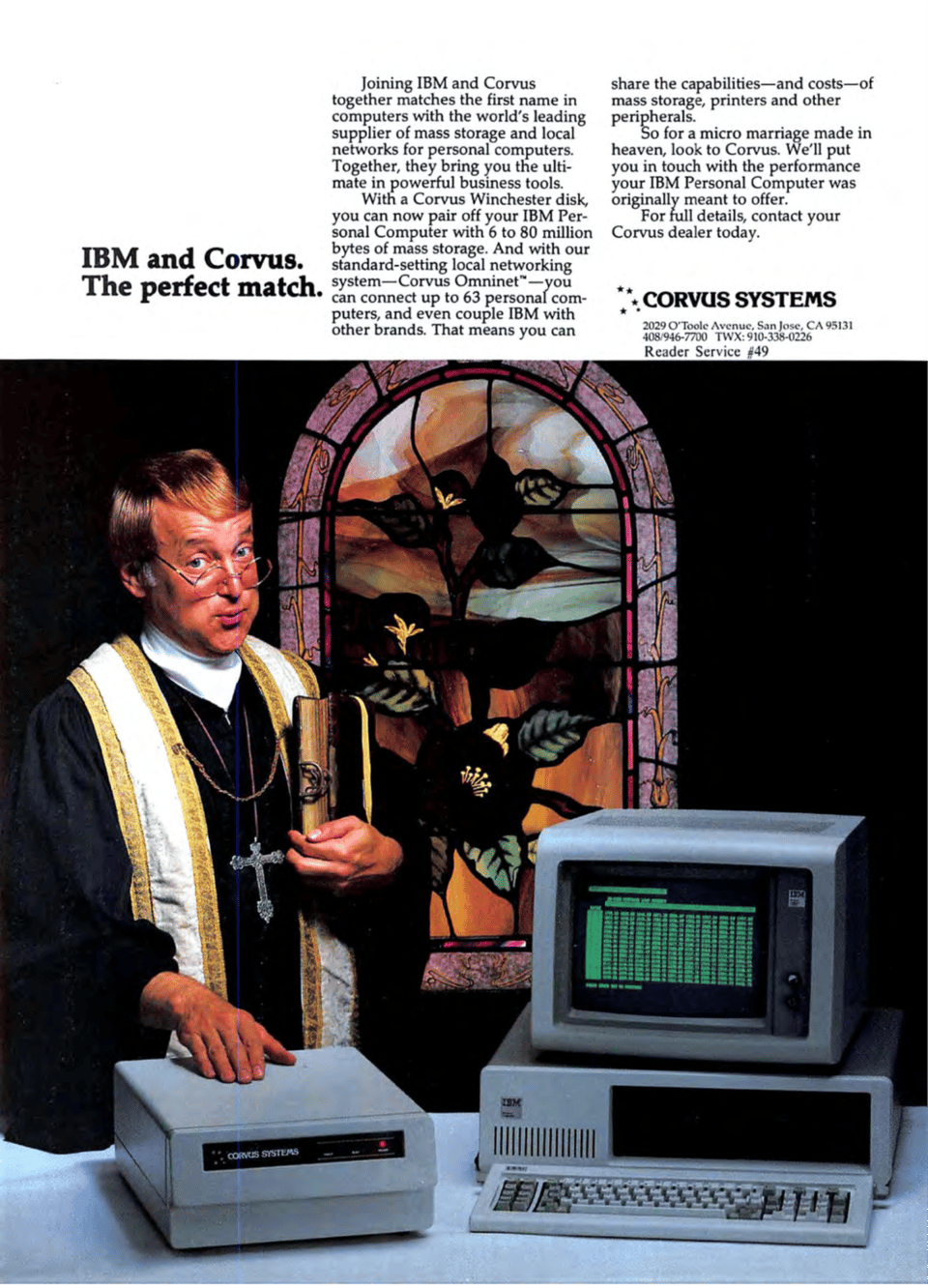
I’ve never been to a wedding where the officiant…it looks like he’s whistling? Whilst lightly caressing one of the betrothed. But maybe that’s just me.
The marriage motif is an especially strange metaphor considering one of the main selling points of Corvus drives was that everything from an Apple ][ to a TRS-80 could read and write to the disk. This wasn’t a one-vendor kind of peripheral.
“Because it's always network-ready, you can connect it to a Corvus OMNINET™ local area network. These networks let more than 60 computers of the same or different brands share the disk system, printers, and other peripherals, and provide intercomputer communication,” according to a company brochure.
Ethernet of that time was expensive, costing around $1,000 to run a stiff and heavy coaxial cable to a single terminal (Wikipedia even has an uncited claim that there was serious risk of injury from falling overhead cables). Corvus Systems’ OMNINET ran along much lighter, and cheaper, wiring that could handle up to four (and later eight) OmniDrives for shared network access.
Other ads claimed these Winchester-based drives were 20 times faster than floppy disks, supposedly making them incredibly popular with software engineers at Apple (another uncited Wikipedia claim).
One thing that’s for certain, though, is that these drives-to-be were not cheap dates.
![A magazine advertise showing an Apple ][ computer with a toy snail in front of it, in front of both is a large, toolbox-sized hard drive.](https://assets.buttondown.email/images/fd2f8e6c-5f47-4533-a0f4-7114a972d2b0.png?w=960&fit=max)
Please ignore the McDonald’s Happy Meal toy snail, and look at those prices. A 10mb disk and MIRROR interface (more on that later) worked out to $25,608 in today’s dollars. A 2026 Honda Civic costs less than that. And looks smaller than Corvus’ drive!
“Its retail price constituted a whopping 53% of the average American’s yearly income in 1979 (about $10,121),” Benj Edwards wrote on Vintagecomputing.com. And in the comments section below that, someone claiming to be a former Corvus Systems employee wrote that “Despite the price, we couldn’t keep up with orders in the early days.” Why were they so popular? These drives weren’t just cross-vendor, they were also cross-medium.
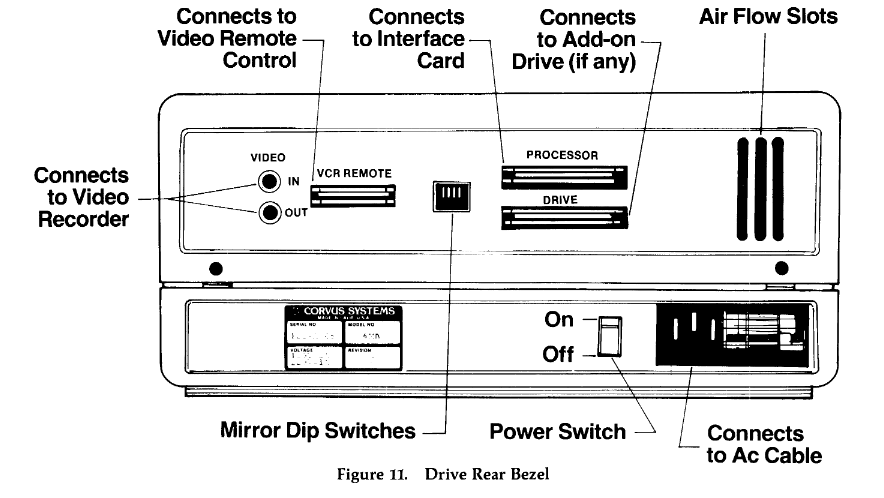
“The Mirror interface would back up the drive to videotape. If you had a fancy Panasonic VCR, you could control it via the backup software. Took about 30 minutes to back up the full 10 mb.” You’d connect the interface card to a VCR with standard RCA cables (video in/out) before selecting the read, write, or verify option in the Corvus Systems software.
Backed up data had 4x redundancy on a tape and a 30-minute tape worked out to 18mb, 60-minute to 36mb, 90-minute to 55mb, and 120-minute tapes could record 73mb of backups. And that’s a pretty good deal considering this is how much desk space a 80mb drive took up in 1982:
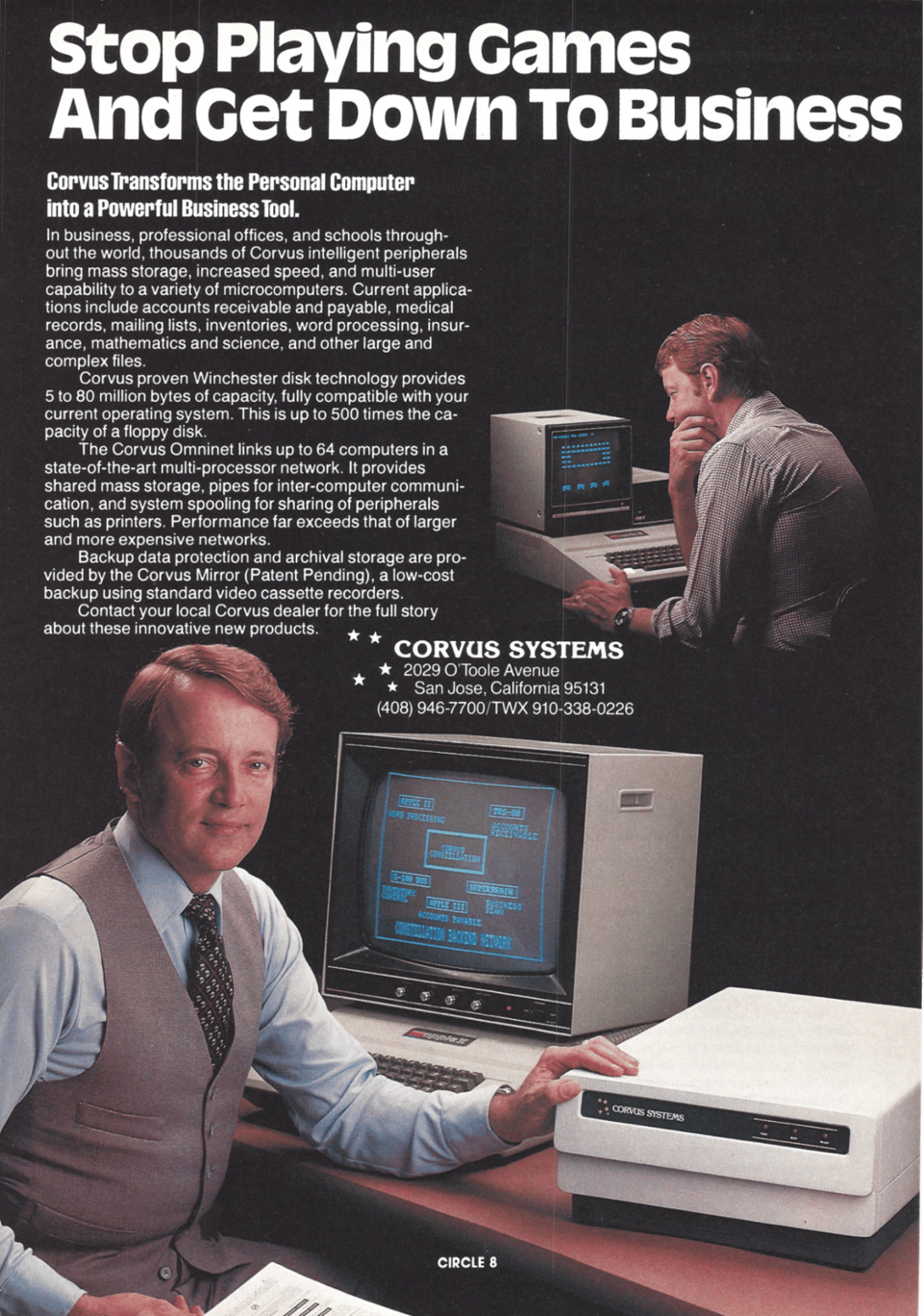
Why yes, that is in fact the same handsy priest from the first ad. It’s unlikely that model of Corvus drive would have sat next to a normal workstation in a typical office, though. Drives would be located in some central location for local-area star-network configurations.
“Omninet uses low cost twisted pair cable—similar to telephone wire—and snap-together tap boxes with standard plugs. This makes it very easy to install and to add stations later, without the expensive professional installation required with coax cable,” according to the Omninet brochure. “Stations can be placed anywhere along the 4000 foot maximum Omninet length.”
Some sources from the time claim that by 1984, three out of every five networked microcomputers were connected to Corvus networks.
The Corvus pitch wasn’t large drives or cheap networks, it was the combination of the two. Companies could buy a few big drives that were, per byte, cheaper and faster than on-device storage, and connect a fleet of low-cost, diskless microcomputers. So, to further that end, Corvus launched…an expensive desktop computer with a big local hard drive.
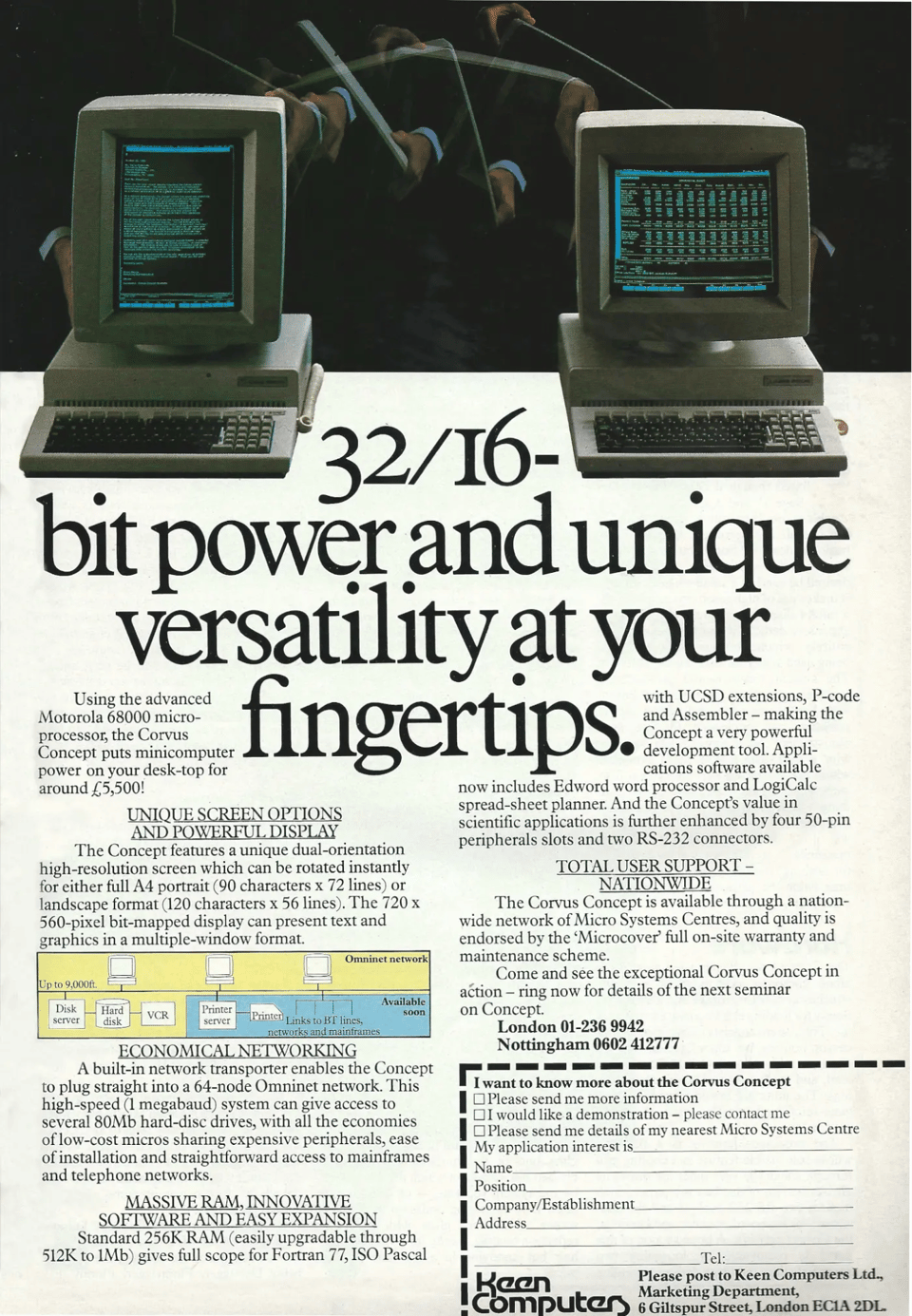
Whoever decided the ad should lead with the price better have been fired. Five thousand five hundred pounds in 1983 works out to over $27,500 when adjusted for inflation. An Apple IIe was something like a quarter of that price, in the same year. But! You could flip the Corvus Concept’s screen.
“The large screen has an added bonus in that it can be oriented either in landscape, with wide sides horizontal, or portrait format — though at the risk of a hernia, it must be said,” Chris Bidmead wrote in a 1983 review for Practical Computing. “With its 15in. Ball Bros CRT it is quite the heaviest screen I have ever handled. It might seem appealing to use the 72-line by 90-column portrait format for word processing and then swap to the 56-line by 120-column landscape mode for spreadsheet calculations. In practice you settle on one format or the other and stick to it.”
Wikipedia claims that you could flip the monitor orientation without restarting the computer, with a mercury switch registering the change. A review in Creative Computing described it differently, however, claiming that “a switch on the back of the CPU sets the mode.”
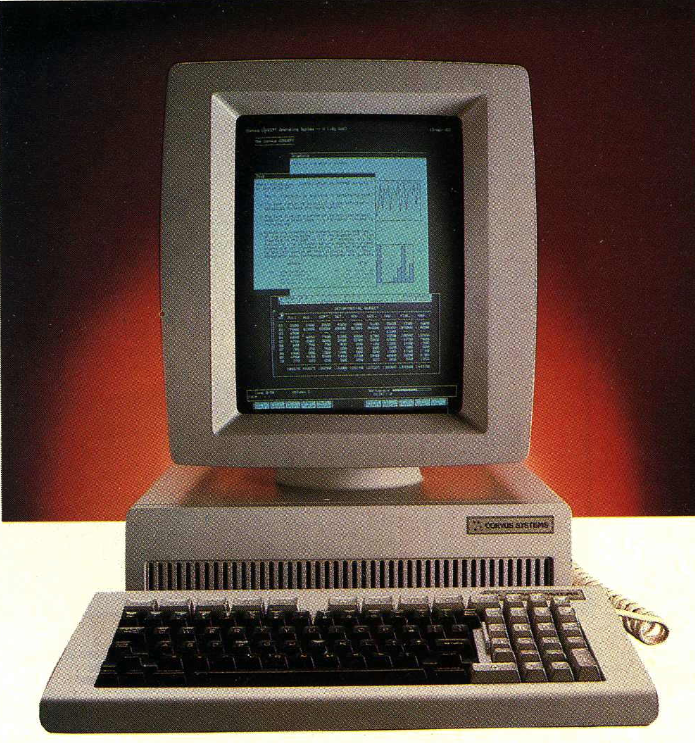
Doubling down on the whole A4-shaped monitor, the Concept shipped with its proprietary Edword word processing software. It had a multi-window system (pictured above) called “pads” for jumping back and forth between up to 17 different files, sometimes populated with custom, user-designed characters. “You can make up your own if you wish on the 16-by-16 dot canvas,” Tom Fox wrote of Edcharset in his review. “Each of the 17 windows separately defined can be set to utilize a different type font.” Oh, and it had undo/redo functions before virtually any other word processing software.
In hindsight, Corvus Systems had made all the wrong bets. Hard drives and Ethernet prices fell off a cliff, making shared network storage a hard pill to swallow. Revenue tanked, executives laid employees off before bailing themselves, and there were lawsuits over the post-chapter 11 restructuring plan.
The IBM and Corvus marriage didn’t last more than four years. It was great while it lasted though, with VCR backups, innovative LANs, and custom-font portrait-orientation desktops, even if the Corvus was hooking up with every other computer vendor on the market.
Cited References:
PC World Oct 1983 - PDF page 82 (Vintageapple.org)
Corvus Disk Systems for IBM Computers (Archive.org)
Practical Computer Jun 1980 - PDF page 60 (World Radio History)
Retro Scan of the Week: Corvus Apple II Hard Drive (Vintagecomputing.com)
Personal Computer Feb 1982 - PDF page 16 (Archive.org)
Omninet Brochure (Archive.org)
Corvus Mirror Service Manual (The Vintage Technology Digital Archive)
Omninet Corvus Connection (Nosher.net)
PC World Mar 1983 via (Nosher.net)
Corvus Systems (Wikipedia)
Corvus Concept Review - Practical Computer Sep 1983; page 87 (Archive.org)
Corvus Concept Review - Interface Age Dec 1982 (Bitsavers.org)
Corvus Concept Review - Creative Computing (Archive.org)
Corvus, in chapter 11, puts up fierce opposition (Tech Monitor)
Corvus Systems INC reports earnings (New York Times)
Unused References and Ads:
AD: Omninet Corvus Connection (Nosher.net)
AD: Corvus 5mb Drive - Byte Jun 1981 (Vintageapple.org)
Corvus: An Inside Look (YouTube)
IMI 7710 Disk Drive Brochure (unbranded Corvus drive) - (Bitsavers.org)
Omninet Local Area Network General Technical Information (Bitsavers.org)
The Bank Diagnostic Guide (Archive.org)
The Bank Brochure (Archive.org)
Corvus Mass Storage Systems General Technical Information (Bitsavers.org)
Corvus Concept Brochure (Bitsavers.org)
Proud supporter of Kagi's Small Web initiative.

[If this page ever becomes unavailable, all Such Bad Tech Ads newsletters, images, and links are regularly archived in the Wayback Machine]
You just read issue #12 of Such Bad Tech Ads. You can also browse the full archives of this newsletter.

