
AI adoption is a change management topic
2026-09-16
Portfolio management of change
In times are changing in large organisation, I wrote about the changes taking place in the world of software development companies.
The move to more podular structures where production of software turns more independent and each of the pods move closer to the customer. This results in each employee focusing on theory of action instead of just change.
I hate the phrase, "AI maturity". It feels like there is a well defined grading mechanism (propagated by a bunch of self declared experts on LinkedIn) that ascertains whether your organisation/team is mature or not. To re-iterate, there isn't one and if anyone uses that word, ditch them.
AI is a platform shift in the making, and in order to leverage it, we need to be good at change management. I have also written on how you could use Boring Tiny Tools frameworks to adopt AI without disrupting your workflows.
So, here you are as a leader, tasked with adopting AI to increase the productivity of your team or division. You are inundated with vendors pitching the use cases they cater to with the potential value they could deliver. The question is whether you can adopt it and realise what is promised.
In my beat of logistics, most of the companies are not in the business of building and selling software. They are in the business of moving freight in the most economical sense. AI should help displace some of the labour they do when adopted properly.
In logistics, things keep evolving based on market, capital and operational challenges. For example, compliance(Montgomery verdict) has become paramount for booking freight if you are a broker in the US. Similarly, the spot market is more often utilised for freight procurement as a shipper.
You keep editing your team’s process flows to their day-to-day tasks. Now, you need to adopt AI as well.
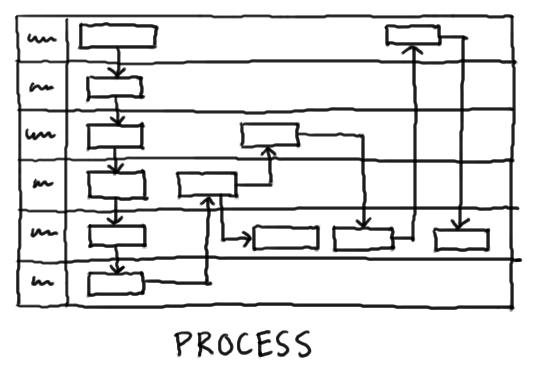
In the past, your rationale for rallying the team came as a step change that was required to win or excel in the current competitive landscape.
But, what if I suggest that with AI there are no single point step changes. Rather, it a process of iterative step changes that helps you achieve the utopian state of learning and incorporating the feedback into the platform.
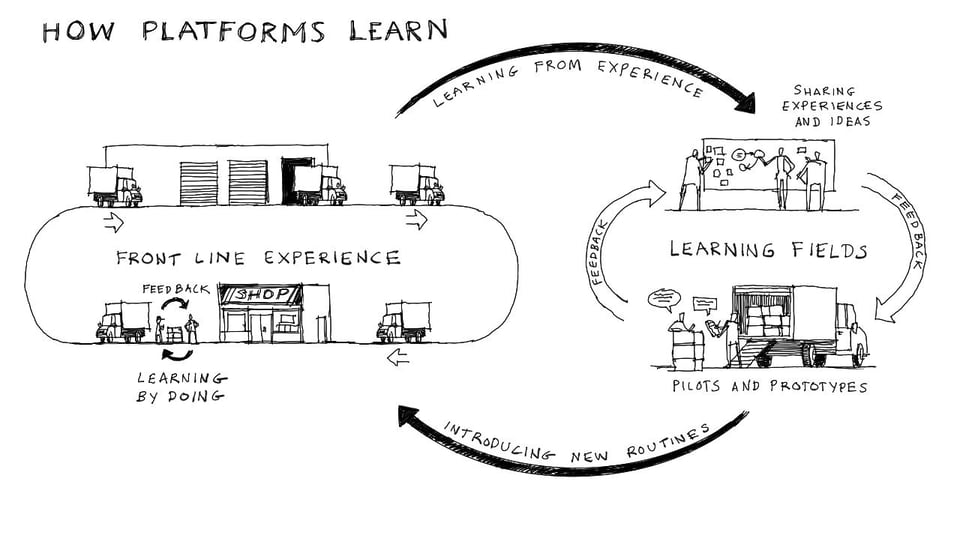
Let’s take an example of a logistics team for a FMCG company that is looking to adopt AI. It starts with auditing payments to carriers and uses an AI product to improve their bill-to-pay cycle and claim resolution time. The calibration of AI will be iterative and it will improve as we use it more. The team has to constantly change its processes in order to let AI replace the labour of auditing carrier payments.
Essentially, AI demands a portfolio management approach. In the above example, the tool you adopt for auditing will fail for oceanic shipments but work for domestic freight. The vendor that you bring on for Oceanic One handles the auditing aspects slightly differently. Now, this is a new deviation to incorporate. The best part, this tangent could be a dead-end upon trialing.
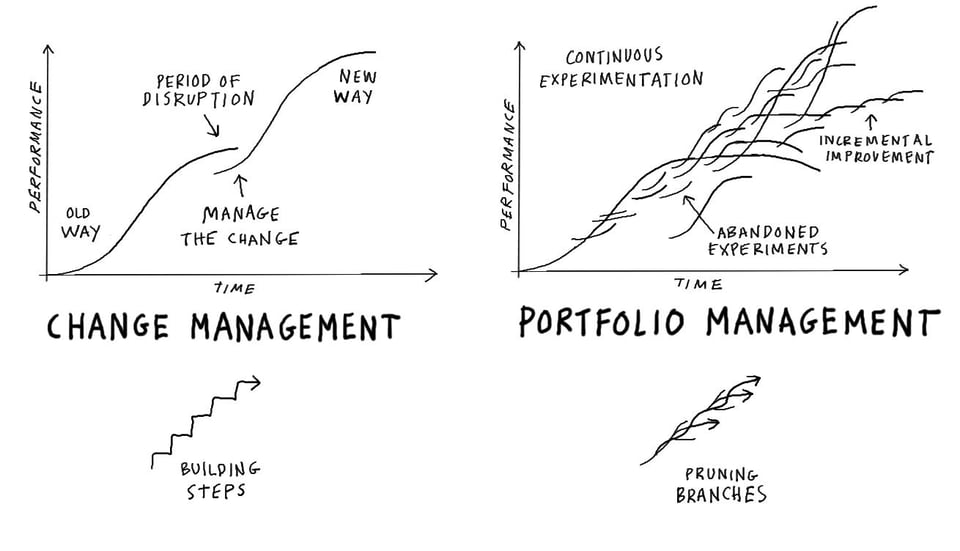
It might feel exhausting just reading how much work is in front of the team, but trust me when I say it frees up the team to do upstream work.
Going back to the example of auditing. Since it will be handled by AI, the team responsible could look at patterns that carriers are repeating and course correct it with the respective carriers. This sort of activity was never part of the daily routine due to bandwidth but is essential in driving economic benefit.
It all makes sense to you and now its time to translate this to the team.
....highlighted how employees occupy very different positions on the acceptance spectrum: AI Alarmists fear job displacement, Pragmatic Resisters need (lots and lots) of proof, and Observers or Bystanders wait for compelling evidence before committing. If managers attempt to implement Gen AI without involving employees early, they risk quiet noncompliance or deeper opposition, with Observers or Bystanders even moving into the Pragmatic Resister camp.
Organizations must develop a strategy of proactive and thorough early engagement to reassure skeptics, energize enthusiasts, and guide the majority of employees who fall between these extremes.
Source : AI adoption at work book by Gleb Tsipursky
Developing the portfolio approach and tailoring the messaging around change are prerequisites for adopting AI. In the end, people vary in their approach to AI.
Engage employees early and keep learning about the AI platform are my two recommendations for leaders dealing with AI adoption in logistics.
I have seen far too many cases where the leader bought into the hype of AI without the foresight of change management required to adopt AI.
All the illustrations belong to Dave Gray's work in his book titled The connected company
Round up
I stumbled into this one via twitter and found the main theme very relevant to current issue.
We are used to getting paid as a function of function and hierarchy. But if you are team manager, what else can you offer beyond salary.
With this question, my manager friend wanted to point out that you can pay people in lots of currencies. Among other things, you can pay them in quality of life, prestige, status, impact, influence, mentorship, power, autonomy, meaning, great teammates, stability and fun. And in fact most people don’t just want to be paid in money — they want to be paid some mixture of these things
If you extend it to yourself. It is a good question to ask when you think about jobs.
So how do you make sure you get paid the way you want to? From what I can tell, the best way is to pick the right industry. It’s fairly straightforward to tell how an industry pays. Politics pays in power. Finance pays in money. Music and art pay in ‘coolness.’ Nonprofit work, teaching and healthcare pay in meaning and, a friend reports, sometimes a sense of superiority over others too.
As for me, I work in a software company in a legacy domain. We are not getting paid the top buck in the cohort with similar titles across industries. But there are other forms of payment that make this a worthwhile career.
Links that resonated
Two posts that talk about the cost and outcome of the AI era of coding.
We are all product engineers now is a post about change required for a programmer to become a theory of action agent.
I never want to use third party apps is a post by Julie where she documents products she built for herself and her kids. Hyper personalisation is cheap ans possible now.
Sign off
I am 4 days late and I apologise for the delay. Life came in the way. Also, getting embedded into work hadn't been smooth. The initiation energy to engage with ideas was also low overall this week.
Systems thinking is turning into a new abstraction that people working with AI need to master. This issue was one instance of it but there are many ways to look at this abstraction layer. I will be back soon with the next one talking about this and how it ties to computational thinking.
Signing off till next time,
Vivek, prepping for some presentations
Don't miss what's next. Subscribe to On the side:

