
Outlining the AI adoption
2026-07-16
Boring Tiny Tool Paradigm
Vaughn Tan wrote about Boring Tiny Tools paradigm at the start of the year. I gave it a read and filed it in the interesting bucket with respect to leveraging AI. I am coming back to it, due to recent conversations with businesses looking to adopt Agentic AI.
Adopting a new technology requires sufficient form of business transformation. Big transformations are hard to pull off but tiny boring ones are possible as Vaughn Tan suggests.
I’ve spent some of the last 6 months engaged in an in-house digital transformation exercise. I’ve been building tiny pieces of extremely narrowly scoped software to improve my tiny consulting company’s internal processes by replacing things I currently do manually without disrupting any other pre-existing workflows and processes.
As a business, there are complicated workflows as processes in place to make a business function on daily basis. What Vaughn insists is that we use AI to build tools that are tiny in their scope, without disrupting any of the workflows at play at the moment.
Before I get into how building Boring tiny tools(BTT) is the first step in AI adoption, we understand the principles that Vaughn outlines
- Build software that limits itself to replacing only parts of work that require no discretion or judgment calls, leaving judgment calls to humans.
- Design BTTs around how work actually happens, not how organisational charts or process documents say it should happen.
- Scope each BTT as narrowly as possible, limiting it to what its actual users want.
- Build the BTT with only off-the-shelf components
When interacting with companies in the logistics space, looking to invest in AI but unable to rationalise the investment. This could be due to lack of cohesive return on investment and weight of the change management that they need to undertake.
As I wrote in demand side sales for AI outcomes
The progress a customer is likely to make is replacing human labour required execute a task. The more they can delegate to agents, the more significant their progress.
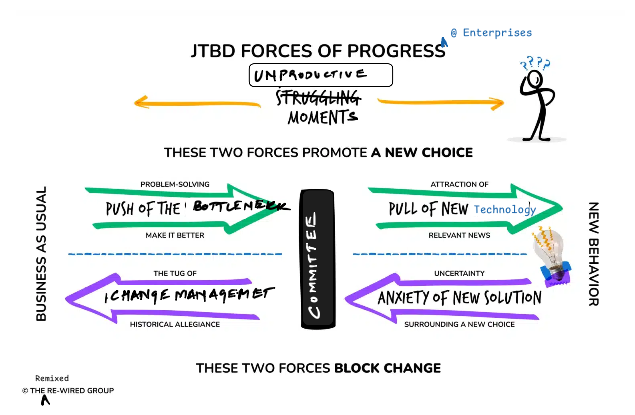
Replacing labour in doing the work should be the ultimate outcome with deploying AI, but lately I am narrowing on the approach which begins with building BTTs in current workflows.
Let us take an example of generating reports like Weekly Business Review of your team as you prepare for a planning meeting. You typically spend 3 hours of times collating data from different systems of record by exporting them in excel or csv format. Combining those disparate files into a single sheet and then spending some more time in extracting the insights to highlight in the meeting.
The more time you spend on it the more you understand how to extract the signal from the noise. If I were to sit with you to talk about this process and your assessment rubric on insights, we would by the end of the conversation have an artefact outlining your expertise. When you delegate this to an AI tool with the artefact as context , it will be able to build purpose build tool to generate the report and also synthesise the insights that you would need for your meeting.
Within the operational workflows, there are 100 sub-tasks that require some form of custom tooling to fasten the process and make it repeatable. Often times, people in operations are fighting with the tools that they use to cross connect them, and make decisions. AI could be leveraged over here to start the process. If less time is spent collating data and more time is spent making deliberated decisions basing on synthesised data, higher is the lift in productivity. The way to measure the return on investment is to calculate the time it takes without AI to with AI. Equate the human labour by time spent measured in their wages and compare it with cost of using AI for the task (tokens costs).
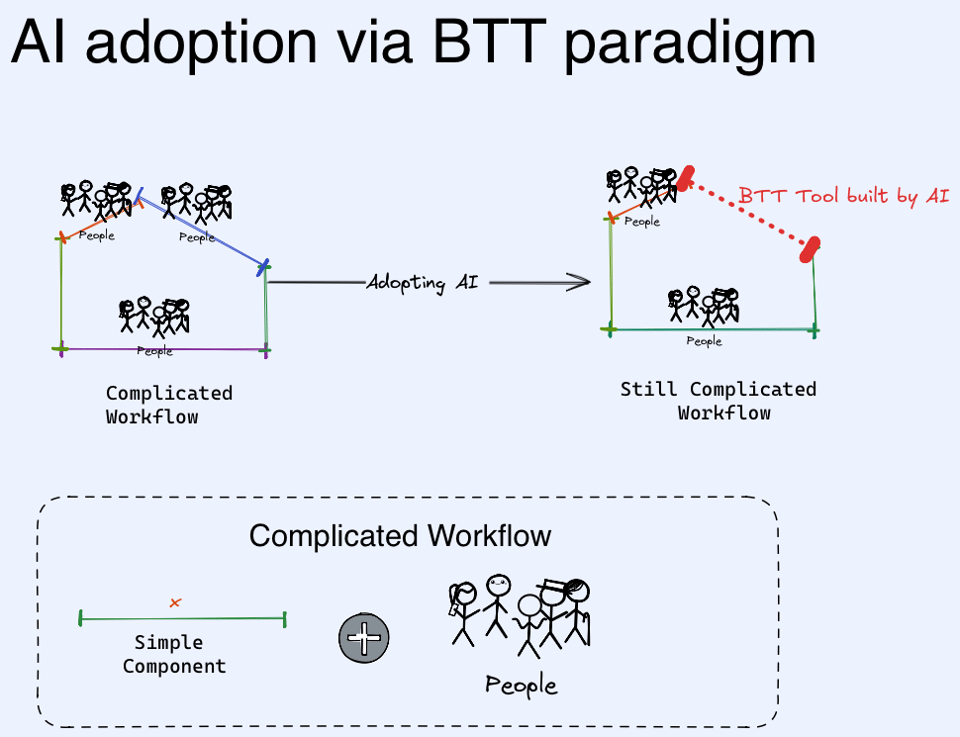
I wrote about my own implementation of BTT paradigm as part of the workflow of sales in Bridging deficits as a form of selling
Products can essentially be broken down into two broad categories, data or workflow. Use data to sell a workflow and vice versa.
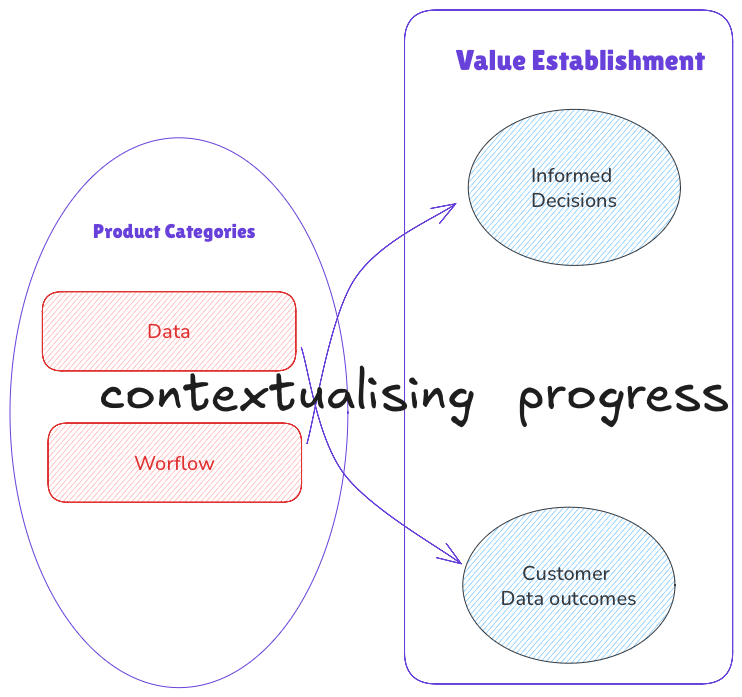
We built a set of boring tiny tools that helps contextualise the progress that the customer could make with buying the product we are selling. Basing on the product, we show the complimentary value establishment tool.
I hope this framework of viewing AI adoption would set the right foundation to start. There is more at Vaughn Tan’s site that could help you navigate this process.
Round up
This is a presentation that I happened to attend by Nirant K. It covers an interesting mental model of how to view agents and why harnesses are required to extract the maximum output from LLM models.
For decades, backend engineering meant managing three resources: network, compute, storage. Intelligence is the fourth. It is metered, it scales and throttles, and it fails in new ways. The harness is how you manage it.
Which brings us to the definition of an agent that I liked very much.
The model is the smallest box, and it should keep getting smaller. Everything that matters is the harness around it. That model + harness = agent.
This is similar to Boring Tiny Tool approach where you are incorporating AI into the existing systems, workflows viewed as harness.
Links that resonated
The action economy as thesis for building
This post by Dharmesh Ba captures some of my own thinking around AI adoption for Indian region. AI becomes the access layer to doing the job but also building systems of record as part of exhaust of doing the job.
This one is from Eugene Wei of Remains of the day fame. If AI transforms your business processes and enables faster growth, you are bound to hit your invisible asymptote. Better to formulate what it is and how you will change to hit it.
Sign off
In the past 1 year this space has become a side stream of exploration on topics I was navigating at my day job.
I am headed into a month long break and would take this time to pause writing in this channel. I would like to put some distance between work for this duration.
I may work on connecting multiple previous issues into an interconnected mind map on my personal website.
It’s been an intense year at work. It comprised of navigating multiple streams of work, adapting to changing organisation and ever increasing focus on growth. It also marked 1 more year of being employed which I believe is a new achievement for yours truly.
Singing off till next time,
Vivek, headed back to base country
Don't miss what's next. Subscribe to On the side:

