
A new platform in the making
2026-08-17
Replacing Labour
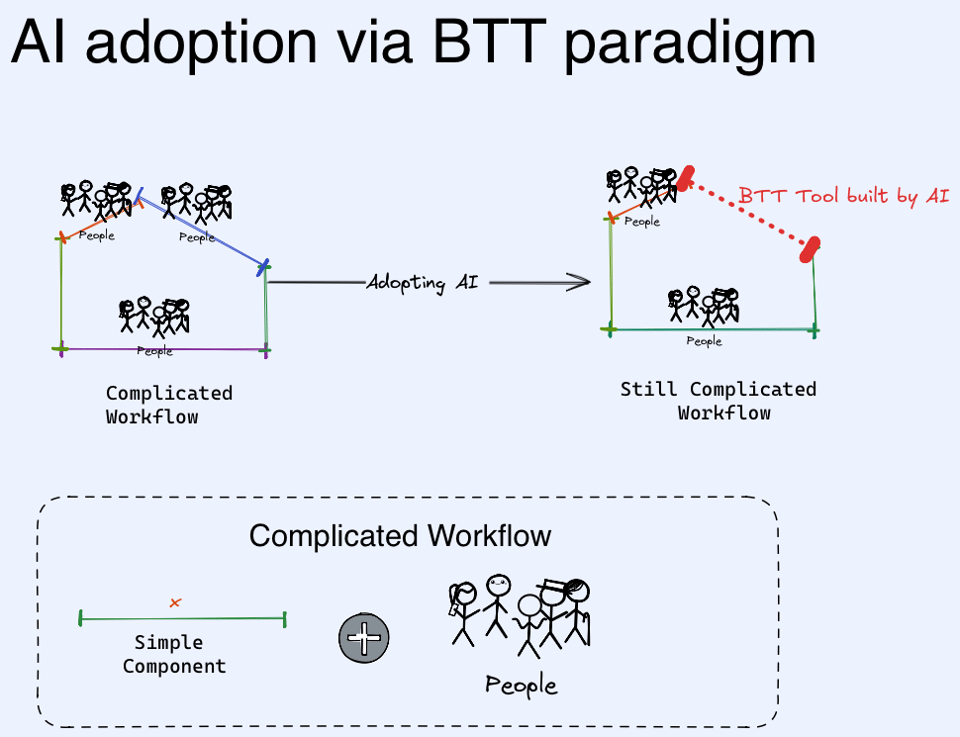
In the previous issue I wrote about the AI adoption. By using Boring Tiny Tools framework, we can start the process of adopting AI with small transformational changes rather then big ones.
Replacing labour in doing the work should be the ultimate outcome with deploying AI, but lately I am narrowing on the approach which begins with building BTTs in current workflows....
..
The ultimate goal for using Agentic AI is to replace human labour.
Agents replace labour not employees. https://t.co/lCNXTyvwso
— V.S.Vivek (@vsvivek93) August 11, 2026
I am going to spend some time explaining the word, labour, because I want to weed out any confusion. Also, refer people here next time I need to reshare this message.
Work or labor refers to the intentional activities individuals engage in to meet their own needs and potentially wants, as well as those of others or organisations.
The other definition that fits the bill is as follows:
When an organisation is viewed as a system at play, it does labour to generate net positive outcomes. We have both humans and technology as part of the system co-ordinating through workflows for achieving the outcomes.
A task is a single unit of work, workflows are a sequence of tasks combined together.
Some of the labour where humans are involved in a workflow can be executed with AI agents given a powerful harness and a clear goal. The extent to displacement of human labour depends on the type of workflow.
If AI agents are leveraged appropriately, then humans will end up using less software for labour.
Computers changed how we work, first. Mobile was the next wave and now AI agents are the new technology that will transform once again.
At the end of the day, people doing labour in all organisations are solving some challenges framed as missions. These missions are directed by a vision. The evaluation rubric is bottom line and growth rate. And this what we call the system at play.
Using software was one of the avenues of doing labour with humans. The progression of software led to jobs that are solely dedicated to software use in legacy industries. Neofirms are springing up to address these issues by using AI as labour. I don't want to go into the details but Sneha does a fantastic job of outlining how Neofirms are different in her post.
The confusion arises because we equate jobs as set of tasks that AI can execute sooner rather than later. Next, we start using LLM morphism when explaining concepts of AI use cases.
LLMorphism is the biased belief that human cognition works like a large language model. ..... the rise of conversational LLMs may make this bias increasingly psychologically available. When artificial systems produce human-like language, people may draw a reverse inference: if LLMs can speak like humans, perhaps humans think like LLMs. This inference is biased because similarity at the level of linguistic output does not imply similarity in cognitive architecture. Yet, LLMorphism may spread through two mechanisms: analogical transfer, whereby features of LLMs are projected onto humans, and metaphorical availability, whereby LLM vocabulary becomes a culturally salient vocabulary for describing thought.
I have been guilty of both mechanisms in the past.
When I say context window when referring to knowledge of processes. We are morphing a LLM primitive to human capabilities. Similarly, when I say out of context, I am implicitly assuming that given the context I could have completed the task just like an AI agent. Nothing can be farther than the truth.
Instead now I approach talking about AI agents from a view of labour being done as part of the system which also humans within an organisation.
Donella Meadows of Systems thinking writes about leverage points.
Folks who do systems analysis have a great belief in “leverage points.” These are places within a complex system (a corporation, an economy, a living body, a city, an ecosystem) where a small shift in one thing can produce big changes in everything.
She writes about how finding leverage points is counterintuitive in nature.
One of the examples I like to explain this phenomenon of counter-intuitive nature comprises dashboards. Once an operator gets their hands on LLM models plus command line interface(CLI), they build dashboards to have understanding of their operations.
Every dashboard in some form monitors a metric which is a proxy for process flow that can be tracked by control charts. Metrics could be as simple as revenue, growth, costs, or a derived metric that is custom to your company.
So, the use of these dashboards would be to learn about any deviation of the control chart and potential actions that need to be undertaken. This is labour that a human using AI can enable for themselves. But the real labour replacement with AI agent happens when the process chart deviation is tracked by an AI agent and the human is only made aware of the action proposed by AI agent for approval.
Building dashboard is 100x better than the Excel sheets that might currently be in use. Still, there is a potential to completely replace the labour of human by building an Agentic AI system which can discern the action needed to be taken.
I have now written about AI agent adoption in organisation from multiple viewpoints. Starting with why using less software should be a north star in legacy domains. Next dispatch was building and using software is rarely the end goal in many companies in legacy domains. Companies selling Agentic AI solutions should be focused on demand, which is doing the work by displacing labour.
The sense making part and mapping the system will still fall into the gambit of humans. AI agents can operate within the outlined system, they can be effective within your organisation or you can expand the system to map the market in which you operate.
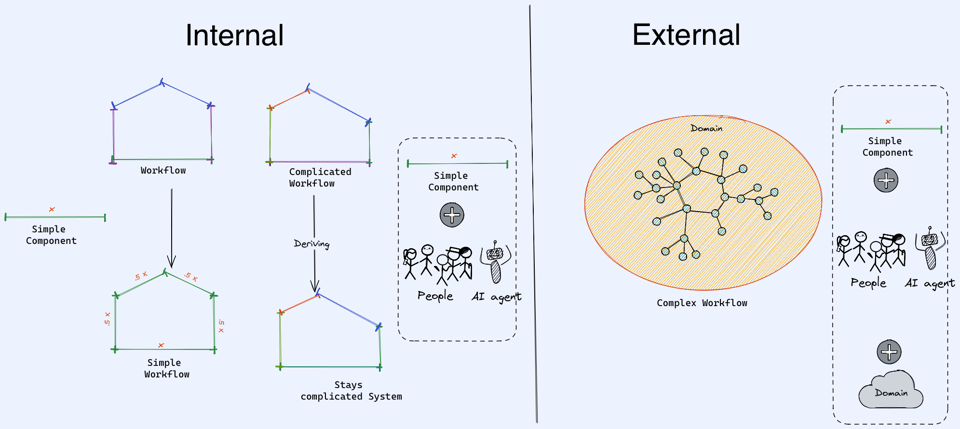
The ultimate goal is to generate net positive outcomes for your org. For which you need to do labour. In the past, humans and humans using software were the norm. Now, that changes as a part of the labour can be handled by AI agents. Thus, you achieve better outcomes with limited human labour overall.
Round up
I am now getting a ring side view of my friend starting a neofirm himself in the renewable energy space using AI agents as labour. The need to hire a team is no longer the constraint since he can get further along just by himself.
The whole software stack framework now collapses into models as processors and the AI agents as a platform on which one builds their company.
This interview with Satya Nadella talks about the platform shift
Interviews with Microsoft CEO Satya Nadella and CTO Kevin Scott About the AI Platform Shift
Combine it with this other post where Ben writes about AI integration and modularisation.
I will only paste one example to outline the point I want to make.

The entire stack is what a neofirm would utilise to leverage AI. They can use Microsoft , Google, AWS or build their own stack. This is the platform on which companies will build their business just like my friend's Neofirm.
Links that resonated
I have done tons of reading this past month. There are many to pick from, but I am going to share two quirky ones.
Vicki writes why writing for human should be the followed norm, rather than generating explanatory artefacts.
Beyond Dashboards where competitive advantage lives
Basketball is always known for crunching the numbers and relying on stats but what happens to the game when AI comes into picture. Interesting interview with a former insider using AI natively in basketball.
Sign off
I will be joining work again starting next Monday and burning the midnight oil for the following few weeks as I find my way back to the states.
The change in scenery and environment made me explore more ideas than the ones I navigate at work. This provided an opportunity to step back and explore some topics that could help address challenges I will face at work as well.
I had lofty ideals before taking the break of completely disengaging from the outside world. On reflection, I spent time on diverse interests across different topics which helped me recover.
One stark change was that I explored these topics without the lens of my current organisation or applicability in my work environment. This helped me remix many different strands in my own thinking. I will pull on those strands in the following weeks.
Signing off till next time,
Vivek, learning to work again
Don't miss what's next. Subscribe to On the side:

