
Increasing Operational leverage in tractor like businesses
2026-04-26
AI assisted SDC in legacy domains
Many years ago when I was in the midst of running my startup I read this essay by Benedict Evans , Rocket Ships and tractors.
It describes the difference in revenue multiples for a software company and not a software company. He also wrote how Amazon is a boring grocer and Netflix is a media company.
Back to the article;
…if you’re on a rocket ship, and it’s going up very fast, don't argue about the thrust-to-weight ratio. The thrust-to-weight ratio is ‘lots’. Your aim is to keep it pointed roughly upwards and make sure you don't blow up - you can worry about the revenue model once you get into orbit.
…For a tractor, success comes down to the gearing ratios - you have 10 or 20 or 30 operating metrics, all interlocking, and their end result is the difference between £19.99 and happiness and £20.01 and misery. If Facebook or Snap were rocket ships, Uber or Instacart are tractors - it’s all about the ratios. For these kinds of companies, you need to have a pretty good idea of the unit economics before you start.
In legacy domains like logistics and agriculture, there is rarely an opportunity to build rocket ships. The way the industries work in these domains, you often end up running or working for a business that falls in the tractor category.
Even if you are building software for these domains, you are dictated by the principle of what defines a legacy domain.
Legacy domains imbibe this nature of resisting change through front line workforce.
I have the firm opinion of building software that helps startups or companies operating in these domains through the new paradigm of software development cycle(SDC) with agents better served then launching GenAI customer facing features.
If companies can run leaner and increase their operational leverage without investing significant capital and address the market demand. You have a sustainable and growing business in the making.
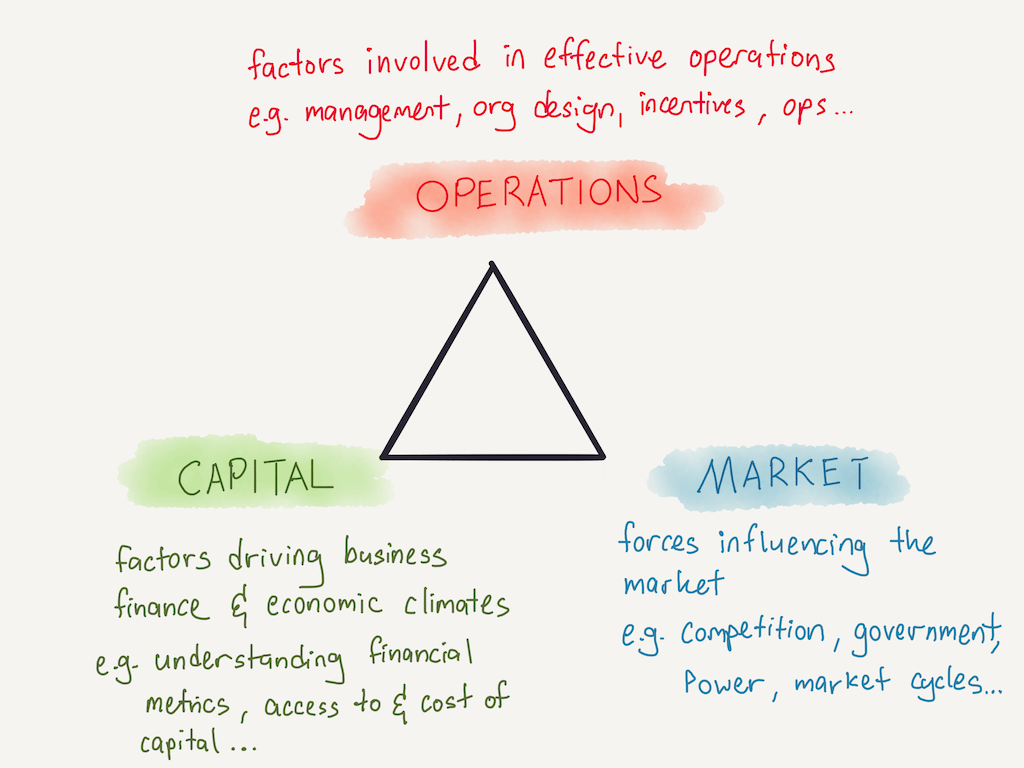
So a pair of duos or trios where one of them being an operator from the industry paired with a developer or engineer could build software that will help them do effective operations.
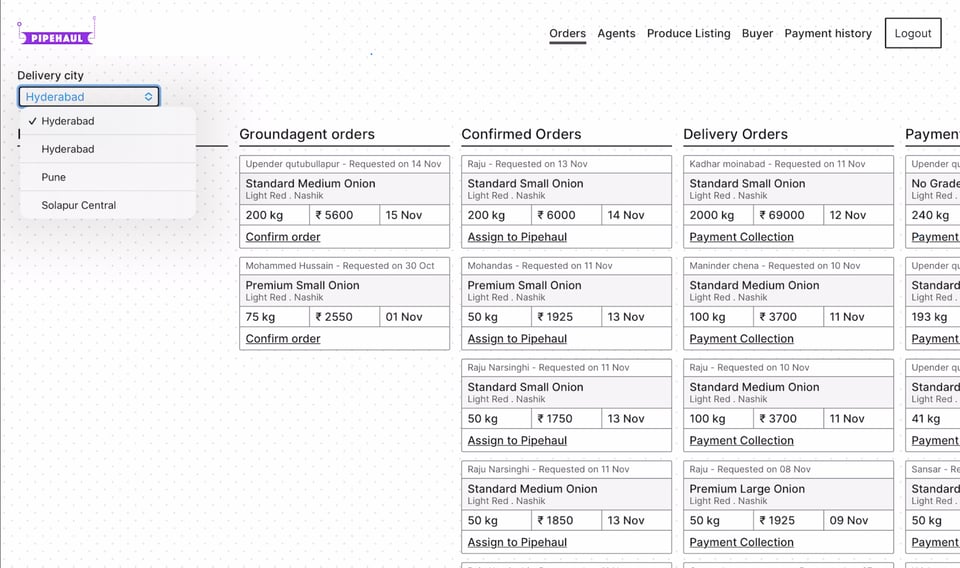
Let’s go back to Subjimandi.app, we needed an ERP (Equipment Resource planning) software to manage commodity supply chains. I spent a lot of time hiring engineers and then spent similar time building software with them. While Airtable (no code software) was the ERP in the meantime.
Was Airtable complete and fulfilled all our requirements, no, but it got the task done and kept the operations running for over 9 months before our software replaced it.
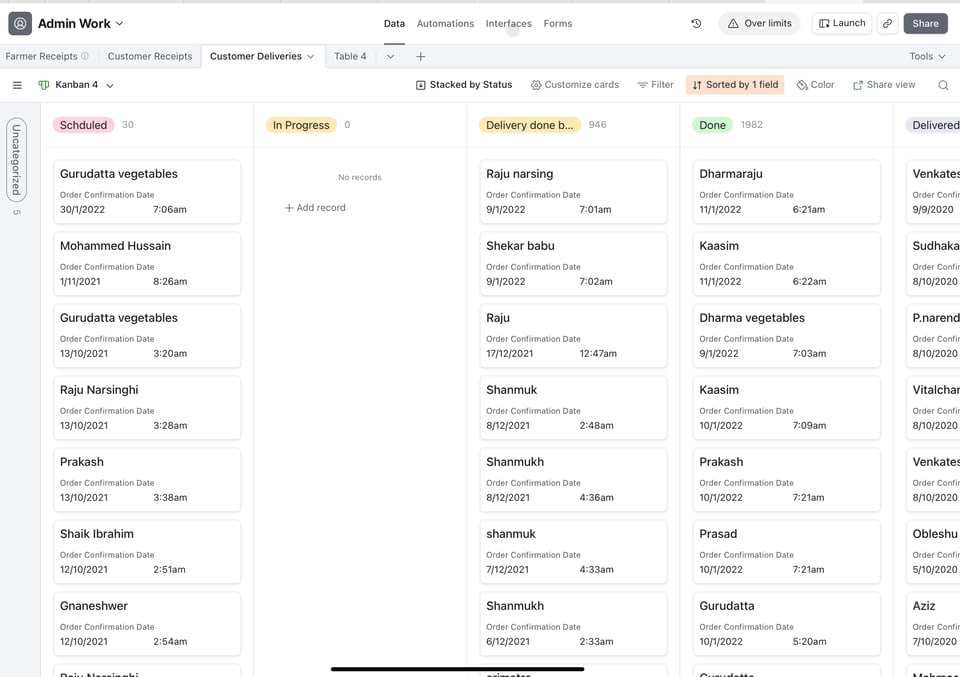
These were our delivery dispatches in Airtable that would track the delivered amount and maintain a ledger against the customer.
Our own software was purpose built and allowed the team to optimise the costs. The team would continue to build on top of it and help us improve our operations.
But the effort, time and cost to achieve the output was not prudent decision making in hindsight. The cost of running operations including Airtable subscription would have been significantly cheaper than hiring 4 product team mates. It would have definitely led to extended runway which could have been used to scale operations.
There is a heavy influence of hindsight bias looking back at these decisions. But if anyone is spending money now on hiring a product team when working in a tractor like business in legacy domain is lighting cash on fire.
Now with AI assisted SDC, we could build the version of software in a week’s time and have it deployed to production. This would allow the operations team to add it in their workflows from the get go.
Software is rarely the end goal if you are in tractor like businesses, it is means to an end.
You can subscribe to get all future issues directly in your inbox.
Round up
How does increasing expertise as a broker look like in the current N.A freight market ?
It involves increasing operational leverage through deploying technology . A direct effect of it would be automated workflows freeing up your team to pursue business expanding activities while the usual is covered within budget and targets. … ….

I wrote about how brokers in North America could increase their operational leverage using software.
Links that resonated
S. Anand writes practical advice on how to use AI in a team setting. It comes with AI generated sketch note which is prompt skill that I picked up from reading his blog.
Aligned Agents Still Build Misaligned Organisations
Rohit writes how even when agents are aligned in a multi-agent system. The end outcome could be misaligned due to the compressed nature of understanding by each agent inherited by the other agents.
Sign off
When I moved into the role of running a division right after our startup. I didn’t waste time waiting on development team being assigned to work with us. Instead, I went about building a TMS with Airtable.
We were up and running in less than a week and over the course of 1 and half years I was there, we increased the scope of that implementation and ran a very cost-effective team. In comparison one of the product teams was building a homegrown ERP to move us away from a no-code tool that the founders used to run their back office. They were still not fully migrated till I the time I left the organisation.
In most situations, this backend software is a large excel sheet. What changes now is that we can dump that excel sheet to one of the Agent CLI tools and ask it to build a production ready app. And with right set of subsequent prompting, you will have an output in your $20 monthly subscription.
Signing off till next time,
Vivek, building software for tractor like businesses
Don't miss what's next. Subscribe to On the side:

