
Internal vs External competition in brokerages
2026-08-23
Let me tell you a kutti (small) story about running a brokerage operation from my past.
It is relevant to the freight market of US, but instead of directly writing about it, I will take this long winded way of talking about my experience of running a logistics and transportation division for an agri supply chain startup in India.
When we joined as a team, two of us were tasked to launch a full fledged logistics division.
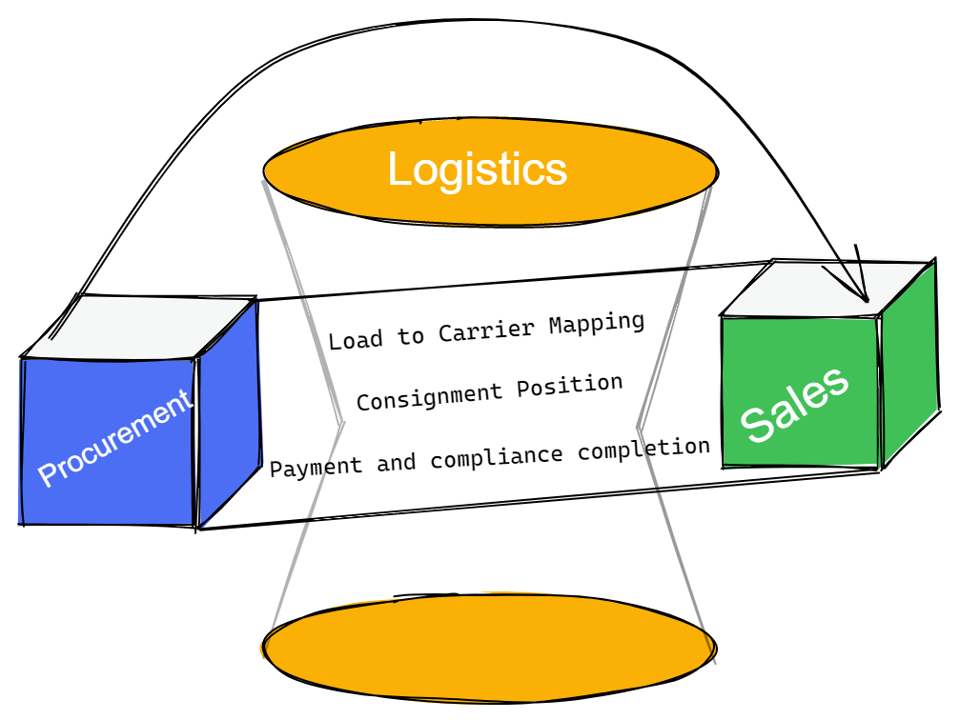
We were the bridge between procurement and sales team. Since, it was logistics in agriculture, sometimes the supply of commodity was available first and then the selling followed. Other times, selling of commodity happened first, and then the procurement was done.
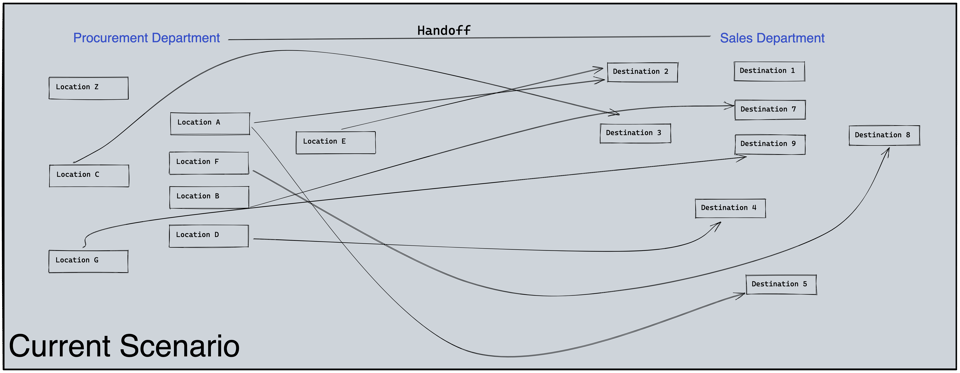
Prior to us joining the firm, above illustration depicted operations. Both sales and procurement would co-ordinate to figure out the freight cost.
When we entered, we created a service division that would facilitate the transactions to take place. The mandate was to help increase the margin by reducing the freight cost. Our end state as depicted below.
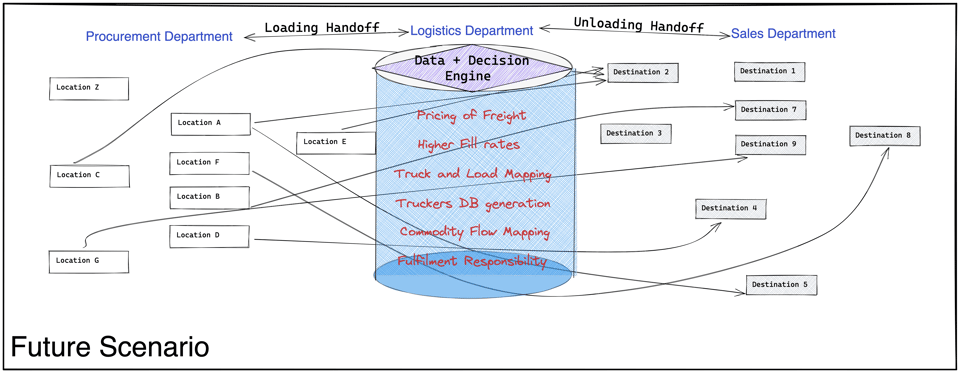
The challenge of being an internal service provider is that, both departments would independently take decisions. We were faced with trying to make margin on the transaction by finding a price for freight. The target price would be hard to achieve because of the deviation from market rate.
All of this resembles a brokerage in North America, instead of a logistics team, a pricing team becomes an internal service division. Their mandate will be to provide a price of freight for a transaction.
The customer sales team (similar to sales in the scenario) would quote to win customer's freight. The carrier sourcing team would refer to the freight price and try to source capacity. The pricing team runs some models by ingesting some market index or benchmarking data to comfort itself that they have wide coverage and their price is relevant
My question back then and even now remains the same, why measure to an arbitrary target like market rate or benchmark?
Why not go the route of finding the supply cost and adding a margin to it to quote to the customer?
6 months in, the logistics division that I ran was able to propose the freight cost before the transaction was booked by the sales. We had the procurement cost, we would add freight cost and target margin to generate the selling price to offer to buyers of commodity.
The same approach can be practised in brokerages as well. Instead of measuring to a refernce price, we find the price at which we can source and add the margin to quote.
There are two major benefits from this approach.
First, there is no need for a Market Benchmark. Market rate is immaterial to you as what you quote will comprise the price at which you could source capacity in the market. The winnability of those quotes can be improved by a trial and error approach. Eventually, basing on past, we can predict the successive sourcing cost for a transaction.
Second, we don't need a dominant presence in the market to be competitive. This results in a smaller pool of carriers to move freight. Thus better fraud prevention and pricing power. Lower the number of carrier, more accurate the predictions get.
By the end of my time there, we were working with 20% of registered transporters who were responsible for moving almost 100% of the volume. The cost of transportation moved in the right direction. And we never bothered with the market rate.
Whenever someone refers to market or benchmark rates, I lay out the argument and question their thought process.
Its not obvious or easy to implement. My previous leadership team, didn't encode the approach even when we were able to substantiate the benefits. I don't expect many brokerages to change as well, but those who do, will fare better off than the competition.
Round up
I am trying to work through the best distillation of why having a pricing, quoting and sourcing team in a brokerage leads to internal football match.
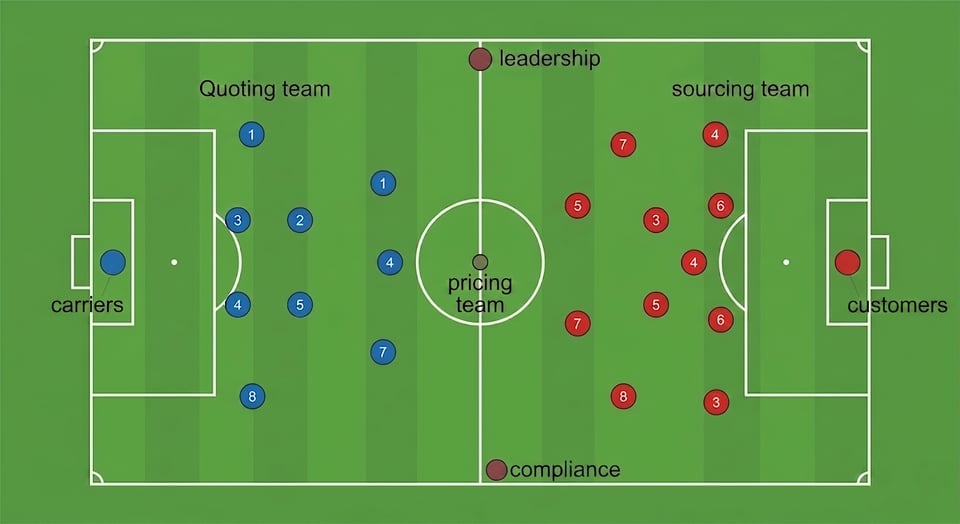
The goal is no longer to achieve the target margin but locally maximise in reference to benchmark. Quoting team would focus on how much more we quoted and the sourcing team would be like how much we saved from benchmark. Post-Hoc the overall margin will be calculated by leadership. It’s a disjointed system that works but has an efficient alternate.
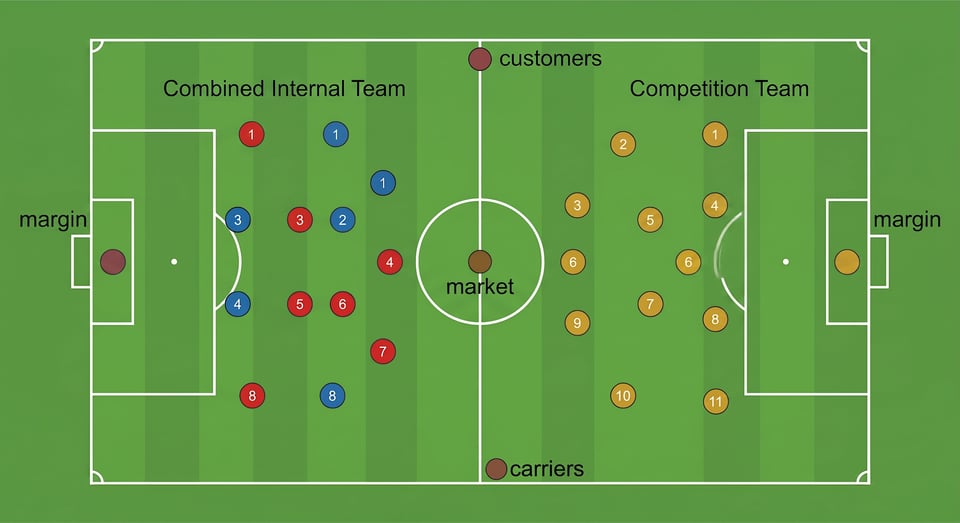
When they focus as a system in step with one another. Then the competion turns out to be with the market.
If you are a Broker or Logistics service provider operating in the freight Market.
Links that resonated
This is a phenomenal post on public markets and why fundamental investing ≠ Value investing
Forward Deployed Engineers are all the rage at present. This article tempers the hype and paints the full picture.
Sign off
One stark change I witnessed when visiting India, I think beyond the topics at work.
In the last week, I had 2 separate hour long conversations witn founders slugging out in agriculture space in India. Working in that domains prepares you well for anything else, including the AI age.
I was able to articulate my point of view because I had previously written a post on it. I now have enough public posts that I can refer to when an overlap occurs. Now, writing comes easy to me, no writing is not easy, but ideas to write on comes easily.
I believe I have given this advice to anyone and everyone who listens, putting your thoughts publicly helps you first, whether anyone reads it or not.
Signing off till next time,
Vivek, once again on the road.
Don't miss what's next. Subscribe to On the side:

