
In search of efficiency in logistics markets
2026-09-20
Centralised aggregators are net loss to decentralised markets
One of the common beliefs of central platforms(aggregators in my understanding) in transportation is that when transactions happen through them, it would reduce the search friction costs and lead to efficiency overall. A paper that I wanted to write about ever since I read, states the opposite. One of the author's of the paper, Search Frictions and Efficiency in decentralised transport markets, Theodore Papageorgiou was kind enough to share it with me when I reached out.
First thing to call out is the mis-understanding in transportation market, it is decentralised market. Decentralised markets don’t have central clearing system like stock market. They are scattered and fragmented in nature. These markets suffer from search friction costs, finding the right counter-party to transact.
The general question the paper is looking to answer is what policies should we apply to help correct the sub-optimal allocations.
Are transport agents thus suboptimally allocated over space, distorting transportation flows? If so, which policies are best at restoring the optimality of the transport network? Can a centralizing platform perform better? In recent years, these questions have captured the interest of industry participants and policy makers alike.
What I like about the paper is how they set up the analytical approach to studying efficiency.
search frictions generate “thick-market and congestion” externalities: when choosing whether to search, carriers take into account the match surplus they create for themselves but do not internalize the surplus they create for customers (thickness), nor the negative congestion they generate by making it harder for other carriers to find a match. The same effect hold for customers.
Congestion is a negative externality while Thickness provides positive surplus. In the example of trucking, think a logistics hub where there is enough carriers willing to move our shipments, we have thick market but the carriers feel the congestion as more of them are vying for our loads.
Efficiency is the equilibrium when congestion is offset by the thickness. And you view this from one of the participants. But, that is not the case for transportation markets.
search frictions generate “composition externalities.” These stem from customer heterogeneity: customers decide not only whether to search for transportation but also their destination. Customers heading to different destinations generate different surplus for the carrier they match with.
For efficiency pricing rule to take shape in such decentralised heterogenous markets.
The two efficiency conditions combined characterize the efficient pricing rule, which can be employed by a central price-setting authority, as in the case of taxicabs, where prices are regulated. In such environments, our results clarify that the role of optimal destination-specific pricing is to correct composition externalities. Instead, when prices are bilaterally negotiated, composition externalities justify the use of destination-specific taxes and subsidies, as negotiated prices typically fail to fully internalize destination effects.
The introduction of centralising platforms when viewed from a market standpoint looks at the visible challenge of search friction costs and provides a solution for it. But it just substitutes one for another, market share.
What the paper finds is that most of the welfare gains due to centralising platforms is attributed to platform profits. The policy maker who is not involved in the process of match making can generate the same welfare gain by levying optimal taxes and subsidies. And, unlike the platform, welfare gains are distributed among counterparties.
The authors use Dry Bulk shipping to test their empirical model. Reading the model they have defined with an LLM ( self recommended ) explains how they are proving the model for the efficiency in price points.
First they look whether the thick market and congestion externalities is internalised.
For each region, the left panel presents the average estimated matching-function elasticity with respect to exporters....

Next they checked for composition externalities are internalised.
For each region i, it plots the coefficient of variation of the ship surplus from matching with exporters headed to different destinations j ≠ i. When composition externalities are internalized, the coefficient of variation should be equal to zero, since the ship is indifferent across destinations. ….. In all regions the coefficient of variation is significantly different from zero and larger than 20%, and in several regions it is substantially higher.

The market was not efficient since the variation was high and the co-efficient of negotiation was lower than the elasticity.
Next they check for welfare loss and cross check the results with a platform in play.
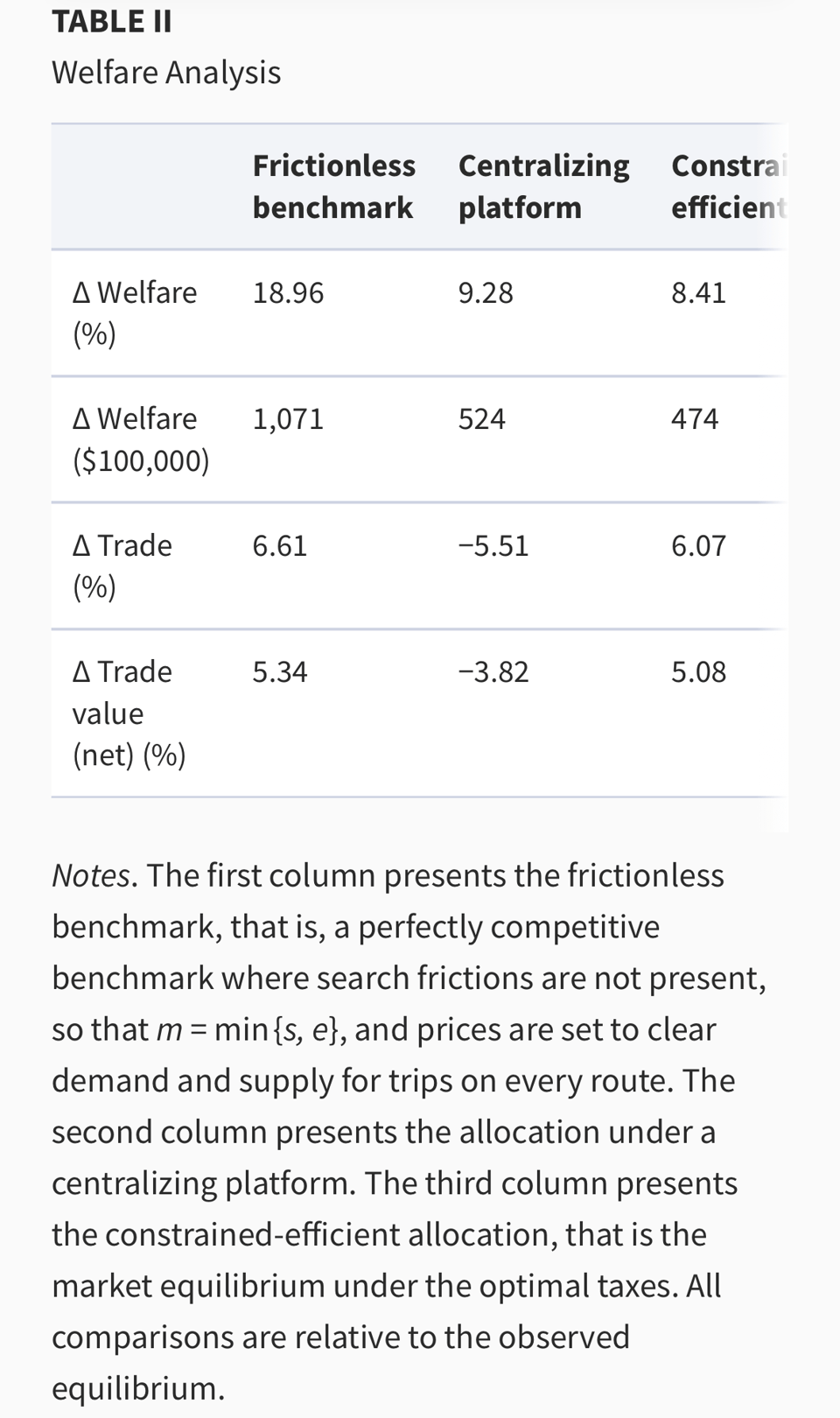
The difference is the agents participating in the market are better off with a redistributive share compared to centralised platform matching.
The authors showcase the relevance of their model by looking at two policies that had a positive(BRI) and negative(IMO 2020) impact on the dry bulk shipping market.
It is an interesting paper in its novelty. It first burst the bubble that centralised platforms are better for the participants.
If I am critical and nitpick, I would change the nature of its framing of the platform. What the authors are describing over here is an aggregator, not a platform.
I have written about the difference between an aggregator and platform in logistics already and it outlines what a true platform would entail in transportation and logistics.
For us to effectively provide a platform on which the participants can have beneficial transactions, the platform should partake in setting some standards and help build networks.
For a distributed market like transportation and logistics, it’s essential that we look at the network of transactions not counterparts transacting.
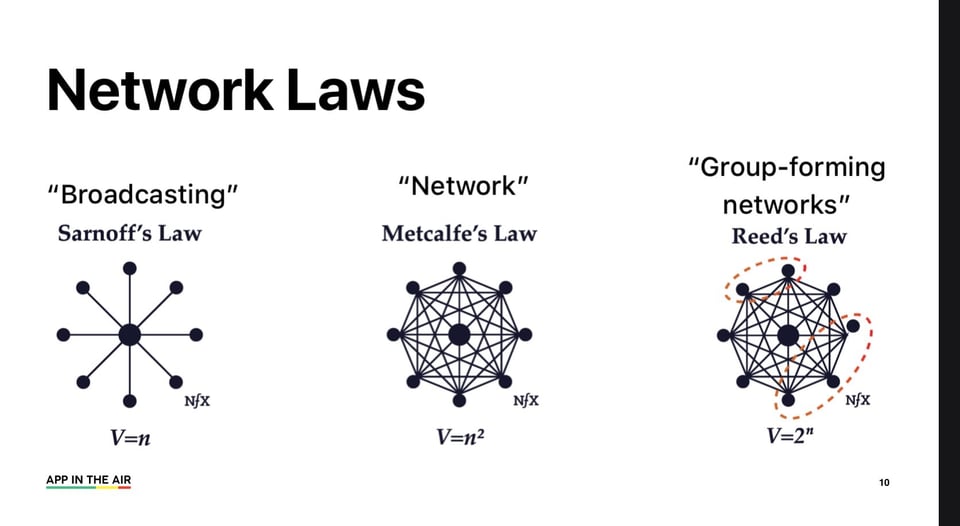
The node in the network is not the counterparts that are transacting, instead it is the transaction itself. Once we move past seeing entities are nodes in the network to contracts as nodes. Moats can be built using laws of network effects on demand size. They come in three types.
Excerpt from Aggregators vs platforms in logistics
Next time, I am with industry folks and they talk about centralised aggregators, I will surely point out that they will cede market share to a 3rd party in the mirage of efficiency. The saving grace is that no aggregator ever becomes dominant due to the nature of the logistics and transportation market's, decentralised.
Round up
Forward Deployed engineers is a hot topic and this feature from Arena magazine made me also take notice.
One illustrative example of what the original Froward Deployed Engineers were aiming for is captured in this excerpt.
Ted Mabrey, Head of Palantir Commercial, responsible for their roughly $3B enterprise business, growing 157% year-over-year, tells Palantir FDEs to “act as if they are the CEO, but with zero authority.” We’d take it even further, and say that the best Palantir FDEs act as if they are Elon, who many would consider the best CEO in the world, but with zero authority. Like Elon, the prototypical engineer-CEO, the best FDEs are deeply curious and ruthlessly pragmatic. They seek to possess an almost superhuman understanding of the real-time state of capabilities and opportunities within their businesses, identify the key blockers (problems) to executing on those opportunities, and go to ground truth as a way to access and instrument the context required to devise systematic solutions.
Everyone is rolling out FDEs in the AI era but it requires a special kind of leap of faith and patience to find success with this approach.
Will unpack more on this as I dig further in context of AI.
Links that resonated
This is a post by Kristen Anderson who wrote about her time at Square and I feel it is worth 10 minutes of your time.
The cardinal sin of platforms building
Matt slotnick writes how platforms are an earned distinction. I like this post because it communicates the essence of platform very succinctly and why most of the companies who claim are not.
Sign off
I am not sure if anyone reads these posts I send out on a regular cadence but it’s extremely fulfilling writing things down week on week.
Things are chaotic all around and the 2–5 hours I spend writing these posts are probably the most focused I am in a week. They really help me progress an idea further in my mind by building some structure around them.
All these escapades are with the belief that it will all make sense in hindsight. The goal is to write one charged sentence that just clicks for everyone who reads my writing here.
Signing off till next time,
Vivek, sipping some sour brews as I finish this one
Don't miss what's next. Subscribe to On the side:

