

You could almost hear Warren Buffett’s frustration through Berkshire Hathaway’s first annual letter. “The textile business again had a very poor year in 1977,” he wrote, without qualification. “We have mistakenly predicted better results in each of the last two years. This may say something about our forecasting abilities, the nature of the textile industry, or both.”
A year and twelve days later, Buffett’s frustrations with the industry showed through again: “We hope we don’t get into too many more businesses with such tough economic characteristics,” he said, dimly, as insurance and other businesses far outshone the business that’d lent Berkshire its name.
Other concerns crowded out the persistent red ink from textiles until, finally, they closed the books on the venture in 1985. “Charlie likes to study errors and I have generated ample material for him,” Buffett tongue-in-cheek confessed. He then spent 1,451 words explaining the rationale behind previously continuing and now exiting the textile business, before concluding the saga with advice: “Should you find yourself in a chronically-leaking boat, energy devoted to changing vessels is likely to be more productive than energy devoted to patching leaks.”
Berkshire Hathaway’s subsidiaries sell you everything from candy to car insurance, Dairy Queen to Duracell. Berkshire Hathaway itself, though, sells shareholders a story, a faith in future profits, an idea that their dollar would be in better hands at Berkshire than anywhere else in the world. For that, it needs people’s trust—and what better way to build trust than with the story straight from the founder?
Sage wisdom tempered with open honesty, with predictions for the future and admissions when things went south, made Berkshire’s annual letters one of the few earnings reports widely read beyond Wall Street. They, almost as much as his company’s persistent, gravity-defying gains, gave Buffett and his partner Charlie Munger almost rock-star status with fans who’d scramble for one of 19,000 tickets then trek to Omaha for the company’s annual shareholder meeting.
It’s me. Hi.
Brands, corporations, are abstractions, legally persons without the humanity. We might trust in their quality, or believe their messaging that their batteries will keep going and going or that 15 minutes will save you 15% on insurance. We might even become fans, enough that we’d queue overnight to buy their latest product.
But we don’t trust them as a friend or turn to them for advice. Corporations are but cold facsimiles of real persons, good at churning out widgets, bad at warmth and wisdom. It’s the people that make up the company who we’re likely to connect with. The founders, especially, who (you would hope) know the industry and their product inside and out, know the pain points their product solves, know the Why behind every What.
Small businesses get that feeling naturally. Half of the charm of an old-school restaurant is talking to the owner and seeing their personal twists on classic dishes, or sitting at the bar and watching the bartender work their magic. A barbershop, a repair shop, any business where you talk to the craftsman should ideally give you a more memorable experience.
Which, perhaps, is why some of the oldest company newsletters—in print, a century before email newsletters were en vogue—attempted to recreate the shopping-from-a-small-store feel.
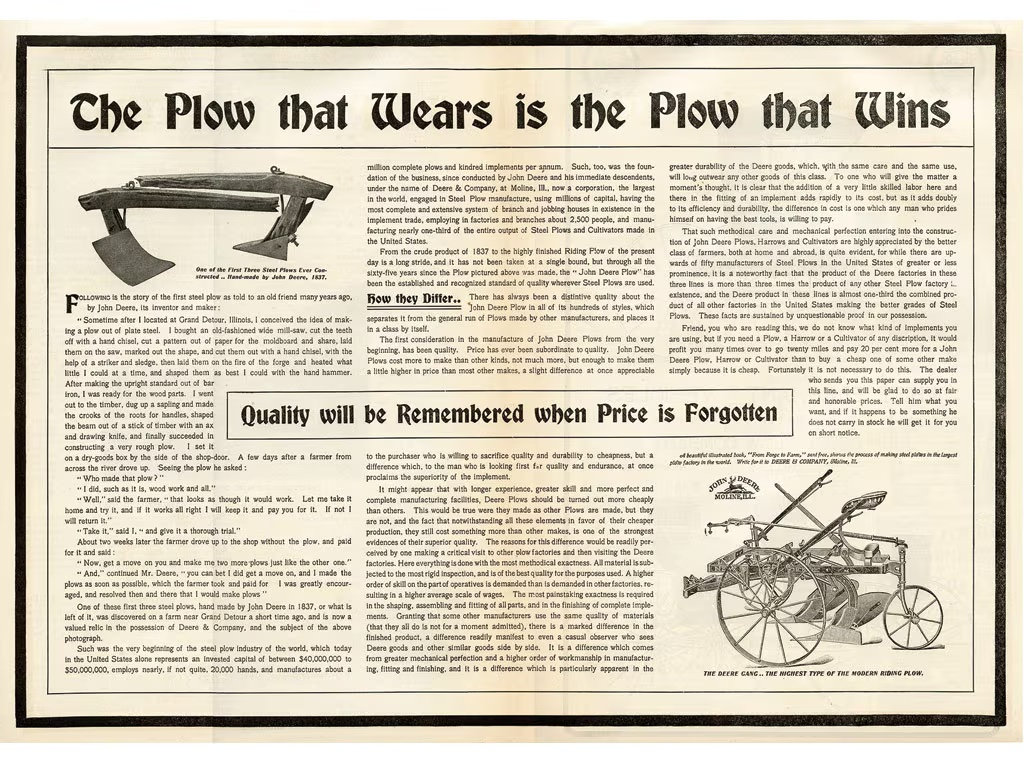
John Deere, the tractor company, has published its in-house publication The Furrow since 1895, morphing from a tabloid broadsheet to a glossy magazine to a blog over the ensuing century and change. The first volume has been lost to time. The oldest remaining, immortalized on their blog, featured John Deere telling the story of making his first sale of a manual, steel-and-wood plow outside of a dry goods store in 1837:
Farmer: “Who made that plow?”
Deere: “I did, such as it is, wood work and all.”
“Well,” said the farmer, “that looks as though it would work. Let me take it home and try it, and if it works all right I will keep it and pay you for it. If not, I will return it.”
“Take it,” said I, “and give it a thorough trial.”
And when Deere closes his story by saying that “I was greatly encouraged, and resolved then and there that I would make plows,” you can see the faint traces of the startup hero’s journey that’d fill many a blog and newsletter a century later.
Imagine yourself as a reader of The Furrow in 1895, as farming was increasingly mechanized, as Benz built his first motorcar, a couple years after the Chicago World’s Fair brought electric lights and motors. The world was changing, fast, and here was John Deere—the man, not the faceless company, someone you could imagine shaking hands with at the general store—to guide your farm through the transition.
Name recognition
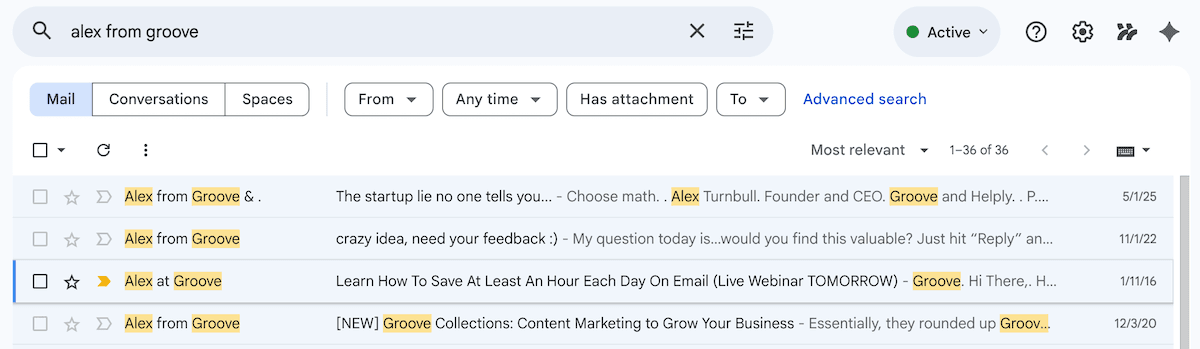
Of the 1,329 software logins I’ve created in a decade of writing about software, of the hundreds of those that I’ve received emails from, only one app’s founder’s name sticks in my head even though I never used their product on a day-to-day basis.
Groove. And more specifically, “Alex from Groove,” the founder whose name showed up in most of their emails’ From field.
The name alone wouldn’t have made Groove stick out in my head (though it, admittedly, did help). Groove’s newsletters, though, were filled with the on-the-ground lessons you’d imagine a founder sharing in a casual chat. What worked. What didn’t. What seemed like a good idea at the time but worked out far differently than expected. Groove was a company founder sharing lessons with other company founders and those who aspired to be one someday. Over time, it planted the idea in your mind: If you’re starting a software company, you should check what Alex from Groove tried and found to work, and perhaps should consider using his software as well.
“I'm more likely to do business with someone I know,” said Len Markidan, Groove’s marketing strategist at the time, and that in part was why every email came from a person at the brand rather than the brand itself. Their newsletter wasn’t just Groove the company with a changelog of new features in the product, it was Alex sharing his lessons from the school of hard knocks, and that made it memorable.
The effect works in your company newsletter, or in a parallel one written by the founder in their own space. One could follow the company for product updates, the founders for the why behind those updates, or both.
Names can come in anywhere. Branding the From line with your name is a less common move that made Groove’s branding stick out. Wanderwell, a small business accounting and advisory brand, puts the byline on their newsletter signup page: “Written by Wanderwell founder Kate Tyson.” Sundog, an upcoming collaborative scientific platform, includes multiple bylines in their newsletter, with separate updates from CEO Alex Mitchell and Tom Armitage, each mentioning things that are top of mind for them about the product. Plausible Analytics takes a similar approach, opening their blog with “Hi! We are Uku and Marko,” and including a first-person voice in many of their takeaways. If you’re an early user, you’ll see them hitting the same issues and pondering the same questions you’re encountering in your work—and you’ll be more likely to give them the benefit of the doubt about any remaining rough edges.
Putting a name to emails and announcements works for more than marketing, too. It can soften otherwise difficult news, humanizing details that might otherwise make customers and suppliers throw up their hands if written in corporate speak. When Apple in 2010 decided to put a line in the sand that they would not ship Flash player on iPhones, they could have issued the idea as a press release under the corporate byline. Steve Jobs, instead, put his name on the “Thoughts on Flash” memo, listing out his thinking on why HTML5 was the future and Flash best left in tech history. “Our motivation is simple – we want to provide the most advanced and innovative platform to our developers, and we want them to stand directly on the shoulders of this platform and create the best apps the world has ever seen,” wrote Jobs, and even owned up to the fact that he believed a better web would help customers and developers and that Apple, also, would “sell more devices because we have the best apps.” Pompous, but for a purpose, more forgivable from a founder seeing his company as through the eyes of a parent than from a PR agent.
Here’s what I learned along the way
Deere, too, spoke as an inventor. “I conceived the idea of making a plow out of plate steel,” started the story, then talked of modifying a mill-saw to cut it, forging and shaping it over a fire, digging up a sapling tree and carving it into a frame and handle. Farmers would resonate with the hands-on nature; here was a man who, too, knew what it was like to work with wood and metal, roots and soil.
The idea is similar to the one Seth Godin coined: “People like us do things like this.” A farmer who sells plows must know what he’s doing, or so Deere hoped the farmer would think. A software CEO telling how he grew his business must sell software that helps grow businesses, we think today. And even if the founder is far removed from your station, if it’s Jobs talking after founding Apple, NeXT, and Pixar, at the very least you’re inclined to read their ideas through a different lens based on their experience.
It can backfire; I’m loath to name newsletters I’ve unsubscribed from when I didn’t agree with the writer, but even then the founder voice in that sense did help align the company with their ideal customers, of which I was not one. It’s risky, putting your name to ideas if they don’t pan out. But people like us put our necks out there every day, risk looking stupid as we try to land clients and build followings, and we appreciate it when founders of the products we use do the same.
But don’t put your name on your company’s newsletter and write in the first-person voice simply to gain readers’ trust, as a marketing trick to edge revenue a percentage point higher. Do it because you actually care about the stuff, because it’s something you’d put your name to regardless of where it was published, because you’re writing things you’d want to read if you were in the audience’s shoes. Do it because it makes you think about your work differently, because it makes you take ownership of ideas more than you would when shielded by the company’s name. Do it because things that reflect your opinions are the most likely to get replies, and the reply loop is the most valuable stat on your email newsletter’s performance, far better proof than open rates that people care about what you say.
Anyone could write something. But only you can write this, through the experience you’ve gained in building this product. Write that, then put your name to it. Everyone might not agree, your ideas might not resonate with the entire audience, but the folks that do agree will remember that you from this company said this, and they’ll stick around to hear what else you have to say.
| Image | Credit |
|---|---|
| Header photo by Cytonn Photography | Unsplash |
| John Deere The Furrow magazine | Deere & Company |